
Font size
 Worksheets
Year 11 Business Studies - Topic Two: Business Management
Total questions: 98
Worksheet time: 49mins
What is the traditional process of management? Fill in the blank: Traditional: Process of ________ a business resources to achieve its goals.
coordinating
selling
advertising
neglecting
What is the modern process of management? Fill in the blank: Modern: Process of working ______ people to achieve business goals in a changing environment.
with/through
against
without
beside
Which of the following is NOT one of the four main types of resources in management?
Physical
Information
Financial
Technological
Human
Efficiency in management is defined as:
Getting the job done to the highest possible standard
Getting the job done to the required standard, using the least amount of resources possible (Time/Money)
Motivating employees
Providing feedback to employees
Effectiveness in management means getting the job done to the ______ possible standard.
highest
lowest
average
minimum
Which of the following is NOT a feature of interpersonal skills in management?
Positive language
Active listening
Ongoing feedback
Financial planning
What is the skill concerned with what one says, how they say it, and the medium they choose to deliver it in?
Communication
Mathematics
Cooking
Painting
Which skill is pivotal in getting employees to understand and want to achieve business goals?
Communication
Technical Writing
Data Entry
Timekeeping
Which skill involves ensuring managers display positive non-verbal communication skills?
Communication
Technical
Financial
Analytical
Poor communication could lead to which of the following?
Faster work processes
Misinterpretation of information
Increased customer satisfaction
None of the above
Which skill involves constantly and critically analysing the internal and external environment, anticipated threats, and opportunities to the goals of the business?
Strategic Thinking
Time Management
Technical Writing
Team Building
Developing the big picture and creating strategic plans for the next 3-5 years is part of which skill?
Strategic Thinking
Technical Writing
Time Management
Data Entry
Which skill is about creating a common shared goal to allow for long term planning/organising of the business activities to motivate employees?
Vision
Technical Skill
Delegation
Time Management
The ability to identify a problem, gather information, develop solutions, and implement and evaluate the solution is known as:
Problem Solving
Time Management
Team Building
Conflict Avoidance
Identify options available and choose a specific course of action. This describes which skill?
Decision making
Time management
Team building
Conflict avoidance
Managers adjusting their behaviour to new information or changing circumstances is an example of which skill?
Flexibility
Delegation
Technical expertise
Time management
Who are directly impacted by the interest of a business? Fill in the blank: Stakeholders are people/groups who are directly impacted by the interest of a ________.
business
school
government
family
Which of the following is NOT an example of a stakeholder?
Employee
Shareholder
Supplier
Accountant
Customer
List any three examples of stakeholders mentioned in the passage.
Employees, Shareholder, Supplier, Customer, Employer (any three)
Mountains, Rivers, Oceans, Deserts, Forests (any three)
Tables, Chairs, Computers, Whiteboards, Projectors (any three)
Apples, Oranges, Bananas, Grapes, Mangoes (any three)
Which skill of management involves?
Being able to make decisions/solutions that satisfy all parties involved as much as possible
Focusing only on personal goals
Ignoring team input in decision making
Avoiding conflict resolution
Being diplomatic with all parties is a skill of management mentioned in the passage.
True
False
What does communication in management involve according to the passage?
Understanding the perspective of all groups
Making quick decisions without input
Focusing only on profits
Ignoring employee feedback
What is the main objective under 'Profits' in achieving business goals?
Ensure profit is as high as possible
Focus only on customer satisfaction
Expand the business globally regardless of cost
Reduce the number of employees
What does 'Market Share' refer to in the context of business goals?
Your slice of the Industry; Increase/Steal from other competitors in the industry
The total revenue generated by a company
The number of employees in a company
The amount of profit earned in a year
What is one way a business can achieve 'Growth' as a business goal?
Sell in new/more markets to increase profits e.g. Online
Reduce the number of employees to cut costs
Limit product range to focus on one item
Decrease advertising to save money
What does 'Share Price' indicate in business goals?
Anticipated business performance
Employee satisfaction
Office location
Product color
Which of the following is NOT a social goal for businesses?
Charity
Sponsor
Family-Friendly
Increase carbon footprint
What are two main environmental goals for businesses?
Reduce carbon footprint; Reduce plastic packaging
Increase water usage; Increase waste production
Expand office space; Increase energy consumption
Use more single-use products; Increase emissions
Give an example of a conflict between profit goals and environmental goals as mentioned in the summary.
McDonalds implemented paper straws, which reduces plastic waste but is more expensive to produce.
McDonalds increased their advertising budget to attract more customers.
McDonalds introduced a new burger to expand their menu options.
McDonalds reduced employee wages to increase profits.
Staff involvement - innovation: Which of the following is NOT a benefit of staff involvement in innovation?
Efficiency
Reduced errors
Higher production rate
Increased absenteeism
Staff involvement - innovation: The best ideas often come from lower level staff because they deal with customers and experience the everyday running of the business.
True
False
Staff involvement - motivation: Which of the following is an example of an incentive for staff motivation?
Financial gains
Free food/Discounts
Promotions
All of the above
Fill in the blank: Money motivation works almost every single time but does not last _________.
Long-term
Forever
A week
A day
Staff involvement - motivation: Which of the following is NOT a disciplinary action mentioned?
Firing/less shifts
Warnings
Promotions
Repetitive reminders
What are two qualities of a good mentor according to the worksheet?
Experience and reliability
Humor and impatience
Strictness and secrecy
Indifference and inexperience
Mentoring involves using experienced employees to guide and teach new employees.
True
False
Fill in the blank: One important quality for staff involvement is being a ________ communicator.
good
silent
careless
rude
Fill in the blank: Another important quality for staff involvement is ________.
patience
impatience
indifference
arrogance
Which of the following is particularly useful for new employees?
Staff involvement - training
Staff meetings
Staff outings
Staff evaluations
What is one benefit of staff involvement in training?
Improves confidence in employees in multiple ways
Reduces employee numbers
Increases workload
Limits communication
What are the three levels of planning in the Classical Approach to management?
Strategic, Tactical, Operational
Short-term, Medium-term, Long-term
Planning, Organising, Controlling
Hierarchical, Bureaucratic, Autocratic
Fill in the blank: In the Classical Approach, a ______ is a predetermined course of action for a business—how it will achieve its goals.
plan
employee
product
location
Which of the following is NOT a step in the organising process according to the Classical Approach?
A) Determine what needs to be done
B) Assign tasks to suitable workers
C) Take corrective measures
D) Delegate authority
Fill in the blank: In the controlling process, managers must establish ______, measure actual performance, and take corrective measures.
standards
budgets
employees
products
Which statement best describes a hierarchical organisational structure?
All employees have equal power
Most power and responsibility are at the top, and instructions go down the hierarchy
Employees set their own rules
There are no clear lines of communication
Bureaucracy is defined as a strict set of rules and regulations that control a business.
True
False
Which of the following is a characteristic of the autocratic leadership style?
Employees make the rules
Strict rules and procedures for everything
Organisation goals are less important than employee interests
Leaders avoid disciplining employees
Fill in the blank: In the autocratic leadership style, organisation goals are considered ______ than employee interests.
more important
less important
equally important
irrelevant
According to the Hawthorne Study, what motivates employees to be more productive?
Self-interest only
Working alone
Being in teams and positively and supportively supervised
High pay rates
Refer to the diagram: Which structure has a large number of levels and a small span of management?
Bureaucratic structure
Organization with flat structure
A manager that leads by example should have which of the following qualities?
Good empathy
Communication skills
Concentration on employees' needs
Want to empower people
All of the above
Fill in the blank: Leadership may fail, however not displaying leadership makes it ______ likely to fail.
more
less
never
rarely
Which of the following is NOT a way to motivate employees according to the Behavioural Approach?
Asking for participation in research
Recognition, self-worth, and positive reinforcement
Ignoring employee feedback
Pay rates and working conditions
Effective communicators are able to share ______ and plans.
thoughts
colors
vehicles
numbers
Open communication is used to motivate employees so they know the business’s vision and goals.
True
False
What does teamwork mean?
People working together towards a common goal
People working independently
Managers making all decisions
Employees working alone
Fill in the blank: In self-directed teams, manager roles become more of a _______ and decisions are made on consensus (agreement).
facilitator
dictator
observer
controller
Which of the following is NOT a benefit of a flatter organizational structure?
Faster communication
More management needed
Increased motivation
More ideas for improvement
In a participative/democratic leadership style, management gets employee input and makes the final decision.
True
False
Fill in the blank: The contingency approach involves _______ to changing circumstances.
adapting
resisting
ignoring
opposing
Fill in the blank: Contingency is an existing situation which has/can result in an ______ or unpredictable outcome.
unknown
expected
routine
planned
Which of the following is a part of contingency management?
Preparing the business for unexpected situations or circumstances that may occur
Ignoring unexpected situations
Only following a fixed plan
Avoiding change
Which of the following best describes contingency management?
Must be flexible/adaptive to suit the changing circumstances
Must always follow a strict plan
Should never change
Is not important for business
Due to the world and business environment constantly changing to keep up with society, contingency management is necessary.
True
False
Which statement about the contingent approach is correct?
It allows a combination of other approaches to be combined, depending on the situation.
It only uses one fixed approach.
It ignores the situation.
It is not adaptable.
What are the four key business functions mentioned in the content summary?
Marketing, Operations, Finance, Human Resources
Sales, Logistics, IT, Procurement
Research, Development, Customer Service, Legal
Production, Distribution, Compliance, Administration
Which business function is responsible for promotion, knowing the target market, and designing products?
Operations
Marketing
Finance
Human Resources
Which business function involves gaining funds, paying taxes, and recording transactions to calculate profits?
Marketing
Operations
Finance
Human Resources
Fill in the blank: The business function that deals with employee conditions, employment contracts, and finding and hiring the right people is called ________.
Human Resources
Marketing
Finance
Operations
Define 'Interdependence' as described in the content summary.
Two or more business functions rely on one another.
A business function operates independently of others.
Interdependence means competition between businesses.
It refers to the outsourcing of business functions.
What is meant by 'Synergy' in the context of business functions?
Where the four departments collaborate well together and their combined output is greater than the sum of all four departments working independently.
Where each department works in isolation to maximize individual output.
Where departments compete against each other for resources.
Where the output of the departments is always less than the sum of their individual outputs.
Describe the main responsibility of the Operations function as mentioned in the content summary.
The Operations function involves transformation and production, and is in charge of a variety of inputs and applying certain processes.
The Operations function is responsible for marketing and sales strategies.
The Operations function focuses on financial planning and investment decisions.
The Operations function manages employee recruitment and training.
Fill in the blank: A Manufacturer uses inputs to produce a ___ (output).
tangible good
service
idea
raw material
Fill in the blank: A Service Provider uses inputs to provide an action for another (output).
action
resource
device
location
What does the 'I' in the 'IPO' diagram stand for?
Inputs
Information
Iteration
Instruction
What does the 'P' in the 'IPO' diagram stand for?
Processes
Products
Programs
Protocols
What does the 'O' in the 'IPO' diagram stand for?
Outputs
Operations
Objects
Order
Which of the following is NOT a goal of Quality Management?
High quality products
Efficient production
Adequate supply
Increasing product prices
Which method of Quality Management involves performing inspections at each stage of the production process to identify and correct defects?
Quality Control- Method 1
Total Quality Management
Six Sigma
Quality Assurance
Which method of Quality Management seeks to prevent defects by applying set standards?
Quality Assurance- Method 2
Quality Control- Method 1
Inspection- Method 3
Testing- Method 4
What is the main focus of Total Quality Management (TQM)?
Making quality a responsibility and commitment for every employee, focusing efforts on satisfying the final consumer.
Reducing production costs by minimizing the number of employees involved in quality control.
Focusing solely on the inspection of finished products to ensure quality standards are met.
Delegating quality management responsibilities only to the top management team.
Define Marketing as described in the content summary.
The activity or business of promoting and selling products or services, including market research and advertising.
A process of manufacturing goods in bulk for export.
The legal process of registering a business name.
A method of accounting for business expenses.
What is the definition of 'Marketing concept'?
A business philosophy that focuses on understanding customer needs and wants, then developing and delivering goods or services that satisfy those needs better than a competitor.
A strategy that emphasizes maximizing production efficiency regardless of customer preferences.
A method of promoting products through aggressive advertising and sales tactics only.
A philosophy that prioritizes company profits over customer satisfaction.
Which of the following is NOT listed as an important reason for business to focus on the marketing concept?
Helps awareness
Generate sales
Build brand reputation
Reduce product quality
Understand customer preferences
Fill in the blank: The market for goods that are produced in large quantities is called ________.
Mass Markets
Niche Markets
Local Markets
Seasonal Markets
What is a 'Market Segment'?
A group of consumers within a larger market who share similar characteristics, needs or behaviours and are likely to respond similarly to market efforts.
A marketing strategy used to increase product prices.
A type of financial investment in the stock market.
A government policy to regulate trade.
What is a 'Niche Market'?
A small, specialised market for a particular product or service.
A market with no competition.
A market that sells only luxury goods.
A market that serves the entire population.
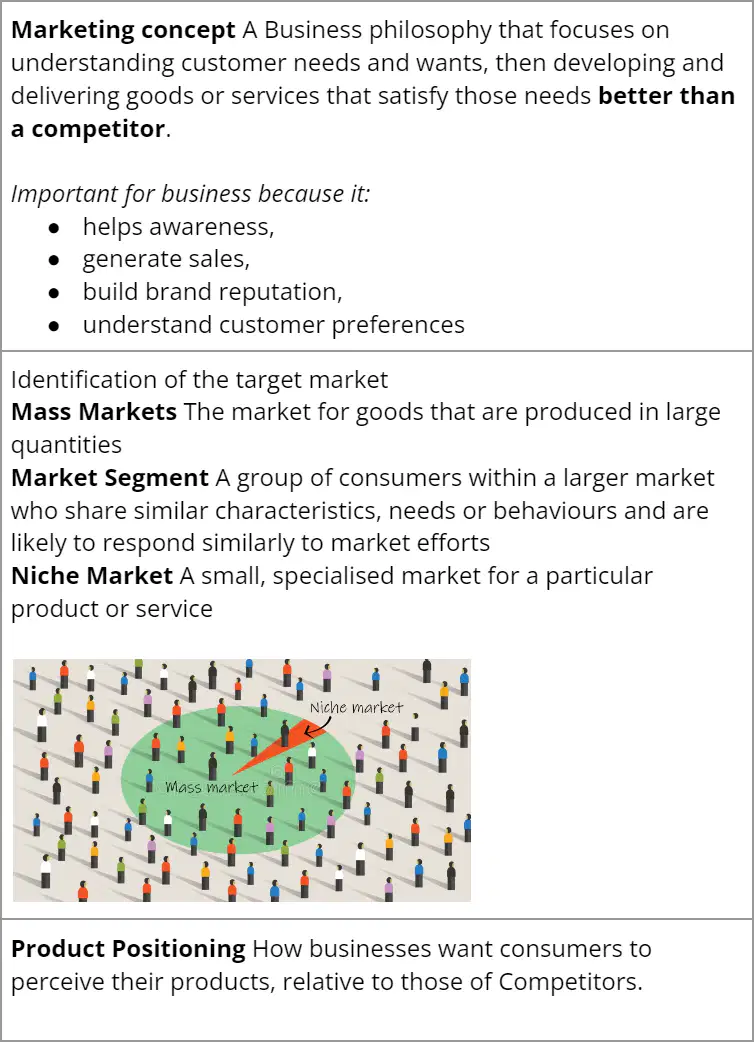
Refer to the diagram. Which area represents the 'Niche market'?
The larger green area
The smaller red area
Both areas
Neither area
What does 'Product Positioning' refer to?
How businesses want consumers to perceive their products, relative to those of competitors.
The process of setting the price for a product in the market.
The method of distributing products to retailers and customers.
The strategy of increasing production to meet demand.
Refer to the diagram comparing Apple, Google, and Microsoft. Which company is described as easy to use but has a limited range of apps?
Apple
Microsoft
What are the four main stages of the Product Life Cycle?
Introduction, Growth, Maturity, Decline
Planning, Development, Launch, Retirement
Start, Peak, Plateau, End
Design, Production, Marketing, Disposal
According to the Product Life Cycle diagram, what stage comes after Growth?
A) Introduction
B) Maturity
C) Decline
D) Product Extension
What is the definition of a Product according to the Marketing Mix - Product section?
An article or substance that is manufactured or refined for sale (good/service)
A marketing strategy used to promote a brand
A method of distributing goods to customers
A pricing technique for maximizing profit
What does Packaging refer to in the context of the Marketing Mix?
Materials used to wrap or protect goods
The process of setting product prices
The method of promoting products through advertising
The selection of distribution channels
Fill in the blank: A ______ is a type of product manufactured by a particular company under a particular name.
Brand
Label
Store
Patent
Fill in the blank: A ______ is a visual symbol, graphic mark, or stylized name used to represent a company, organisation, product or brand.
Brand Logo
Business Card
Invoice
Brochure
Fill in the blank: ______ is the reputation or image.
Intangible qualities
Physical assets
Financial statements
Legal documents
Which pricing method involves considering the costs of inputs and then deciding a particular percentage profit margin to add on?
Cost Plus
Market-based pricing
Competitors base/price

