
 Worksheets
Biology and Neuroscience Vocabulary
Total questions: 86
Worksheet time: 43mins
A system that reduces change, like sweating to get cooler, is called ________.
Negative Feedback Loop
Positive Feedback Loop
Homeostasis Disruption
Thermal Expansion
A system that increases change, like shivering to get warmer, is called ________.
Positive Feedback Loop
Negative Feedback Loop
Homeostasis
Equilibrium
Physical breakdown of food, like chewing and intestine breaks down, is called ________.
Mechanical Digestion
Chemical Digestion
Absorption
Assimilation
Chemical breakdown of food is called ________.
Chemical Digestion
Mechanical Digestion
Absorption
Ingestion
Glands that produce saliva and make it easy for food to go down are called ________.
Salivary glands
Sweat glands
Sebaceous glands
Endocrine glands
An organ that digests food is called the ________.
Stomach
Liver
Heart
Lung
An organ that produces digestive enzymes is called the ________.
Pancreas
Liver
Heart
Kidney
The last part of the large intestine that stores feces before elimination is called the ________.
Rectum
Ileum
Duodenum
Cecum
The opening at the end of the digestive tract is called the ________.
Anus
Esophagus
Stomach
Rectum
An enzyme that breaks down carbohydrates is called ________.
Pancreatic Amylase
Pepsin
Lipase
Trypsin
An enzyme that breaks down proteins is called ________.
Trypsin
Amylase
Lipase
Lactase
Fluid that helps digest fats is called ________.
Bile
Saliva
Plasma
Mucus
An enzyme that breaks down fats is called ________.
Lipase
Amylase
Protease
Lactase
The upper chambers of the heart are called ________.
Atria
Ventricles
Valves
Septum
The lower chambers of the heart are called ________.
Ventricles
Atria
Septum
Valves
Large veins that carry blood to the heart are called ________.
Vena Cavas
Aorta
Arterioles
Capillaries
An artery that carries blood to the lungs is called the ________.
Pulmonary Artery
Coronary Artery
Carotid Artery
Renal Artery
The largest artery in the body is called the ________.
Aorta
Pulmonary vein
Carotid artery
Femoral artery
Structures that prevent backflow of blood are called ________.
Valves
Arteries
Capillaries
Ventricles
Blood vessels that carry blood to the heart are called ________.
Veins
Arteries
Capillaries
Aorta
The smallest blood vessels are called ________.
Capillaries
Arteries
Veins
Venules
Pharynx: _________. (Fill in the blank with the correct definition.)
Throat.
Lung.
Stomach.
Esophagus.
Trachea: _________. (Fill in the blank with the correct definition.)
Windpipe.
Food pipe.
Voice box.
Lung sac.
Bronchioles: _________. (Fill in the blank with the correct definition.)
Small branches of the bronchi.
Tiny air sacs in the lungs.
Tubes that carry food to the stomach.
Muscles that control breathing.
Alveoli: _________. (Fill in the blank with the correct definition.)
Air sacs in the lungs.
Tubes that carry blood.
Muscles of the heart.
Bones in the arm.
Diaphragm: _________.
A muscle that helps with breathing.
A bone in the arm.
A gland in the neck.
A part of the digestive system.
Medulla Oblongata: _________. (Fill in the blank with the correct definition.)
Part of the brain that controls breathing and heart rate.
Outer layer of the cerebrum responsible for higher thinking.
Gland that regulates metabolism and growth.
Structure that connects the two hemispheres of the brain.
Allergen: _________. (Fill in the blank with the correct definition.)
A substance that causes an allergic reaction.
A type of vitamin found in food.
A medicine used to treat infections.
A mineral essential for bone health.
Neuron: _________. (Fill in the blank with the correct definition.)
Nerve cell.
Blood vessel.
Muscle fiber.
Bone tissue.
Serotonin: _________. (Fill in the blank with the correct definition.)
A neurotransmitter that affects mood.
A hormone that regulates blood sugar.
A protein that builds muscle.
An enzyme that digests fat.
Acetylcholine: _________. (Fill in the blank with the correct definition.)
A neurotransmitter that affects muscle movement.
A hormone that regulates blood sugar levels.
An enzyme that breaks down proteins in the stomach.
A mineral essential for bone formation.
Endorphins: _________. (Fill in the blank with the correct definition.)
Neurotransmitters that reduce pain.
Hormones that regulate blood sugar.
Cells that transmit electrical impulses.
Proteins that carry oxygen in the blood.
Pons: _________. (Fill in the blank with the correct definition.)
Part of the brain that relays signals.
A type of muscle found in the heart.
A gland that produces hormones.
A bone in the lower leg.
Thalamus: _________. (Fill in the blank with the correct definition.)
Part of the brain that relays sensory information.
Hormone produced by the pancreas.
Outer layer of the skin.
Muscle that moves the arm.
Dopamine: _________. (Fill in the blank with the correct definition.)
A neurotransmitter that affects mood and movement.
A hormone that regulates blood sugar levels.
A protein that builds muscle tissue.
An enzyme that breaks down carbohydrates.
Norepinephrine: _________.
A neurotransmitter that affects alertness.
A hormone that regulates blood sugar levels.
An enzyme that breaks down proteins.
A vitamin essential for vision.
Cerebellum: _________. (Fill in the blank with the correct definition.)
Part of the brain that controls coordination.
A gland that produces hormones.
A type of connective tissue in the body.
A chamber of the heart.
Hypothalamus: _________. (Fill in the blank with the correct definition.)
Part of the brain that controls body temperature and hunger.
A gland that produces insulin in the body.
A muscle responsible for voluntary movement.
A part of the ear that helps in hearing.
Corpus Callosum: _________. (Fill in the blank with the correct definition.)
Connects the two halves of the brain.
Regulates heartbeat and breathing.
Controls voluntary muscle movements.
Produces cerebrospinal fluid.
Cerebrum: _________. (Fill in the blank with the correct definition.)
The largest part of the brain. Controls your senses.
A gland that produces hormones.
A tube that connects the mouth to the stomach.
A muscle that pumps blood throughout the body.
Autonomic System: _________.
Part of the nervous system that controls involuntary actions.
System responsible for voluntary muscle movements.
Part of the digestive system that absorbs nutrients.
System that regulates hormone production.
Sympathetic Nervous System: _________.
Part of the autonomic nervous system that prepares the body for action.
Part of the digestive system that absorbs nutrients.
A gland responsible for hormone secretion.
A muscle group involved in voluntary movement.
Parasympathetic Nervous System: _________. (Fill in the blank with the correct definition.)
Part of the autonomic nervous system that calms the body.
Part of the nervous system responsible for voluntary movements.
System that increases heart rate and energy levels.
Network of nerves that controls reflex actions.
Stimulus: _________. (Fill in the blank with the correct definition.)
Something that causes a response.
A type of energy produced by the sun.
A device used to measure temperature.
A process of breaking down food.
The human digestive system consists of which structures and their functions?
Mouth, esophagus, stomach, intestines; responsible for breaking down food and absorbing nutrients
Heart, lungs, veins, arteries; responsible for circulating blood
Kidneys, bladder, ureters, urethra; responsible for filtering blood and producing urine
Brain, spinal cord, nerves; responsible for transmitting signals throughout the body
The process of digestion and absorption of carbohydrates, proteins, and lipids involves which of the following?
Enzymatic breakdown and absorption in the small intestine
Direct absorption in the stomach without breakdown
Absorption only in the large intestine
Digestion without any absorption
The role of the enzymes/chemicals used in digestion is to:
Break down food into simpler substances for absorption
Transport nutrients throughout the body
Store energy in the form of fat
Produce hormones for growth
The main functions of the human circulatory system include transporting nutrients, oxygen, and hormones to cells and removing waste products, which helps maintain homeostasis by regulating internal conditions. Which of the following best describes these functions?
Transporting nutrients, oxygen, and hormones to cells and removing waste products to maintain homeostasis
Producing digestive enzymes to break down food in the stomach
Controlling voluntary muscle movements throughout the body
Generating electrical impulses for communication between neurons
What is the function of amylase in digestion?
Amylase breaks down starch into smaller carbohydrates (e.g., maltose).
Amylase breaks down proteins into amino acids.
Amylase emulsifies fats into fatty acids and glycerol.
Amylase neutralizes stomach acid in the small intestine.
What is the function of pepsin in digestion?
Pepsin breaks down proteins into smaller peptides in the stomach.
Pepsin emulsifies fats in the small intestine.
Pepsin neutralizes stomach acid.
Pepsin breaks down carbohydrates into simple sugars.
What is the function of hydrochloric acid (HCl) in digestion?
Hydrochloric acid activates pepsinogen to pepsin and provides an acidic environment for pepsin activity in the stomach.
Hydrochloric acid neutralizes the acidic chyme in the stomach.
Hydrochloric acid breaks down carbohydrates into simple sugars.
Hydrochloric acid emulsifies fats for easier digestion.
What is the function of bile in digestion?
Bile emulsifies fats, increasing the surface area for lipase action.
Bile breaks down proteins into amino acids.
Bile neutralizes stomach acid completely.
Bile digests carbohydrates into simple sugars.
What is the function of lipase in digestion?
Lipase breaks down fats into fatty acids and monoglycerides.
Lipase breaks down proteins into amino acids.
Lipase breaks down carbohydrates into glucose.
Lipase neutralizes stomach acid.
What is the function of trypsin and chymotrypsin in digestion?
Trypsin and chymotrypsin break down proteins and polypeptides into smaller peptides in the small intestine.
Trypsin and chymotrypsin help in the absorption of fats in the large intestine.
Trypsin and chymotrypsin are responsible for the breakdown of carbohydrates into glucose in the stomach.
Trypsin and chymotrypsin aid in the emulsification of lipids in the mouth.
What is the function of peptidases in digestion?
Peptidases break down small peptides into amino acids in the small intestine.
Peptidases emulsify fats in the stomach.
Peptidases convert starch into glucose in the mouth.
Peptidases neutralize stomach acid in the small intestine.
What is the function of maltase, sucrase, and lactase in digestion?
Maltase, sucrase, and lactase break down disaccharides (maltose, sucrose, lactose) into monosaccharides (glucose, fructose, galactose) in the small intestine.
They help in the absorption of amino acids in the stomach.
They are responsible for the emulsification of fats in the small intestine.
They break down proteins into amino acids in the large intestine.
What is the transport function of the circulatory system?
The transport function is to transport oxygen, nutrients, hormones, and immune cells to tissues and remove carbon dioxide and metabolic wastes.
The transport function is to produce energy for muscle contraction.
The transport function is to regulate body temperature only.
The transport function is to control the nervous system.
What is the regulation function of the circulatory system?
The regulation function is to help regulate body temperature, pH, and fluid volume.
It is responsible for producing hormones in the body.
It controls the movement of bones and muscles.
It helps in the digestion and absorption of nutrients.
What is the protection function of the circulatory system?
The protection function is to protect against blood loss through clotting and against infection through immune responses.
The protection function is to transport oxygen to the tissues.
The protection function is to regulate body temperature only.
The protection function is to produce hormones for growth.
These functions help maintain homeostasis by: 1. ________ Ensures cells receive necessary resources for energy production and function.
Oxygen and Nutrient Delivery
Waste Removal
Hormone Secretion
Temperature Regulation
These functions help maintain homeostasis by: 2. ________ Prevents toxic buildup by removing metabolic wastes.
Waste Removal
Nutrient Absorption
Oxygen Transport
Hormone Production
These functions help maintain homeostasis by: 3. ________ Allows for communication between different parts of the body.
Hormone Distribution
Oxygen Absorption
Waste Elimination
Nutrient Storage
These functions help maintain homeostasis by: 4. ________ Dissipates heat through vasodilation and conserves heat through vasoconstriction.
Temperature Regulation
Blood Clotting
Oxygen Transport
Nutrient Absorption
These functions help maintain homeostasis by: 5. ________ Buffers in the blood help maintain a stable pH.
pH Balance
Oxygen Transport
Nutrient Absorption
Hormone Secretion
These functions help maintain homeostasis by: 6. ________ Transports immune cells to sites of infection or injury.
Immune Response
Gas Exchange
Nutrient Absorption
Waste Elimination
The structures of the heart include:
atria, ventricles, valves, septum
lungs, arteries, veins, capillaries
brain, spinal cord, nerves, ganglia
bones, muscles, tendons, ligaments
The structure and function of blood vessels can be described as:
Blood vessels are tubular structures that transport blood throughout the body, including arteries, veins, and capillaries, each with specific functions.
Blood vessels are solid organs that store blood for future use.
Blood vessels are only found in the heart and have no role in circulation.
Blood vessels are responsible for producing blood cells in the body.
The upper and lower respiratory tracts have distinct structures and functions. Which of the following best describes them?
The upper tract includes the nose, pharynx, and larynx for air passage and filtering; the lower tract includes the trachea, bronchi, and lungs for gas exchange.
The upper tract includes the trachea and bronchi for gas exchange; the lower tract includes the nose and pharynx for air passage.
Both tracts only function in gas exchange and do not filter air.
The lower tract includes the nose and mouth for filtering air; the upper tract includes the lungs for gas exchange.
The mechanics of breathing involve which of the following processes, and what primarily controls the rate of breathing?
Inhalation and exhalation controlled by the respiratory center in the brain
Digestion and absorption controlled by the stomach
Circulation and filtration controlled by the kidneys
Movement and balance controlled by the cerebellum
The organization of the nervous system can be described as:
Central and peripheral divisions
Only the brain and spinal cord
Muscles and bones
Digestive and respiratory systems
The structure and function of a reflex arc can be described as:
A pathway involving a sensory neuron, interneuron, and motor neuron that enables a rapid, involuntary response to a stimulus.
A process where only the brain is involved in responding to a stimulus.
A system that only uses motor neurons to produce voluntary movements.
A pathway that delays response to allow for conscious thought before action.
Fill in the blank: The primary respiratory control center in the brain is the _________.
Medulla Oblongata
Cerebellum
Thalamus
Hypothalamus
Fill in the blank: The ________ influences the rate and depth of breathing.
Pons
Cerebellum
Medulla Oblongata
Thalamus
Fill in the blank: ________ detect changes in blood levels of carbon dioxide, oxygen, and pH.
Chemoreceptors
Photoreceptors
Mechanoreceptors
Thermoreceptors
Fill in the blank: In the lungs, ________ prevent over-inflation.
Stretch Receptors
Alveoli
Goblet Cells
Cilia
The spinal cord and brain structures are responsible for which of the following functions?
Transmitting nerve signals and processing information
Digesting food and absorbing nutrients
Producing hormones and regulating metabolism
Filtering blood and producing urine
The components of the peripheral nervous system are:
Cranial nerves and spinal nerves
Brain and spinal cord
Heart and blood vessels
Bones and muscles
What does the somatic nervous system control?
The somatic nervous system controls voluntary movements of skeletal muscles.
The somatic nervous system controls involuntary actions of internal organs.
The somatic nervous system controls the release of hormones.
The somatic nervous system controls the regulation of body temperature.
What does the autonomic nervous system (ANS) regulate?
The autonomic nervous system regulates involuntary functions of smooth muscle, cardiac muscle, and glands.
The autonomic nervous system regulates voluntary movements of skeletal muscles.
The autonomic nervous system regulates the production of red blood cells in bone marrow.
The autonomic nervous system regulates the secretion of digestive enzymes only.
What is the function of the sympathetic division?
Prepares the body for 'fight-or-flight' responses.
Regulates voluntary muscle movements.
Controls digestion and nutrient absorption.
Maintains balance and posture.
What are the effects of the sympathetic division?
Increases heart rate, increases breathing rate, dilates pupils, inhibits digestion, and releases glucose from the liver.
Decreases heart rate, constricts pupils, stimulates digestion, and stores glucose in the liver.
Slows breathing rate, contracts pupils, enhances saliva production, and promotes rest.
Lowers blood pressure, increases digestive activity, and causes constriction of the bronchi.
What is the function of the parasympathetic division?
Promotes 'rest-and-digest' activities.
Initiates 'fight-or-flight' response.
Regulates voluntary muscle movement.
Controls hormone secretion from the pituitary gland.
What are the effects of the parasympathetic division?
Decreases heart rate, decreases breathing rate, constricts pupils, stimulates digestion, and promotes storage of glucose.
Increases heart rate, increases breathing rate, dilates pupils, inhibits digestion, and releases glucose.
Decreases heart rate, increases breathing rate, dilates pupils, inhibits digestion, and promotes glucose breakdown.
Increases heart rate, decreases breathing rate, constricts pupils, inhibits digestion, and releases glucose.
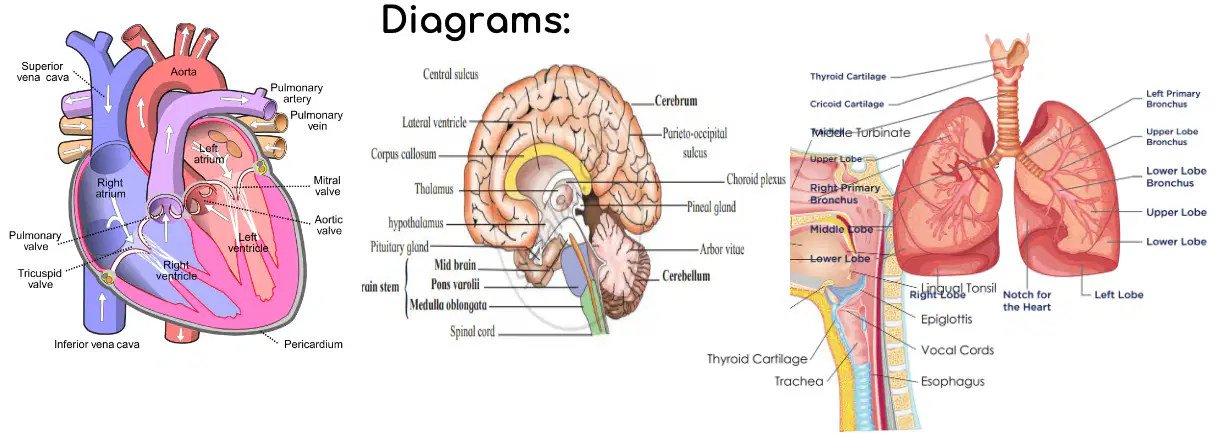
The labeled parts of the heart in the diagram are:
right atrium, left ventricle, aorta, pulmonary artery
left atrium, right ventricle, vena cava, pulmonary vein
right ventricle, left atrium, septum, tricuspid valve
left ventricle, right atrium, mitral valve, aortic valve
The diagram shows labeled parts of the brain. Which of the following correctly identifies the cerebellum?
A
B
C
D
The labeled parts of the lungs in the diagram are:
Trachea, Bronchi, Alveoli, Diaphragm
Heart, Liver, Stomach, Kidney
Esophagus, Pancreas, Spleen, Colon
Femur, Tibia, Fibula, Patella

