
 Worksheets
Microbiology Ch. 8/9
Total questions: 88
Worksheet time: 44mins
The initial effect of ionizing radiation on a cell is that it causes
The formation of highly reactive ions.
Base substitutions.
DNA to break.
Bonding between adjacent thymines.
The cells to get hot.
Which of the following is NOT a product of transcription?
tRNA
None of these
mRNA
A new strand of DNA
RNA
An enzyme that copies DNA to make a molecule of RNA is
RNA polymerase.
Transposase.
DNA polymerase.
Restriction enzyme.
DNA ligase.
Transformation is the transfer of DNA from a donor to a recipient cell
As naked DNA in solution.
By cell-to-cell contact.
By sexual reproduction.
By a bacteriophage.
By crossing over.
The mechanism by which the presence of arabinose controls the arabinose operon is
Repression.
Translation.
Induction.
Catabolite repression.
DNA polymerase.
The damage caused by ultraviolet radiation is
Repaired during transcription.
Never repaired.
Repaired by DNA replication.
Repaired during translation.
Cut out and replaced.
DNA is constructed of
None of these.
A single strand of nucleotides with internal hydrogen bonding.
Two strands of identical nucleotides with hydrogen bonds between them.
Two strands of nucleotides running antiparallel.
Nucleotides bonded A-C and G-T.
Conjugation differs from reproduction because conjugation
Transfers DNA horizontally, to cells in the same generation.
Copies RNA to make DNA.
Replicates DNA.
Transfers DNA vertically, to new cells.
Transcribes DNA to RNA.
Repair of damaged DNA might be viewed as a race between an endonuclease and
Methylase.
Helicase.
DNA ligase.
Primase.
DNA polymerase.
The cancer gene ras produces mRNA containing an extra exon that includes a number of UAA codons. Cancer cells produce ras mRNA missing this exon. This mistake most likely is due to a mistake by
DNA polymerase.
snRNPs.
A chemical mutagen.
Photolyases.
UV radiation.
Which of the following statements is false regarding a bacterium that is R+?
It is resistant to certain drugs and heavy metals.
R+ can be transferred to a cell of the same species.
It is F+.
R+ can be transferred to a different species.
It possesses a plasmid.
If you knew the sequence of nucleotides within a gene, which one of the following could you determine with the most accuracy?
The tertiary structure of the protein
The secondary structure of the protein
The quaternary structure of the protein
The primary structure of the protein
Can't tell
According to the operon model, for the synthesis of an inducible enzyme to occur, the
Repressor must not be synthesized.
Repressor must bind to the operator.
Substrate must bind to the repressor.
End-product must not be in excess.
Substrate must bind to the enzyme.
Synthesis of a repressible enzyme is stopped by
The end-product binding to the promoter.
The allosteric transition.
The corepressor-repressor binding to the operator.
The corepressor binding to the operator.
The substrate binding to the repressor.
A specific gene can be inserted into a cell by all of the following EXCEPT
Agrobacterium.
A gene gun.
Electroporation.
Microinjection.
Protoplast fusion.
If you have inserted a gene in the Ti plasmid, the next step in genetic engineering is
Inserting the Ti plasmid into a plant cell.
Splicing T DNA into a plasmid.
Inserting the Ti plasmid into Agrobacterium.
Transformation of an animal cell.
Transformation of E. coli with Ti plasmid.
Which of the following processes is NOT involved in making cDNA?
Translation
Transcription
Reverse transcription
RNA processing to remove introns
The following steps must be performed to make a bacterium produce human protein X: 1-Translation; 2-Restriction enzyme; 3-Prokaryotic transcription; 4-DNA ligase; 5-Transformation; 6-Eukaryotic transcription; 7-Reverse transcription. Put the steps in the correct sequence.
6, 7, 2, 4, 5, 3, 1
5, 2, 3, 4, 7, 6, 1
6, 2, 1, 3, 4, 5, 7
1, 2, 3, 5, 4, 7, 6
6, 7, 2, 3, 4, 5, 1
You have a small gene that you wish replicated by PCR. You add radioactively labeled nucleotides to the PCR thermocycler. After 3 replication cycles, what percentage of the DNA single strands are radioactively labeled?
12.5%
87.5%
50%
0%
100%
Which of the following methods of making rDNA could be described as "hit or miss"?
Transformation
Cloning
Protoplast fusion
Viral transduction
Gene gun
Gene silencing blocks an undesirable product by
End-product repression.
Blocking transcription.
Making double-stranded RNA.
Blocking DNA replication.
Allosteric inhibition of an enzyme.
Which of the following is an advantage of using E. coli to make a human gene product?
It can't process introns.
Its genes are well known.
None of these.
It doesn't secrete most proteins.
Endotoxin may be in the product.
Assume you have discovered a cell that produces a lipase that works in cold water for a laundry additive. You can increase the efficiency of this enzyme by changing one amino acid. This is done by
Selective breeding.
Selection.
Enrichment.
Site-directed mutagenesis.
Irradiating the cells.
The reaction catalyzed by DNA polymerase is
DNA --> DNA
mRNA --> cDNA
tRNA --> mRNA
mRNA --> protein
DNA --> mRNA
A colleague has used computer modeling to design an improved enzyme. To produce this enzyme, the next step is to
Mutate bacteria until one makes the improved enzyme.
Look for a bacterium that makes the improved enzyme.
Determine the nucleotide sequence for the improved enzyme.
Synthesize the gene for the improved enzyme.
Use siRNA to produce the enzyme.
Which of the following is NOT an agricultural product made by DNA techniques?
Frost retardant
Bacillus thuringiensis insecticide
Nitrogenase (nitrogen fixation)
Glyphosate-resistant crops
Pectinase
A population of cells carrying a desired plasmid is called a
Vector.
PCR.
Clone.
Library.
Southern blot.
The use of an antibiotic-resistance gene on a plasmid used in genetic engineering makes
Direct selection possible.
All of these.
The recombinant cell unable to survive.
Replica plating possible.
The recombinant cell dangerous.
The purpose of the Human Genome Project was to
None of these.
Identify all of the human genes.
Translate human DNA.
Sequence the nucleotides in human DNA.
Identify genes of all organisms.
You want to determine whether a person has a certain mutant gene. The process involves using a primer and Taq. This process is
PCR.
Transformation.
Translation.
Restriction mapping.
Site-directed mutagenesis.
E. coli makes insulin because
The insulin gene was inserted into it.
No reason; it doesn't make insulin.
It picked up the insulin gene from another cell.
It needs to regulate its cell-glucose level.
It's an ancient gene that now has no function.
Which of the following statements is false?
DNA replication proceeds in one direction around the bacterial chromosome.
DNA polymerase joins nucleotides in one direction only.
Multiple replication forks are possible on a bacterial chromosome.
The lagging strand of DNA is started by an RNA primer.
The leading strand of DNA is made continuously.
The mechanism by which the presence of glucose inhibits the arabinose operon is
DNA polymerase.
Translation.
Catabolite repression.
Repression.
Induction.
An enzyme produced in response to the presence of a substrate is called
A promoter.
An operator.
A restriction enzyme.
A repressible enzyme.
An inducible enzyme.
Genetic change in bacteria can be brought about by
Transformation.
All of these.
Transduction.
Conjugation.
Mutation.
Which of the following statements about bacteriocins is false?
Bacteriocins kill bacteria.
They cause food-poisoning symptoms.
They can be used to identify certain bacteria.
Nisin is a bacteriocin used as a food preservative.
The genes coding for them are on plasmids.
Which of the following pairs is mismatched?
Transposase - insertion of DNA segments into DNA
DNA ligase - joins segments of DNA
RNA polymerase - makes a molecule of RNA from an RNA template
DNA gyrase - coils and twists DNA
DNA polymerase - makes a molecule of DNA from a DNA template
When glucose is high, cAMP is ________ : CAP ________ bind the lac operator, and RNA polymerase ________ bind the lac promoter.
low, does, does
high, doesn't, does
low, doesn't, doesn't
high, does, does
You have a small gene that you wish replicated by PCR. After 3 replication cycles, how many double-stranded DNA molecules do you have?
16
4
Thousands
2
8
Self-replicating DNA used to transmit a gene from one organism to another is a
Clone.
Vector.
PCR.
Library.
Southern blot.
The following steps are used to make DNA fingerprints. What is the third step?
Collect DNA.
Add stain.
Lyse cells.
Perform electrophoresis.
Digest with a restriction enzyme.
Large numbers of bacterial cells are NOT found in crown galls because
The assumption is not true; many bacteria are in the galls.
A gene in plant cells is controlling growth.
The plant kills the bacteria.
Bacteria kill plants.
Cell walls protect the plant from bacterial invasion.
PCR can be used to identify an unknown bacterium because
All cells have RNA.
The RNA primer is specific.
DNA polymerase will replicate DNA.
DNA can be electrophoresed.
All cells have DNA.
A source of heat-stable DNA polymerase is
Thermus aquaticus.
Agrobacterium tumefaciens.
Saccharomyces cerevisiae.
Pseudomonas.
Bacillus thuringiensis.
Subunit vaccines can be made by genetic modification of yeast cells. A side effect of these vaccines might be
The disease.
A yeast infection.
Failure of the vaccine to provide immunity.
None of these.
Due to extraneous material.
Restriction enzymes are
Animal enzymes that splice RNA.
Bacterial enzymes that splice DNA.
Viral enzymes that destroy host DNA.
Bacterial enzymes that destroy phage DNA.

In Table 8.1, what will be the result of conjugation between cultures 1 and 2?
1 will remain the same;
2 will become F+ and recombination may occur
1 will become F-, leu+, his+;
2 will become F+, leu-, his-
1 will remain the same;
2 will become F+, leucine-, histidine-
1 will become F-, leu-, his-;
2 will remain the same
1 will remain the same;
2 will become F+, leu+, his+
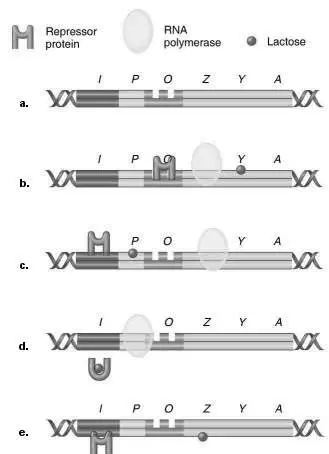
In Figure 8.5, which model of the lac operon correctly shows RNA polymerase, lactose, and repressor protein when the structural genes are being transcribed?
a
b
c
d
e
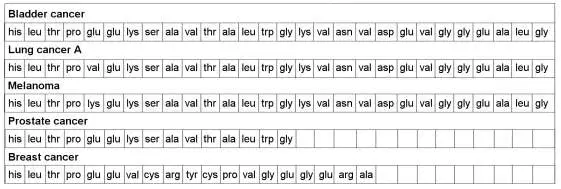
Amino Acids Encoded by the Human p53 Gene
Based on the information in Table 8.3, prostate cancer is probably the result of which kind of mutation?
None of these
Analog
Missense
Nonsense
Frameshift
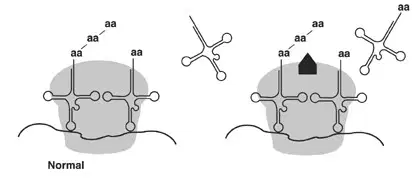
In Figure 8.4, the antibiotic chloramphenicol binds the 50S ribosome as shown. From this information you can conclude that chloramphenicol
Prevents transcription in prokaryotes.
Prevents transcription in eukaryotes.
Prevents mRNA-ribosome binding.
Prevents translation in eukaryotes.
Prevents translation in prokaryotes.

(Use Table 8.2.) What is the sequence of amino acids encoded by the following sequence of bases in a strand of DNA?
3' ATTACGCTTTGC
Leucine-arginine-lysine-alanine
Asparagine-arginine-lysine-alanine
Transcription would stop at the first codon
Can't tell
Asparagine-cysteine-valine-serine

In Figure 8.3, if enzyme A is a repressible enzyme, compound C would
Bind to gene a.
Bind to the corepressor.
Always be in excess.
Bind to the enzyme.
Bind to RNA polymerase.

In Figure 8.3, if compound C reacts with the allosteric site of enzyme A, this would exemplify
Feedback inhibition.
Competitive inhibition.
Repression.
Transcription.
A mutation.

(Use Table 8.2.) The anticodon for valine is
CAA
GTA
CTT
GUU
CUU
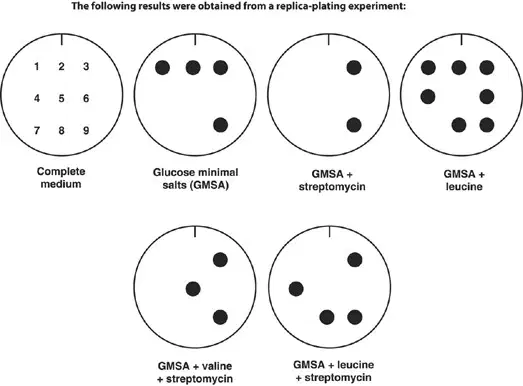
In Figure 8.1, which colonies are streptomycin-resistant and leucine-requiring?
5 and 6
3 and 9
4, 6, and 8
4 and 8
1, 2, 3, and 9

(Use Table 8.2.) If the sequence of amino acids encoded by a strand of DNA is serine-alanine-lysine-leucine, the coding for the antisense strand of DNA is
5' TCTGCAAAGTTA
5' ACAGTTTCAAT
3' UCUCGAAAGUUA
3' TCACGUUUCAAU
3' UGUGCAAAGUUA
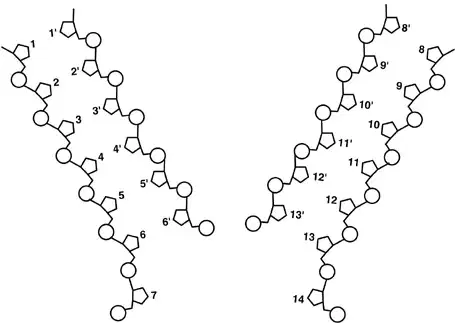
In Figure 8.2, if base 4 is thymine, what is base 4'?
Uracil
Adenine
Thymine
Guanine
Cytosine
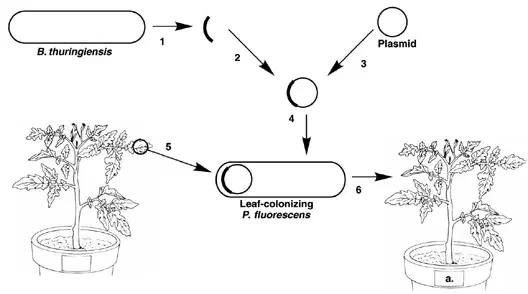
In Figure 9.4, the resulting P. fluorescens has
No new gene.
A Bacillus gene.
A tomato gene.
A tomato and a Bacillus gene.
An E. coli gene.
Which enzyme does NOT make sticky ends?





Which enzyme would cut this strand of DNA: GCATGGATCCCAATGC?





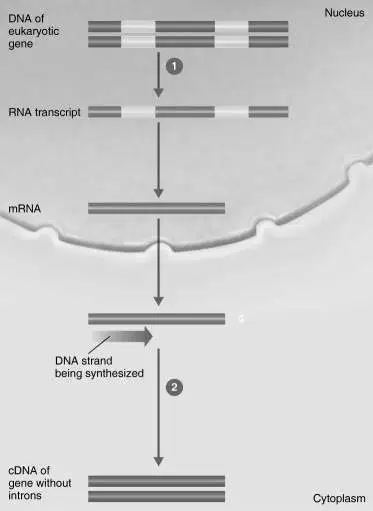
In Figure 9.2, the enzyme in step 2 is
DNA ligase.
DNA polymerase.
Reverse transcriptase.
Spliceosome.
RNA polymerase.
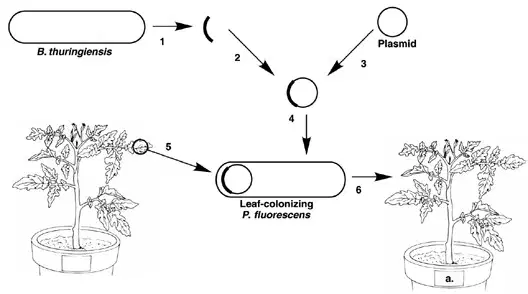
In Figure 9.4, the resulting organism (a) is
E. coli.
A tomato plant.
a plant x Pseudomonas hybrid.
Bacillus thuringiensis.
Pseudomonas fluorescens.
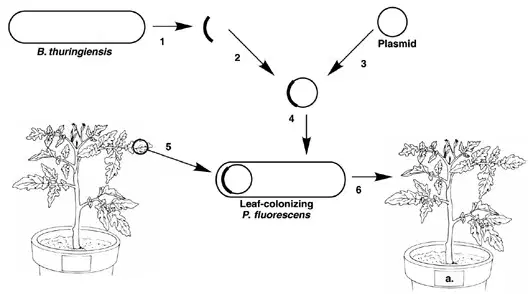
In Figure 9.4, the vector is
Pseudomonas.
A plasmid.
RNA.
A virus.
A library.
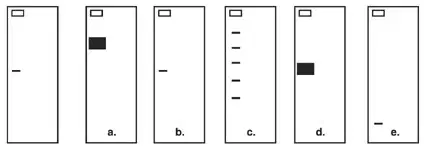
The figure at the left in Figure 9.3 shows a gene identified by Southern blotting. What will a Southern blot of the same gene look like after PCR?
a
b
c
d
e
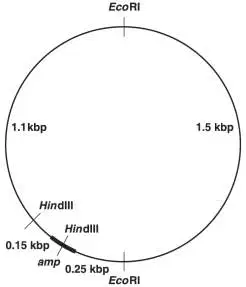
How many pieces will EcoRI produce from the plasmid shown in Figure 9.1?
1
2
3
4
5

Assume the two E.coli strains shown below are allowed to conjugate.
What supplements would you add to glucose minimal salts agar to select for a recombinant cell that is lys+, arg+, amp-resistant?
Ampicillin, lysine, arginine
Lysine arginine
Proline, histidine, methionine
Ampicillin, proline, histidine, methionine
Ampicillin, prolein, histidine, lysine
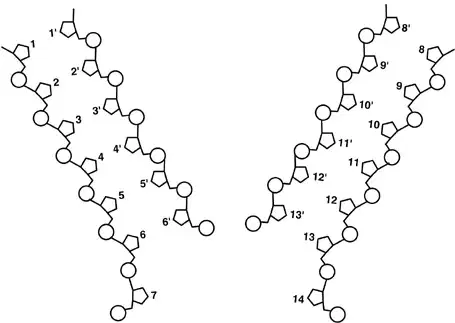
In Figure 8.2, if base 4 is thymine, what is base 11'?
Adenine
Guanine
Uracil
Cytosine
Thymine

(Use Table 8.2.) If the sequence of amino acids encoded by a strand of DNA is serine-alanine-lysine-leucine, what is the order of bases in the sense strand of DNA?
5' TGTGCTTTCTTA
3' AGACGTTTCAAT
3' TCTCGTTTGTTA
5' AGAGCTTTGAAT
3' UGUGCAAAGUUA

(Use Table 8.2.) If a frameshift mutation occurred in the sequence of bases shown below, what would be the sequence of amino acids coded for?
3' ATTACGCTTTGC
Asparagine-cysteine-valine-serine
Translation would stop at the first codon
Can't tell
Leucine-arginine-lysine-alanine
Asparagine-arginine-lysine-alanine
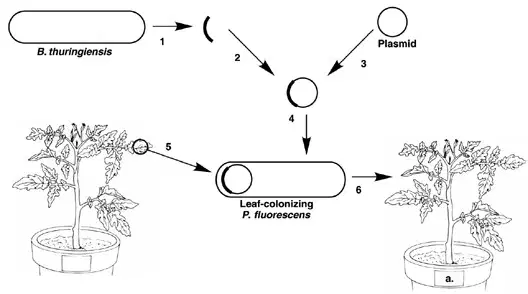
In Figure 9.4, the process required in step 5 is
Transcription.
PCR.
Southern blotting.
Conjugation.
Transformation.
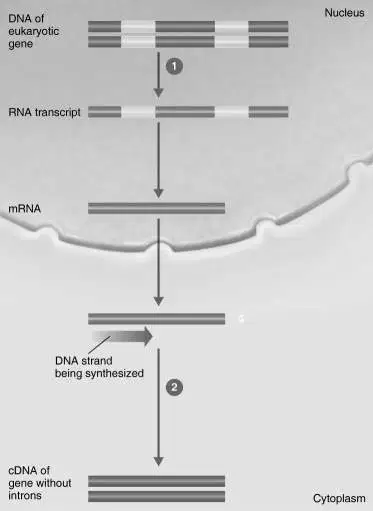
In Figure 9.2, the enzyme in step 1 is
RNA polymerase.
Reverse transcriptase.
DNA ligase.
DNA polymerase.
Spliceosome.
An enzyme that cuts double-stranded DNA at specific nucleotide sequences.
DNA ligase
Restriction enzyme
Transposase
RNA polymerase
DNA polymerase
The necessary ingredients for DNA synthesis can be mixed together in a test tube. The DNA polymerase is from Thermus aquaticus, and the template is from a human cell. The DNA synthesized would be most similar to
A mixture of human and T. aquaticus DNA.
Human DNA.
T. aquaticus RNA.
T. aquaticus DNA.
Human RNA.
An enzyme that makes covalent bonds between nucleotide sequences in DNA is
DNA polymerase.
Restriction enzyme.
RNA polymerase.
DNA ligase.
Transposase.

In Table 8.1, if culture 1 mutates to Hfr, what will be the result of conjugation between the two cultures?
1 will remain the same;
Recombination will occur in 2
1 will become F+, leu+, his+;
2 will become F+, leu+, his+
Can't tell
1 will become F-, leu+, his+;
2 will become Hfr, leu+, his+
They will both remain the same
A restriction fragment is
A segment of mRNA.
A gene.
A segment of DNA.
cDNA.
A segment of tRNA.
The value of cDNA in recombinant DNA is that
It lacks exons.
It lacks introns.
It's really RNA.
It contains introns and exons.
Suicide genes can be controlled by the fimbriae-gene operator. This would result in the death of
All cells.
Cells making flagella.
Cells at 37°C.
Conjugating cells.
Cells making fimbriae.
Pieces of DNA stored in yeast cells are called a
Clone.
Vector.
Library.
PCR.
Southern blot.
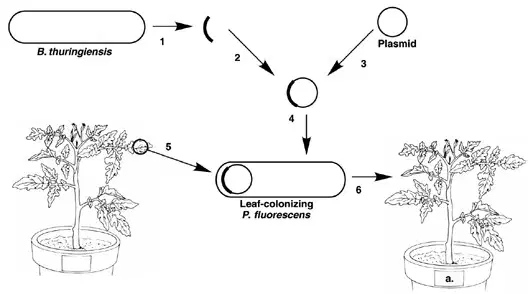
In Figure 9.4, the purpose of this experiment is to
Put an insecticide on plant leaves.
Make a better tomato.
Isolate Pseudomonas from a plant.
Put a gene into a plant.
Put a gene in Bacillus.
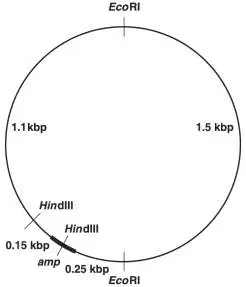
In Figure 9.1, after digestion with the appropriate restriction enzyme, what is the smallest piece containing the ampicillin-resistance (amp) gene?
0.25 kbp
3.00 kbp
0.17 kilobase pairs
1.08 kbp
1.50 kbp

In Figure 8.3, if enzyme A is an inducible enzyme,
Compound C would react with gene a.
Compound C would bind to the repressor.
Compound A would bind to the repressor.
Compound B would bind to enzyme A.
Compound A would react with enzyme B.
In transcription,
RNA is copied to DNA.
Proteins are made.
DNA is changed to RNA.
DNA is copied to RNA.
DNA is replicated.
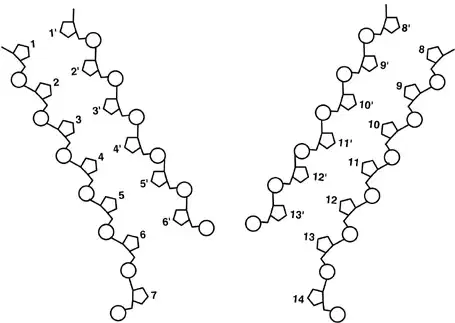
In Figure 8.2, base 2 is attached to
Ribose.
Thymine.
Can't tell.
Phosphate.
Deoxyribose.
The Pap test for cervical cancer involves microscopic examination of cervical cells for cancerous cells. A new, rapid diagnostic test to detect human papilloma virus (HPV) DNA before cancer develops is done without microscopic exam. The steps involved in this FastHPV test are listed. What is the second step?
It doesn't matter.
Add an RNA probe for HPV DNA
Add enzyme-linked antibodies against DNA-RNA
Lyse human cells
Add enzyme substrate
Protein synthesis in eukaryotes is similar to the process in prokaryotes in that both eukaryotes and prokaryotes
Have exons.
Use codons to arrange amino acids.
Require snRNPS.
Have introns.
Use methionine as the "start" amino acid.
A gene is best defined as
A sequence of nucleotides in DNA that codes for a functional product.
A segment of DNA.
Three nucleotides that code for an amino acid.
A sequence of nucleotides in RNA that codes for a functional product.
A transcribed unit of DNA.
PCR can be used to amplify DNA in a clinical sample. The following steps are used in PCR. What is the fourth step?
Add DNA polymerase.
Incubate at 94°C.
Collect DNA.
Incubate at 72°C.
Incubate at 60°C.

