
Font size
 Worksheets
UEECD0020
Total questions: 96
Worksheet time: 48mins
What is the primary purpose of accessories used in construction and other industries?
To decorate surfaces
To support or attach items to a wide variety of surfaces
To paint surfaces
To clean surfaces
When selecting the appropriate fixing method, what must be considered?
The color of the fixing
Whether it needs to be permanent or removable, and the finished appearance and mechanical strength
The price only
The brand name only
Name two types of fixing options mentioned in the text.
Nails, screws (also bolts, wall plugs, chemical anchors)
Glue, tape
Paint, varnish
Sandpaper, brush
Nails are commonly used in construction because they are difficult to remove or replace.
True
False
Nails are an economical and reliable solution that can withstand the required ______ and force exerted on the installation.
weight
color
temperature
length
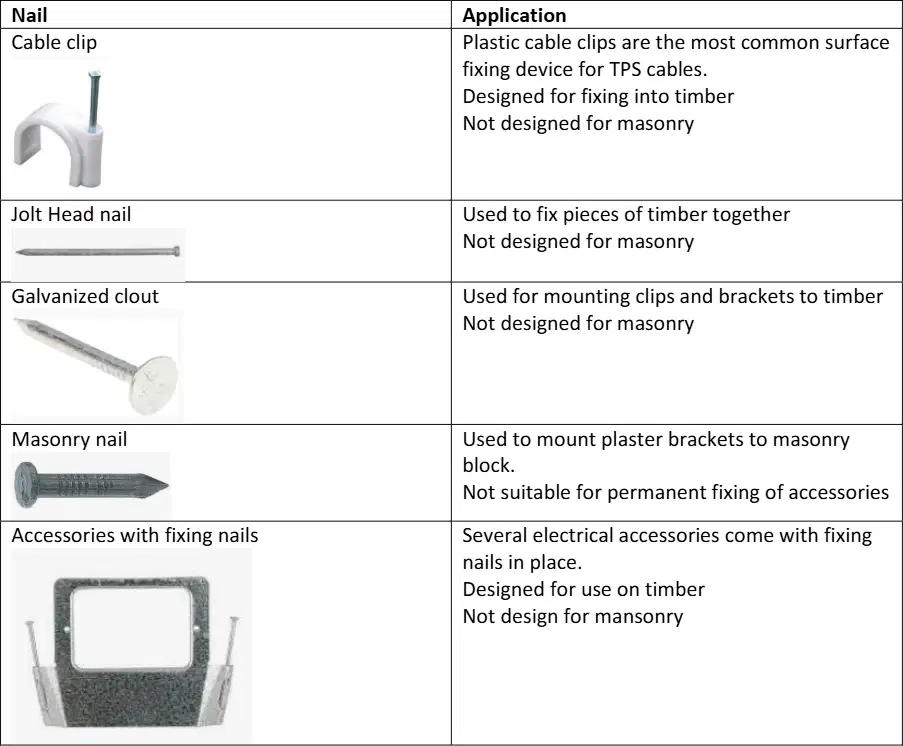
Which type of nail is designed for fixing into timber but not for masonry?
Cable clip
Masonry nail
Galvanized clout
Accessories with fixing nails
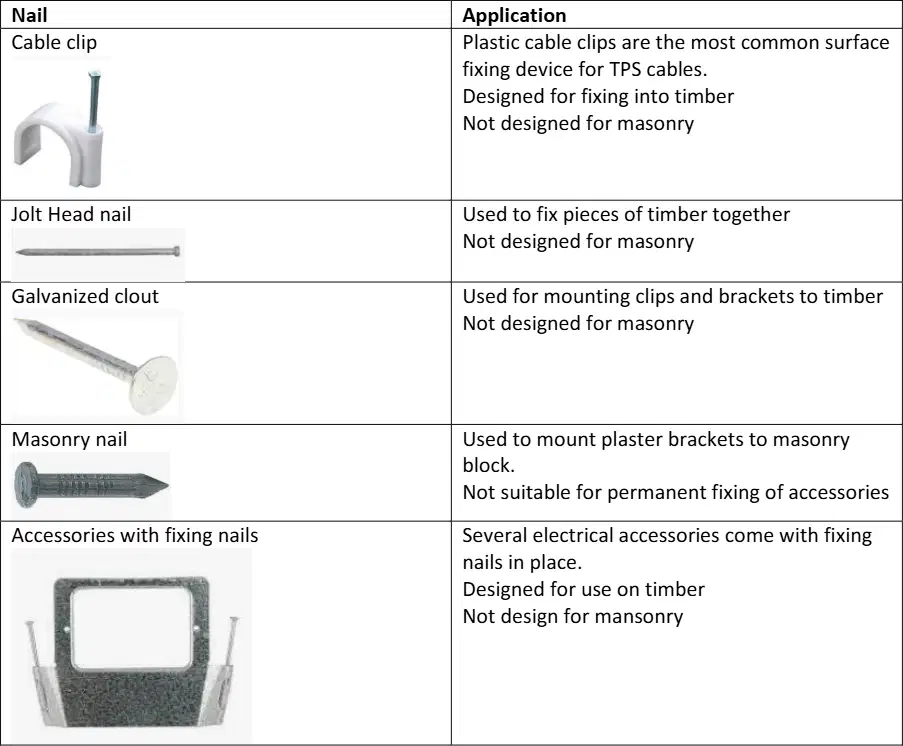
Jolt Head nails are used to fix pieces of timber together.
True
False
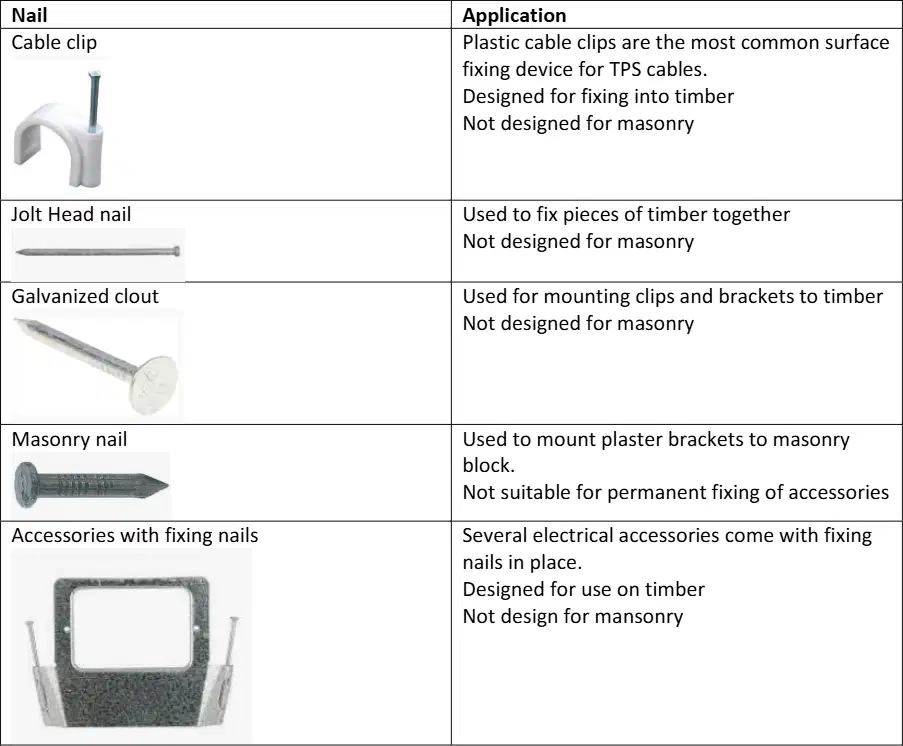
What is the primary use of a galvanized clout?
Used for mounting clips and brackets to timber
Used for electrical wiring connections
Used for plumbing pipe joints
Used for painting surfaces
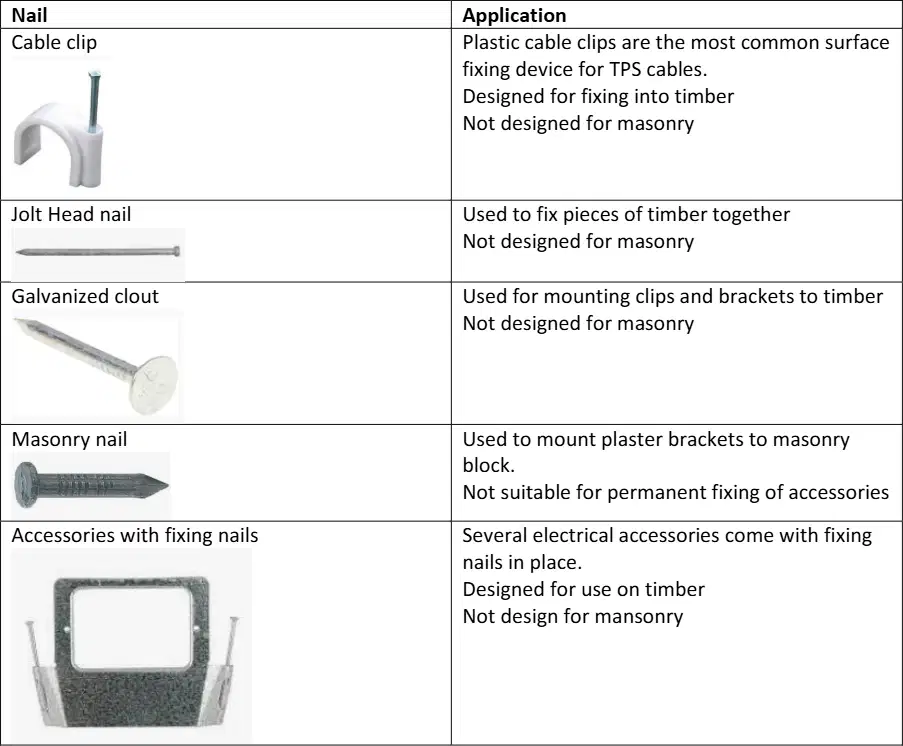
Masonry nails are suitable for permanent fixing of accessories.
True
False
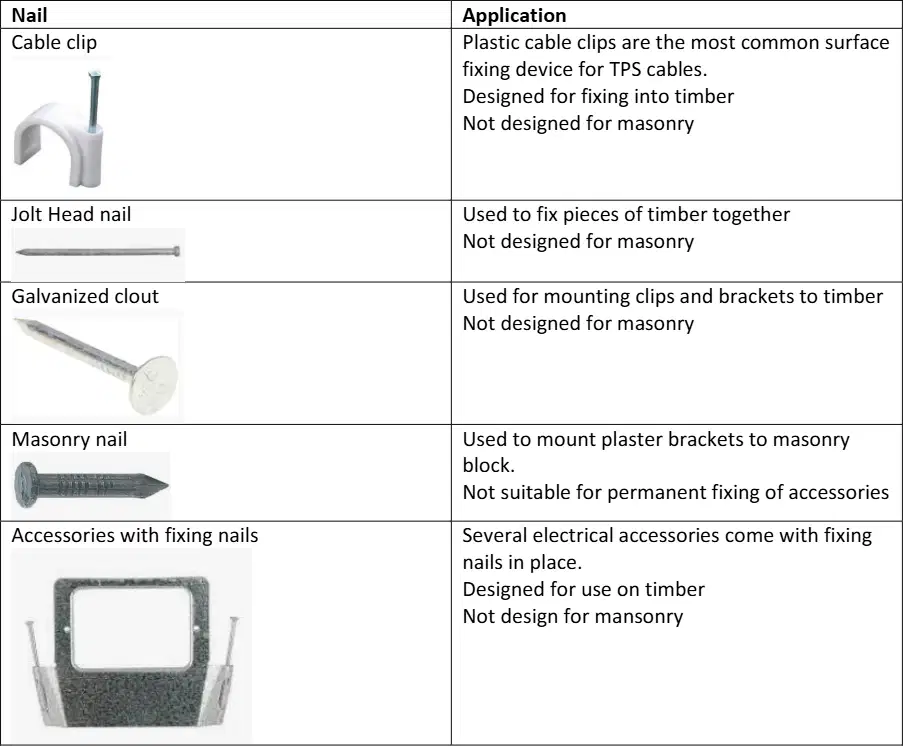
Accessories with fixing nails are designed for use on timber.
True
False
Wood screws are widely used in which industries to secure and support installations?
Construction and woodworking industries
Textile and fashion industries
Pharmaceutical and healthcare industries
Food and beverage industries
Unlike nails, wood screws have threads that provide better holding power and prevent the joint from pulling apart.
True
False
List two advantages of wood screws over other fixing methods.
Ability to provide a strong and permanent bond between materials; easy removal and re-installation if necessary.
They are always cheaper than nails and glue.
Wood screws can only be used on metal surfaces.
Wood screws do not require any tools for installation.
Multiple Choice: Which of the following is not a common material for nails?
Steel
Copper
Brass
Aluminum
Nails are a good choice for permanent fixing of accessories to masonry.
True
False
Matching: Match the nail to its corresponding application:
Cable clip
Used to fix pieces of timber together
Jolt Head nail
Used for mounting clips and brackets to timber
Galvanized clout
Used to mount plaster brackets to masonry block
Masonry nail
Plastic cable clips are the most common surface fixing device for TPS cables.
Wood screws have what advantages over nails in securing and supporting installations?
They provide greater holding power and are less likely to loosen over time.
They are easier to remove than nails.
They are less expensive than nails.
They require no pilot holes.
Critical Thinking: The best type of material to choose for wood screws when installing a deck in a coastal area with high levels of salt and moisture in the air is:
Stainless steel
Brass
Plain steel
Aluminum
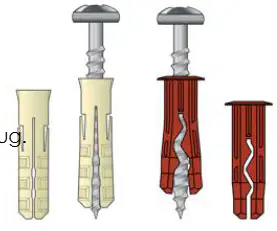
Wall plug/Expanding plastic anchors are commonly used for fixing to which materials?
Brick and concrete
Wood
Plastic
Foam
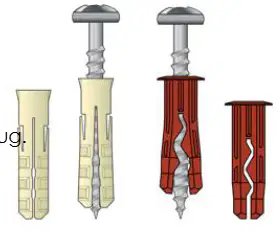
What must be done before inserting a wall plug/expanding plastic anchor?
A pre-drilled hole is required.
Apply glue to the anchor.
Hammer the anchor directly into the wall.
Soak the anchor in water first.
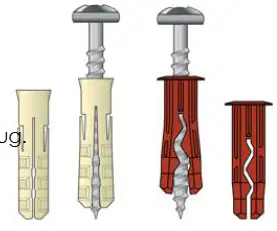
What happens to a wall plug when a screw is screwed into it?
The plug expands.
The plug contracts.
The plug melts.
The plug dissolves.
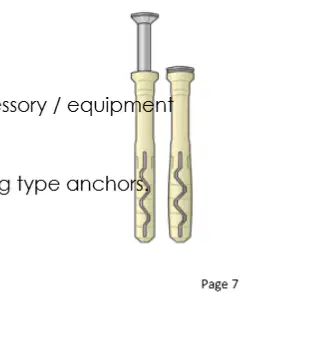
Nail-In/Knock-In anchors require a pre-drilled hole.
True
False
What action causes a Nail-In/Knock-In anchor to expand and lock in position?
When the nail is hammered in.
When the anchor is twisted by hand.
When the anchor is soaked in water.
When the anchor is exposed to sunlight.
Nail-In/Knock-In anchors are as strong as other expanding type anchors.
True
False
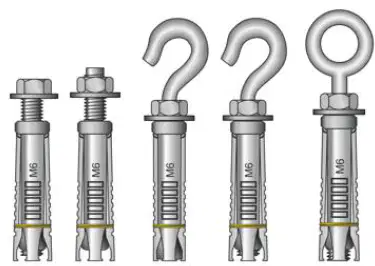
Which type of anchor is commonly used for fixing and securing heavy-duty equipment and requires a pre-drilled hole, is hammered into position, and contains a threaded rod with a bulb on the end that expands the sleeve when the nut is tightened?
Expanding sleeve anchor
Toggle bolt
Plastic wall plug
Drop-in anchor
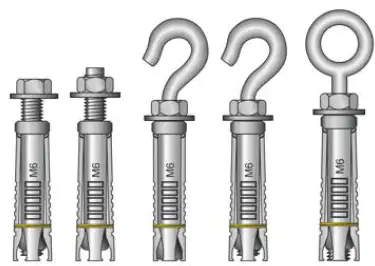
Which type of anchor contains a nut at the base which is drawn up, expanding the sleeve when a bolt is inserted and tightened?
Loxin
Rawl bolt
Toggle bolt
Wedge anchor
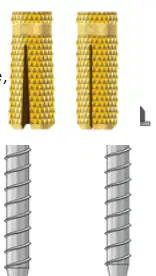
Which type of anchor requires a pre-drilled hole and is fixed in position by screwing the screw/bolt into the hole, with the large thread gripping in the hole?
Concrete screws/bolts
Toggle bolts
Plastic wall plugs
Expansion shields
True or False: The expanding sleeve anchor is fixed in position by screwing it into the hole.
True
False
Both the expanding sleeve anchor and Loxin require a pre-drilled hole and are hammered into position.
True
False
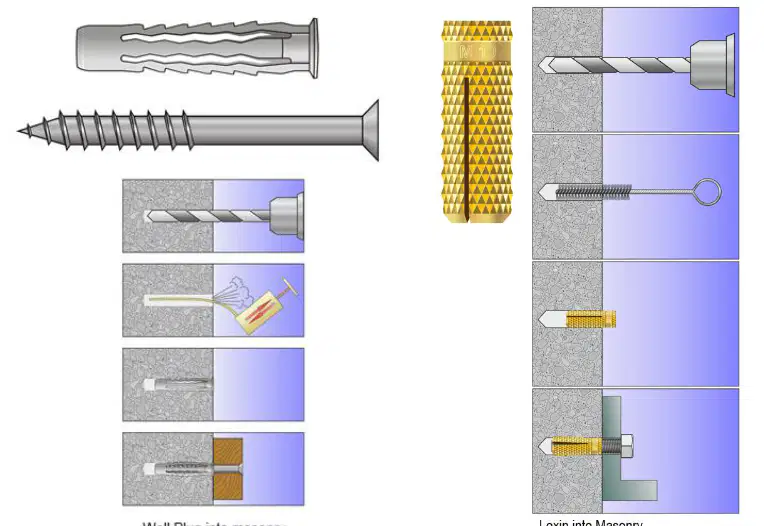
Look at the diagram labeled 'Wall Plug into masonry'. What is the name of the fixing method shown in the step-by-step images?
Wall Plug into masonry
Nail and adhesive fixing
Screw with rawl plug
Direct screw fixing
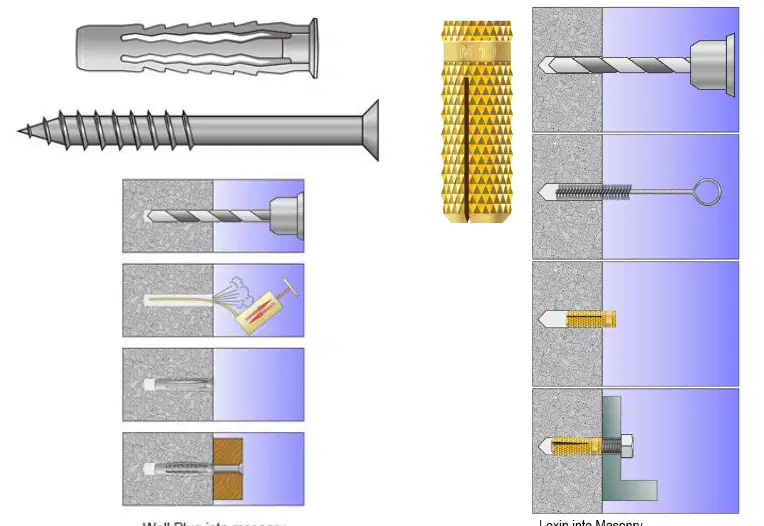
What is the name of the fixing method shown in the step-by-step images?
Loxin into Masonry
Rawl Plug Fixing
Chemical Anchor Fixing
Through Bolt Fixing
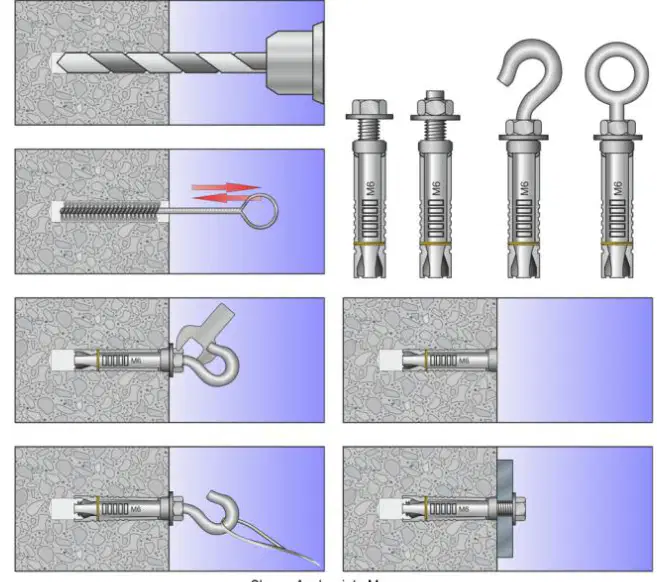
Look at the diagram labeled 'Sleeve Anchor into Masonry'. What is the name of the fixing method shown in the step-by-step images?
Sleeve Anchor into Masonry
Through Bolt Fixing
Chemical Anchor Fixing
Nail-in Anchor Fixing
According to the text, what type of adhesive is used in the adhesive method of fixing into masonry?
Two-part resin based adhesive
Polyvinyl acetate glue
Hot melt glue
Contact cement
The adhesive method of fixing into masonry is particularly useful close to the edge of a slab because:
it reduces the risk of cracking the masonry
it increases the load capacity significantly
it is the cheapest method available
it requires no surface preparation
Match the following scenarios with the correct fixing method:
Wall Plugs and Screws
A
Nail-in Anchors
B
Loxins or expanding sleeve anchors
C
Chemical anchors
D
Sleeve anchors or concrete bolts
E
The most prevalent design for fixing accessories to concrete and masonry walls is:
Expansion anchor
Wood screw
Plastic toggle
Adhesive tape
Q2. The type of fixing accessory commonly used for fixing and securing heavy-duty equipment is known as which of the following, and what is the basic principle behind its design?
Anchor bolt; it works by expanding within the material to provide a secure hold.
Screw; it works by threading into the material for grip.
Nail; it works by friction and pressure.
Clamp; it works by applying external pressure.
The process for installing a wall plug or expanding plastic anchor involves which of the following steps?
Drill a hole, insert the anchor, and screw in the fastener
Hammer the anchor directly into the wall without drilling
Glue the anchor to the wall and wait for it to dry
Insert the anchor without any hole and screw in the fastener
The type of anchor that is quick and easy to install but not as strong as other expanding type anchors is:
Plastic anchor
Wedge anchor
Sleeve anchor
Toggle bolt
The adhesive method of fixing into masonry is particularly useful when:
the masonry is weak or hollow and cannot support traditional fixings
the masonry is very dense and hard
the masonry is exposed to high temperatures
the masonry is already painted
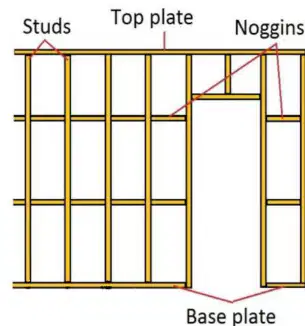
What is the name of the horizontal member at the top of the wall?
Top plate
Sole plate
Stud
Joist
Which type of anchor is self-drilling, self-tapping, and can be installed with a screwdriver?
Gyprock anchor
Toggle bolt
Expansion shield
Plastic wall plug
Which anchor is suitable for light-duty loads and used for fixing onto plasterboard?
Gyprock anchor
Expansion bolt
Sleeve anchor
Chemical anchor
Which anchor requires a pre-drilled hole and is suitable for walls and ceilings?
Spring toggle
Plastic expansion anchor
Adhesive anchor
Hammer-in anchor
Which anchor uses gravity to drop and clamp onto the inside surface of the plasterboard or block when tightened?
Gravity toggle
Plastic plug
Spring toggle
Sleeve anchor
Which anchor is suitable for vertical walls only?
Gravity toggle
Expansion anchor
Sleeve anchor
Plastic anchor
Which anchor has plastic wings that splay out and clamp onto the inside surface of the plasterboard or block when tightened?
Winged plastic toggle
Expansion bolt
Sleeve anchor
Masonry nail
The two most common types of sheeting materials used for hollow wall structures are:
Plywood and gypsum board
Glass and steel
Aluminum and copper
Brick and concrete
Match the scenario with the correct fixing method:
Timber Frame – wood screws/coach bolts; Metal Frame – metal thread screws
A
Hollow wall anchor, spring toggle or gravity toggle
B
Hollow wall anchor, spring toggle
C
Wood screws into timber frame
D
Winged plastic anchor or wall mate anchor
E
The strength limitation of sheeting material used for timber or metal frame walls is:
It must not be weaker than the frame it supports.
It must be transparent.
It must be heavier than the frame.
It must be made of plastic.
The clamping principle used for fixing to hollow structures is known as:
Toggle principle
Wedge principle
Friction principle
Magnetic principle
The difference between a spring toggle and a gravity toggle is:
A spring toggle uses a spring mechanism to expand the wings, while a gravity toggle relies on gravity to position the wings.
A spring toggle is used only in wood, while a gravity toggle is used only in metal.
A spring toggle requires no drilling, while a gravity toggle does.
A spring toggle is stronger than a gravity toggle in all applications.
Critical Thinking: The advantages of using hollow wall structures in construction include:
Reduced material usage and improved insulation
Increased weight and higher costs
Decreased structural stability
Limited design flexibility
Which of the following is a benefit of using hollow walls in construction projects?
They are more expensive than solid walls
They are harder to install than solid walls
They are less expensive and easier to install than solid walls
They require more labor than solid walls
Fill in the blank: Hollow walls can be installed more quickly and easily than ______ walls, which can reduce labor costs and construction time.
solid
painted
glass
curved
It is important for workers to receive proper training and certification before using powder-actuated tools because:
it ensures safe and correct use of the tools
it makes the tools more powerful
it reduces the cost of the tools
it increases the speed of work regardless of safety
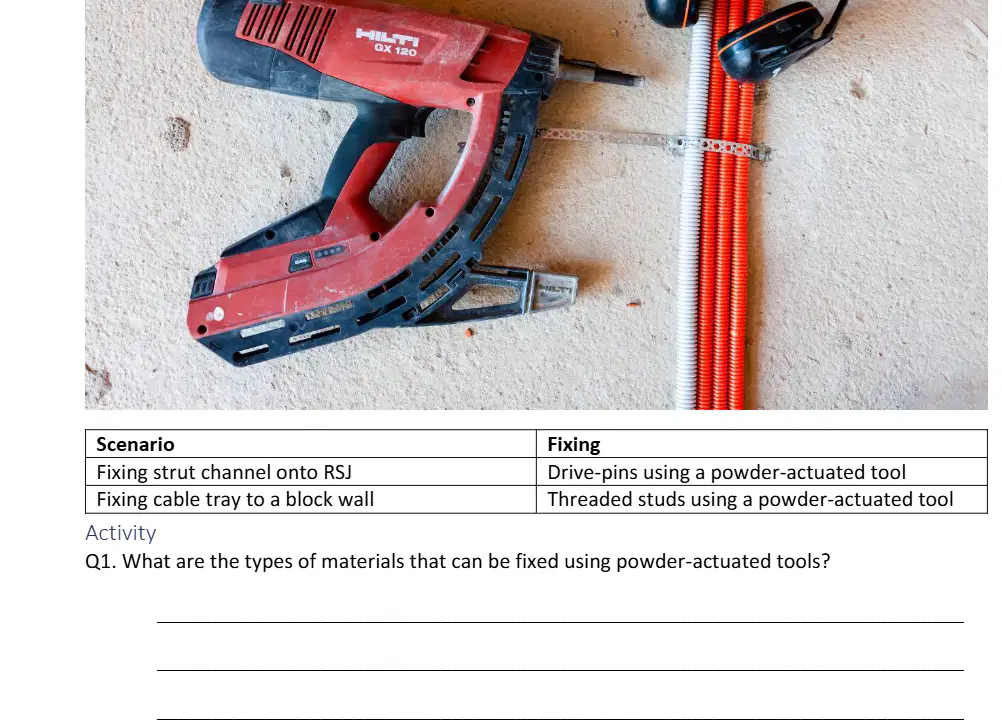
Types of materials that can be fixed using powder-actuated tools include:
Concrete, steel, and masonry
Wood, plastic, and glass
Rubber, foam, and fabric
Paper, cardboard, and leather
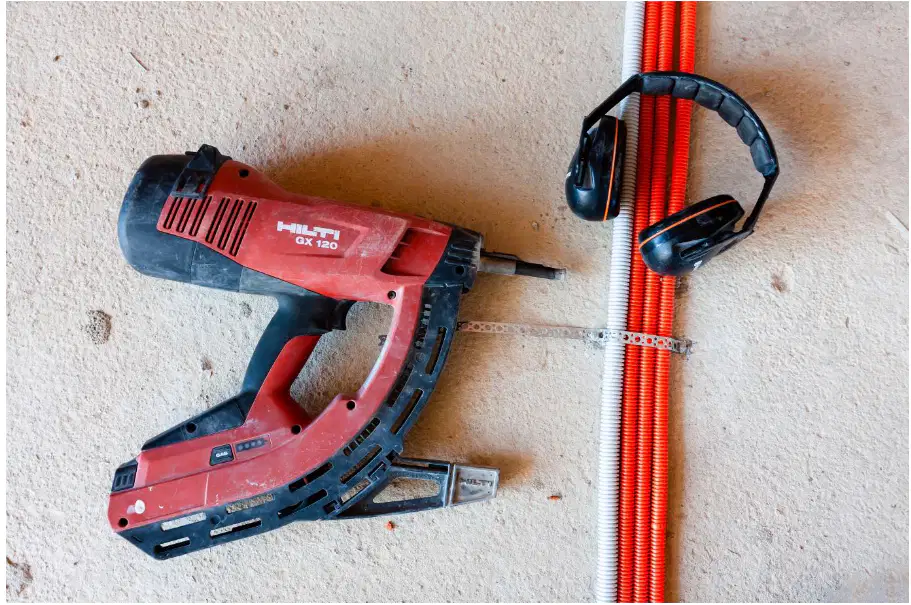
It is important for workers to receive proper training and certification before using powder-actuated tools because:
it ensures safe and correct use of the tools
it makes the tools more powerful
it reduces the cost of the tools
it increases the speed of work regardless of safety
Some examples of fixings that can be launched into various surfaces using powder-actuated tools are:
Nails, studs, and pins
Screws, bolts, and washers
Glue, tape, and staples
Clamps, brackets, and hinges
The recommended fixing method for fixing strut channel onto an RSJ is:
Using beam clamps
Using wood screws
Using plastic anchors
Using adhesive glue
The recommended fixing method for fixing cable tray to a block wall is:
Using wall plugs and screws
Using adhesive tape
Using cable ties
Using magnets
What is PVC pipe cement used for?
For jointing PVC pipes and conduits.
For painting PVC pipes.
For cleaning metal surfaces.
For insulating electrical wires.
What happens to the bonded surfaces of the PVC pipe when PVC cement is applied?
The bonded surfaces of the PVC pipe soften when PVC cement is applied.
The bonded surfaces of the PVC pipe become brittle when PVC cement is applied.
The bonded surfaces of the PVC pipe expand when PVC cement is applied.
The bonded surfaces of the PVC pipe dissolve completely when PVC cement is applied.
Why does adhesion occur when using PVC pipe cement?
Adhesion is due to solidification of dissolved PVC polymer.
Adhesion is due to the evaporation of water from the cement.
Adhesion is caused by a chemical reaction with metal ions.
Adhesion occurs because of magnetic attraction between PVC molecules.

What type of joint does PVC pipe cement create?
It creates a waterproof joint.
It creates a flexible joint.
It creates a magnetic joint.
It creates a threaded joint.
What is multipurpose construction adhesive suitable for bonding?
PVC mini-duct and small plastic parts onto brickwork and concrete
Glass panels onto wooden frames
Ceramic tiles onto metal surfaces
Rubber sheets onto plastic pipes
Which adhesive is used for bonding steel studs, bolts and anchors into concrete, masonry, brickwork and stone?
Chemical anchor
Epoxy paint
White cement
Silicone sealant
PVC/Electrical tape is used as an electrical insulator on what?
Conductors
Insulators
Semiconductors
Non-metals
Which tape is suitable for making temporary repairs in most industrial applications?
Duct tape
Masking tape
Electrical tape
Double-sided tape
Some environmental conditions that adhesives and tapes can withstand include:
High temperatures, moisture, chemicals, and UV exposure
Only dry and cool environments
Only low temperatures and no chemicals
Only indoor conditions with no sunlight
Adhesives can bond which of the following sets of five materials?
Wood, metal, plastic, glass, ceramics
Paper, sand, oil, water, air
Rubber, ice, salt, sugar, pepper
Fabric, grass, stone, cloud, smoke
PVC pipe cement is used for:
Joining PVC pipes together
Painting PVC pipes
Insulating PVC pipes
Cleaning PVC pipes
Identify the main difference between PVC tape and duct tape.
PVC tape is made from polyvinyl chloride, while duct tape is made from fabric and polyethylene.
PVC tape is only used for plumbing, while duct tape is only used for electrical work.
Duct tape is waterproof, while PVC tape is not.
PVC tape is always transparent, while duct tape is always silver.
The adhesive you should use to fix cantilever brackets close to the edge of a concrete surface is:
Epoxy adhesive
Wood glue
Silicone sealant
Hot melt glue
What is the purpose of a wall box in electrotechnology installations?
To provide decorative features
For flush mounting switches with extensive applications
To support ceiling fans
To store tools
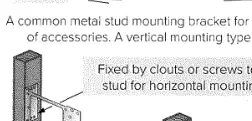
A common metal stud mounting bracket is used for ______ mounting of accessories.
horizontal
vertical
diagonal
overhead
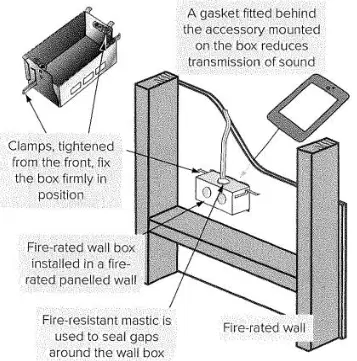
The fire-rated wall box is suitable for use in both single-sided and back-to-back installations in fire-rated walls.
True
False
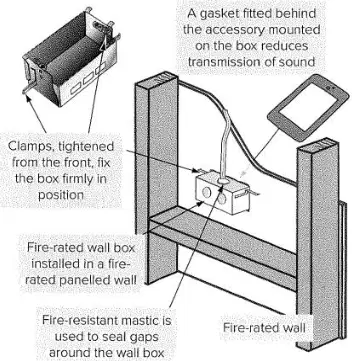
What is used to seal gaps around the wall box in a fire-rated wall?
Electrical tape
Fire-resistant mastic
Plastic covers
Metal brackets
Which accessory is used to mark out the correct size hole for the wallboard mounting clip?
A screwdriver
A plug point level stencil
A hammer
A measuring tape
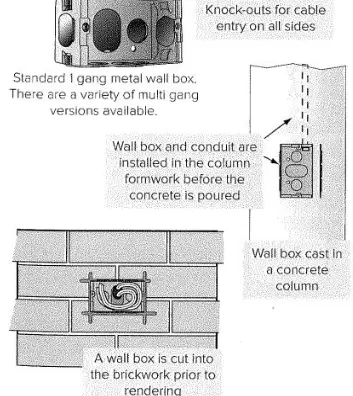
Knock-outs for cable entry are available on how many sides of a standard 1 gang metal wall box?
all sides
two sides
three sides
one side
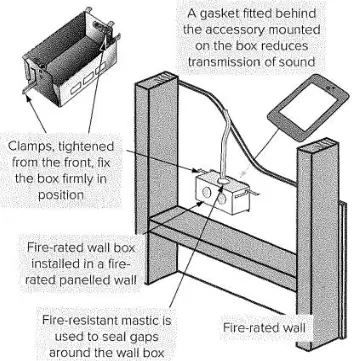
What is the function of a gasket fitted behind the accessory mounted on the box?
To increase electrical conductivity
To reduce transmission of sound
To provide extra insulation
To make installation easier
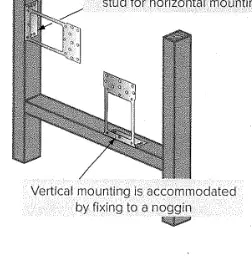
How is vertical mounting of a wall box accommodated?
by fixing to a noggin
by using adhesive tape
by hanging from the ceiling
by placing on the floor
A C-clip is used instead of a wall bracket for mounting an electrical accessory when:
the accessory is to be mounted in a flush box
the accessory is heavy and needs extra support
the wall surface is uneven
the accessory is to be mounted on a wooden surface
The consequences of failed fixings for an electrical accessory include:
Risk of electrical hazards and equipment damage
Improved electrical safety
Enhanced accessory performance
Reduced need for maintenance
Which of the following are examples of locations that might require a fire rated wall box?
Apartments, hospitals, and schools
Parks, beaches, and forests
Cafes, open fields, and playgrounds
Swimming pools, gyms, and stadiums
The two fixings commonly used to secure a plaster bracket are:
Screws and plugs
Nails and glue
Bolts and washers
Clips and tape
The accessory used to mount a flush socket outlet surface on a finished wall is:
A mounting box
A junction box
A conduit
A circuit breaker
What is the main reason for following safe work practices when fixing to walls?
To prevent injury and damage to the structure.
To save time during installation.
To use fewer tools and materials.
To make the wall look more attractive.
Why is it important to identify and locate any electrical wiring before drilling into a solid wall?
To avoid the risk of electric shock.
To improve the wall's appearance.
To make the drilling process faster.
To reduce noise during drilling.
What are two materials mentioned in the passage that pose additional health risks when drilling or cutting into walls?
Asbestos and silica.
Wood and plastic.
Copper and aluminum.
Glass and rubber.
Safe work practices: Asbestos is a fibrous mineral that was commonly used in building materials until it was banned in the 1980s due to its link with various lung diseases. True or False: Asbestos is still present in some buildings constructed before the 1990s.
True
False
Precautions that should be taken before drilling into a solid wall to avoid electric shock include:
Checking for hidden electrical wires using a detector.
Wearing gloves only.
Drilling at random spots without checking.
Using a wooden drill bit.
Precautions that should be taken when dealing with materials that produce harmful dust and debris, such as asbestos and silica, include:
Wearing appropriate personal protective equipment and using proper ventilation.
Ignoring the dust and working as usual.
Using only water to clean up the dust.
Relying solely on open windows for ventilation.
Manual handling risks can be minimized when fixing and securing equipment by:
Using proper lifting techniques and equipment
Ignoring safety guidelines
Rushing through the task
Lifting heavy items alone
Exposure to high levels of noise and vibration when using hammer drills and powder/gas actuated fixing tools can be reduced by:
Using proper personal protective equipment and maintaining tools regularly.
Increasing the speed and power of the tools.
Working in enclosed spaces without ear protection.
Ignoring manufacturer safety guidelines.
Precautions that should be taken when using chemical anchors to avoid chemical hazards include:
Wearing appropriate personal protective equipment (PPE)
Ignoring ventilation requirements
Mixing chemicals with bare hands
Storing chemicals in unlabelled containers

