
 Worksheets
Chap 7
Total questions: 75
Worksheet time: 39mins
Is the following statement true and false?
“The key trade-off that lies at the heart of working capital management, is that between business stability and solvency”
True
False
Is the following statement true and false?
“Insurance cost is an inventory holding cost”
True
False
Is the following statement true and false?
“Profit and cash flows are the same.”
True
False
Is the following statement true and false?
“When using the EOQ formula to find the optimal quality to be ordered, the purchase price per unit is included in the calculation”
True
False
Is the following statement true and false?
“Just in time (JIT) manufacturing systems require a large amount of inventory to be held for production and sales”
True
False
Is the following statement true and false?
“Perpetual inventory method is a system whereby inventory levels are reviewed at fixed time intervals to fit in with production schedules, and variable quantities are ordered as appropriate.”
True
False
Is the following statement true and false?
“In the re-order level system of inventory control, a fixed quantity will be ordered whenever inventory falls to a pre-determined level”
True
False
Is the following statement true and false?
“In the ABC system of inventory control, inventory is categorized into classes A, B or C according to annual cost of the usage of that inventory item, or the difficulty of replacements, or the importance to the production process.”
True
False
Is the following statement true and false?
“In the periodic review system of inventory control, the inventory records are updated for each receipt and issue of inventory as it occurs.”
True
False
Which of the following is the correct formula to calculate working capital?
A. Inventory - Cash - Receivables + Payables
B. Inventory + Cash + Receivables - Payables
C. Receivables + Payables- Inventory - Cash
D. Inventory + Cash + Payables - Receivables

What does h describe in this formula?
A. The cost of holding one unit of inventory for one period
B. The cost of placing one order
C. The cost of a unit of inventory
D. The customer demand for the item

What does c describe in this formula?
A. The cost of holding one unit of inventory for one period
B. The cost of placing one order
C. The cost of a unit of inventory
D. The customer demand for the item
Biel lLtd. is a manufacturing company which has several thousand types of inventory items. The company wants to introduce a new inventory control system
Biel lLtd. is a manufacturing company which has several thousand types of inventory items. The company wants to introduce a new inventory control system
A. Re-order level system
B. Periodic review system
C. ABC system
D. Just-in-time system
The annual demand for an item of inventory is 2,400 units. The cost of placing an order is $80 and the cost of holding an item in stock for one year is $15.
What is the economic order quantity, to the nearest unit?
A. 113
B. 160
C. 12,800
D. 25,600
The demand for a product is 13,500 units for a three-month period. Each unit of product has a
purchase price of $15 and ordering costs are $20 per order placed. The annual holding cost of one unit of product is 10% of its purchase price.
What is the Economic Order Quantity (to the nearest unit)?
A. 424
B. 600
C. 848
D. 1,200
A company determines its order quantity for a raw material by using the Economic Order
Quantity( EOQ) model.
What would be the effect on the EOQ and the total annual holding cost of the decrease in the cost ofordering a batch of raw material?
A. Lower EOQ, Lower Total annual holding cost
B. Higher EOQ, HigherTotal annual holding cost
C. Lower EOQ, Higher Total annual holding cost
D. Higher EOQ, Lower Total annual holding cost
A manufacturing company uses 25,000 components at an even rate during a year. Each order placed
with the supplier of the components is for 2,000 components, which is the economic order quantity.The
company holds a buffer inventory of 500 components. The annual cost of holding one component
inventory is $2.
What is the total annual cost of holding inventory of the component?
A. $2,000
B. $2,500
C. $3,000
D. $4,000
A company wished to minimize its inventory costs. Order costs are $10 per order and holding costs are $0,10 per unit per month. Fall Co estimates annual demand to be 5,400 units.
What is the economic order quantity?
A. 300 units
B. 949 units
C. 1,039 units
D. 90,000 units
For a particular component, the reorder quantity is 6,000 units and the average inventory Holding is 3,400 units.
What is the level of safety inventory (in whole units)?
A. 400
B. 3,000
C. 3,400
D. 6,400
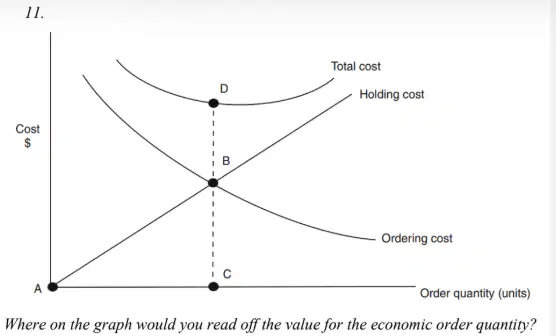
Where on the graph would you read off the value for the economic order quantity?
A. At point A
B. At point B
C. At point C
D. At point D
Apart from the actual cost of buying inventory, there are other inventory costs to consider.
Which of the following is an inventory holding cost?
A. Clerical and administrative expenses
B. Opportunity cost of capital tied up
C. Production stoppages due to lack of raw materials
D. The cost of inventory packaging materials
Which of the following is correct with regard to inventories?
(i) stock-outs arise when top little inventory is held
(ii) Safety inventories are the level of units maintained in case there is unexpected demand
(iii) A re order level is where an order should be placed whenever inventory falls to this level.
A. (i) and (ii) only
B. (i) and (iii) only
C. (ii) and (iii) only
D. (i), (ii), and (iii)
Which of the following is/are a reason(s) for holding inventory?
(i) to ensure continuity of production
(ii) to reduce ordering costs
(iii) for technical reasons
(iv) to take advantage of quantity discounts
A. (iii) only
B. (i) and (ii) only
C. (i),(ii) and (iv) only
D. All of the above
The key trade-off that lies at the heart of working capital management is that between
A. business stability and solvency
B. Debtor and creditors
C. Current assets and current liabilities
D. Liquidity and profitability
Claw is preparing its cash flow forecast for the next quarter.
Which of the following items should be excluded from the calculations?
A The receipt of a bank loan that has been raised for the purpose of investment in a new rolling mill
B Depreciation of the new rolling mill
C A tax payment that is due to be made, but which relates to profits earned in a previous accounting period
D Disposal proceeds from the sale of the old rolling mill
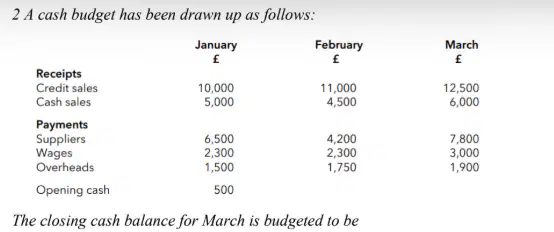
The closing cash balance for March in budgeted to be
A 5,800
B 12,450
C 17,750
D 18,250
A machine that was bought in January 20X1 for £44,000 and has been depreciated by £8,000 per year, is expected to be sold in December 20X3 for £17,600
What is the net cash inflow or (outflow) that will appear in the cash budget for December 20X3?
A £9,000 inflow
B £15,200 inflow
C £17,600 inflow
D £17,600 outflow
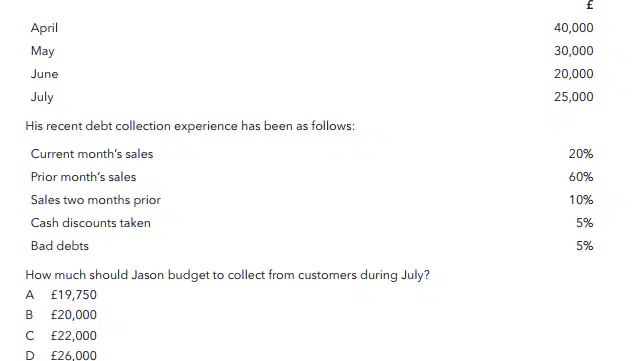
Jason is preparing a cash budget for July. His actual credit sales are: How much should Jason budget to collect from customers during July?
A £19,750
B £20,000
C £22,000
D £26,000
Lotsa plc has budgeted that sales will be £101,500 in January 20X2, £580,500 in February, £215,000
in March and £320,500 in April.
Half of sales will be credit sales. 80% of customers are expected to pay in the month after sale, 15%
in the second month after sale, while the remaining 5% are expected to be bad debts.
Customers who pay in the month after sale can claim a 4% early settlement discount
What level of sales receipts should be shown in the cash budget for March 20X2 (to the nearest £)?
A £338,025
B £347,313
C £568,550
D £587,125
A company has a two-month receivables cycle. It receives in cash 45% of the total gross sales value in
the month of invoicing.
Bad debts are 7% of total gross sales value and there is a 10% discount for settling accounts within
30 days
What percentage of the first month’s sales will be received as cash in the second month?
A 38%
B 43%
C 48%
D 58%
From the customer collection records of Low Ltd, it is possible to determine that 60% of invoices are
paid in the month after sale, 30% in the second month after sale and 5% in the third month after sale.
Invoices are raised on the last day of each month and 5% become bad debts.
Customers who settle in the month after sale are entitled to a 4% settlement discount. Budgeted
credit sales in January 20X6 are £221,500, in February £332,000, in March £175,000 and in April
£384,000.
Requirement
What is the amount budgeted to be received in April from credit sales (to the nearest £)?
A £211,475
B £215,675
C £290,284
D £299,500
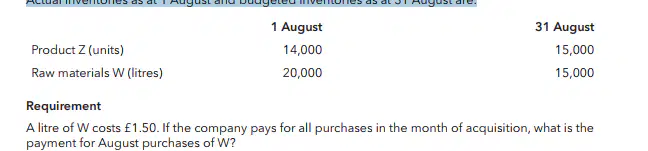
A company anticipates that 10,000 units of product Z will be sold during August.
Each unit of Z requires two litres of raw material W.
Actual inventories as at 1 August and budgeted inventories as at 31 August are:
A £17,000
B £25,500
C £33,000
D £34,500

Sam is a trading company that holds no inventories. Each month the following relationships hold:
How much cash is budgeted to be paid in May to suppliers?
A £19,740
B £21,900
C £23,340
D £24,060
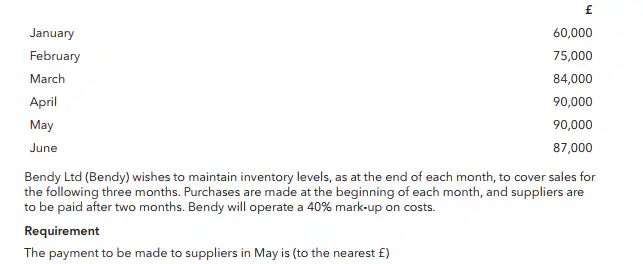
The budgeted sales for the first six months of Bendy Ltd’s business are:
A £52,200
B £62,143
C £64,286
D £87,000
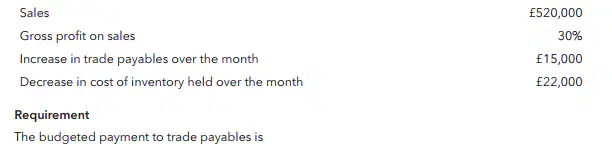
The following is an extract from an entity’s budget for next month
A £327,000
B £357,000
C £371,000
D £401,000
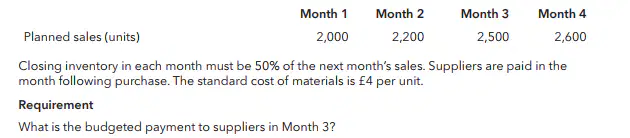
A company is preparing the budget for a product, and the following data has been provided:
A £8,200
B £9,400
C £10,000
D £10,200
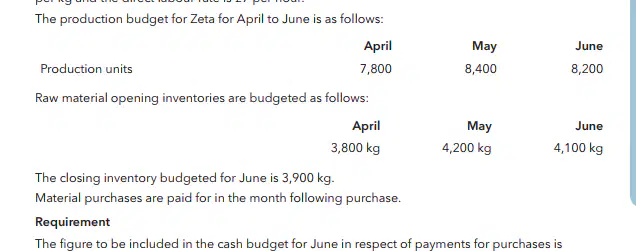
Each unit of product Zeta requires 3 kg of raw material and four direct labour hours. Material costs £2
per kg and the direct labour rate is £7 per hour
A £25,100
B £48,800
C £50,200
D £50,600
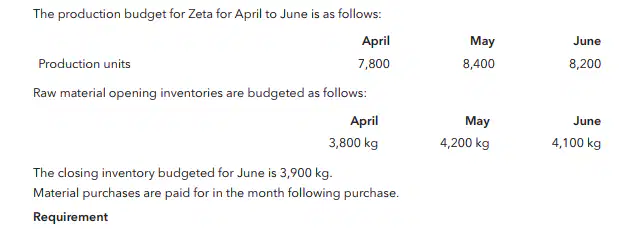
Each unit of product Zeta requires 3 kg of raw material and four direct labour hours. Material costs £2 per kg and the direct labour rate is £7 per hour
Requirement
The figures to be included in the cash budget for May in respect of wages is
E £222,600
F £231,000
G £233,800
H £235,200
Aaron Products is considering the implementation of a revised receivables policy, which will result in
an increase in the average collection period from the current 60 days to 90 days. This is expected to
lead to a 20% increase in annual sales revenue, currently £960,000, resulting in additional inventories
and trade payables of £30,000 and £15,000 respectively. It is expected that all customers will take
advantage of the extended credit period.
Requirement
The net increase in working capital investment that would result from the change in policy, assuming
a 360-day year, is
A £31,000
B £95,000
C £113,000
D £143,000
In order to improve operational cash flows, indicate whether a business needs to increase or
decrease each of the following.
Requirements
Receivables
A Increase
B Decrease
In order to improve operational cash flows, indicate whether a business needs to increase or
decrease each of the following. Inventory
C Increase
D Decrease
In order to improve operational cash flows, indicate whether a business needs to increase or
decrease each of the following.
Requirements
The credit period from trade suppliers
E Increase
F Decrease
Which two of the following actions would be appropriate if the cash budget identified a short-term cash deficit?
A Issue shares
B Pay suppliers early
C Arrange an overdraft
D Implement better credit control procedures
E Replace non-current assets
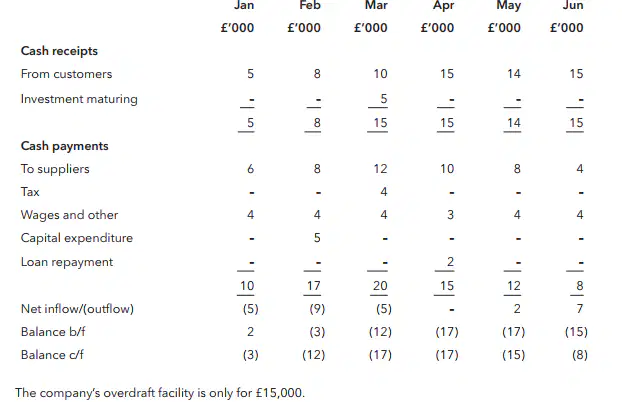
A company’s cash budget for the next six months is shown below
It has been proposed to reschedule the cash flows by delaying payment of 50% of the supplier
payments in each of the first five months by one month.
Requirement
The maximum overdraft and the overdraft at the end of June will now be
A Maximum: £18,000; End of June: £8,000
B Maximum: £12,000; End of June: £6,000
C Maximum: £18,000; End of June: £6,000
D Maximum: £12,000; End of June: £8,000
A telephone business has annual sales of £1.1 million and a gross profit margin of 10%. It is currently
experiencing short-term cash flow difficulties and intends to delay its payments to trade suppliers by
one month.
Requirement
To the nearest £, the amount by which the cash balance will benefit in the short term from this
change in policy, assuming sales are spread evenly over the year, and inventory levels remain
constant throughout, is
A £82,500
B £83,333
C £91,667
D £100,833
A company’s cash budget highlights a short-term surplus in the near future.
Requirement
Which two of the following actions would not be appropriate to make use of the surplus?
A Increase inventories and receivables to improve customer service
B Buy back the company’s shares
C Increase payables by delaying payments to suppliers
D Invest in a short-term deposit account
A company has annual sales of £3 million and its gross profit is 60% of sales. Inventory turnover is 60
days, customers take an average of 35 days to pay and the company pays its suppliers after 25 days.
Requirement
Defining working capital as average inventories plus average receivables minus average trade
payables and using a 365-day year for your calculations, to the nearest £1,000, the company’s
working capital will be
A £280,000
B £403,000
C £567,000
D £699,000
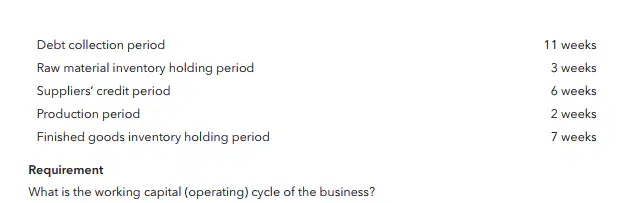
The following information relates to a business:
A 6 weeks
B 7 weeks
C 17 weeks
D 29 weeks
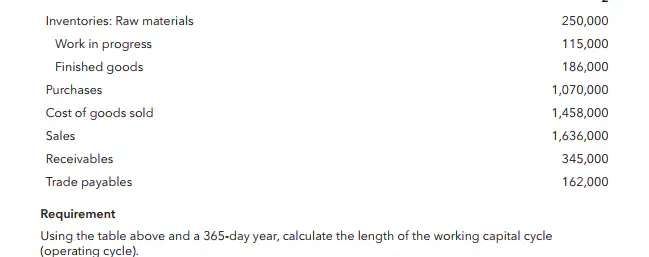
Requirement
Using the table above and a 365-day year, calculate the length of the working capital cycle
(operating cycle)
A 174 days
B 182 days
C 193 days
D 293 days
Which two of the following might be associated with a lengthening cash cycle?
A Lower net operating cash inflow
B Lower investment in working capital
C Taking longer to pay trade suppliers
D Slower inventory turnover
E Higher net asset turnover
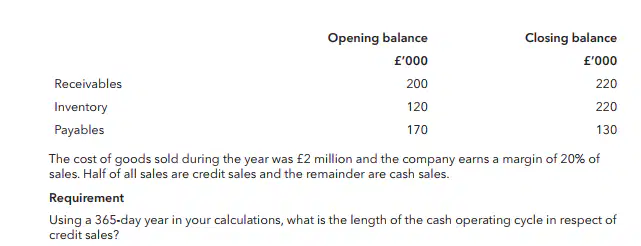
The following information is available for a wholesale business for the latest year.
A 65 days
B 66 days
C 68 days
D 118 days
A company has liquidity ratio (receivables divided by payables and bank overdraft) equal to 0.5. The
directors believe that the company has to reduce its bank overdraft and have agreed to alter the
company’s credit terms to customers from two months to one month.
Requirement
What would be the effects on the company’s cash operating cycle and liquidity ratio if this change
were to be achieved?
A Cash operating cycle: Decrease; Liquidity ratio: Decrease
B Cash operating cycle: Decrease; Liquidity ratio: No change
C Cash operating cycle: Decrease; Liquidity ratio: Increase
D Cash operating cycle: Increase; Liquidity ratio: Increase
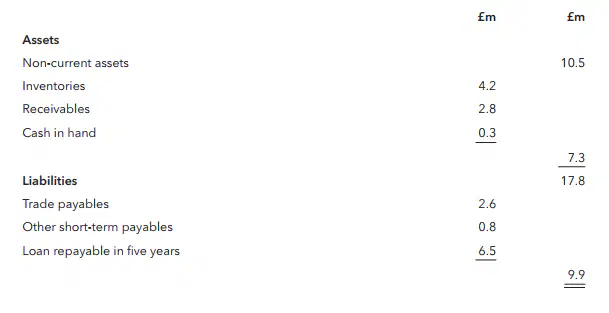
Requirement
From the extracts from a draft balance sheet above, calculate the quick (liquidity) ratio.
A 0.31
B 0.91
C 1.80
D 2.15
A company’s liquidity (quick or acid test) ratio, which includes receivables, cash and payables, is 0.5.
Consideration is being given to two changes:
Proposal 1: Offer a 2% cash discount to customers for early settlement.
Proposal 2: Delay payment to all suppliers.
Requirements
All other things being equal, what will be the effects of the proposed change on the liquidity ratio?
Proposal 1
A IncreaseB DecreaseC No changeProposal 2D IncreaseE DecreaseF No change
1B 2D
1A 2E
1B 2F
1A 2E
If an increase in inventory levels is funded by an increase in the bank overdraft, what will be the effect on the quick (liquidity) ratio?
A Increase
B Decrease
C Remain the same
D Increase, decrease or remain the same depending on the initial size of the quick ratio
A company has a current ratio greater than 1:1 and a quick (liquidity) ratio less than 1:1.
Requirements
If the company uses cash to reduce trade payables, how will these payments affect each of the
ratios?
Current ratio
A IncreaseB DecreaseC No changeQuick (liquidity) ratioD IncreaseE DecreaseF No change
1A 2E
1B 2D
1C 2F
1A 2D
A retailing company’s current assets and current liabilities consist of inventory at cost £2,100,
receivables, cash and trade payables. Its financial ratios include the following:
Quick (liquidity) ratio = 2:1
Rate of inventory turnover = 10 times p.a.
Gross profit margin = 30%
Receivables collection period = 1 month
Payables payment period = 1.6 months
The opening inventory, receivables and payables balances are the same as the closing balances.
Requirement
The closing cash in hand balance will be
A £3,100
B £2,170
C £1,000
D £100
Fenton Ltd’s projected revenue for 20X1 is £350,000. It is forecast that 12% of sales will occur in
January and remaining sales will be equally spread among the other 11 months. All sales are on
credit. Receivables accounts are settled 50% in the month of sale, 45% in the following month, and
5% are written off as bad debts after two months.
Requirement
The budgeted cash collections for March are
A £24,500
B £26,600
C £28,000
D £32,900
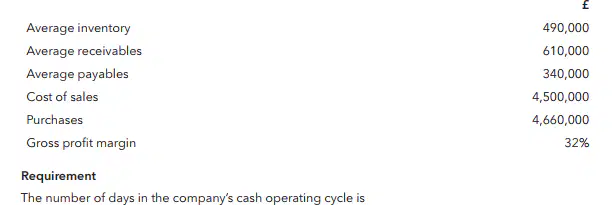
A retail company extracts the following information from its accounts at 30 June 20X6
A 34 days
B 44 days
C 47 days
D 51 days
Fraser Ltd manufactures leather bags. The company buys raw materials from suppliers that allow the
company 2.5 months credit. The raw materials remain in inventory for 1 month and it takes Fraser Ltd
2 months to produce the goods, which are sold immediately production is completed. Customers
take an average 1.5 months to pay.
Requirement
Fraser Ltd’s cash operating cycle iS
A 1 month
B 1.5 months
C 2 months
D 6 months
Trant plc has a two-stage trading process.
Stage 1: buy a large quantity of goods on credit
Stage 2: immediately sell them on credit at a profit
Requirement
Which of the following will increase after Stage 1?
A Receivables and inventory
B Current assets and non-current assets
C Payables and cash
D Current assets and current liabilities
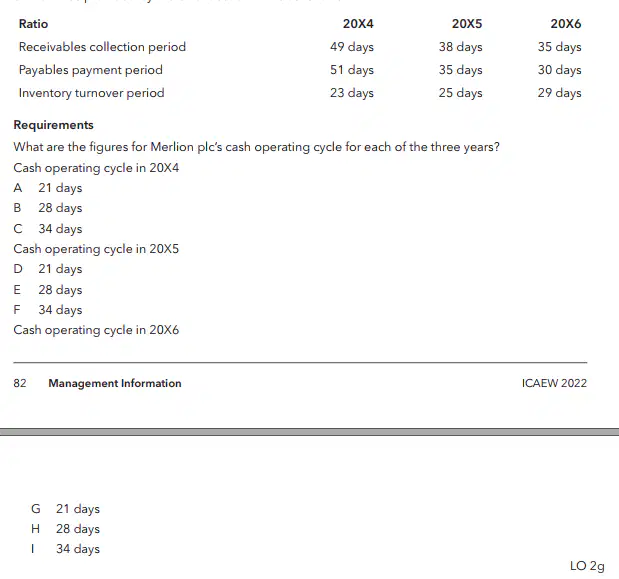
Merlion plc is an international company based in Malaysia. It manufactures and sells items for a wide
variety of outdoor leisure pursuits including wind surfing, camping and mountain biking. A summary
of the ratios provided by the chief accountant is as follows:
1A 2E 3I
1B 2E 3H
1A 2D 3G
1C 2F 3I
Shrier plc is trying to decide on its optimal level of current assets. The company’s management face a trade-off between
A profitability and risk
B liquidity and risk
C equity and debt
D short-term and long-term borrowing
If a business is suffering from liquidity problems, the aim must be to reduce the length of the cash operating cycle.
Which three of the following actions would achieve this?
A Reducing the credit period extended to receivables
B Reducing the payables payment period
C Extending the period of credit taken from suppliers
D Reducing the production period
E Extending the inventory holding period
Albert’s Autos is a small garage providing car servicing. Business is good, there is a steady stream of
income from repeat customers and breakdown recoveries. There are no significant cash reserves and
there is no need for an overdraft. Now the organisation that passes on most of the breakdown
recovery work offers Albert a contract to supply recovery services over a 50-mile radius. It is seeking
60 days credit rather than Albert’s usual 30 days. Albert is keen but has been warned to look for signs
of overtrading.
Requirement
Which two of the following are most likely to be symptoms of overtrading?
A A lengthening of the cash operating cycle
B A rapid reduction in sales
C Increase in the level of the current ratio
D A rapid increase in sales
E A shortening of the cash operating cycle
Apart from the actual cost of buying inventory, there are other inventory costs to consider.
Requirement
Which two of the following are inventory holding costs?
A Clerical and administrative expenses
B Insurance
C Opportunity cost of capital tied up
D Production stoppages due to lack of raw materials
E The cost of inventory packaging materials
The different functions within a company (finance, production, marketing, etc) often have differing
views about what is an ‘appropriate’ level of inventory. Essentially, two inventory problems need to
be answered – how much to order and when to order?
Requirement
If we order inventory more frequently which of the following can we expect?
A Lower ordering costs and lower average inventory
B Lower ordering costs and higher average inventory
C Higher ordering costs and lower average inventory
D Higher ordering costs and higher average inventory
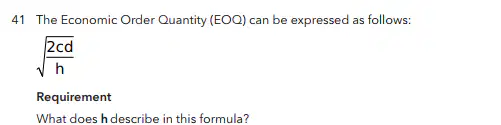
Requirement
What does h describe in this formula?
A The cost of holding one unit of inventory for one period
B The cost of placing one order
C The cost of a unit of inventory
D The customer demand for the item
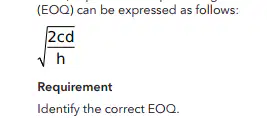
Fruit & Nut Ltd is re-evaluating its inventory control policy. Its daily demand for wooden boxes is
steady at 40 a day for each of the 250 working days (50 weeks) of the year. The boxes are currently
bought weekly in batches of 200 from a local supplier for £2 each. The cost of ordering the boxes
from the local supplier is £64 per order, regardless of the size of the order. The inventory holding
costs, expressed as a percentage of inventory value, are 25% pa. The Economic Order Quantity
(EOQ) can be expressed as follows:
A 101 boxes
B 253 boxes
C 1,600 boxes
D 2,262 boxes
Kate Osmond works for a company manufacturing industrial fasteners, so the company has several thousand types of inventory item. The company wants to introduce a new inventory control system and Kate is reviewing what is available
Requirement Identify the most suitable system for an organisation with so many inventory items.
A Re-order level system
B Periodic review system
C ABC system
D Just-in-time system
The key trade-off that lies at the heart of working capital management is that between
A business stability and solvency
B debtors and creditors
C current assets and current liabilities
D liquidity and profitability
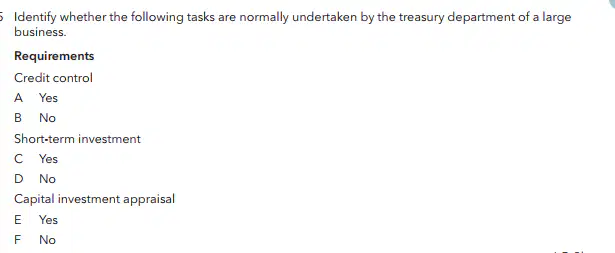
Requirements
1B 2D 3E
1A 2C 3F
1A 2D 3E
1B 2D 3E
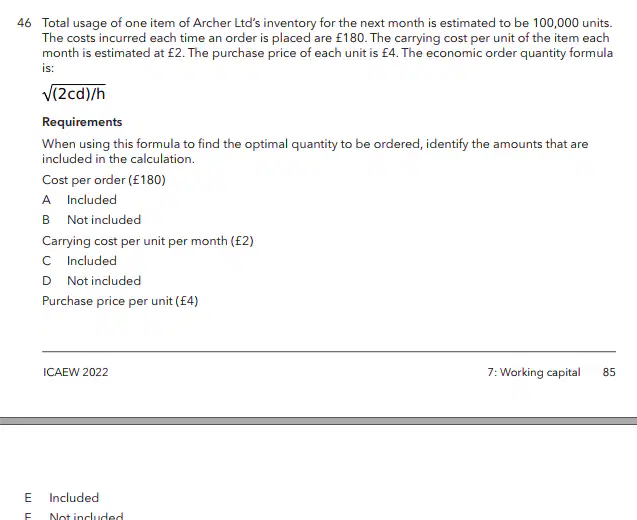
?
1A 2C 3F
1B 2C 3E
1A 2D 3F
1B 2D 3E
Rust Ltd invoices customers at the beginning of the month following the month in which a sale is
made. All of the cash to be received in respect of these invoices occurs within two calendar months
of invoicing. The company receives in cash 45% of the total gross sales value in the month of
invoicing. Because Rust Ltd operates in a market where there is poor creditworthiness bad debts are
20% of total gross sales value, but there is a 10% discount for settling accounts within a calendar
month of invoicing.
Requirement
What percentage of the sales invoiced in the first month will be received as cash in the second
month by Rust Ltd?
A 55.0%
B 35.0%
C 39.5%
D 30.0%
Requirement
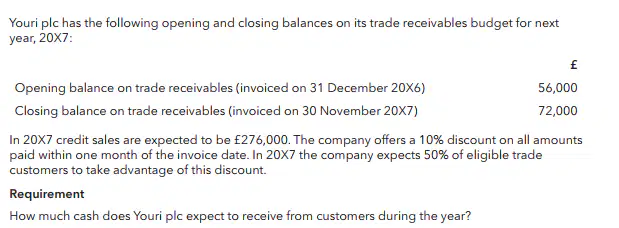
How much cash does Youri plc expect to receive from customers during the year?
A £247,000
B £243,400
C £260,000
D £276,000

