
Font size
 Worksheets
Sport Psychology Topic Outline
Total questions: 64
Worksheet time: 32mins
The use of goal setting and SMART targets in sport psychology is to:
improve and/or optimise performance
increase the risk of injury
reduce motivation in athletes
focus only on winning at all costs
Classification of skills in the context of sport psychology refers to:
Grouping skills based on their characteristics and requirements.
Ranking athletes according to their performance.
Assigning scores to different sports.
Dividing sports into team and individual categories.
The importance of guidance and feedback on performance in sport psychology is:
to help athletes improve and reach their potential
to increase stress and anxiety in athletes
to discourage athletes from setting goals
to make athletes dependent on their coaches
Mental preparation is important for performance in sport psychology because it:
helps athletes manage stress and focus on their goals
guarantees a win in every competition
eliminates the need for physical training
ensures athletes never make mistakes
Identify the 4 types of guidance from the options below.
Visual, Verbal, Manual, Mechanical
Physical, Emotional, Cognitive, Social
Direct, Indirect, Passive, Active
Formal, Informal, Structured, Unstructured
Which of the following best describes the advantages and disadvantages of each type of guidance?
Each type of guidance has specific strengths and weaknesses that affect learning outcomes.
All types of guidance are equally effective in every situation.
There are no disadvantages to any type of guidance.
Only one type of guidance is beneficial for learners.
When learning any new skills, different forms of guidance are required.
True
False
The type of guidance depends on the skill or the ability of the performer.
True
False
Fill in the blank: The 4 types of guidance you need to know are ________, Verbal, Manual, and Mechanical.
Visual
Auditory
Physical
Written
Which of the following is NOT one of the 4 types of guidance?
Visual
Verbal
Manual
Written
Mechanical
Fill in the blank: The 4 types of guidance you need to know are Visual, ________, Manual, and Mechanical.
Verbal
Auditory
Physical
Cognitive
Fill in the blank: The 4 types of guidance you need to know are Visual, Verbal, ________, and Mechanical.
Manual
Physical
Auditory
Digital
Fill in the blank: The 4 types of guidance you need to know are Visual, Verbal, Manual, and ________.
Mechanical
Physical
Auditory
Digital
What is visual guidance?
When the performer is told how to do the skill
When the performer is shown the skill
When the performer reads about the skill
When the performer listens to music
Visual guidance is good for ________ so they can see the whole skill.
beginners
experts
coaches
spectators
Which of the following is NOT a form of visual guidance?
Demonstration
Playback of a video clip
Observe technique from images or stills
Listening to instructions
Forms of visual guidance include: Demonstration, Playback of a video clip, and (a) .
Reading a book
Observe technique from images or stills
Writing notes
Practicing alone
Fill in the blanks for the following advantages of visual guidance: Provides the learner with a mental ____________ of the skill.
Image
Sound
Movement
Feeling
Fill in the blanks for the following advantages of visual guidance: Can be used with large __________ of learners.
Groups
Books
Rooms
Boards
Fill in the blanks for the following advantages of visual guidance: Ideal for __________ skills where less information needs to be given.
Simple
Complex
Dangerous
Team
Fill in the blanks for the following disadvantages of visual guidance: Needs to be __________ and clear otherwise the skill can be learnt incorrectly.
Accurate
Slow
Expensive
Complicated
Fill in the blanks for the following disadvantages of visual guidance: Can be __________ consuming.
Time
Energy
Money
Space
Fill in the blanks for the following disadvantages of visual guidance: __________ or quick movements can be difficult to recognise.
Complex
Simple
Slow
Obvious
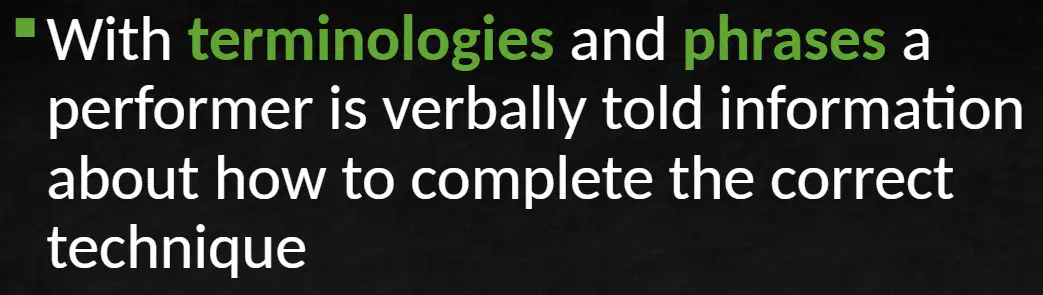
What is verbal guidance in sports coaching? Fill in the blank: With ________ and ________ a performer is verbally told information about how to complete the correct technique.
terminologies, phrases
actions, gestures
equipment, drills
videos, demonstrations

Verbal guidance is good for experienced performers who already know what the skill looks like.
True
False
Which type of performers benefit most from verbal guidance?
Beginners
Experienced performers
Injured performers
Young children
Which of the following is an advantage of verbal guidance?
It allows for immediate feedback and clarification.
It eliminates the need for communication.
It guarantees perfect performance every time.
It is only useful for written instructions.
Is 'No equipment' an advantage of verbal guidance?
True
False
Does verbal guidance rely on the coach’s communication skills?
True
False
Can instructions be given quickly in verbal guidance?
True
False
Is 'Tactics can be explained' an advantage of verbal guidance?
True
False
Can learners lose concentration during verbal guidance?
True
False
Can verbal guidance overload beginners?
True
False

Which of the following is an example?
A specific instance illustrating a concept
A general idea without specifics
A definition of a term
A list of unrelated items
Decide whether the following statement is an advantage or disadvantage of manual guidance: Builds confidence
Advantage
Disadvantage
Decide whether the following statement is an advantage or disadvantage of manual guidance: Eliminates danger
Advantage
Disadvantage
Decide whether the following statement is an advantage or disadvantage of manual guidance: Learner becomes dependent on support
Advantage
Disadvantage
Decide whether the following statement is an advantage or disadvantage of manual guidance: Gives the performer a feel for the movement
Advantage
Disadvantage
Decide whether the following statement is an advantage or disadvantage of manual guidance: Can only really be used coaching 1 to 1
Advantage
Disadvantage
Decide whether the following statement is an advantage or disadvantage of manual guidance: Feeling is not the same as completing the skill unaided
Advantage
Disadvantage
What does mechanical guidance involve? Fill in the blank: Mechanical guidance involves using _______ to support the performer whilst practicing a skill.
equipment
music
verbal instructions
videos

Which of the following is an example of mechanical guidance?
Watching a video demonstration
The use of floats in swimming to help learners develop leg kicking action
Listening to a coach's instructions
Practicing without any equipment
Using a harness when learning somersaults in trampoline is an example of mechanical guidance.
True
False
When/Who Uses Mechanical Guidance?
Mechanical guidance is typically used by beginners or individuals learning a new skill who need support to perform the movement correctly and safely.
Mechanical guidance is only used by professional athletes to enhance their performance.
Mechanical guidance is mainly used by spectators to observe sports more closely.
Mechanical guidance is exclusively used in virtual reality gaming environments.
What are the advantages of Mechanical Guidance?
Advantages include increased safety, reduced risk of injury, and helping learners understand the correct movement pattern.
It increases the difficulty of the skill for beginners.
It discourages the use of correct techniques.
It makes the learning process slower and more confusing.
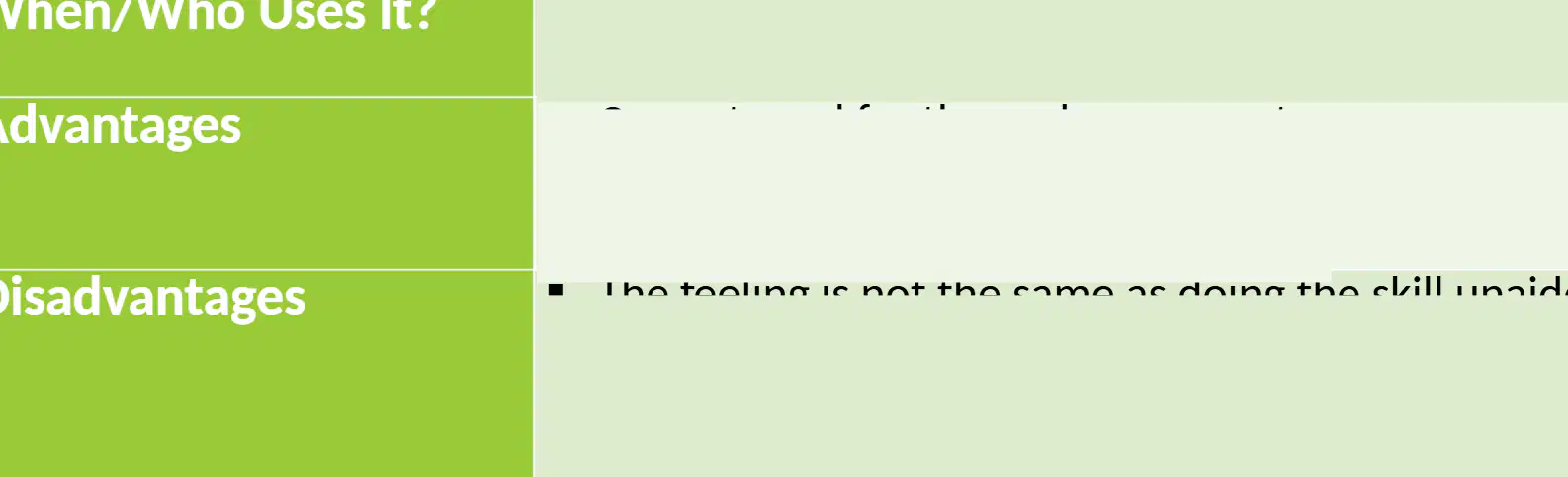
What are the disadvantages of Mechanical Guidance?
The feeling is not the same as doing the skill unaided, and learners may become dependent on the guidance.
It increases the risk of injury during practice.
It always speeds up the learning process significantly.
It eliminates the need for any further practice.
One advantage of using mechanical guidance when teaching a trampolinist to somersault is:
It helps the trampolinist feel the correct movement safely.
It allows the trampolinist to perform without any supervision.
It guarantees perfect technique every time.
It removes the need for any practice.
One disadvantage of using mechanical guidance when teaching a trampolinist to somersault is:
The performer may become dependent on the guidance and not learn the correct technique independently.
It always increases the risk of injury for the performer.
It makes the skill easier to forget because it is too simple.
It guarantees perfect technique every time.
The two types of guidance given by the coach to develop interception techniques are:
Visual and verbal guidance
Physical and written guidance
Demonstration and feedback
Observation and imitation
Manual guidance can be used by a coach to develop the netball team’s intercepting techniques by:
Physically guiding players’ movements during intercepting drills
Only giving verbal instructions from the sideline
Allowing players to practice intercepting without any feedback
Using video analysis instead of hands-on practice
Assess the relative importance of each type of guidance to a group of people who have just started learning to swim.
Verbal, visual, and manual guidance are all important for beginners learning to swim.
Only verbal guidance is important for beginners learning to swim.
Manual guidance is not necessary for beginners learning to swim.
Visual guidance is the least important for beginners learning to swim.
State one advantage of using mechanical guidance (such as a harness) when teaching a somersault in trampolining.
Mechanical guidance will allow the trampolinist to use a harness when learning to somersault so they are able to learn the correct technique for the somersault without risk of injury.
Mechanical guidance will make the somersault more difficult to perform and increase the risk of injury.
Mechanical guidance will prevent the trampolinist from ever learning the correct technique for the somersault.
Mechanical guidance will ensure the trampolinist never needs to practice the somersault again.
State one disadvantage of using mechanical guidance (such as a harness) when teaching a somersault in trampolining.
The trampolinist may get over-reliant on using the harness so unwilling to practice without one, impeding their progress.
It makes the somersault easier to learn for everyone.
It guarantees perfect technique every time.
It removes all risk of injury completely.
Name two types of guidance mentioned in the mark scheme.
Visual and verbal guidance
Written and practical guidance
Physical and emotional guidance
Technical and motivational guidance
Explain what manual guidance involves and give an example from the mark scheme.
Manual guidance involves physical support from another person, for example, the coach could move the arms of the girls into the correct position to help with the technique.
Manual guidance involves watching a video demonstration and copying the movements shown.
Manual guidance involves using equipment to support the performer without any physical contact from another person.
Manual guidance involves giving only verbal instructions to correct the technique.
What is visual guidance? Fill in the blank:
Visual guidance is when the performer is shown the skills, by either a demonstrator or video.
Visual guidance is when the performer listens to instructions without seeing the skill.
Visual guidance is when the performer reads about the skill in a textbook.
Visual guidance is when the performer imagines performing the skill without any demonstration.
What is one advantage of visual guidance for beginners? Fill in the blank:
It provides the learner with a mental image/the movement can be copied.
It makes the activity more difficult to understand.
It removes the need for practice.
It guarantees immediate mastery of the skill.
What is one disadvantage of visual guidance?
It can be detrimental if the demonstration is poor.
It always guarantees perfect performance.
It eliminates the need for practice.
It is never used in sports.
What is verbal guidance? Fill in the blank: Verbal guidance is when the performer is told information about how to complete the correct technique.
Verbal guidance is when the performer is told information about how to complete the correct technique.
Verbal guidance is when the performer is shown a demonstration of the correct technique.
Verbal guidance is when the performer practices the technique without any feedback.
Verbal guidance is when the performer receives physical support to complete the technique.
What is one advantage of verbal guidance? Fill in the blank:
Instructions can be given quickly.
It eliminates the need for practice.
It guarantees perfect performance.
It removes the need for feedback.
What is one disadvantage of verbal guidance for beginners?
It can be confusing if too much information is given.
It always guarantees perfect understanding.
It eliminates the need for practice.
It is the fastest way to learn a skill.
Which of the following lists the four types of guidance and provides an advantage or disadvantage for each?
Visual, verbal, manual, mechanical; visual aids help understanding, verbal gives quick feedback, manual provides physical support, mechanical ensures correct movement
Visual, auditory, kinesthetic, cognitive; visual aids are always best, auditory is slow, kinesthetic is confusing, cognitive is not useful
Manual, digital, written, oral; manual is outdated, digital is expensive, written is slow, oral is unclear
Physical, emotional, logical, creative; physical is tiring, emotional is distracting, logical is boring, creative is time-consuming
Which of the following lists the four types of guidance?
Visual, Verbal, Manual, Mechanical
Visual, Auditory, Physical, Cognitive
Instructional, Demonstrative, Interactive, Passive
Direct, Indirect, Supportive, Restrictive
The best type of guidance for a coach to use with a beginner cricket player learning to bat is:
Manual guidance
Verbal guidance
Visual guidance
None at all

