wayground logo

Free Printable Worksheets

Font size

S
M
L
XL
Worksheets

Functional Anatomy A

Total questions: 68

Worksheet time: 44mins

Name
Class
Date
1.
Bob is very small. He needs to stand on his "tip toe's" to reach the cookie jar on the top shelf of the cupboard.  What is the movement of his ankles?
a)
Plantar Flexion
b)
Extension
c)
Dorsiflexion
d)
Anterior Rotation
2.
Mark is sitting in a chair, legs out in front of him resting on an ottoman. His knees are.....
a)
Hyperextended
b)
Rotated
c)
Flexed
d)
Extended
3.
Remember when Mrs. Smith was mad, she was tapping her right foot on the floor? Which best describes her ANKLE movement as her foot lifts off the floor in an UPWARD motion?
a)
Plantar Flexion
b)
Dorsi Flexion
c)
Inversion
d)
Eversion
4.
When doing a star jump, what is the type of movement of the arms when the move outwards from the body?
a)
Abduction
b)
Adduction
c)
Extension
d)
Flexsion
5.
When the outstanding Dustin Martin kicks a football the movement of the knee joint in the back swing, before kicking the ball is......
a)
Abduction
b)
Flexion
c)
Extension
d)
Adduction
6.
Movement of the ankle that brings the foot farther from the shin is
a)
dorsiflexion.
b)
plantar flexion.
c)
inversion.
d)
eversion.
7.
Moving a body part towards the midline is
a)
adduction.
b)
abduction.
c)
rotation.
d)
protraction.
8.
Straightening parts at a joint so the angle between them increases is
a)
flexion
b)
hyperextension
c)
extension
9.
Moving a body part away from the midline is 
a)
rotation.
b)
adduction.
c)
abduction.
d)
pronation.
10.
What is the name for the connector that attaches bone to bone?
a)
ligament
b)
tendon
c)
patella
d)
string
11.

Define 'Flexion'.

a)

Movement away from the midline of the body or body part

b)

Movement toward the midline of the body or body part

c)

Decrease in the angle of a joint by bending

d)

Increase in the angle of a joint; straightening of a joint

12.

Turning the foot inward at the ankle joint

a)

inversion

b)

eversion

c)

pronation

d)

supination

13.

Rotation is:

a)

Turning onto one’s stomach or turning the hand so that the palm is facing down

b)

Turning onto one’s back or turning the hand so that the palm is facing upward

c)

Circular movement around specific axis

14.

Our muscles and bones help us stand-up straight, even though the force of _______ tries to "pull us down".

a)

Gravity

b)

Anterior

c)

Legs

d)

Exterior

15.

What bone is highlighted?

a)

Skull (Cranium)

b)

Mandible

c)

Clavicle

d)

Scapula

16.

What bone is highlighted?

a)

Skull (Cranium)

b)

Scapula

c)

Clavicle

d)

Mandible

17.

What bone is highlighted?

a)

Skull (Mandible)

b)

Clavicle

c)

Mandible

d)

Scapula

18.

Name the type of joint found at the elbows,knees, and fingers.

a)

Ball and Socket Joint

b)

Hinge joints

c)

Pivot Joint

d)

Gliding Joint

19.

Turning the head is example of a ______________ joint.

a)

Ball and Socket Joint

b)

Hinge Joint

c)

Pivot Joint

d)

Gliding Joint

20.

This attaches bone to muscle.

a)

cartilage

b)

tendon

c)

ligament

21.
Movement away from the mid-line is called _____________.
a)
abduction
b)
adduction
c)
internal rotation
d)
external rotation
22.
Turning the hand so that the palm is upward or facing anteriorly (in anatomical position).
a)
supination
b)
pronation
c)
flexion
d)
dorsiflexion
23.
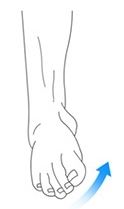
Turning the foot so the plantar surfaces faces medially.
a)
plantar flexion
b)
eversion
c)
inversion
d)
dorsiflexion
24.

What muscle is highlighted in the picture?

a)

Triceps

b)

Biceps

c)

Quads

d)

Deltoids

25.

What muscle is highlighted?

a)

Triceps

b)

Biceps

c)

Quads

d)

Deltoids

26.

What muscle is highlighted?

a)

Hamstrings

b)

Quads

c)

Calves

d)

Gluteus

27.
The muscle which causes movement is the....
a)
Antagonist
b)
Agonist
28.

Callum plays for the school team. When kicking a ball during extension at the knee, which is the antagonist?

a)

Hamstring

b)

Quadriceps

c)

Gastrocnemius

d)

Obliques

29.

Alan is shrugging his shoulders which muscles causes this movement?

a)

Deltoid

b)

Trapezius

c)

Abdominals

d)

Obliques

30.
Which muscle group contracts to create shoulder abduction?
a)
Pectoral
b)
Deltoid
c)
Trapezius
d)
Quadriceps
31.
a)

deltoid

b)

trapezius

c)

latissimus dorsi

d)

triceps

32.
a)

gleteus maximus

b)

hamstrings

c)

quadriceps

d)

soleus

33.
a)

latissimus dorsi

b)

hamstrings

c)

quadriceps

d)

soleus

34.
a)

triceps

b)

deltoid

c)

biceps

d)

pectoralis major

35.
__________ the muscle that contracts to create movement. 
a)
Voluntary
b)
Antagonistic
c)
Antagonist
d)
Agonist
36.
When a muscle shortens under tension it is called a...
a)
Concentric contraction
b)
Eccentric contraction
c)
Isometric contraction
37.
Which of these is NOT an antagonistic pair?
a)
Biceps & Triceps
b)
Hamstrings & Quadriceps
c)
Pectorals & Abdominals
d)
Abdominals & Latissimus Dorsi
38.

The following is NOT one of the 3 Joint Classifications..

a)

Cartilaginous

b)

Cartilage

c)

Fibrous

d)

Synovial

39.

The joints that allow the most movement are called

a)

Fixed

b)

Fibrous

c)

Cartilaginous

d)

Synovial

40.

Examples of a Ball & Socket Joint are found in the

a)

Shoulder

b)

Knee

c)

Hip

d)

Ankle

41.

A hinge joint allows

a)

A wide range of movements

b)

Circumduction

c)

Rotation

d)

Movement in only one direction (ie. backwards & forwards)

42.

An example of a Saddle joint is in the

a)

Knee

b)

Hip

c)

Thumb

d)

Vertebral column

43.

Which of the following is part of a Synovial joint

a)

Synovial membrane

b)

Joint cavity

c)

Ligament

d)

Cartilage

44.

When kicking a football the knee

a)

Flexes

b)

Extends

c)

Abducts

d)

Adducts

45.
Identify the joint action being performed.
a)
Extension
b)
Flexion
c)
Abduction
d)
Adduction
46.
Identify the joint action being performed.
a)
Extension
b)
Flexion
c)
Abduction
d)
Adduction
47.
Identify the joint action being performed.
a)
Extension
b)
Flexion
c)
Abduction
d)
Adduction
48.
Identify the joint action being performed.
a)
Extension
b)
Flexion
c)
Abduction
d)
Adduction
49.
Identify the joint action being performed.
a)
Circumduction
b)
Lateral Rotation
c)
Medial Rotation
d)
Eversion
50.
Identify the joint action being performed.
a)
Inversion
b)
Eversion
c)
Plantarflexion
d)
Dorsiflexion
51.
Hip and shoulder have examples of this type of joint
a)
ball and socket
b)
condyloid
c)
hinge
d)
gliding
52.
The elbows, knees and phalanges are examples of this type of joint
a)
ball and socket
b)
condyloid
c)
gliding
d)
hinge
53.
This type of joint allows the your first two vertebrate to rotate as in shaking your head no
a)
condyloid
b)
gliding
c)
pivot
d)
saddle
54.
Carpals and tarsals (flat bones) are examples of this type of joint
a)
condyloid
b)
gliding
c)
hinge
d)
saddle
55.
The knee joint is
a)
Hinge
b)
Gliding
c)
Ball and socket
d)
Pivot
56.
Name this joint
a)
gliding
b)
saddle
c)
condyloid
d)
pivot
57.
Fibrous joints are?
a)
freely moveable
b)
partially moveable
c)
immovable
58.
Flexion is...
a)
Decrease of angle at a joint
b)
Increase of angle at a joint
c)
Shortening of a muscle
d)
Lengthening of a muscle
59.
Circumduction is a combination of...
a)
Rotation, adduction and abduction
b)
plantarflexion, dorsiflextion, pronation and supination
c)
Flexion, extension, pronation and supination
d)
Flexion, extension, adduction and abduction
60.
Circumduction can occur at a...
a)
Pivot joint
b)
Saddle joint
c)
Ball and socket joint
d)
Condyloid joint
61.
An example of a joint where flexion and extension can take place would be...
a)
Ankle
b)
Knee
c)
Atlantoaxial
d)
Radioulnar
62.
Which muscle group is mainly responsible for Flexion at the elbow?
a)
Triceps
b)
Quadraceps
c)
Deltoids
d)
Biceps
63.
Which muscle group is mainly responsible for abduction at the shoulder?
a)
Pectorals
b)
Deltoids
c)
Lattisimus Dorsi
d)
Gluteals
64.
When kicking a football, _____________________ joint is one of the main movements required.
a)
Extension at the elbow
b)
Extension at the Knee
c)
Abduction at the hip
d)
Circumduction at the hip
65.
Extension at the elbow would be most useful when...
a)
Executing a high jump
b)

Executing a bicep curl

c)
Pushing off the blocks in a sprint start
d)
Making a chest pass in netball
66.
Which joint allows for the widest range of movement?
a)
Knee
b)
Wrist
c)
Radioulnar
d)
Shoulder
67.
What TYPE of joint allows for the widest range of movement?
a)
Pivot
b)
Hinge
c)
Ball and Socket
d)
Saddle
68.
Abduction can take place at the...
a)
knee
b)
Atlantoaxial joint
c)
Radioulnar joint
d)
Hip