
NEW
Font size
 Worksheets
BS7671 AMD3 Mock 3
Total questions: 60
Worksheet time: 45mins
The scope of BS7671 applies to
Systems for distribution of electricity to the public
Railway traction equipment
Equipment on board ships
Onshore units of electrical shore connections for inland navigation vessels
The scope of BS7671 does not apply to
Residential premises
Fixed offshore installations
Commercial premises
Photovoltaic systems
When designers address the nature of the demand, which one of the following needs to be considered
Frequency
Prospective fault current
Location of points of power demand
External earth supply
During the initial verification process, which of the following shall make a recommendation for the interval to the first periodic inspection and test:
Test engineer
Installer
Inspector
Designer
An extraneous-conductive-part is defined as
a conductive part of equipment which may be touched and which is not normally live, but which can become live when basic insulation fails
a conductive part liable to introduce a potential, generally Earth potential, and not forming part of the electrical installation
equipment designed to be fastened to a support or otherwise secured in a specific location
a room or location in which air is heated, in service, to high temperatures
Protection against electric shock under single fault conditions is
Basic protection
Fault protection
Additional protection
Supplementary protection
A system which provides neutral and protective functions combined in a single conductor (PEN) in a part of a single-source system is a:
TN-C-S System
TT System
TN-S System
IT System
Which of the following is not a characteristic of the supply or supplies?
The nature of the current and frequency
The division of the circuits
The nominal voltage(s)
The type and rating of the overcurrent protective device(s) acting at the origin
A concise list of external influences is located in
Appendix 6
Part 7
Appendix 5
Definitions
Compatibility of characteristics requires an assessment to be made of any characteristics of equipment likely to have
an effect on the frequency and quality of maintenance
an effect on indirect energizing of a circuit intended to be isolated
harmful effects upon other electrical equipment or other services
an effect on the external influences
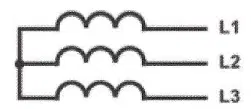
The conductor arrangement shown in the exhibit below is:
Three-phase 3-wire
Three-phase 4-wire
Two-phase 3-wire
Single-phase 3-wire
For a new installation, which of the following items of information might need to be given to the DNO?
Prospective short-circuit current
Maximum demand
Nominal voltage
Earth fault loop impedance
A readily accessible horizontal top of an enclosure should have a minimum degree of protection of
IPXXD or IP4X
IPXXB or IP2X
IP1X
IP3X
A 6A BS EN 60898 circuit breaker is used to protect a circuit with a maximum earth fault loop impedance (Zs) of 3.64Ω would be type
A
B
C
D
Additional protection by means of an RCD with a rated residual operating current not exceeding 30 mA shall be provided for
socket outlets with electrical separation
socket-outlets with a rated current not exceeding 63 A
all socket outlets
socket-outlets with a rated current not exceeding 32 A
Where there is a danger of fire due to the nature of the stored material, a 100W spotlight shall be installed at a minimum distance from combustible materials of
0.5 m
0.8 m
1 m
2 m
Suitable precautions against undervoltage should be taken where either a reduction in voltage or a loss and subsequent restoration of voltage
is a routine event
could cause danger
occurs infrequently
will not cause danger
In the event of failure of the provision for basic protection, additional protection may be provided by
supplementary bonding
the use of a time delayed 100mA RCD
use of a RCD not exceeding IΔn of 30mA
electrical separation
The maximum permitted value of earth electrode and earthing conductor (RA) for a circuit protected by a 300 mA RCD and forming part of a 230 V AC TT system is
500 Ω
100 Ω
167 Ω
1667 Ω
Which one of the following would be used to determine the rating of an overcurrent device?
Cable size
Grouping factor
Design current
Overload current
Fault protection may be provided by
Barriers and enclosures to IPXXB or IP2X
Insulation of live parts
Protective earthing and protective equipotential bonding
Placing out of reach
Where an RCD is used in a circuit, the product of IΔn and the Zs in a TT installation should not be greater than
2 V
10 V
40 V
50 V
Which of the following methods should be adopted where fixed equipment having a high surface temperature is likely to have an adverse effect on adjacent materials?
Erection of warning notices advising high temperatures
Be mounted so as to allow safe dissipation of heat
The use of non-combustible wiring materials
The provision of suitable fire extinguishers
An overload current could occur
During an earth fault
During a short-circuit fault
When a motor becomes jammed
When a shower is switched off
In an IT system, which of the following monitoring devices and protective devices is not listed as appropriate:
RCMs
IMDs
IFLS
AFDDs
The earth fault loop impedance (Zs) for a consumer's circuit is determined by
R1 + R2 - Ze
R1 + R2 + Ze
R1 + R2 + Rn
R1 + R2 + Ze
A copper earthing conductor not mechanically protected and not protected against corrosion is buried in soil. The minimum size of earthing conductor is
4 mm²
16 mm²
25 mm²
50 mm²
In the event of crossing or proximity of underground telecommunication cables and underground power cables, the required minimum clearance
200 mm
300 mm
50 mm
100 mm
A suitable supply for safety services is a
Primary cells
Standard mains supply
Non-earthed transformer
Mains operated generator
Non-sheathed cables for fixed wiring installations should be
thermosetting
thermoplastic
enclosed in conduit, ducting or trunking
a minimum of 4 mm² cross-sectional area
A permanent label with the words 'Safety Electrical Connection – Do Not Remove' shall be permanently fixed
at the point of connection of every earthing conductor to an earth electrode
at every socket outlet connection
at the point of connection between the earthing and PEN conductor of a TN-C-S system
at the point of connection of to an exposed-conductive-part
A conduit or cable trunking system classified as non-flame propagating need not be internally sealed providing its maximum cross-sectional area does not exceed
625 mm²
710 mm²
1250 mm²
2500 mm²
Where practical, the main protective equipotential bonding to the gas service in a building should be made, where practicable, within
3 m of the meter on the supply side
3 m of the meter on the consumer side
600 mm of the meter on the supply side
600 mm of the meter outlet union
Every firefighter’s switch should be
not more than 2.75 m from the ground
coloured red with the off position at the bottom
installed in the high-voltage circuit
mounted at a minimum height of 3 m
An RCD that is installed for protection against the risk of fire must be
Integral to and socket-outlet
Installed at the origin of the circuit to be protected
Rated at 500 mA
Arranged to switch line conductors only
Where foundation earthing earth electrodes are installed, the materials and dimensions of the earth electrodes shall be selected to withstand
heat
voltage
current
corrosion
It is recommended that Type 3 SPDs should not be installed
at distribution circuits
at consumer units
close to sensitive equipment
at the origin
What is the maximum value of earth resistance R_A for an RCD with a rated residual operating current of 3 Amps
17 Ω
1.7 Ω
167 Ω
1667 Ω
In order to avoid unwanted tripping of an RCD, the accumulation of protective conductor currents should not exceed
25% of the rated operating current
30% of the rated operating current
35% of the rated operating current
40% of the rated operating current
A cable surrounded by thermal insulation for a length of 50 mm has a derating factor (C_I) of
0.63
0.50
0.88
0.78
Which of the following is not allowed for use as a circuit protective conductor?
Galvanised metallic conduit
Lead sheath of cable
Steel wire armouring of cable
Metallic flexible conduit
Which of the following checks are not carried out during inspection of a new installation
Measures against electromagnetic disturbances
Selection and installation of suitable SPD where required
Erection methods
Voltage drop
Which of the following tests will be carried out first during initial verification
Continuity of conductors
Insulation Resistance
Earth Fault Loop Impedance
RCD Testing
Where relevant, the polarity of the supply at the origin of the installation shall be verified
by an ordinary person
before the installation is energized.
Only after the installation has been certified
After the full installation has been checked
The frequency of periodic inspection and testing of an installation shall be determined having regard to
The type of installation and equipment
the age of the building
the contractor who installed it
the person ordering the work
In Marinas, equipment above a jetty must be with a minimum degree of protection for external mechanical impact of at least
IK05
IK06
IK07
IK08
In zone 3 of rooms containing a sauna, the sheaths of cables shall withstand a minimum temperature of
170 °C
125 °C
115 °C
70 °C
Which of the following is not permitted to be installed in zone 1 of a bathroom?
Shower
Towel rail
Shaver socket
Whirlpool unit
A ceiling heating system should incorporate means of limiting the temperature to
50 °C
60 °C
70 °C
80 °C
The height to which zone 1 of a large swimming pool extends above a diving board is
1 m
1.5 m
2 m
2.5 m
Which of the following protective measures can be used on a construction site
ADS
electrical separation for the supply of more than one current-using equipment
earth-free equipotential bonding
non-conducting location
Fire protection in a cattle shed may be achieved by use of a
30 mA RCD
6 A type B CB
300 mA RCD
6 A type C CB
Protection by obstacles in a bathroom is
allowed in all zones
allowed in zones 1 and 2
allowed in zone 2 only
not allowed
The nominal supply voltage for onshore installations dedicated to the supply of inland navigation vessels shall be
400 V three-phase AC
110 V AC
1000V AC
400V AC to earth
The maximum interval between periodic inspection of a touring caravan is
5 years
3 years
2 years
3 months
A 32A BS 88-3 fuse subjected to a fault current of 240 A should operate in
0.2 s
0.4 s
1 s
5 s
BS 7671 gives the classification of external influences. Which one of the following is described as being in the general category of external influences?
Utilisation
Installation
Propagation
Ionisation
The tables listing current-carrying capacities of various cables in Appendix 4 of BS 7671 are based on an ambient temperature of
30 °C
50 °C
70 °C
90 °C
A 230V final circuit is protected by a 20 Amp rated - type B – BS EN 60898 circuit breaker. Under a fault current of 200 Amps, the device will operate within
0.1 s
10 s
20 s
30 s
The external influence having a classification of AE5 indicates
Humidity
Moderate dust
Jets of water
Vibration

