
 Worksheets
Class 11 CSO, DR & BL
Total questions: 115
Worksheet time: 1hrs 11mins
A computer is an ______________ device.
a. Electronic
b. Electrical
c. Mechanical
d. None of the above
CPU stands for ___________________
b. Central Processing Unit
a. Central Processor Unit
d. None of the above
c. Control Processing Unit
CPU is called _____________ of computer.
b. Brain
a. Heart
d. None of the above
c. Eyes
CPU can be placed on one or more microchips called IC. Here IC stands for ___________
d. None of the above
b. Internal Circuit
c. Interesting Circuit
a. Integrated Circuit
ALU stands for __________
d. None of the above
c. Arithmetic Logic gates Unit
b. Arithmetic Logic Universe
a. Arithmetic Logic Unit
Devices which feed data into the computer are called ___________
c. Input devices
a. Output devices
b. Storage devices
d. None of the above
Example of input device is :
a. Keyboard
c. Microphone
d. All of the above
b. Scanner
Data entered through input device is temporarily stored in ____
a. RAM
b. ROM
c. Hard disk
d. All of the above
Which of the following is a type of printer?
a. ink jet
b. laser jet
c. Dot Matrix
d. All of the above
What does RAM stand for?
a. Random Access Memory
b. Read Access Memory
c. Rapid Access Memory
d. None of the above
Which of the following is a storage device?
a. USB Flash Drive
b. Mouse
c. Monitor
d. Keyboard
What is the function of an operating system in a computer?
a. Manage hardware resources
b. Run applications
c. Both a and b
d. None of the above
Which component of a computer is responsible for storing data permanently?
a. RAM
b. CPU
c. Hard disk
d. Cache memory
What is the role of a motherboard in a computer system?
a. Connect all components
b. Process data
c. Display output
d. None of the above
What does BIOS stand for in a computer system?
a. Basic Input Output System
b. Binary Input Output System
c. Basic Integrated Operating System
d. None of the above

To increase the speed of memory access in pipelining, we make use of _______
Special memory locations
Special purpose registers
Cache
Buffers
The type of control signal is generated based on ________
contents of the step counter
Contents of IR
Contents of condition flags
All of the mentioned
What kind of laser does Blu-ray disc use?
Blue-red laser
Blue-green laser
Blue-violet laser
Purple-green laser
A compiler converts
High level language to machine language
source code to object code
Both 1) and 2)
Which of the following is true about primary
storage
it is a part of the CPU
It allows very fast access to data
It is relatively more expensive
all of the above
The process of copying data from a memory
location is called
booting
reading
writing
controlling
the brains of the computer where most calculations take place.
Algorithm
Program
CPU
Hardware
Hardware attached to the computer
Input Device
Peripheral
Output Device
Software
Holds information for us to use later:
Software
Hardware
Peripheral
Storage Device
Which of these is NOT an example of a peripheral?
Mouse
Monitor
Microsoft Word
Keyboard
Main chip in the computer:
Motherboard
RAM
ROM
CPU
What is a flash drive an example of?
Software
Storage Device
Hardware
Input Device
EEPROM means (a) .

Holds information for us to use later:
Software
Hardware
Peripheral
Storage Device

The three main types of computer parts are
processing devices
input/output devices
data storage devices
display devices
The ALU works on the instructions and data held in the _______________
Notebook
Registers
Copy Pad
I/O devices
A register that keeps track of the next instruction to be executed is called a _____________
Program Counter
Instruction Register
Accumulator
Data Register
_______________ is a large multilayered printed circuit board inside a computer that contains CPU,BIOS,ROM chip and the CMOS setup information.
Motherboard
RAM
ROM
Cache
The ___________ informs the CPU about the location of the data residing in the memory.
Data bus
Address bus
Cache
Control line
A computer system is the integration of
Hardware
Software
Both a and b
Either a and b
Software are called as _____
Physical entities
Non physical entities
Set of program
None of the above
Physical entities of the computer is called as ______
Hardware
Software
Input Unit
Program
Based on the functionalities, computer hardware are classified into ______ categories.
3
4
5
6
What is used provide data and program?
Keyboard
Mouse
Output Unit
Input Unit
Which is not an input unit?
Keyboard
Mouse
Monitor
Scanner
Which is used to provide result of processing?
Moitor
Keyboard
Input Unit
Output Unit
Find the odd one?
Keyboard
Monitor
Speaker
Printer
_______ store data and program temporarily.
Hard disk
Pen drive
Memory Unit
CD Rom
Identify the function of CPU?
Perform computation
Decision making
Control different devices
All the above
CPU consists of ______?
ALU
CU
Internal memory
All the above
______ is the computer calculator.
ALU
CU
Internal Memory
CPU
_____ directs and controls the activities of the
computer system.
ALU
CU
Register
CPU
Which of the following busses is omnidirectional?
The control bus
The R42 to manchester
The address bus
The data bus
Holds the memory address of the next instruction to be executed:
CIR (current instruction register)
MAR (memory address register)
SR (status register)
PC (program counter)
Holds the address in memory where the processor is required to fetch or store data from or to:
Memory Buffer Register (MBR)
Program counter (PC)
Status register (SR)
Memory Address Register (MAR)
The fetch and execution cycles are interleaved with the help of ________
Modification in processor architecture
Clock
Special unit
Control unit
Which of the following represents the binary number 1101 in decimal form (base 10)?
11
8
9
13
Which of the following represents the decimal number 10 in binary form (base 2)?
0110
1010
1000
1001
Which of the following represents the decimal number 29 in hexadecimal form (base 16)?
1D
AA
29
2C
Which of the following represents the decimal number 45 in hexadecimal form (base 16)?
ABC
2D
22
45
Which of the following represents the binary number 1110 1110 in hexadecimal form (base 16)?
1414
223
1E
EE
Which of the following represents the hexadecimal number C in binary form (base 2)?
1001
1100
1111
1000
Which of the following represents the hexadecimal number AF1 in binary form (base 2)?
1010 1001 0001
1110 1111 0011
1010 1111 0000
1010 1111 0001
Name the law which states X+Y = Y+X
Associative Law
Indempotence Law
Commutative Law
Involution Law
Name the law which states that X(Y+Z)=XY+XZ
Commutative Law
Associative Law
Distributive Law
Absorption Law
Statement of Involution Law


Statement of Properties of 1


Name the gate
XOR
OR
NOT
XNOR
Which is the symbol of NAND gate?


In Hexadecimal number system, D represents ______
13
11
14
12
Which gates are called Universal gates?
OR, AND
NAND, NOR
NOT
XOR, XNOR
Name the gate which produces output 1 when the input have odd number of 1's
XNOR
XOR
OR
NAND
When the result of any logical statement or expression is always TRUE or 1, it is called _________
Boolean False
Fallacy
Boolean True
Tautology
__________ and __________ are called truth values
(a)
(a) operator operates on a single variable
Name the procedure "Break the line, change the sign"
Demorgan's law
Duality principle
Demorganization
Fallact
(a) is called inverted AND gate
(a) is called inverted OR gate
Which of the following are boolean constants ?
Yes
NO
1
ALL OF THESE
Which of the following are boolean constants ?
Yes
NO
1
ALL OF THESE
Which of the following are boolean operators ? ( SELECT MULTIPLE ANSWERS)
AND
YES
NIL
OR
What is the dual of the operation A.B+A.C ?
A.C+A.B
2A.B + 2A.C
A+B.A+C
None of the above
Which of the following represents Absorption Law
A+AB=A
A.(A+B)
Both (a) and (b)
Neither (a) nor (b)
Which of the following is/are also known as universal gates (SELECT MULTIPLE ANSWERS)
XOR
NAND
NOR
AND
Which operator has the lowest priority?
AND
NOT
NOR
OR
If the result of a logical expression or logical statement is always true or 1
TAUTOLOGY
FALLACY
TRUE
LOGIC GATE
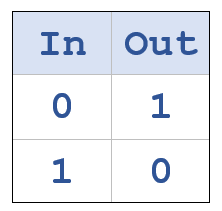
This is the truth table for which logic gate?
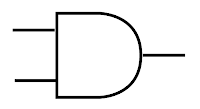
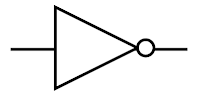
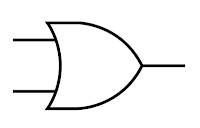
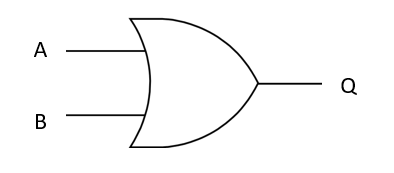
In this logic circuit, if A = 0 and Q = 1, what is B?
0
We can't say
1
A NOT takes a single Boolean value, either true or false, and ______
makes it true
makes it false
negates it
keeps it the same
Using an OR gate, it one transistor is on and the other is off, the output is ________
off
on
indeterminate
negated

Which logic gate is commonly represented by a "triangle with a dot"?
NOT
AND
OR
XOR

Which logic gate is commonly represented by a "spaceship" symbol?
NOT
AND
OR
XOR
The only time an XOR is true is when _______
both inputs are false
both inputs are true
one input is true and the other input is false
the output is grounded

Which logic gate is commonly represented by a "spaceship with a smile"?
NOT
AND
OR
XOR
When we use symbols for logic gates, rather than transistors, we are moving up _____
a row on a logic table
a layer of abstraction
the ladder of complexity
the trophic pyramid
TO CONVERT DECIMAL TO OCTAL NUMBER WE HAVE TO
SUBTRACT BY 8
MULTIPLY BY 8^0
DIVIDE BY 8
convert binary number 110102 to hexadecimal number
B116
D016
1A16

