
 Worksheets
Exam 4 Practice MCQs
Total questions: 68
Worksheet time: 34mins
Name
Class
Date
1.
Which of the following sensory functions involves neurons in the posterior root ganglion?
a)
Smell
b)
Hearing
c)
Touch
d)
Taste
e)
Vision
2.
Voluntary motor impulses leave the spinal cord via the _________ of gray matter.
a)
anterior horn
b)
posterior horn
c)
anterior funiculus
d)
posterior funiculus
e)
lateral horn
3.
Cerebrospinal fluid fills the space between the __________.
a)
dural sheath and dura mater
b)
dural sheath and vertebral bones
c)
dura mater and arachnoid mater
d)
arachnoid mater and pia mater
e)
dura mater and pia mater
4.
The bundle of nerve roots that occupy the vertebral canal from L2 to S5 is called the __________.
a)
medullary cone
b)
cauda equina
c)
lumbosacral enlargement
d)
cervical enlargement
e)
spinal cord
5.
Which of the following fractures would be the least likely to cause a spinal cord injury?
a)
A fracture of vertebra C2
b)
A fracture of vertebra C6
c)
A fracture of vertebra T5
d)
A fracture of vertebra T12
e)
A fracture of vertebra L4
6.
Which of the following is contained within gray matter?
a)
Glial cells, axons of motor neurons, and Schwann cells
b)
Glial cells and myelinated fibers
c)
Neurosomas, dendrites, and proximal parts of axons of neurons
d)
The distal part of axons of lower order motor neurons
e)
Glial cells only
7.
The upper motor neurons that control skeletal muscles begin with a neurosoma in the __________.
a)
posterior horn of the spinal cord
b)
anterior horn of the spinal cord
c)
motor association cortex of the cerebrum
d)
postcentral gyrus of the cerebrum
e)
precentral gyrus of the cerebrum
8.
Many upper motor neurons synapse with lower motor neurons in the ___________.
a)
posterior horn
b)
anterior horn
c)
posterior funiculus
d)
anterior funiculus
e)
posterior root ganglion
9.
Second-order neurons synapse with third-order neurons in the __________.
a)
thalamus
b)
dorsal root ganglion
c)
spinal cord
d)
cerebral cortex
e)
medulla oblongata
10.
The signals that control your handwriting travel down the spinal cord in the _________ tracts.
a)
tectospinal
b)
corticospinal
c)
lateral vestibulospinal
d)
medial vestibulospinal
e)
spinocerebellar
11.
A ganglion is a _________.
a)
bundle of axons in the CNS
b)
cluster of dendrites in either the CNS or the PNS
c)
cluster of neurosomas in the PNS
d)
bundle of axons in the PNS
e)
cluster of neurosomas in the CNS
12.
Which of the following branches of a spinal nerve has the neurosomas of only sensory neurons?
a)
Posterior (dorsal) root
b)
Anterior (ventral) root
c)
Posterior ramus
d)
Anterior ramus
e)
Meningeal branch
13.
Sensory stimuli enter the spinal cord via __________.
a)
afferent axons
b)
efferent axons
c)
interneurons
d)
sensory receptors
e)
efferent effectors
14.
The cervical plexus is the origin of the __________ nerve(s).
a)
oculomotor
b)
sciatic
c)
musculocutaneous
d)
radial
e)
phrenic
15.
Which of the following is not a property of reflexes?
a)
Reflex responses are very predictable.
b)
Reflexes are responses to sensory inputs.
c)
Reflexes are quick responses of the nervous system.
d)
Reflexes are not voluntary.
e)
Reflexes do not require a stimulus.
16.
Which one of the following best describes the order of a somatic reflex?
a)
Somatic receptor → interneuron → afferent nerve fiber → efferent nerve fiber → skeletal muscle
b)
Somatic receptor → efferent nerve fiber → interneuron → afferent nerve fiber → skeletal muscle
c)
Somatic receptor → afferent nerve fiber → interneuron → efferent nerve fiber → skeletal muscle
d)
Somatic receptor → efferent nerve fiber → afferent nerve fiber → interneuron → skeletal muscle
e)
Somatic receptor → afferent nerve fiber → interneuron → efferent nerve fiber → smooth muscle
17.
A simple spinal reflex typically involves how many neurons?
a)
3
b)
2
c)
4
d)
1
e)
5
18.
A nurse pricks your finger to type your blood. You flinch at the pain, pulling your hand back. This is called the __________ reflex.
a)
painful
b)
stretch
c)
flexor (withdrawal)
d)
tendon
e)
crossed extension
19.
A reflex in which the sensory input and motor output are on opposite sides of the spinal cord is called __________.
a)
intersegmental
b)
contralateral
c)
ipsilateral
d)
polysynaptic
e)
monosynaptic
20.
You go to the movies after a long day and you begin to nod off as soon as the movie starts. Your head starts to lower a little, but a reflex causes your head to rise. This is called the __________ reflex.
a)
tendon
b)
crossed extension
c)
withdrawal
d)
stretch (myotatic)
e)
flexor (withdrawal)
21.
What is the most caudal component of the brainstem?
a)
Pons
b)
Medulla oblongata
c)
Midbrain
d)
Cerebellum
e)
Diencephalon
22.
Which of the following structures appears as a large bulge just rostral to the medulla?
a)
Pons
b)
Midbrain
c)
Cerebellum
d)
Medulla oblongata
e)
Hypothalamus
23.
From superficial to deep, the meninges occur in which order?
a)
Dura mater, pia mater, arachnoid
b)
Dura mater, arachnoid, pia mater
c)
Pia mater, dura mater, arachnoid
d)
Pia mater, arachnoid, dura mater
e)
Arachnoid, pia mater, dura mater
24.
Which of the following is not a function of CSF?
a)
To regulate the chemical environment of the nervous tissue
b)
To rinse metabolic wastes from the nervous tissue
c)
To provide oxygen and nutrients to the nervous tissue
d)
To protect the brain from striking the cranium when the head is jolted
e)
To allow the brain to attain considerable size without being impaired by its own weight
25.
Which structures create the blood brain barrier (BBB)?
a)
Gap junctions between endothelial cells that form the capillary walls
b)
Tight junctions between endothelial cells that form the capillary walls
c)
Gap and tight junctions between astrocytes and endothelial cells that form the capillary walls
d)
Desmosomes and tight junctions between astrocytes and ependymal cells that form the capillary walls
e)
Gap junctions between ependymal cells and endothelial cells that form the capillary walls
26.
Where are the cardiac, vasomotor, and respiratory centers found?
a)
Medulla oblongata
b)
Pons
c)
Midbrain
d)
Spinal cord
e)
Diencephalon
27.
The __________ function(s) in visual attention, such as to look and follow the flight of a butterfly.
a)
inferior colliculi
b)
superior colliculi
c)
tegmentum
d)
red nucleus
e)
substantia nigra
28.
Loss of equilibrium and motor coordination would most likely be related to a lesion in which structure?
a)
Limbic system
b)
Pons
c)
Pituitary gland
d)
Medulla oblongata
e)
Cerebellum
29.
Which of the following is not associated with the pons?
a)
Sensory information from the middle region of the face
b)
Sensory information from the inferior region of the face
c)
Sensory information from the superior region of the face
d)
Lateral eye movements
e)
Neck movement
30.
Nearly all the somatosensory input to the cerebrum passes by way of synapses in which region of the brain?
a)
Thalamus
b)
Hypothalamus
c)
Epithalamus
d)
Cerebellum
e)
Reticular formation
31.
Which of the following is correct regarding the occipital lobe?
a)
It is chiefly concerned with mood, memory, and emotions.
b)
It is the principal visual center of the brain.
c)
It is the primary site for receiving and interpreting signals from the general senses.
d)
It is concerned with voluntary motor functions.
e)
It is likely to play a role in understanding spoken language.
32.
A predominance of which waves in an electroencephalogram (EEG) might indicate that a person is physically and mentally relaxed?
a)
Alpha
b)
Beta
c)
Theta
d)
Delta
e)
Gamma
33.
Short-term memory is associated with the __________, whereas long-term memory is associated with __________.
a)
cerebral cortex; hippocampus
b)
hippocampus; cerebral cortex
c)
cerebral cortex; amygdala
d)
amygdala; hippocampus
e)
hippocampus; midbrain
34.
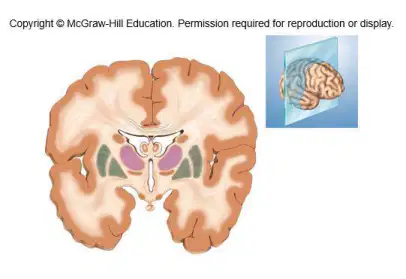
The masses of cerebral gray matter shown in this diagram play an important role in which of the following?
a)
Motor control
b)
Emotional control
c)
Vision
d)
Memory
e)
Understanding language
35.
Your dentist gives you an injection of anesthetic in preparation for a filling. Which cranial nerve did they target?
a)
V
b)
VII
c)
IX
d)
XII
e)
XI
36.
Which of the following cranial nerves is mispaired?
a)
Abducens - VI
b)
Trochlear - IV
c)
Facial - VII
d)
Accessory - XI
e)
Optic - I
37.
Exhausted from studying all night, you briefly close your eyes and your mind starts to wander. Which brain waves would be most predominant in an EEG?
a)
Alpha
b)
Beta
c)
Delta
d)
Theta
e)
Sigma
38.
The autonomic nervous system controls all of the following except the __________.
a)
adrenal gland
b)
smooth muscle in the walls of the aorta
c)
cardiac muscle in the right atrium
d)
skeletal muscle in the rectus abdominis
e)
parotid salivary gland
39.
Which one of the following best describes the order of a visceral reflex?
a)
Sensory receptor → interneuron → afferent nerve fiber → efferent nerve fiber → gland
b)
Sensory receptor → efferent nerve fiber → interneuron → afferent nerve fiber → gland
c)
Sensory receptor → afferent nerve fiber → interneuron → efferent nerve fiber → gland
d)
Sensory receptor → efferent nerve fiber → afferent nerve fiber → interneuron → gland
e)
Sensory receptor → interneuron → efferent nerve fiber → afferent nerve fiber → gland
40.
The effect of autonomic fibers on target cells is _________. The effect of somatic fibers on target cells is __________.
a)
always excitatory; always excitatory
b)
excitatory or inhibitory; always excitatory
c)
excitatory or inhibitory; excitatory or inhibitory
d)
always inhibitory; excitatory or inhibitory
e)
always inhibitory; always excitatory
41.
Preganglionic fibers of the autonomic efferent pathway are _________ and secrete __________.
a)
myelinated; norepinephrine (NE)
b)
myelinated; acetylcholine (ACh)
c)
myelinated; acetylcholine (ACh) and norepinephrine(NE)
d)
unmyelinated; acetylcholine (ACh)
e)
unmyelinated; norepinephrine(NE)
42.
Which of the following is associated with the "flight-or-fight" reaction?
a)
Pupillary constriction
b)
Glycogen synthesis
c)
Increased gastric motility
d)
Reduced urinary output
e)
Reduced heart rate
43.
Most fibers of the parasympathetic nervous system travel in the __________.
a)
vagus
b)
trigeminal
c)
splanchnic
d)
facial
e)
sciatic
44.
Sympathetic fibers arise only from the __________ region(s) of the spinal cord.
a)
cervical, thoracic, and lumbar
b)
thoracic and lumbar
c)
thoracic
d)
cervical
e)
lumbar
45.
Which of the following is not a feature of the sympathetic division of the ANS?
a)
It originates in the thoracolumbar region of the spinal cord.
b)
It has long postganglionic fibers.
c)
It has long preganglionic fibers.
d)
Its ganglia are adjacent to the spinal column.
e)
It has an extensive neural divergence and a relative widespread effect.
46.
Which of the following structures releases neurotransmitter molecules in a paravertebral ganglion?
a)
Preganglionic sympathetic fiber
b)
Postganglionic sympathetic fiber
c)
Somatic motor fiber
d)
Preganglionic parasympathetic fiber
e)
Postganglionic parasympathetic fiber
47.
__________ nerve(s) pass(es) throughout sympathetic ganglia without synapsing.
a)
Facial
b)
Trigeminal
c)
Vagus
d)
Celiac
e)
Splanchnic
48.
A neuron that synapses in the adrenal medulla is a ___________ neuron, and releases the neurotransmitter ___________.
a)
preganglionic; acetylcholine (ACh)
b)
postganglionic; norepinephrine (NE)
c)
preganglionic; norepinephrine (NE)
d)
postganglionic; acetylcholine (ACh)
e)
somatic; norepinephrine (NE)
49.
If a cell has α1 adrenergic receptors, it is sensitive to __________.
a)
acetylcholine (ACh)
b)
norepinephrine (NE)
c)
muscarine
d)
alpha adrenaline
e)
nicotine
50.
Which of the following is more effective in producing bronchodilation?
a)
Acetylcholine
b)
Nicotine
c)
Muscarine
d)
Norepinephrine
e)
Thyroxine
51.
The enzyme that breaks down norepinephrine (NE) is called __________.
a)
noradrenalinase
b)
adenosine
c)
monoamine oxidase (MAO)
d)
norepinephrinase
e)
norepinephrine hydroxylase
52.
Changes in blood pressure are detected by __________ in certain arteries.
a)
mechanoreceptors
b)
chemoreceptors
c)
proprioceptors
d)
nociceptors
e)
thermoreceptors
53.
Pain, heat, and cold are detected by __________.
a)
tactile discs
b)
tactile corpuscles
c)
lamellar corpuscles
d)
free nerve endings
e)
end bulbs
54.
Which of the following is not an analgesic (pain reliever) found naturally in the central nervous system?
a)
Endogenous opioid
b)
Dynorphin
c)
Enkephalins
d)
Endorphins
e)
Bradykinin
55.
In a taste bud, which cell produces a receptor potential?
a)
Taste hairs
b)
Sensory nerve fibers
c)
Supporting cells
d)
Basal cells
e)
Gustatory cells
56.
Which taste sensation is produced by amino acids such as aspartic acid and glutamic acid?
a)
Salty
b)
Umami
c)
Bitter
d)
Sweet
e)
Sour
57.
Where is the primary olfactory cortex located?
a)
Parietal lobe
b)
Insula
c)
Occipital lobe
d)
Frontal lobe
e)
Temporal lobe
58.
Which of the following structures belong to the inner ear?
a)
Tympanic membrane
b)
Helix
c)
Incus
d)
Semicircular duct
e)
Tensor tympani muscle
59.
The incus articulates with which bone(s)?
a)
Malleus and stapes
b)
Malleus
c)
Stapes
d)
Malleus, stapes, and temporal
e)
Malleus, stapes, and tympanic
60.
Which structure allows upper respiratory infections to spread from the throat to the tympanic cavity?
a)
Oval window
b)
Cochlear duct
c)
Auditory canal
d)
Auditory (eustachian) tube
e)
Tympanic cavity
61.
Stimuli produced by sound waves reach the brain following which pathway?
a)
Cochlear duct → spiral organ → ossicles → oval window → auditory canal → tympanic membrane → fibers of cochlear nerve
b)
Auditory canal → tympanic membrane → oval window → cochlear duct → ossicles → spiral organ → fibers of cochlear nerve
c)
Cochlear duct → oval window → auditory canal → tympanic membrane → ossicles → spiral organ → fibers of cochlear nerve
d)
Tympanic membrane → auditory canal → ossicles → oval window → cochlear duct → spiral organ → fibers of cochlear nerve
e)
Auditory canal → tympanic membrane → ossicles → oval window → cochlear duct → spiral organ → fibers of cochlear nerve
62.
Each upward movement of the basilar membrane causes the stereocilia of the inner hair cells to bend, opening __________ gates.
a)
K+
b)
Na+
c)
Ca2+
d)
Cl
e)
Mg2+
63.
Nerve fibers from all regions of the retina converge on the __________ and exit the eye by way of the optic nerve.
a)
macula lutea
b)
optic disc
c)
fovea centralis
d)
ora serrata
e)
lens
64.
Half of the fibers of each optic nerve decussate at the __________.
a)
superior colliculus
b)
optic chiasm
c)
lateral geniculate nucleus of the thalamus
d)
optic foramen
e)
midbrain
65.
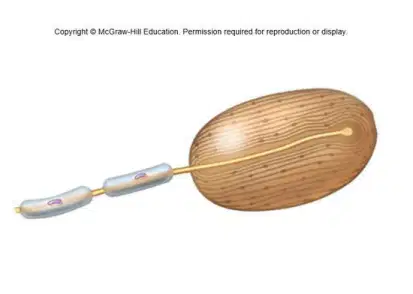
What type of sensory receptor is pictured here?
a)
Lamellar corpuscle
b)
Tactile corpuscle
c)
Muscle spindle
d)
Tendon organ
e)
Tactile disc
66.
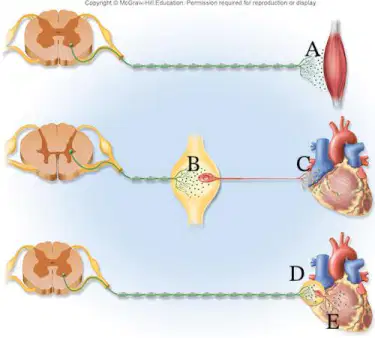
Which synapses are cholinergic? Check all that apply. 66)
a)
A
b)
B
c)
C
d)
D
e)
E
67.
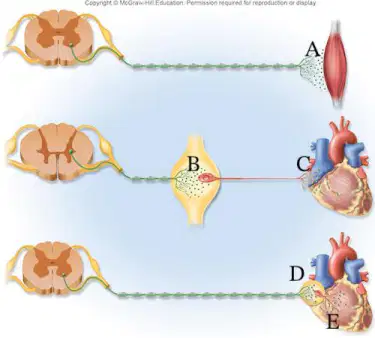
Which synapses have nicotinic receptors? Check all that apply.
a)
A
b)
B
c)
C
d)
D
e)
E
68.
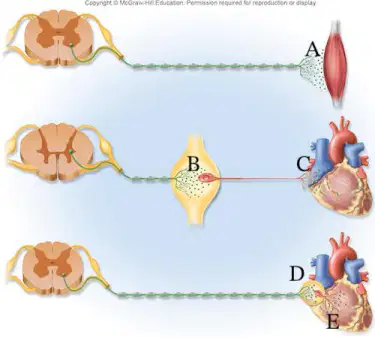
Which synapses have muscarinic receptors? Check all that apply.
a)
A
b)
B
c)
C
d)
D
e)
E
100 %

