
 Worksheets
States of Matter Quiz
Total questions: 70
Worksheet time: 41mins
Which statement about a solid, a liquid or a gas is correct?
A solid has a fixed shape and can be compressed.
A liquid takes the shape of the container it is in and can be compressed.
A solid has no fixed shape and cannot be compressed.
A gas takes the shape of the container it is in and can be compressed.
Which statement about the molecules in ice, water or steam is correct?
The H2O molecules are on average closest together in steam.
The H2O molecules are on average furthest apart in water.
The H2O molecules in steam have the second highest average velocity.
The H2O molecules in ice are able to vibrate.
Which statement about liquids and gases is correct?
1 cm3 of gas contains more particles than 1 cm3 of liquid.
A given mass of liquid has a fixed volume at room temperature.
Particles in a liquid can easily be forced closer together.
Particles in a liquid have fixed positions.
What are the processes X, Y and Z?
melting, condensing, evaporating
evaporating, melting, freezing
melting, freezing, condensing
freezing, evaporating, condensing
Which two diagrams show the states of matter before and after the sublimation of carbon dioxide?
2 to 1
2 to 3
3 to 1
3 to 2
Which row describes the spacing and arrangement of particles in a solid, a liquid and a gas?
close together and randomly arranged, close together and randomly arranged, close together and regularly arranged
close together and regularly arranged, far apart and randomly arranged, close together and randomly arranged
close together and randomly arranged, far apart and randomly arranged, close together and regularly arranged
close together and randomly arranged, far apart and randomly arranged, close together and randomly arranged
How many samples are liquids?
0
1
2
3
What is the melting point of X?
270°C
240°C
170°C
20°C
Between which times is substance M freezing?
P to Q
Q to R
R to S
S to T
Which row describes the cause of the pressure of the gas and the effect of increasing the temperature of the gas?
collisions between gas particles, collisions become less frequent
collisions between gas particles, the average speed of the gas particles increases
collisions between gas particles and the container, collisions become less frequent
collisions between gas particles and the container, the average speed of the gas particles increases
At which point is the substance a solid?
A
B
C
D
In which changes of state is energy being given out?
1 and 2
1 and 4
2 and 3
3 and 4
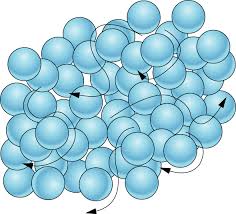
Which is not true about the liquid state of matter?
The liquid state has a definite volume and a definite shape.
The liquid state takes on the shape of its container.
The liquid state has a definite volume and an indefinite shape.
The particles in a liquid can easily move past each other.
The state of matter in which a material has a definite volume and a definite shape is the:
Solid
Liquid
Gas
Plasma
If I add heat to a solid, how will the motion of the particles be affected?
They will move slower
They will stop moving
They will move faster
They will move to a different container
How can you stop the movement of particles?
Increase the temperature
Decrease the temperature
You can't.
Hold them still with your hands.
Which process could cause a material to change state from gas to liquid?
Adding heat
Adding energy
Removing particles
Removing energy
If I add heat to a solid, how will the motion of the particles be affected?
They will move slower
They will stop moving
They will move faster
They will move to a different container

kinetic energy is changing between
A and B
B and C
C and D
D and E
E and F
phase change between b and c
melting
boiling
vaporization
condensation
State at F
solid
liquid
gas
plasma

In the PT graph shown,if a gas at a low pressure of 0.4 kPa is heated from -100 to + 100 the sample will
stay solid
turn into a liquid
turn into a vapor
be at the critical point
Deposition is the change from
solid to gas
gas to solid
liquid to solid
solid to liquid
Sublimation is the change from
solid to liquid
solid to vapor
gas to solid
liquid to vapor

Matter is made of tiny particles called atoms and molecules.
True
False

The diagram shows the changes in state of water (H2O). What is the process Z called?
Condensation
Freezing
Vaporization
Melting

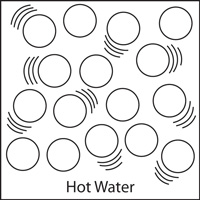
When a beaker of water is heated its volume increases a little. What is happening to the particles in the liquid?
They are getting bigger.
They are moving slower.
They are moving faster.
They are getting smaller.

Which is NOT a property of a solid?
They do not flow.
Definite volume.
No definite shape.
They are incompressible.

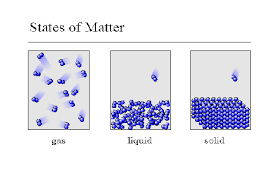
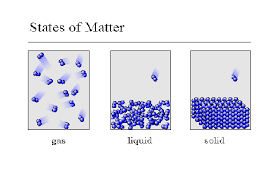
Which state of matter is represented in the following diagram?
Liquid
Liquid and gas
Gas
Solid

Which change of state occurs when particles in a solid begin to move slowly past each other?
Melting
Freezing
Condensing
Vaporizing
Kinetic energy of a gas depends upon
Molecular mass
Equivalent mass
Surface area
None of these
What causes gas pressure in a container such as a helium balloon?
the walls of the container
atmospheric pressure acting on the outside walls of the container
the vacuum maintained in the container
the simultaneous collisions of fast-moving particles in the container
Which of the following will evaporate the fastest?
water at 0⁰ C
water at 20⁰ C
water at 40⁰ C
All samples will evaporate at the same rate.
Which of the following statements is part of the kinetic theory?
The particles of a gas move independently of each other.
The particles in a gas move rapidly.
The particles in a gas are relatively far apart.
all of the above


No attractive forces between particles
Solid
Liquid
Gas
Fluid and compressible
Solid
Liquid
Gas
Particles have more kinetic energy than some states and less than others
Solid
Liquid
Gas
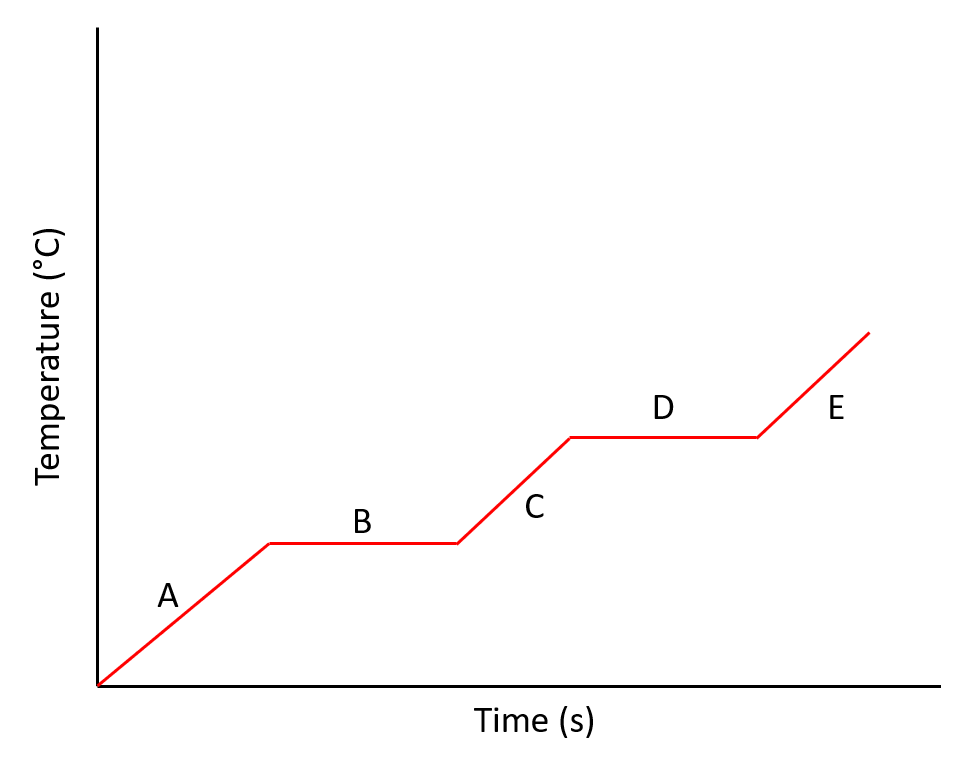
The diagram shows a heating curve for ice. Which line represents the ice melting?
A
B
C
D
E
Why are lines B and D flat?
The ice is melting
The ice is freezing
All of the thermal energy is used to break the bonds
They stopped the stopwatch
They stopped heating the ice.
The diagram shows a heating curve for ice. Which line represents the ice in a liquid state (water)?
A
B
C
D
E

The graph shows the cooling curve of a substance. At which stages the specific latent heat released?
AB and CD
BC and DE
AB and EF
BC and CD

