wayground logo

Free Printable Worksheets

Font size

S
M
L
XL
Worksheets

Atomic Structure and The Periodic Table - PATERSON

Total questions: 65

Worksheet time: 35mins

Name
Class
Date
1.

Subatomic particles with a negative charge

a)

Electrons

b)

Neutrons

c)

Protons

d)

Quarks

2.
subatomic particles found on the outermost shell & responsible for the atom's reactivity
a)
neutrons
b)
valence electrons
c)
isotopes
d)
ions
3.
Subatomic particles with a positive charge
a)
neutrons
b)
atomic mass
c)
protons
d)
isotopes
4.
Value representing the number of protons in an element
a)
Atomic Mass
b)
Mass Number
c)
Valence Electrons
d)
Atomic Number
5.
Subatomic particles that are neutral in charge
a)
Neutrons
b)
Protons
c)
Nucleus 
d)
Electrons
6.
Where electrons are likely to be found as they travel around the nucleus
a)
Nucleus
b)
Electron Cloud
c)
Within a Proton
d)
Within a Neutron
7.
A tiny but very dense, positively charged portion of the atom that holds most of the atomic mass
a)
Electron Shells
b)
Orbitals
c)
Electron Cloud
d)
Nucleus
8.
Arrangement of elements organized by atomic number
a)
Electron Cloud 
b)
Periodic Table 
c)
Electron Configuration
d)
None of these
9.

A horizontal row of elements in the periodic table

a)

Molecule

b)

Period

c)

Family

d)

Atom

10.

What is one way Neutrons are different from electrons?

a)

they both are negative

b)

neutrons have no charge, while electrons have a negative charge

c)

Both are in the nucleus( center of atom)

d)

Electrons are inside nucleus and neutrons are outside the nucleus.

11.

What is the atomic number?

a)

35

b)

18

c)

17

d)

52

12.

How many protons and electrons does this element have?

a)

35

b)

18

c)

17

d)

52

13.

How many neutrons does calcium have?

a)

20

b)

40

c)

60

d)

0

14.

What is the atomic mass of Arsenic?

a)

33

b)

107

c)

75

15.

The vertical (up and down) columns in the Periodic Table are called

a)

groups

b)

towers

c)

periods

d)

atomic numbers

16.
An element's identity is determined by the number of
a)
electrons.
b)
protons.
c)
neutrons.
d)
valence.
17.
Which is a proton?
a)
A
b)
B
c)
C
18.
Which is a neutron?
a)
A
b)
B
c)
C
19.

Elements in the same group have the same

a)

Properties

b)

Number of electrons

c)

Number of protons

d)

Nucleus

20.

Which are of the following are subatomic particles. Select three:

a)

Protons

b)

Neutrons

c)

Electrons

d)

Nucleus

21.

The atomic number will tell me... (select three)

a)

Number of Protons

b)

Number of Electrons

c)

Number of Neutrons

d)

What element is it

22.

The nucleus of an atom contains which of the following subatomic particles: (Select two)

a)

protons

b)

Neutrons

c)

Electrons

d)

Shells

23.

The nucleus of an atom contains which of the following subatomic particles: (Select two)

a)

protons

b)

Neutrons

c)

Electrons

d)

Shells

24.

Hydrogen has an atomic number of 1. How many electrons does hydrogen have?

a)

1

b)

2

c)

4

d)

0

25.

Silicon has an atomic number of 14 and an atomic mass of 28. How many neutrons does it have?

a)

14

b)

28

c)

2

d)

10

26.

Which of the following are properties of a metal: (you should select more than one)

a)

Good conductor of heat and electricity

b)

Brittle (break easily)

c)

Malleable (able to bend without breaking)

d)

Luster (shiny)

e)

Dull

27.

This element is found in group 2, period 3:

a)

Li

b)

Mg

c)

Be

d)

B

28.

Valence electrons are:

a)

Just the electrons on the last energy level (outer shell)

b)

All the electrons in the atom

29.

Which diagram would you draw if you wanted to represent just the valence electrons?

a)

Electron Configuration

b)

Lewis Dot

c)

Bohr Model

30.

What best describes the difference between the bohr model and the lewis dot?

a)

The bohr model diagram represents all the subatomic particles, while the lewis dot diagram only shows the symbol and the valence electrons.

b)

The lewis dot shows all the electrons and the bohr model only shows the electrons in the last shell

c)

The lewis dot shows the number of neutrons and the bohr model only shows the electrons

31.

What is the charge of a proton?

a)

Positive

b)

Negative

c)

No charge, Neutral

32.

Which of the following is the electron configuration for Magnesium, Mg? (Atomic number 12)

a)

2-4-4

b)

2-8-2

c)

2-8

d)

2-4-6

33.

This diagram represents the atom of what element?

a)

Kr (Krypton)

b)

Cd (Cadmium)

c)

Se (Selenium)

d)

Ca (Calcium)

34.

A student drew a lewis dot structure with 7 valence electrons. Which of the following elements might have the student drawn?

a)

Cl (Chlorine)

b)

Ne (Neon)

c)

N (Nitrogen)

d)

Li (Lithium)

35.
An element with a mass number of 10 and an atomic number of 6 has how many protons?
a)
5
b)
8
c)
6
d)
10
36.
How many electrons does Si contain? (click to see image)
a)
14
b)
28
c)
2
d)
4
37.
Elements which are shiny, conduct electricity and heat are called
a)
metal
b)
nonmetal
c)
metalloid
d)
nonexistent
38.
Group 18 elements are known as the _____ _____ and have full valence shells.
a)
royal gases.
b)
supreme solids.
c)
noble gases.
d)
legit liquids.
39.
What period and group is Silver (Ag)? 
a)
Period 2, Group 1
b)
Period 3, Group 16
c)
Period 5, Group 11
d)
Period 2, 14
40.
Which elements have the most similar chemical properties?
a)
K and Na
b)
K and Ca
c)
K and Cl
d)
K and S
41.
An element's identity is determined by the number of
a)
electrons.
b)
protons.
c)
neutrons.
d)
valence.
42.
Rows on the period table are called _____ while columns are called _____.
a)
groups, families
b)
groups, periods
c)
periods, groups
d)
families, groups
43.
The central region of an atom where its neutrons and protons are is called the
a)
nucleus 
b)
electron cloud
c)
core 
d)
center 
44.
 Why does group number 18 have the least reactive elements?
a)
They all have an odd number of protons.
b)
They all have an even number of protons. 
c)
They have the largest masses.
d)
Their electron shells are the most filled and do not need to be very reactive.
45.
Beryllium is in group number______.
a)
Group 2
b)
Group 3
c)
Group 4
d)
Group 7
46.
The period for Bromine is ___________.
a)
3
b)
2
c)
4
47.
How many Valance electrons does Iodine Have?
a)
6
b)
16
c)
7
d)
17
48.
The elements in a column of the periodic table...
a)
have similar atomic numbers
b)
start with the same letter
c)
have similar properties
d)
are not related in any way
49.
What period and group is Flourine on the periodic table?
a)
Period 7, Group 3
b)
Period 5, Group 4
c)
Period 2, Group 17
d)
Period 8, Group 2
50.
Which of the following has six valence electrons?
a)
Sodium
b)
Iodine
c)
Oxygen
d)
Neon
51.
Metals are good conductors of heat and electricity.
a)
true
b)
false
52.
What is the atomic mass of "F"
a)
9
b)
18
c)
17
d)
19
53.
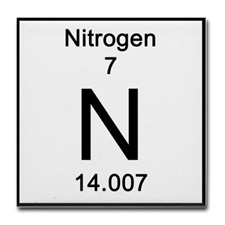
What is the number of protons that the element in this image contain?
a)
14
b)
7
c)
15
d)
18
54.
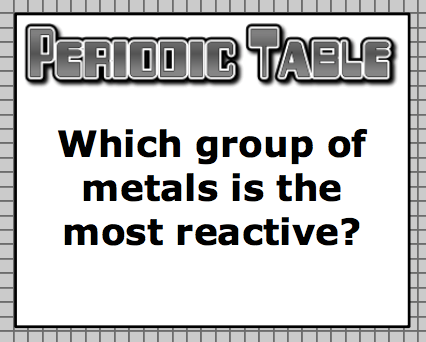
a)
Group 1
b)
Group 17
c)
Group 18
d)
Group 2
55.
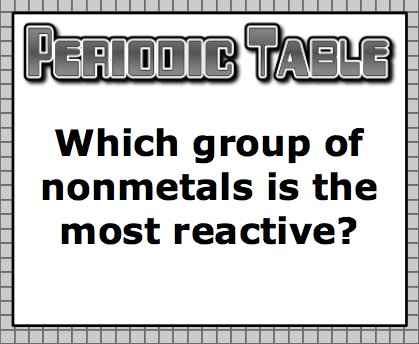
a)
Group 1
b)
Group 17
c)
Group 18
d)
Group 2
56.

Which is an alkali metal?

a)

Magnesium Mg

b)

Iron Fe

c)

Sodium Na

d)

Europium Eu

57.

What is the formula in getting the number of neutron?

a)

n= atomic mass + atomic number

b)

n= atomic mass - atomic number

c)

n= atomic mass X atomic number

d)

n= atomic mass / atomic number

58.
The majority of elements on the periodic table are
a)
man made.
b)
nonmetals.
c)
metals.
d)
gases.
59.
The elements in this group only have 1 valence electron and include Li, Na, and K. 
a)
Group 11
b)
Group 1
c)
Group 3
60.
Which of the following represent a compound?
a)
He
b)
Mg
c)
NaCl
d)
Li
61.
How many dots would be shown in an electron dot diagram for Nitrogen element number 7?
a)
one
b)
two
c)
five
d)
eight
62.
What is the symbol of an atom containing 36 protons?
a)
Ca
b)
C
c)
Ne
d)
Kr
63.
What is the symbol of an atom containing 36 protons?
a)
Ca
b)
C
c)
Ne
d)
Kr
64.
What is water?
a)
element
b)
compound
c)
mixture
65.
What is krypton?
a)
element
b)
compound
c)
mixture