wayground logo

Free Printable Worksheets

Font size

S
M
L
XL
Worksheets

Evolution, Natural Selection and Adaptations.

Total questions: 42

Worksheet time: 21mins

Name
Class
Date
1.
According to this evolutionary tree, birds are LEAST related to: 
a)
Amphibians
b)
Sharks
c)
Ray Finned Fish
d)
Crocodiles
2.

The body structures for a population of chimpanzees were stable for a long time. Then, their body structures changed, making the chimpanzees stronger. Why did this happen?

a)

Organisms naturally become stronger over time.

b)

It is impossible to say without more information.

c)

The chimpanzee population wanted to be stronger.

d)

Their environment must have changed.
3.
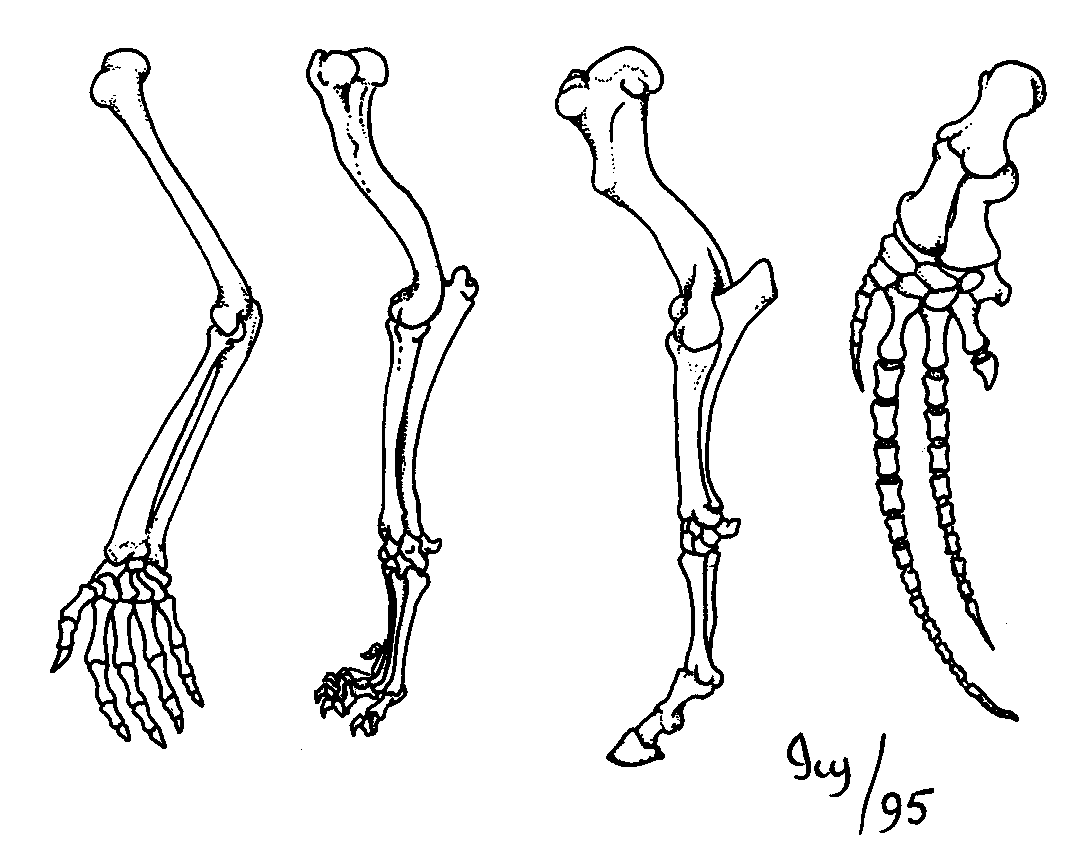
What is this an example of?
a)
vestigial structures
b)
embryology
c)
homologous structures
d)
fossil record
4.
Darwin wrote that organisms with traits that are best suited to the environment will ________________
a)
increase in number
b)
become extinct
5.
Survival of the Fittest and Evolution were proposed by what scientist?
a)
Charles Darwin
b)
Albert Einstein
c)
Steven Hawking
d)
Isaac Newton
6.
Where the better adapted organisms survive to pass traits along to offspring.
a)
Evolution
b)
Natural Selection
c)
Extinction
d)
Artifical Selection
7.
Why are advantageous traits more likely to be passed onto offspring?
a)
Because they are more likely to survive and reproduce.
b)
Because they come from dominant alleles.
c)
Because they come from recessive alleles.
d)
Because the trait is an acquired phenotype.
8.
Mutations are a change in what?
a)
DNA
b)
tRNA
c)
genotype
d)
phenotype
9.
Where humans have bred organisms together based on traits we like.
a)
Evolution
b)
Natural Selection
c)
Extinction 
d)
Artificial Selection
10.
Structures with the same parts have different functions; suggests that organisms share a common ancestry
a)
vestigial structures
b)
homologous structures
c)
adaptive radiation
d)
fossil
11.
Genetic differences between organisms of the same species
a)
Variation
b)
Adaptation
c)
Behavior
d)
Environment
12.
Study of embryos of various organisms to show a common ancestor because of similarities in development
a)
natural selection
b)
embryology
c)
speciation
d)
evolution
13.
A fossil of an extinct dinosaur is found and the anatomy of the fossil shows similarities to that of a bird. What could this mean?
a)
This is purely by chance and isn't significant
b)
The extinct dinosaur and modern bird share a common ancestor
c)
All dinosaurs evolved into birds and that's why there aren't any dinosaurs alive today
d)
Dinosaurs choose to fly, and evolved into birds to escape predation and capture food
14.
All of these finches have different shaped beaks, they are an adaptation to gain access of 
a)
Water
b)
Food
c)
Shelter
15.
Change over time is
a)
evolution
b)
generation
c)
growth
d)
biogenesis
16.
Which of the following is not a piece of evidence for evolution?
a)
Homologous structures
b)
embryology
c)
fossil age
d)
vestigial structures
17.
The environment around Manchester, England, changed during the Industrial Revolution.  How did this change affect peppered moths living in the area?
a)
Natural selection favored moths with dark wings because predators could not see them on the soot-colored trees.
b)
Natural selection favored moths with white wings that were easy for predators to see.
c)
Natural selection favored moths with white wings because predators could not see them on the soot-colored trees.
d)
Natural selection caused moths with white wings to become extinct.
18.
Two organisms that are closely related would have
a)
very similar DNA sequence
b)
exactly the same DNA sequences
c)
no proteins in common
d)
completely different DNA sequence
19.
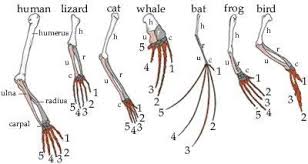
Humans, birds, whales, and lizards all have similar arm bones. What is the reason for this?
a)
The function of these bones is the same in all animals
b)
They live in similar environments
c)
They have a common ancestor
d)
All organisms resemble humans
20.
An organism's ability to survive and reproduce in its environment refers to its
a)
Fitness
b)
Variation
c)
Selection
d)
Mutation
21.

How does embryology support the Theory of Evolution?

a)

It shows that embryos who develop similarly share a common ancestor

b)

It shows that embryos who develop similarly are not related to one another

c)

It shows that organisms have the ability to evolve, or change, over time

22.

Birds are eating all the green beetles. Because the brown beetles are surviving they reproduce more and make more brown beetles. This is called ___________

a)

Artificial Selection

b)

The Theory on the Origin of Species

c)

Natural Selection

d)

Mutation

23.

_________ is the process of change by which species of organism change over time.

a)

Nucleotides

b)

Evolution

c)

Mutation

d)

Carbon

24.

Why were the beaks on Darwin's finches so Important?

a)

They showed the finches always existed as Darwin found them.

b)

They showed that the finches could mutate their beaks whenever they want.

c)

They showed variability in the finches species. All finches were equally adaptable to all islands.

d)

They show that the finches adapted to their environments. Their beak shape matched the food available on each island.

25.

4. When the industrial revolution started, the trees have been covered in soot from coal factories. Which moth will be more successful in this environment?

a)

White Moth

b)

Dark Moth

c)

Both are Equally Successful in this Environment

26.

Why could the same species of moth be two different colors?

a)

Their color was based on their DNA. Sometimes a mutation would cause the moth to be born with a different color.

b)

Their color was caused by the environment. The soot from the factories would fuse with the moth's skin.

c)

Bacteria inside the moth's stomach would sometimes give the moth stomach the ability of the moth to have "active camouflouge." This allowed the moths to change their color at will.

27.

If scientists find fossils of a type of mosquito on the bottom layer and find fossils of beetles towards the top layer, what can scientists infer?

a)

Mosquitos ate the beetles

b)

Mosquitos are older fossils than beetles

c)

Beetles are older fossils than mosquitos

d)

Both mosquitos and Beetles must have lived at the same time.

28.

When we examine this whale fossil, we can see that the whale has a pelvic bone that doesn't seem to be used by the whale. What do scientists infer?

a)

The whale had an ancestor with legs

b)

The whale must use the pelvis for an unknown reason

c)

The whale was born with an extra bone and has a disorder

d)

The whale had an ancestor with wings

29.

Why are vestigial structures evidence for evolution?

a)

They are useful in the organism and show natural selection at work.

b)

They are not useful in the organism but they were probably useful in some ancestor of that species.

c)

They show that these organs or behaviors help an organism adapt to new environments

30.

Scientists believe horses evolved over a period of 50 million years. How did they change?

a)

They became much larger

b)

Their toes eventually were replaced by a hoof

c)

Their environment changed from a forest to a grassland environment

d)

all the other answers!

31.
The diagram shows fossils in different rock layers. Which of these statements about the age of these fossils is most likely correct?
a)
Fossil A and C are the same age
b)
Fossil B is older than fossil C
c)
Fossils A is older than fossil B
d)
Fossil D is older than fossil C
32.
A theory has significant evidence to support it.  True or False
a)
True
b)
False
33.
An error in DNA copying that results in a new trait
a)
Homeostasis
b)
Mutation
c)
Natural Selection
d)
Selective Breeding
34.
An organism that survives longer is more likely to produce_______offspring
a)
less
b)
the same amount
c)
more
d)
no
35.
Which of the following is an example of a physical trait , or structural adaptation?
a)
a long neck of a giraffe
b)
building a nest
c)
regulation of body functions
d)
production of a toxic substance
36.

What is the best definition of animal adaptation?

a)

Changes to an animal's diet.

b)

Characteristics that help animals survive.

c)

Characteristics of an animal's habitat.

d)

Skills learned in order to hunt.

37.

Animals who travel to warmer habitats in the winter to escape the cold are using which behavioral adaptation?

a)

Mimicry

b)

Camouflage

c)

Hibernation

d)

Migration

38.

Fill in the blanks: A _________ adaptation is the way an animal acts in order to help them survive.

a)

Physical

b)

Behavioral

c)

Simple

d)

Memory

39.

Which of the following is a physiological adaptation?

a)

The thick fur of a polar bear

b)

The ability of some fish to produce antifreeze proteins

c)

The long neck of a giraffe

d)

The camouflage of a chameleon

40.

Why do Arctic foxes have small ears?

a)

To improve their hearing in cold environments

b)

To retain body heat

c)

To help them swim better

d)

To make them more aerodynamic

41.

The ability of your skin to produce more pigment during the summer season compared to the winter season, is an example of ____.

a)

Acclimation

b)

Critical Factor

c)

Limiting Factor

d)

Generalists

42.

Physical changes that allow organisms to survive in a given environment.

a)

Limiting Factors

b)

Adaptations

c)

Advantages

d)

Critical Factors