
Font size
 Worksheets
Econ quiz yr 13
Total questions: 75
Worksheet time: 38mins
What does GDP measure?
Income inequality
Total value of goods and services produced
Total government spending
Average tax rates
Which of the following is a limitation of using GDP to measure living standards?
It includes inflation
It includes non-market transactions
It does not account for inequality
It uses purchasing power parity
What is CPI used for in the UK?
Calculating GDP
Measuring government budget deficit
Measuring inflation
Tracking employment
Which measure of unemployment uses a survey approach?
Claimant count
Labour force survey
GDP survey
Workforce index
Which is not a component of aggregate demand?
Consumption
Government spending
Imports
Savings
Which of the following causes demand-pull inflation?
Increase in productivity
Fall in oil prices
Increase in consumer spending
Increase in unemployment
What happens in disinflation?
Prices fall
Prices rise at a decreasing rate
Prices rise at an increasing rate
Prices stay constant
What does (X-M) in AD = C + I + G + (X-M) represent?
Imports
Exports minus imports
Investment
Government debt
Which of the following is a supply-side policy?
Increase in interest rates
Exports minus imports
Investment
Government debt
What is the main goal of monetary policy?
Reducing inequality
Managing inflation
Increasing exports
Reducing government debt
The multiplier effect is greater when:
Marginal propensity to consume is low
Marginal propensity to save is high
Marginal propensity to tax is low
Marginal propensity to import is high
What is a budget surplus?
When imports exceed exports
When government spending exceeds revenue
When revenue exceeds government spending
When GDP is negative
What does the Bank of England's Monetary Policy Committee do?
Sets income tax
Regulates stock markets
Sets interest rates
Prints currency
Which of the following would reduce a current account deficit?
Increase in imports
Strong exchange rate
Decrease in export competitiveness
Devaluation of currency
What does a negative output gap imply?
Economy is overheating
Economy is in equilibrium
Economy has spare capacity
High inflation
What is the impact of high interest rates on AD?
Increase investment
Increase consumption
Decrease aggregate demand
Increase exports
Which of the following is a contractionary fiscal policy?
Increase in government spending
Decrease in taxes
Decrease in government spending
Increase in exports
Which of these is NOT a macroeconomic objective?
(a)
The trade cycle does not include:
Boom
Recession
Innovation
Recovery
Which of the following policies is most likely to reduce structural unemployment?
Lower interest rates
Expansionary fiscal policy
Job training programmes
Income tax cuts
Inflation caused by rising wages is an example of:
Cost-push inflation
Demand-pull inflation
Deflation
Hyperinflation
What is a key assumption of classical long-run aggregate supply?
Prices are sticky
Wages are rigid
All markets clear
There is involuntary unemployment
What does the Phillips Curve illustrate?
Link between interest rates and growth
Trade-off between inflation and unemployment
Government spending and tax revenues
Balance of payments
A decrease in income tax is an example of:
Monetary policy
Supply-side policy
Fiscal policy
Protectionism
What is the effect of an increase in consumer confidence?
Decrease in AD
Increase in imports
Increase in consumption
Decrease in investment
Government borrowing to fund spending is:
Budget surplus
Fiscal expansion
Fiscal contraction
Supply-side
What is the primary aim of supply-side policies?
Control inflation
Reduce budget deficit
Increase aggregate supply
Increase tax revenue
Which of the following would shift the AD curve to the right?
Rise in imports
Increase in government spending
Fall in investment
Higher interest rates
Which measure includes income from abroad?
GDP
GNI
CPI
RPI
What does an increase in MPT (marginal propensity to tax) do to the multiplier?
Increases it
Decreases it
No effect
Causes inflation
What does cyclical unemployment result from?
Structural changes
Technological advancement
Downturn in the business cycle
Seasonal factors
A fall in the exchange rate makes:
Imports cheaper
Exports more expensive
Imports more expensive
Exports fall
What is frictional unemployment?
Caused by lack of skills
Temporary during job search
Due to economic downturn
Due to overseas competition
Which policy is most likely to boost potential growth?
Reducing interest rates
Increasing AD
Improving education
Increasing imports
Which is NOT a reason for government intervention?
Achieve macroeconomic objectives
Redistribute income
Promote monopoly
Stabilise the economy
A classical economist would argue the economy:
Requires constant government intervention
Is always in disequilibrium
Self-adjusts in the long run
Suffers permanent unemployment
What is stagflation?
High growth and low inflation
High unemployment and inflation
Falling prices and rising growth
Low interest and inflation rates
What policy is best to reduce demand-pull inflation?
Cut in interest rates
Increase in government spending
Cut in VAT
Increase in interest rates
What would an increase in productivity do?
Shift AS right
Shift AD right
Shift AS left
Shift AD left
Which is not a type of unemployment?
Frictional
Cost-push
Cyclical
Structural
Which of the following is an injection in the circular flow?
Savings
Imports
Taxes
Investment
What does a rise in the base interest rate do?
Increases borrowing
Reduces saving
Decreases AD
Encourages investment
What is the likely short-run effect of expansionary fiscal policy?
Fall in inflation
Fall in AD
Increase in unemployment
Rise in AD
Which is not a component of national income?
Investment
Tax
Exports
Government spending
What effect does an increase in indirect taxes have?
Increase in AD
Fall in prices
Cost-push inflation
Increase in real income
Which is most likely to reduce the natural rate of unemployment?
Decrease in interest rates
Education and training
Increase in benefits
Increase in imports
A reduction in corporation tax is designed to:
Increase consumption
Reduce inflation
Encourage investment
Reduce imports
A weak pound benefits:
UK importers
UK exporters
Foreign tourists in the UK
UK consumers buying imports
Which of the following is a withdrawal from the circular flow?
Government spending
Investment
Savings
Exports
An increase in the marginal propensity to import will:
Increase the multiplier
Decrease the multiplier
Have no effect
Increase GDP
What is the main objective of studying "Trading blocs and the World Trade Organisation (WTO)" in international economics?
To understand factors influencing trading blocs and the WTO and their effect on economic activity.
To learn about the history of world currencies.
To analyze only the disadvantages of international trade.
To focus solely on domestic economic policies.
How might the growth of trading blocs affect global economic activity?
It can increase regional cooperation and trade, but may also create barriers for non-members.
It always leads to global economic decline.
It has no effect on international trade.
It only benefits non-member countries.
What is one of the objectives of studying trading blocs and the World Trade Organisation (WTO) as stated in the material?
To understand the factors influencing trading blocs and the WTO and their effect on economic activity
To learn about the history of world currencies
To study the impact of technology on trade
To analyze the growth of multinational corporations
Discuss one potential advantage and one disadvantage of being part of a trading bloc.
Advantage: Increased market access; Disadvantage: Loss of economic sovereignty
Advantage: Higher taxes; Disadvantage: More trade opportunities
Advantage: Less competition; Disadvantage: Lower employment
Advantage: Reduced tariffs; Disadvantage: Increased pollution
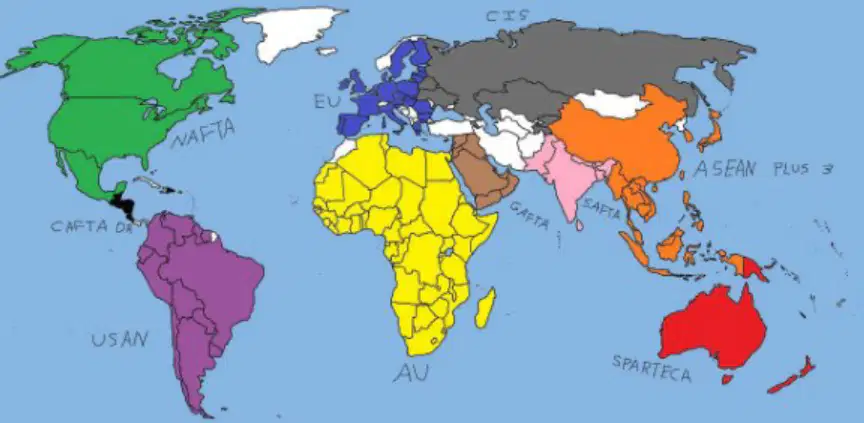
Which trading bloc includes the United States, Canada, and Mexico?
NAFTA
EU
ASEAN
AU
According to the success criteria, what should students be able to do regarding the impact of being part of a trade bloc?
Discuss impact advantages and disadvantages of being apart of a trade bloc
Only list the countries in a trade bloc
Ignore the disadvantages of trade blocs
Focus only on the economic growth of a single country
What is one of the tasks students are expected to perform related to the growth of trading blocs?
Analyse growth of trading blocs and bilateral trading agreements and the role WTO
Memorize the names of all trading blocs
Write a story about international travel
Draw a map of Europe
What is the main objective of studying Trading blocs and the World Trade Organisation (WTO) as mentioned in the material?
To understand factors influencing trading blocs and the WTO and their effect on economic activity.
To learn about the history of world trade.
To memorize the names of all trading blocs.
To study only the disadvantages of trading blocs.
Which of the following is an example of a trading bloc?
The European Union (EU)
The United Nations (UN)
The World Health Organization (WHO)
The International Monetary Fund (IMF)
What is a key feature of a common market within a trading bloc?
Members agree to the removal of trade barriers and allow freedom of movement of factors of production
Members use a single currency
Members have no economic policies in common
Members only trade goods, not services
Which of the following best describes a monetary union?
A group of countries that only share a common currency
A group of countries with both a customs union and a common market, including common economic policies
A group of countries that only remove tariffs on goods
A group of countries that do not allow movement of labor
Which type of trading bloc aims to eliminate trade barriers among member countries and adopts a common approach to trade barriers with non-members?
Free trade areas
Monetary unions
Common markets
Customs unions
What is one of the main objectives of the World Trade Organisation (WTO)?
To influence trading blocs and their effect on economic activity
To set national interest rates
To control immigration policies
To regulate domestic education systems
Which of the following is an advantage of the single European market (SEM)?
Trade creation
Trade diversion
Monopolies
Unemployment
How does the SEM benefit consumers according to the material?
By driving productive and dynamic efficiency through stronger competition
By increasing tariffs on imported goods
By restricting the movement of labor
By reducing the number of available markets
Why might the creation of large monopolies be a disadvantage of the SEM?
They may exploit economies of scale and reduce competition
They always lower prices for consumers
They increase the number of small businesses
They eliminate tariffs on all goods
Which of the following is a potential positive implication of EU enlargement?
Decreased competition for consumers
Increased potential for economies of scale and free trade
Higher production costs for businesses
Reduced geographical area
What is the main objective when studying the impacts of globalisation on economic activity?
To memorize the history of globalisation
To evaluate impacts of globalisation on economic activity
To ignore the effects of globalisation
To focus only on local businesses
Analyse how a sharp drop in overall inflation, as expected in the official figures, could impact consumers and producers.
Consumers may face higher prices, and producers may see increased costs
Consumers may benefit from lower prices, and producers may need to adjust pricing strategies
Consumers will stop buying goods, and producers will stop producing
Consumers and producers will not be affected at all
According to the International Monetary Fund (IMF), what does globalisation involve?
The free flow of ideas, people, goods, services, and capital leading to the integration of economies and societies
The restriction of goods and services between countries
The separation of economies and societies
The elimination of international trade agreements
Which of the following is a characteristic of globalisation?
Growth of international trade
Decrease in cultural exchange
Reduction in outsourcing
Decline in multinational corporations
Which of the following best describes the impact of globalisation on labour?
Enhanced mobility of labour
Decreased opportunities for workers to move internationally
Reduced demand for skilled workers
Elimination of all forms of employment
Which of the following best describes the impact of globalisation on labour?
Enhanced mobility of labour
Decreased opportunities for workers to move internationally
Reduced demand for skilled workers
Elimination of all forms of employment
Which of the following is NOT typically considered a characteristic of globalisation?
Increased international trade
Greater labour mobility
Reduced communication between countries
Growth of multinational corporations (MNCs)
What is a potential negative impact of globalisation on the environment?
Decreased use of natural resources
Increased carbon emissions due to higher production and transportation
Reduction in waste generation
Improved air quality worldwide

