
 Worksheets
specific heat and latent heat
Total questions: 40
Worksheet time: 41mins

Which material heats up quickest?
Aluminium
Concrete
Diamond
Glass
Water

Which material heats up slowest?
Aluminium
Concrete
Diamond
Glass
Water

10 kg of aluminium is heated from 120C to 220C. How much energy is needed?
8 970 000 J
897 J
8970 J
89 700 J
897 000J
What are the units for specific heat capacity?
J kg / °C
J / kg / °C
J / °C
J / kg
kg °C / J
Specific latent heat is the amount of energy required to change the state of 1 kg of a substance without changing its (a) .
Select the state changes that latent heat of fusion applies to.
melting
evaporating
freezing
condensing
sublimation
Select the state changes that latent heat of vaporisation applies to.
melting
evaporating
freezing
condensing
sublimation
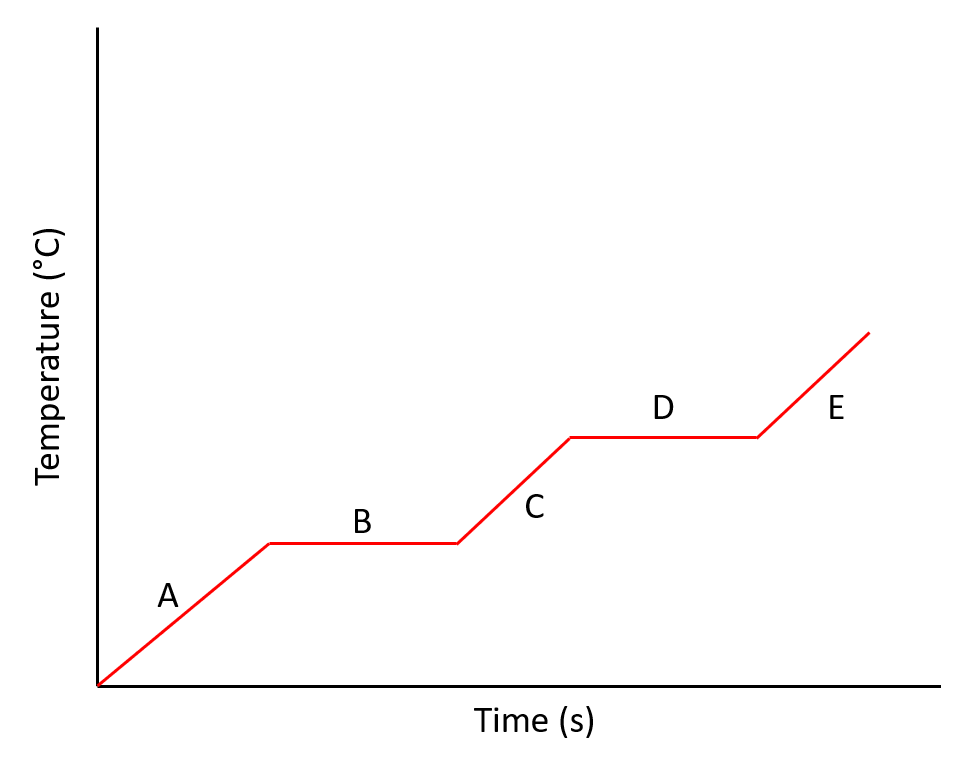
The diagram shows a heating curve for ice. Which line represents the ice melting?
A
B
C
D
E
Why are lines B and D flat?
The ice is melting
The ice is freezing
All of the thermal energy is used to break the bonds
They stopped the stopwatch
They stopped heating the ice.
The diagram shows a heating curve for ice. Which line represents the ice in a liquid state (water)?
A
B
C
D
E

The diagram shows a cooling curve for ice. Which line represents the ice in a liquid state (water)?
A
B
C
D
E
The diagram shows a cooling curve for ice. Which line represents the ice freezing?
A
B
C
D
E
The diagram shows a cooling curve for ice. Which line represents the ice in a solid form?
A
B
C
D
E
Specific heat capacity is the amount of energy required to increase the temperature of 1 kg of a substance by 1°C without changing its (a) .
The unit of specific heat capacity is J/kg°C.
True
False
The specific heat capacity of water is 4200 J/kg°C. How much energy is needed to raise the temperature of 1 kg of water by 1°C?
(a)
The specific heat capacity of water is 4200 J/kg°C. How much energy is needed to raise the temperature of 2 kg of water by 1°C?
(a)
Which of these substances is the best conductor of heat?
Water (s.h.c = 4200 J/kg°C)
Copper (s.h.c = 390 J/kg°C)
Mercury (s.h.c = 139 J/kg°C)
Air (s.h.c = 718 J/kg°C)
What are the factors that affect the specific heat capacity of a substance?
Age, height, and width
Volume, pressure, and conductivity
Color, shape, and density
Type of material, mass, and temperature
Which statement is true about substances with a higher specific heat capacity?
They heat up or cool down quickly.
They conduct heat poorly.
They require more heat to change their temperature.
They have a lower boiling point.
If two substances, A and B, receive the same amount of heat, and substance A has a lower specific heat capacity than substance B, what can be said about their temperature changes?
Substance A will experience a greater temperature change than substance B.
Substance B will experience a greater temperature change than substance A.
Both substances will experience the same temperature change.
The specific heat capacity does not affect temperature change.
Water molecules have the greatest kinetic energy in
Ice at 0 ⁰C
Water at 90 ⁰C
Water at 373 K
Steam at 150 ⁰C
Which of the following best explains why the sand at the beach is hotter than the water?
Sand has a higher specific heat than water.
Sand has a lower specific heat than water.
There is more water than sand at the beach.
There is more sand than water at the beach.


Specific latent heat is the amount of energy required to change the state of 1 kg of a substance without changing its (a) .
The unit of specific heat capacity is J/kg°C.
True
False
The specific heat capacity of water is 4200 J/kg°C. How much energy is needed to raise the temperature of 1 kg of water by 1°C?
(a)
What are the units for specific heat capacity?
Kg/JºC
J/KgºC
N/mºC
Watts
There are four main processes in changing of phase, and they are
Melting
Boiling
Condensation
All the above
The heat absorbed by melting a solid is known as
latent heat of fusion
latent heat of solid
latent heat of liquid
latent heat of vaporisation

