
 Worksheets
Classification and States of Matter Test
Total questions: 16
Worksheet time: 8mins
Name
Class
Date
1.
The forces of attraction between the particles of a matter sample are strong and draw particles together, keeping them in their place. This is an example _____.
a)
of the liquid state of matter
b)
of the solid state of matter
c)
of superficial tension
d)
of viscosity
2.
The sum of all the potential energy and kinetic energy of an object equals its _____
a)
thermal energy
b)
kinetic energy
c)
potential energy
d)
force
3.
In a chemical formula, the number of each type of atom in the compound is shown with numbers that are ____.
a)
superscripts
b)
chemical symbols
c)
oxidation numbers
d)
subscripts
4.
In a gas, which quantities relate in such a way that when one increases, the other one decreases?
a)
volume, pressure
b)
temperature, pressure
c)
temperature, volume
d)
number of particles, pressure
5.
In which state of matter there are very weak attractions between particles?
a)
liquid
b)
solid
c)
gas
d)
clay
6.
When a liquid boils, its particles get ____. This may be due to the ____ in pressure.
a)
further apart; decrease
b)
closer together; decrease
c)
further apart; increase
d)
closer together; increase
7.
A change in the state of matter occurs if enough _____ is added or removed from an object.
a)
thermal energy
b)
kinetic energy
c)
potential energy
d)
force
8.
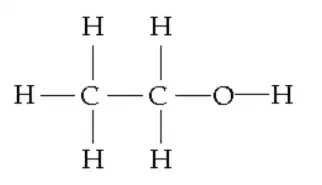
Ethanol has six hydrogen atoms, two carbon atoms, and one oxygen atom. Which is the correct chemical formula of the model below?
a)
Option 1
b)
Option 2
c)
Option 3
d)
Option 4
9.
In general, nonmetals are ____ since they are composed of individual atoms or small molecules.
a)
good conductors of electricity
b)
malleable and ductile
c)
good conductors of heat
d)
gases at room temperature
10.
In general, metals are ____ since they are composed of individual atoms or small molecules.
a)
poor conductors of heat
b)
brittle
c)
poor conductors of electricity
d)
good conductors of heat
11.
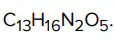
Aspartame is an artificial sweetener; its formula is below. What element in the formula has the most number of atoms?
a)
carbon
b)
hydrogen
c)
nitrogen
d)
oxygen
12.
What change is likely to happen to the particles inside a beaker with liquid water as thermal energy is removed?
a)
get further apart
b)
slow down
c)
move faster
13.
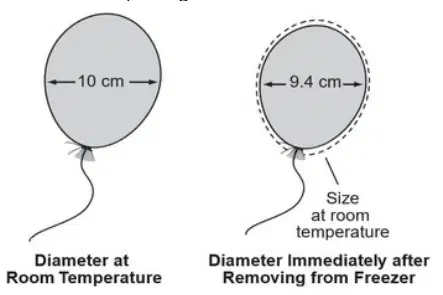
Jocelyn used a balloon to make a model of gas particles. She measured the balloon's diameter at room temperature. Then, she placed the balloon in a freezer. An hour later, she removed the balloon from the freezer and measured the diameter immediately after. Jocelyn made these drawings to show the balloon's diameter at room temperature and immediately after removing it from the freezer. The dotted line represents the size of the balloon before placing it in the freezer. Then, Jocelyn placed the balloon in a tub of heated water that is warmer than the room temperature. Which is the best prediction of what may happen?
a)
The balloon expands to a diameter of 10 cm and stops because the gas particles return to their original movement.
b)
The balloon expands to a diameter over 10 cm because the gas particles move faster
c)
The balloon shrinks to a diameter below 9.4 cm because the gas particles move slower
d)
The balloon remains at a diameter of 9.4 cm because the gas particles maintain their current movement
14.

Model X and Model Y both represent particles of the same substance. Identify the states of matter represented by Model X and Model Y
a)
Model X is a liquid, Model Y is a solid
b)
Model X is a gas, Model Y is a solid
c)
Model X is a solid, Model Y is a liquid
d)
Model X is a liquid, Model Y is a gas
15.
Juana is creating a lab simulation about the movement of the particles in a nonmetal gas. The user can change the pressure in the gas' temperature and see the effect of the change in the gas' volume. What change should Juana program to cause the decrease in the gas' volume?
a)
decrease in pressure
b)
increase in pressure
c)
increase in temperature
16.
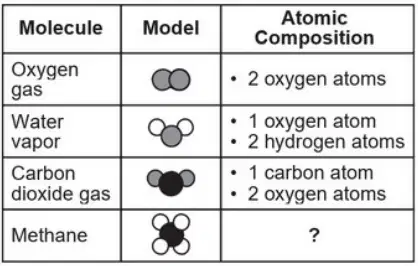
The table shows models of four molecules and describes the atomic composition of each molecule. Based on the information on the table, describe the atomic composition of methane.
a)
1 oxygen atom, 1 carbon atom
b)
1 oxygen atom, 4 carbon atoms
c)
1 hydrogen atom, 4 carbon atoms
d)
1 carbon atom, 4 hydrogen atoms
100 %

