
 Worksheets
Qualitative Research Learning Objectives Quiz
Total questions: 15
Worksheet time: 8mins
What is a key focus when using data from case studies according to the objectives?
To learn about different types of qualitative analysis processes
To calculate statistical significance
To develop new mathematical models
To create financial forecasts
What does the ontological premise in qualitative methods suggest?
The world is socially constructed and subjective.
Phenomena are observable through human interaction.
Discovering new knowledge involves the researcher as part of the observed.
The world is objectively measurable and independent of human perception.
Which premise in qualitative methods involves the belief that phenomena are observable through human interaction?
Ontological
Epistemological
Methodological
Theoretical
What is a key characteristic of qualitative research?
It involves numerical data.
It starts with a specific hypothesis.
It uses words, pictures, and audio recordings.
It is primarily deductive.
Which approach is often used in qualitative research to develop new conceptions?
Deductive
Inductive
Quantitative
Hypothetical

What is an example of a qualitative method shown in the image?
Counting the number of people who took the ice cream
Asking how many people were excited
Asking what people felt when they saw the ice cream
Measuring the temperature of the ice cream
Which type of phenomena are case study methods well-suited to study?
Simple and predictable
Well-understood and theorized
Ambiguous and complex
Quantitative and static
Which of the following is a method for collecting case data?
Individual interviews
Online surveys
Telephone marketing
Product testing
What is a potential influence on case studies as mentioned in the material?
Researcher's influence
No external influence
Complete objectivity
Unbiased results
What is a potential bias in interviews?
Interviewer/respondent bias.
Geographic bias.
Technological bias.
Seasonal bias.
Which of the following is an advantage of observation?
Extensive training is needed
All data obtained from observations are usable
Limited information
Expensive
Which of the following is NOT mentioned as a component related to themes?
Categories
Labels
Codes
Algorithms
Which of the following is a method for identifying themes?
Repetitions
Random sampling
Hypothesis testing
Data encryption
Why is identifying missing data important in theme identification?
It helps in creating new theories.
It ensures all relevant information is considered.
It simplifies the data collection process.
It increases the speed of data entry.
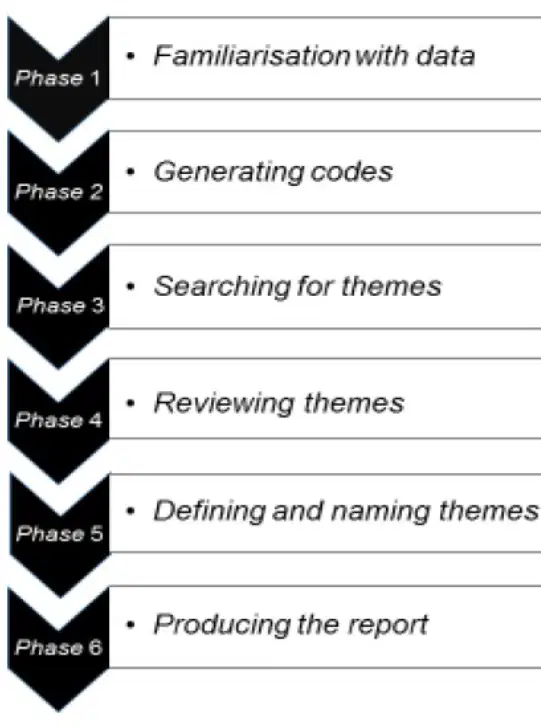
Which phase involves defining and naming themes in thematic analysis?
Phase 2
Phase 4
Phase 5
Phase 6

