
 Worksheets
Financial Lit: Credit, Loans, Investing
Total questions: 39
Worksheet time: 22mins
Fill in the blank: A ______ is a partial refund of the purchase price, often offered as a special promotion by dealers.
rebate
deposit
invoice
warranty
Fill in the blank: ______ is the act of using a car for a set period of time by making regular payments, without owning the car at the end of the term.
Leasing
Financing
Renting
Purchasing
What does extended warranty protection do?
It will extend the manufacturer’s warranty on certain parts or services.
It provides free insurance for your car.
It covers accidental damages not included in the original warranty.
It offers lifetime replacement for all parts.

What is the monthly payment for the car loan as shown in the sample sales contract?
$448.82
$512.30
$399.99
$475.50
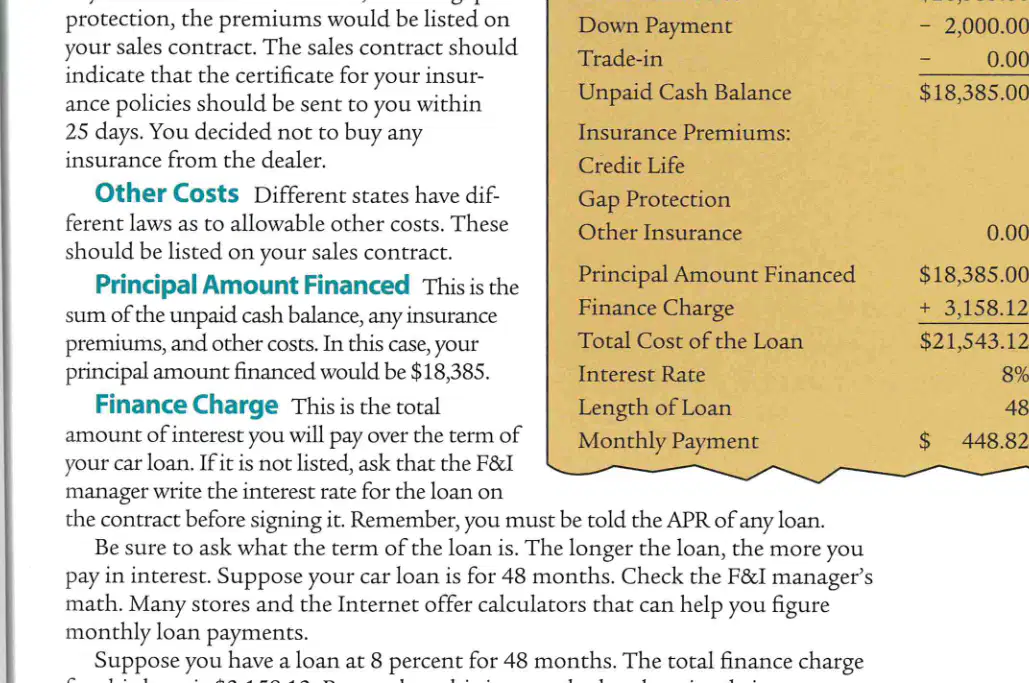
What is the interest rate for the loan in the sample sales contract?
5%
8%
10%
3%
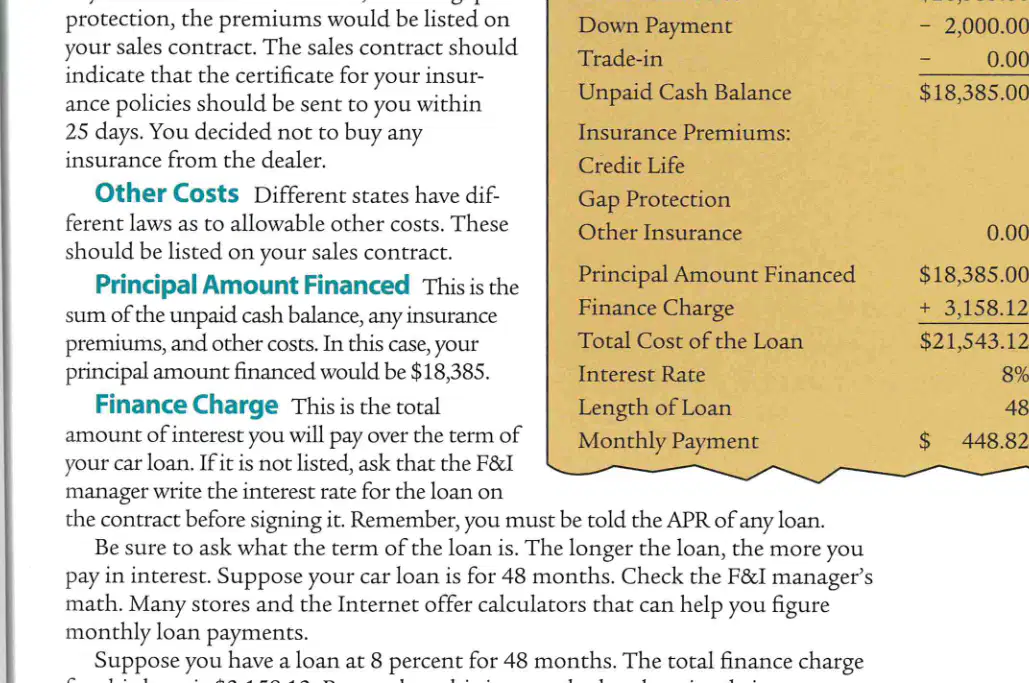
How many months is the length of the loan in the sample sales contract?
48
36
60
24
Money is withdrawn directly from a checking or savings account.
Debit Card
Credit Card
Both
Consumers can purchase items now and pay for them later.
Debit Card
Credit Card
Both
Interest may be charged but can be avoided by paying the entire balance each month.
Debit Card
Credit Card
Both
Rosa’s gas pump went out as she was driving her car to work. Since she did not have enough money to cover the cost to replace the pump, she used a card that allowed her to pay later. What card did she use?
Debit Card
Credit Card
Both
Has perks such as, cash back and rewards
Debit Card
Credit Card
Both
Affects credit score
Debit Card
Credit Card
Both
Annual Fee is the yearly charge imposed by a financial institution for a credit card or similar service.
A yearly fee
A monthly fee
A one-time fee
No fee
Annual Percentage Rate (APR) represents the annual cost of borrowing, including any fees and additional costs.
It represents the annual cost of borrowing, including fees and additional costs.
It is the monthly interest rate multiplied by 12.
It is the annual return on investment from a bank account.
It only considers the interest rate without any fees.
A Consolidation Loan is a loan that combines multiple debts into one payment.
It is a loan that combines multiple debts into one payment.
It is a loan that consolidates real estate properties.
It is a loan designed to merge business accounts.
It is a loan that is only used for credit card debts.
Who is a Cosigner? A cosigner is a person who signs with a borrower to guarantee the loan repayment.
A person who signs with a borrower to guarantee the loan repayment
A person who borrows money
A person who assists in loan documentation
A person who finances the loan
The typically low rate charged during the introductory period after a credit account is opened, after which the regular, typically higher, _______ will apply.
APR
interest rate
annual fee
penalty rate

A key difference between saving and investing is
Saving is for everyone, investing is for the wealthy
Your money is insured when investing, it is not in savings
Investing has a guaranteed return, savings does not
Saving is for emergencies & goals, investing is for long-term wealth
The possibility of losing all or part of your investment is known as
asset allocation
compounding
return
risk
Generally, how is risk related to return?
the lower the risk, the greater the possibility of a high return
the greater the risk, the greater the possibility of a high return
the greater the risk, the greater the possibility of a low return
risk and return have no relationship
A single share of ownership of a company is called a:
Bond
Mutual Fund
Annuity
Stock
Which of the following is TRUE about owning a share of stock?
The value of a share is set by the company and never changes.
You have to return the share of the company you own typically after 5 years, otherwise, you pay a penalty fee each year.
Companies lose significant amounts of money every time someone buys a share.
Owning a share means you own a percentage of the company.
An Investment Portfolio Includes-
Bonds
Stocks
Other Securities
All of the Above
Roth IRAs are a good option for young people because your investment will grow over the years tax free and is tax free when you withdrawal
True
False
1. A tax deferred retirement investment fund for employees of for profit companies.
401(k)
403b
457
402(a)
When is it best to start saving for retirement?
after your home is paid off
after you get a promotion
after you get your dream job
ASAP
Why is diversification a recommended investment strategy?
Investing in a diversified portfolio guarantees that you won’t lose money with your investments
If you tell your fund manager to use diversification, they’ll charge you lower fees
Diversifying your portfolio helps reduce risk
If you diversify your portfolio, you will definitely earn a high return
As a shareholder in a public company, what are the benefits available to you?
You may receive dividends from the company, if the company pays them, and you have ownership of a portion of the company
You must receive dividends from the company (all companies must pay them) and you can select members of the management team (e.g., the Chief Executive Officer (CEO))
You can select members of the management team [e.g., the Chief Executive Officer (CEO)] and vote for members of the Board of Directors
You have ownership of a portion of the company and receive coupon payments from the issuer
How is a bond different from a stock?
Bonds are best for earning high returns while stocks are best for providing a stable source of income
A bond is a loan you give to an organization while a stock is partial ownership in a company
Bonds are usually issued by smaller startup companies while stocks are issued by well established organizations
Bonds are typically riskier than stocks but have the potential to earn higher returns

