Wayground logo

Free Printable Worksheets

Font size

S
M
L
XL
Worksheets

Unit 4

Total questions: 28

Worksheet time: 1hrs 21mins

Name
Class
Date
1.
What part of the water cycle does this picture show?
a)
condensation
b)
precipitation
c)
evaporation
2.
Which best explains why runoff is important?
a)
It returns water to other locations on Earth
b)
It increases the chance of flooding
c)
It makes evaporation occur faster
d)
It increases condensation
3.
What is it called when water is formed from a liquid to a water vapor?
a)
EVAPORATION
b)
PRECIPITATION
c)
TRANSPIRATION
4.
The water cycle has no start or end
a)
true
b)
false
5.

As a part of the water cycle, water from Earth's surface enters the clouds and finally falls back to the ground in the form of rain. What is the correct sequence of processes water undergoes?

a)

Evaporation, Condensation, Precipitation

b)

Precipitation, Condensation, Evaporation

c)

Condensation, Evaporation, Precipitation

d)

Evaporation, Precipitation, Condensation

6.

The image shows various stages in the water cycle. During which stage does water flow back towards the sea as runoff?

a)

W

b)

X

c)

Y

d)

Z

7.
Carbon can be found in...
a)
The atmosphere
b)
Soil
c)
Fossil fuels
d)
All of the above
8.
Respiration is the process by which animals take in _____ and release _____. 
a)
photosynthesis, air
b)
carbon, oxygen
c)
oxygen
d)
oxygen, carbon dioxide
9.

Carbon atoms cannot be created or destroyed

a)

True

b)

False

c)

Not enough information to answer

10.
Carbon can be found in...?
a)
The atmosphere
b)
Inside of the Earth
c)
Fossil fuels
d)
All of the above!
11.

_____________ is an essential element of all living creatures.

a)

Gold

b)

Carbon

c)

Carbon dioxide

d)

Silver

12.

What kind of organism takes out the most carbon from the atmosphere?

a)

Plants

b)

Bacteria

c)

Animals

d)

Humans

13.

Gas that makes up 78% of our atmosphere.

a)

Oxygen

b)

Nitrogen

c)

Hydrogen

d)

Carbon Dioxide

14.

Plants and animals cannot use nitrogen directly from the air.

a)

True

b)

False

15.

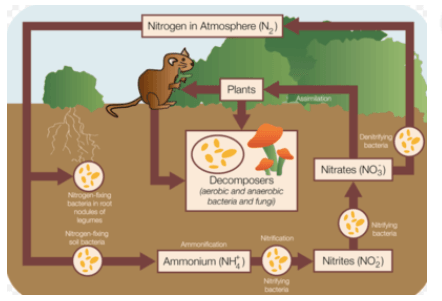
The process that allows organisms to use nitrogen

a)

assimilation

b)

denitrification

c)

fixation

d)

ammonification

16.

A correct path that nitrogen could take would be

a)

air -> animals -> plants -> bacteria

b)

animals -> air -> bacteria -> plants

c)

bacteria -> air -> plants -> animals

d)

air -> bacteria -> plants -> animals

17.
What happens when organisms die and decay? 
a)
Their bodies are lifted up
b)
Their nitrogen returns to the soil
c)
they keep their nitrogen
d)
They stay on earth forever
18.

What happens when too much Nitrogen finds its way to the ocean?

a)

Algae Bloom

b)

Acid Precipitation

c)

Nitrogen Fixation

d)

Decomposition

19.
Which type of organism gets its energy directly from the Sun?
a)
producer
b)
consumer
c)
composer
d)
decomposer
20.
One path that energy could take through an ecosystem is called a ________________________.
a)
Food Web
b)
Food Chain
c)
Abiotic Factors
d)
Biotic Factors
21.
An animal that only eats other animals is a _______________.
a)
carnivore
b)
omnivore
c)
herbivore
d)
decomposer
22.
A living thing that makes its own food is called a __________________________.
a)
consumer
b)
producer
c)
carnivore
d)
herbivore
23.
If you connect all the food chains in an ecosystem you get a __________________________.
a)
food web
b)
food chain
c)
niche
d)
symbiosis
24.
Recently, a family of bobcats moved into an area with a large rabbit population. What changes may occur in the ecosystem?
a)
The rabbit population may increase
b)
The rabbit population may decrease
c)
The rabbit population may increase first, then decrease
d)
The rabbit population will remain the same
25.
A population of mice lives in a barn community. A cat population has just joined the community. What will happen?
a)
Mouse and cat populations both go up?
b)
Mouse and cat populations both go down
c)
Mouse population goes down as cat population goes up
d)
Mouse population goes up as cat population goes down
26.

Why do you think it is called an energy pyramid?

a)

Because there are MORE animals at the top

b)

Because there are LESS organisms at the bottom

c)

Because there is MORE energy at the top

d)

Because there are LESS animals at the top

27.

About how much energy is actually transferred from each level

a)

100%

b)

25%

c)

10%

d)

50%

28.

What would happen if the owl population decreased?

a)

A. The owl population would increase

b)

B. The insect population would decrease

c)

C. The mouse population would decrease

d)

D. The mouse population would increase