
 Worksheets
Academic Integrity Worksheet
Total questions: 55
Worksheet time: 28mins
Which of the following is NOT one of the six fundamental values of academic integrity as defined by ICAI?
Honesty
Trust
Creativity
Courage
According to ICAI, which value is essential for academic integrity and involves being truthful in all academic endeavors?
Fairness
Honesty
Responsibility
Respect
If the CIHI boys ensure that their actions are just and impartial in group work, which fundamental value of academic integrity are they demonstrating?
Fairness
Trust
Courage
Responsibility
A student faces a difficult situation where telling the truth may have negative consequences for themselves. Which value of academic integrity should guide their decision?
Respect
Courage
Trust
Fairness
How does the value of 'Responsibility' contribute to academic integrity in a learning environment?
By ensuring students are creative in their work
By holding students accountable for their actions and commitments
By encouraging students to compete with each other
By promoting dishonesty to achieve better results
What is the primary outcome of embracing fundamental values in academic communities?
It creates effective scholarly communities where integrity is a touchstone.
It increases the number of students in a class.
It guarantees higher grades for all students.
It eliminates the need for teachers and administrators.
According to the material, what happens to the work of teachers, learners, and researchers without fundamental values?
It loses value and credibility.
It becomes more innovative.
It is automatically published.
It is rewarded with scholarships.
What is academic integrity?
The commitment to and demonstration of honest and moral behavior in an academic setting.
The practice of achieving high grades through consistent study in an academic setting.
The dedication to completing assignments independently in an academic setting.
The effort to follow institutional rules strictly in an academic setting.
Why is it important to provide credit to other people when using their ideas in academic work?
To avoid being accused of plagiarism
To make the paper longer
To impress Thanos (hahaha :) )
To reduce the amount of research needed
Which of the following best describes plagiarism?
Failing to acknowledge the contributions of other people
Neglecting to revise written drafts thoroughly before submission.
Omitting to include proper references in research assignments.
Asking for help from a classmate during individual and group assignments.
Explain why acknowledging the contributions of others is a key aspect of academic integrity.
It ensures that original authors receive proper credit and helps maintain honesty in academic work.
It makes the paper more colorful.
It allows students to copy more freely.
It is only necessary for published research.

Which of the following best defines honesty?
The quality of being truthful, free from fraud or deception; legitimate and sincere.
The ability of persuading others to follow your directives willingly in various situations.
The practice of withholding confidential information from others to maintain personal privacy.
The skill of making others believe something that is not true.
Which of the following situations demonstrates honesty?
Admitting to a mistake you made at work.
Lying to avoid getting in trouble.
Taking credit for someone else’s work.
Hiding important information from your team.
Why is honesty considered an important value in academic and professional settings?
It builds trust and credibility.
It allows for more shortcuts.
It encourages competition among peers.
It helps avoid responsibility.
Which action best represents the "Keep" principle in demonstrating honesty?
Keep promises.
Keep secrets from everyone.
Keep changing your story.
Keep ignoring facts.
How can you "Provide" honesty in an academic or professional setting?
Provide factual evidence.
Provide rumors.
Provide assumptions.
Provide incomplete information.
A student is writing a research paper and uses a quote from a famous author. According to the ways to demonstrate honesty, what should the student do?
Give credit to the author.
Ignore the source.
Rewrite the quote as their own.
Only mention the author if asked.
You are part of a group project and you promised to complete your section by the deadline. Which principle of honesty are you demonstrating if you fulfill this promise?
Keep
Provide
Aspire
Give
Why is it important to aspire to objectivity and consider all sides when demonstrating honesty?
It helps avoid personal bias and ensures fairness.
It makes you appear indecisive.
It allows you to ignore evidence.
It encourages you to only support your own views.
What is the definition of trust ?
The capacity to influence, direct, or regulate the behavior and actions of other individuals.
The assured reliance on the character, ability, strength, or truth of someone or something
The act or practice of evaluating options and reaching conclusions within a short period of time, often under pressure or with limited information.
The act of challenging or critically examining those in positions of power or authority.
Which of the following best illustrates the concept of trust?
Doubting a friend's intentions
Relying on a colleague's expertise to complete a project
Ignoring someone's advice
Refusing to delegate tasks
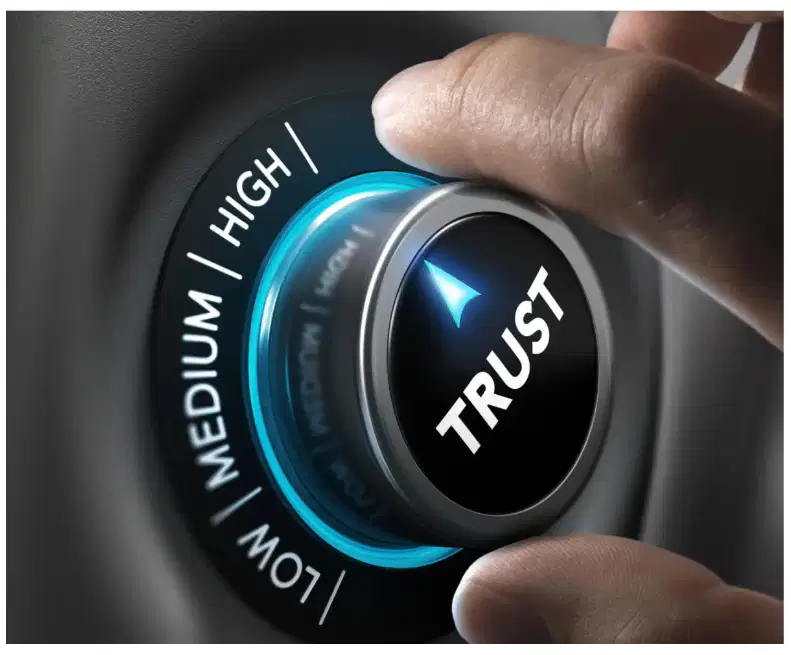
What does the image of the dial labeled "TRUST" with settings for LOW, MEDIUM, and HIGH symbolize?
The different levels of trust that can be placed in someone or something
The speed at which confidence and reliability are established between individuals or groups.
The count or proportion of individuals deemed reliable or worthy of trust.
The amount of money involved in trust

Which of the following is a way to demonstrate trust in a group setting?
Listening actively to others
Ignoring team members' opinions
Withholding important information
Frequently interrupting others
During a group discussion, which action best shows that you trust your teammates?
Sharing your honest thoughts and feedback
Refusing to participate in the conversation
Criticizing every suggestion made
Avoiding eye contact with the group
What does promoting transparency in values, processes, and outcomes help to demonstrate?
Trust
Indifference
Suspicion
Competition
Which action best encourages mutual understanding in a team environment?
Listening to others and considering their perspectives.
Making decisions alone.
The act of disregarding input, suggestions, or concerns shared by team members.
Focusing only on me , myself and I
Why is it important to act with genuineness when trying to build trust?
It shows honesty and authenticity, which are essential for trust.
A tactic used to influence or control others for personal gain.
It allows you to hide your true intentions.
It makes you appear more powerful as Thanos with the gauntlet.
Which of the following is NOT listed as a way to demonstrate trust in the material?
Competing aggressively with others.
Trusting others.
Giving credence.
Encouraging mutual understanding.
How can giving credence contribute to building trust in a professional setting?
By acknowledging and valuing others' input and perspectives.
By dismissing others' ideas.
By focusing only on your own achievements.
By withholding information.

Which icon might best represent the concept of "encouraging mutual understanding"?
A group of people.
A checkmark.
A target.
A single person.
What is the definition of fairness as described in the learning material?
The quality or state of being fair, especially fair or impartial treatment, lack of favoritism toward one side or another.
The ability to make quick decisions without considering both sides.
The consistent favoring of one side or group over another, regardless of circumstances.
The strict adherence to rules or guidelines without deviation or flexibility.
Which of the following best demonstrates fairness in a classroom setting?
Giving extra points to students you like.
Treating all students equally regardless of personal feelings.
Ignoring the needs of some students.
Allowing only certain students to participate in activities.
Kenny is grading assignments and notices that Nimish is a close friend. According to the definition of fairness, what should the Kenny do?
Give Nimish a higher grade to maintain the friendship. Bro-code!
Grade Nimish's assignment impartially, without favoritism.
Ignore Nimish's assignment completely. Strike with zero regardless.
Ask Neha to grade the assignment. Otherwise straight zero!

What does the image of the golden scale most likely represent in the context of fairness?
The importance of wealth in decision-making.
The need for balance and impartiality in treatment.
The value of speed in resolving conflicts.
The significance of law tradition in education.
Which of the following is a way to demonstrate fairness?
Apply rules and policies consistently.
Ignore established guidelines.
Favor certain individuals over others.
Avoid taking responsibility for mistakes.
What does it mean to engage with others equitably?
Treating everyone with fairness and impartiality.
Only working with people you like.
Ignoring the needs of others.
Making decisions based on personal bias.
Which action best reflects keeping an open mind in a professional setting?
Listening to different perspectives before making a decision.
The unwillingness to accept, explore, or entertain alternative perspectives or innovations.
Sticking to your opinion no matter what and don't care!
Dismissing feedback from others. Don't mind them!
Which of the following best demonstrates taking responsibility for your own actions?
Admitting when you make a mistake and working to correct it.
Blaming every other person for your errors.
Ignoring the consequences of your actions.
Denying involvement in a problem.
According to the material, what does respect in academic communities require?
Only showing respect for others.
Showing respect for oneself as well as others.
Ignoring personal values to fit in.
Avoiding challenges and disagreements.
Which of the following best describes respect for self in academic communities?
Always agreeing with others to avoid conflict.
Tackling challenges without compromising your own values.
The act of compromising or abandoning personal beliefs in order to gain acceptance or avoid rejection.
The deliberate choice to withhold input or remain silent during conversations or group dialogues.
How does the material suggest we show respect for others in academic communities?
By valuing the diversity of opinions and appreciating the need to challenge, test, and refine ideas.
The habit of seeking out and paying attention only to opinions that align with our own, while disregarding differing viewpoints.
The tendency to steer clear of conflict or opposing views in order to maintain harmony or comfort.
By insisting on our own ideas without considering others.
Why is respect considered reciprocal in academic communities?
Due to its relevance or restriction solely to individuals in a student role or academic setting.
Because it involves both giving and receiving respect among all members.
Because it is only necessary during group projects.
Because it is not important for academic success especially virtual classes
Which of the following is a way to demonstrate respect in a group discussion?
Listening actively to others' opinions
Interrupting others while they speak
Ignoring group members' contributions
Speaking over others to make your point
Why is it important to demonstrate respect during a group discussion?
It encourages open communication and collaboration
It allows only one person to dominate the conversation
It makes the discussion shorter
It prevents anyone from sharing their ideas
What does it mean to "affirm others and accept differences" as a way to demonstrate respect?
To recognize and value the uniqueness of each individual
To only agree with people who are similar to you
To avoid interacting with people who are different
To criticize others for their differences
Which action best reflects the concept of "showing empathy" in a professional setting?
Understanding and sharing the feelings of a colleague
Ignoring a coworker’s dirty stinking shoes
Focusing only on your own needs like getting on running brands only
Refusing to listen to others
Why is it important to recognize the consequences of our words and actions on others?
Because our words and actions can impact others positively or negatively
Because it is not important to consider others' feelings
Because only our intentions matter, not the outcomes
Because consequences are always predictable
Which of the following is NOT listed as a way to demonstrate respect in the material?
Seek open communication
Receive feedback willingly
Ignore others' opinions
Accept that others’ thoughts and ideas have validity
How can seeking open communication help in demonstrating respect?
It encourages honest dialogue and mutual understanding
It prevents people from sharing their thoughts
It creates misunderstandings
It discourages feedback
A healthcare leader is faced with a situation requiring moral, legal, and mental accountability. Which value from the learning material should guide their actions?
Responsibility
Efficiency
Emotional Intelligence
Flexibility

Which of the following is a way to demonstrate responsibility?
Completing tasks on time
Ignoring assigned duties
Blaming others for mistakes
Avoiding group work
Why is it important to demonstrate responsibility in a group setting?
It helps the group achieve its goals efficiently
It allows you to avoid work
It makes it easier to blame others
It reduces the need for communication
Which of the following is a way to demonstrate responsibility by holding yourself accountable?
Hold yourself accountable for your actions.
Ignore your mistakes and blame others.
Wait for someone else to take responsibility.
Avoid making decisions.
Why is it important to create, understand, and respect personal boundaries as a way to demonstrate responsibility?
It helps maintain healthy relationships and mutual respect.
It allows you to control others.
It means you never have to compromise.
It is not important in a professional setting.
Which action best represents the "Follow Through" aspect of responsibility?
Completing tasks and meeting expectations.
Starting tasks but not finishing them.
Delegating all your work to others.
Ignoring deadlines.

