
 Worksheets
Science Test
Total questions: 115
Worksheet time: 1hrs 12mins
The information you collect while doing your experiment is called
conclusions
data
hypotheses
procedures
How many independent variables should you have in an experiment?
two
as many as possible
four
one
The variable that is being measured or observed is called the _______________. Hint: this is the variable that is the result or effect
independent variable
dependent variable
control variable
What is a constant/control in an experiment?
Things that do not change in a experiment. It's the variable that stays the same. You can have many variables stay the same.
It's the variables that the scientist changes in the experiment
It's the variables that are being measured in an experiment

At what temperature did bread mold the slowest?
20
40
60
80
As temperature increases, the time for the bread to mold
Increases
Decreases


Identify the tool/equipment.
Erlenmeyer Flask
Florence Flask
Beaker
Graduated Cylinder

Identify the tool/equipment.
Erlenmeyer Flask
Florence Flask
Beaker
Graduated Cylinder

Identify the tool/equipment.
Erlenmeyer Flask
Florence Flask
Beaker
Graduated Cylinder

Identify the tool/equipment.
Erlenmeyer Flask
Florence Flask
Beaker
Graduated Cylinder

Identify the tool/equipment.
Test Tube
Dropper
Pipette
Stirring Rod

Identify the tool/equipment.
Test Tube
Dropper
Pipette
Stirring Rod

Identify the tool/equipment.
Test Tube
Dropper
Pipette
Stirring Rod

Identify the tool/equipment.
Crucible and cover
Evaporating Dish
Petri Dish
Wire Gauze

Identify the tool/equipment.
Crucible and cover
Evaporating Dish
Petri Dish
Wire Gauze

Identify the tool/equipment.
Crucible and cover
Evaporating Dish
Petri Dish
Wire Gauze

Identify the tool/equipment.
Crucible and cover
Evaporating Dish
Petri Dish
Wire Gauze

Identify the tool/equipment.
Triple beam balance
Double arm balance
Spring balance
Digital scale

Identify the tool/equipment.
Triple beam balance
Double arm balance
Spring balance
Digital scale

Identify the tool/equipment.
Triple beam balance
Double arm balance
Spring balance
Digital scale

Identify the tool/equipment.
Triple beam balance
Double arm balance
Spring balance
Digital scale


What safety symbol is this?
Explosion
Flammable
No Open Flame
Oxidizing Agent

What symbol is this?
Explosive Material
Hot surface
Sharp Object
Cold Hazard

What symbol is this?
Cold Hazard
Biohazard
Radiation Hazard
Laser Hazard

What symbol is this?
Strong Magnetic Field
Lizard
Hazard
Hot Surface


I may get the science supplies I need for an experiment.
whenever I want
when I think it is safe
when the supplies are out and ready to use
when the teacher gives me permission
When you finish working with chemicals, biological specimens, and other lab substances, always
treat your hands with skin lotion.
wipe your hands on a towel.
wipe your hands on your clothes.
wash your hands thoroughly with soap and water

4. Why are safety symbols important?
They tell me how to do an experiment
Because the icon looks cool
Symbols tell me the content of the substances
They tell me specific dangers
The wearing of flip flops and other open toed shoes are acceptable during a laboratory investigation during the hot summer months.
True
False
Which of the following should NOT be worn during a lab investigation?
Flip flops
Dangling jewelry
Loose, long hair
All of the above
Long hair in the laboratory must be
cut short.
tied back or kept entirely out of the way with a hair band, hairpins, or other confining device.
always neatly groomed.
held away from the experiment with one hand.
It is okay to drink water from a beaker if it looks clean.
True
False
Only report major injuries to your teacher.
True
False
Which picture represent eye safety?


Which of the following hazard symbols means flammable?
A
B
C
D

........................ are quantities that can be measured.
Physical properties
Physical quantities
Measurements
Units of measurement
Which of the following is NOT an example of fundamental quantity?
length
mass
volume
temperature
Which of the following is an example of derived quantity?
length
mass
density
temperature
......................... is a measure of the quantity of matter in a body.
Mass
Length
Volume
Density
......................... is the distance between two specified points.
Mass
Length
Volume
Density
......................... is the amount of space an object occupies.
Mass
Length
Volume
Density
Choose the correct SI unit and symbol for mass.
kilogram = kg
metre = m
Kelvin = K
second = s
Choose the correct SI unit and symbol for length.
kilogram = kg
metre = m
Kelvin = K
second = s
Cubic centimetre (cm^3), litre (l) and millilitre (ml) are other units for .........................
mass
volume
length
density
Which of the following instruments is used to measure volume?


Which of the following instruments is used to measure lengths that are greater than 1 m or lengths that are curved?
metre rule
vernier caliper
measuring tape
Which of the following instruments is used to measure mass?
metre rule
vernier caliper
measuring cylinder
balance
Which of the following instruments is used to measure short lengths and diameters of objects of up to 10 cm?
metre rule
vernier caliper
measuring tape

What is this instrument called?
vernier caliper
metre rule
triple beam balance
retractable measuring tape

What do you call the curvature of the liquid in the container?
liquid level
curved line
parallax
meniscus
When reading the volume, where do you place your eyes to avoid parallax error?
Place your eyes at the same level as the bottom of the meniscus.
Place your eyes higher than the bottom of the meniscus.
Place your eyes lower than the bottom of the meniscus.
How do you measure the volume of regularly shaped solids?
Use the right formulae involving measurements of different lengths.
Use the method of displacement of a liquid.

Based on the picture, what is being measured using the displacement can and measuring cylinder?
the volume of a regularly shaped solid
the volume of an irregular solid
the mass of a regularly shaped solid
the mass of an irregular solid

The smallest division on the metre rule is ............... cm.
0.1
0.01
1.0
0.001
When molecules of matter are heated to their boiling point, energy pulls them apart from one another so they no longer have contact. The
______ molecules vaporize and become vapor molecules.
solid
liquid
gas
Which of the following best describe gas particles?
almost no intermolecular forces
closely packed in an orderly arragement
vibrate in fixed position
move slowly
Suppose you have three identical test tubes that contain equal masses of a solid, liquid, and gas form of the same substance. Which form of the substance has the largest volume and why?
Gas: It expands to fill the container
Liquid: It takes the shape of the container
Solid: It has the hardest surface.
None: All of them have the same volume
A ________ is a state of matter in which atoms or molecules do not have enough energy to move.
liquid
solid
gas
Which of the following best explains why solids do not change much when pressure is applied to them?
The particles in a solid have large spaces between them.
The particles in a solid keep vibrating.
The particles in a solid are packed very close to each other.
The particles of solid have weak intermolecular forces.
Which substance does not have a definite shape, color, or texture?
milk
air
metal
grass
In which state of matter are particles spread farthest apart from one another?
gas
liquid
solid
Compared to gases, liquids can be easily compressed.
FALSE
TRUE
Which of the following is NOT true about liquid?
flows and diffuses slowly
has definite volume
no definite shape
no intermolecular force
Existence of a substance as a solid or a gas largely depends on:
intermolecular forces
thermal energy
temperature
all of the choices
Liquids possess definite volume, but not shape.
FALSE
TRUE
The volume of solids cannot be changed due to the strong particle attraction.
FALSE
TRUE
How will freezing the liquid affect its mass?
Freezing the liquid will increase its mass.
Freezing the liquid will decrease its mass.
Freezing the liquid will not change its mass.
Which of the following statements is NOT TRUE about gas?
It has no definite shape.
Its particles have limited motion.
It can be compressed.
It has the ability to flow.
Which of the following pairs is FALSE?
liquid: nearly imcompressible
gas: exerts pressure
gas: diffuses easily
solid: can be compressed
Which of the following is NOT an assumption of the Particle Nature Model?
Particles of matter have spaces between them.
Particles of matter are in motion.
All matter is made up of particles.
Adding heat to matter makes the particles move slower.
________ particles slide past each other.
Solid
Liquid
Gas
Gas particles are in constant, chaotic motion.
FALSE
TRUE
Smelling perfume from a distance shows that
gases exert pressure.
gases have no definite shape and volume.
gases can be compressed
gases diffuse easily.
It is the resistance of a liquid to flow.
adhesion
diffusion
surface tension
viscosity


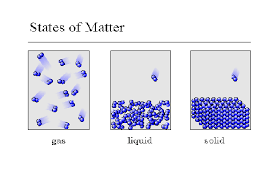
Phase changes are
a physical change
a chemical change
When when kinetic energy is lost, this state condenses into a liquid and the molecules slow down.
Solid
Liquid
Gas
When kinetic energy is lost, this state freezes into a solid and the molecules slow down.
Solid
Liquid
Gas
What is it called when a solid turns directly into a gas?
Sublimation
Condensation
Liquid
All phase changes (changing states) requires energy to be gained or lost.
True
False
Evaporation is . . . .
gas to liquid
liquid to gas
gas to solid
solid to liquid

Examine the image. Which arrow shows the process of condensation?
arrow A
arrow B
arrow C
arrow D
none of the arrow choices


Examine the image. Arrow B shows the process of . . .
melting
deposition
freezing
sublimation
The measurement of average KINETIC ENERGY of molecules in a substance is it's
Deposition
Temperature
Sublimation
Condensation
which of these are true of mass and weight?
weight is measured in grams
Mass is measured in grams
weight is the amount of matter in a substance
mass is the amount of matter in a substance
weight is a force
What are the units of weight?
Kilogram
Newtons
Grams
Pascals
Which unit of length would be best to measure the distance between 2 cities?
centimetres
millimetres
kilometres
metres
The unit does g stand for (a)
Which of these units are measures of length?
millimetres
metres
kilometres
kilograms
millilitres
10mm is equal to
1cm
1m
1dm
10cm

