
Font size
 Worksheets
4.3 Turning effect of forces 2019-2020
Total questions: 23
Worksheet time: 13mins
Which statement gives a complete description of any object that is in equilibrium?
There are no forces acting.
There is no resultant force.
There is no resultant force and no resultant turning effect.
There is no resultant turning effect.
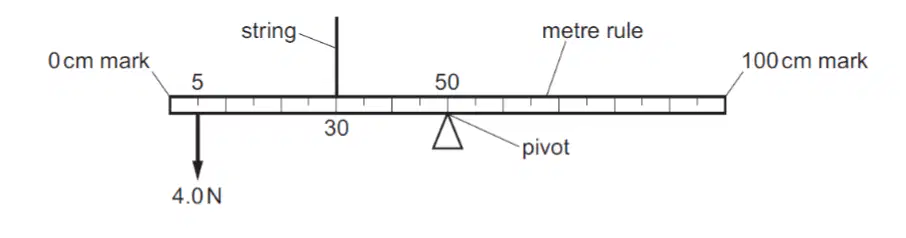
The diagram shows a uniform metre rule.
The rule is pivoted at its mid-point.
A downward force of 4.0 N acts on the rule at the 5 cm mark.
The rule is held by a string at the 30 cm mark.
The rule is in equilibrium.
What is the upward force that the string exerts on the rule?
0.67 N
4.0 N
6.0 N
9.0 N
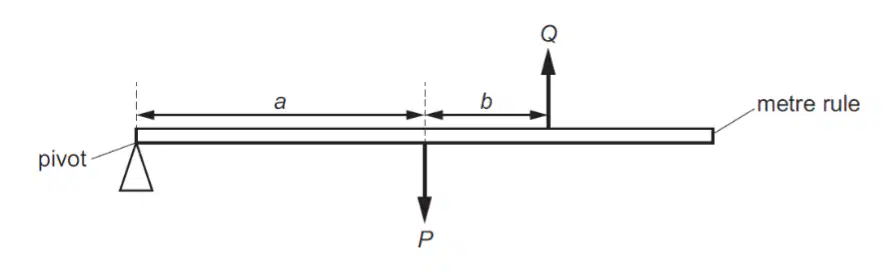
Two forces P and Q act on a metre rule as shown.
The metre rule is pivoted at one end.
The rule starts to rotate in a clockwise direction.
Which statement is correct?
P equals Q
P is less than Q
(P × a) is equal to (Q × b)
(P × a) is greater than (Q × (a + b))
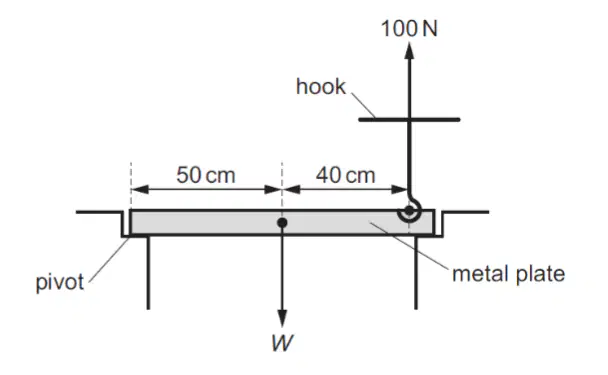
A hook is used to lift a metal plate, as shown.
An upward force of 100 N is needed to lift the metal plate about the pivot, as shown.
What is the weight W of the metal plate?
80 N
100 N
180 N
225 N
What is the unit of the moment of a force?
N
N/kg
N/m
Nm
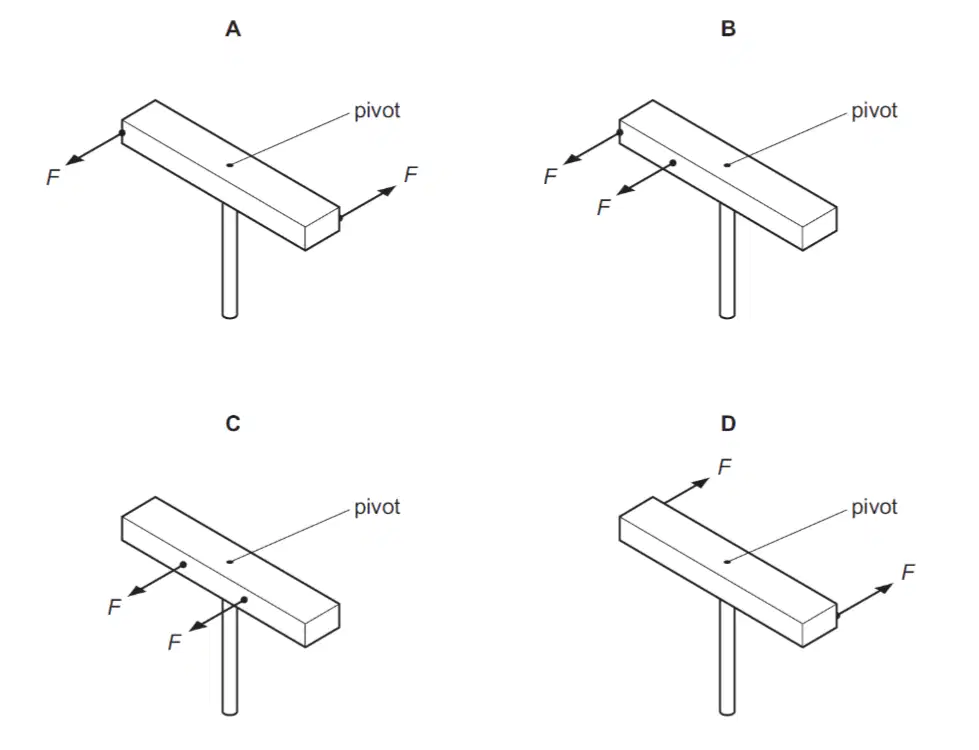
A wooden bar is pivoted at its centre so that it can rotate freely. Two equal forces F are applied to the bar.
In which diagram is the turning effect greatest?
(a)
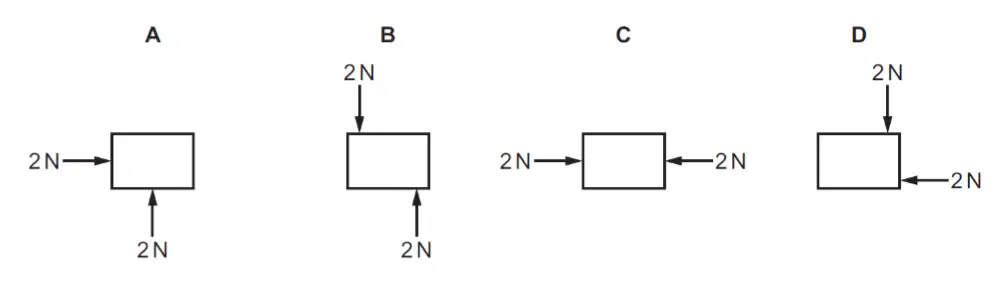
Which object is in equilibrium?
(a)
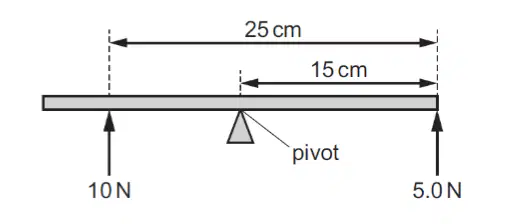
A beam is pivoted at its centre of mass.
It is acted upon by two forces, 10 N and 5.0 N, as shown.
What is the resultant moment about the pivot?
25 N cm anticlockwise
25 N cm clockwise
175 N cm anticlockwise
175 N cm clockwise
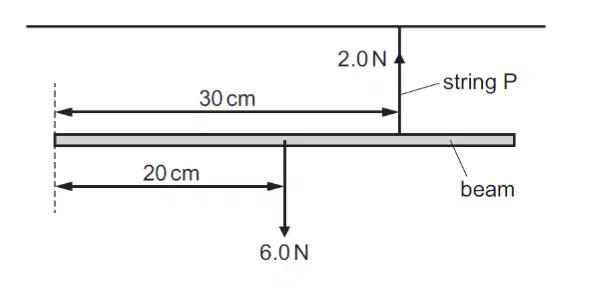
A beam of weight 6.0 N is suspended from two strings P and Q. String P is 30 cm from the left-hand end of the beam.
What is the tension in string Q and where is it attached so that the beam is in equilibrium?
4.0 N at 10.0 cm from the left-hand end
4.0 N at 15.0 cm from the left-hand end
6.0 N at 10.0 cm from the left-hand end
8.0 N at 7.5 cm from the left-hand end
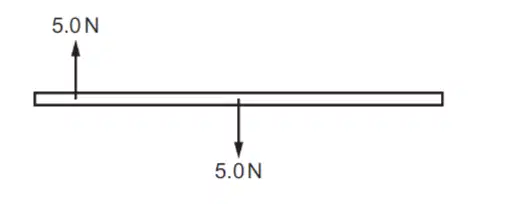
The diagram shows a wooden beam with two forces acting on it.
Which way will the beam move?
accelerate up the page
accelerate down the page
turn anticlockwise
turn clockwise
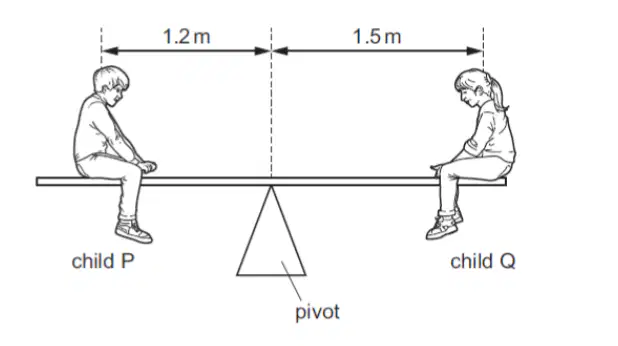
A uniform plank rests on a pivot at its centre.
Two children P and Q sit on the plank in the positions shown.
The mass of child P is 25 kg. The plank is balanced.
What is the mass of child Q?
20 kg
25 kg
31 kg
45 kg
An object is in equilibrium on the Earth. Which statement is correct?
All the forces acting on the object are in the same direction.
All the forces acting on the object have the same value.
The object is weightless.
The resultant force acting on the object is zero.
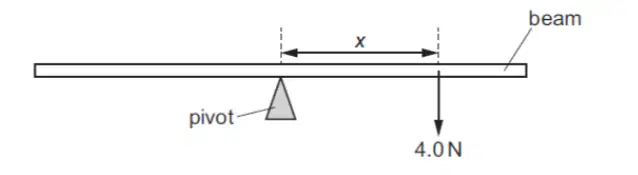
A force of 4.0 N acts on a beam as shown in the diagram.
The line of action of the force is a distance x from a pivot.
The moment of this force about this pivot is 8.0 N cm.
What is distance x?
0.50 cm
2.0 cm
12 cm
32 cm
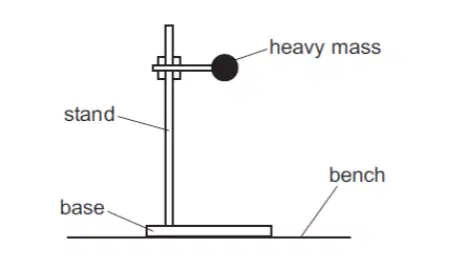
The diagram shows a stand.
The stand holds a heavy mass above the bench.
Which two changes would definitely make the stand more stable?
Lower the mass and make the base narrower.
Lower the mass and make the base wider.
Raise the mass and make the base narrower.
Raise the mass and make the base wider.
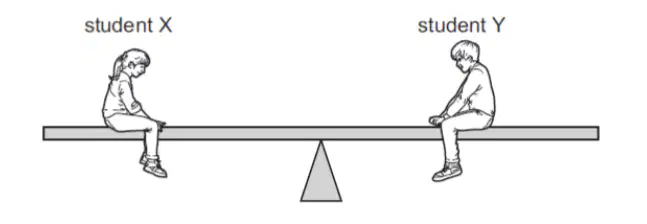
Students X and Y are sitting on a seesaw.
Student X has a weight of 400 N and student Y has a weight of 600 N. The seesaw is in equilibrium.
Which statement correctly describes why the seesaw is in equilibrium?
The resultant force is zero and the resultant moment is zero.
The resultant force is 200 N and the resultant moment is zero.
The sum of the downward forces is zero and the resultant moment is zero.
The total downward force is 1000 N and the resultant moment is 200 N·m.
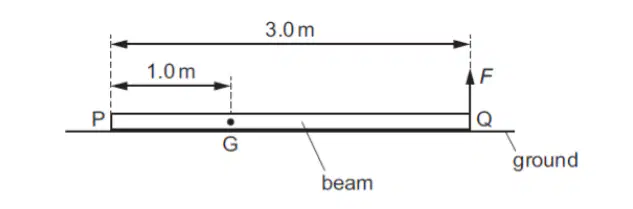
The diagram shows a beam lying on the ground.
End Q is lifted from the ground by the force F.
End P of the beam remains on the ground.
The length of the beam is 3.0 m and its weight is 600 N.
The centre of mass of the beam at G is 1.0 m from end P.
What is the size of the force F when it just raises end Q from the ground?
200 N
300 N
400 N
600 N
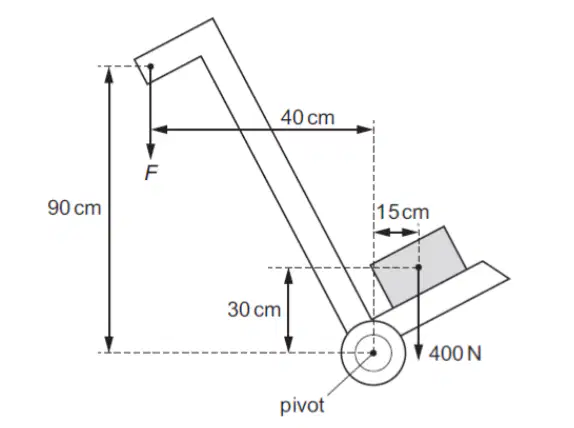
The diagram shows a trolley used to transport a load of 400 N.
A force F vertically downwards is needed to balance the trolley as shown.
The centre of mass of the trolley is vertically above the pivot.
What is the value of F?
133 N
150 N
300 N
400 N
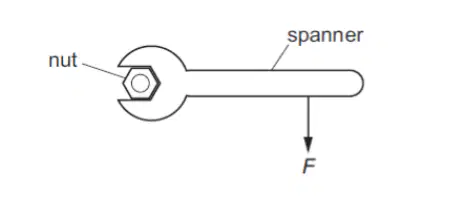
A force F is applied to a spanner, as shown.
Which action increases the moment of F about the centre of the nut?
apply the force F to the end of the spanner handle
apply the force F parallel to the spanner handle
spray oil on the nut
use a shorter spanner
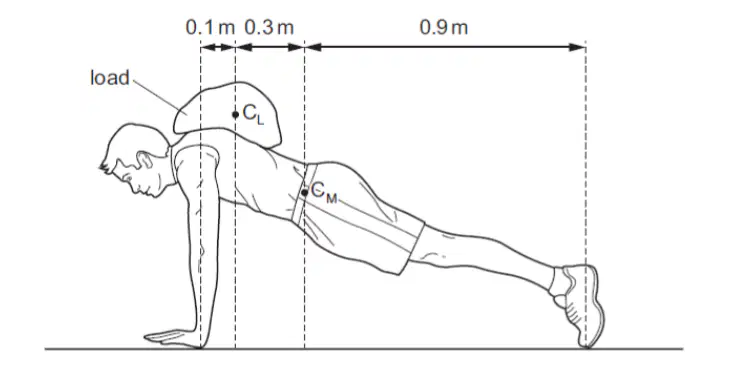
An athlete with mass 70kg trains by performing press-ups with a load on his back.
The diagram shows the perpendicular distances involved.
The centre of mass of the athlete is CM and the centre of mass of the load he is carrying is CL.
The mass of the load is 6.0kg.
What is the upward force exerted by his two arms?
54 N
76 N
540 N
760 N
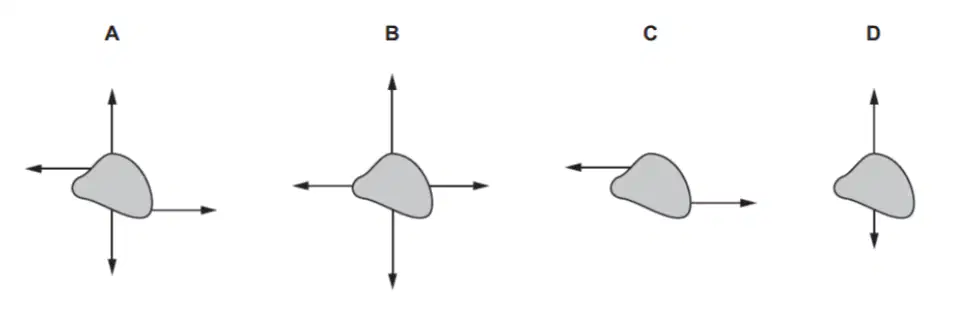
Forces are applied to four identical objects.
The lengths of the arrows indicate the magnitude of each force. Which object is in equilibrium?
(a)
What is meant by the moment of a force on an object?
the magnitude of the force on the object
the direction of the force on the object
the time for which the force acts on the object
the turning effect of the force on the object
Which statement about the moment of a force is not correct?
If an object is balanced about a pivot the resultant moment on the object must be zero.
The moment of a force is a measure of its turning effect.
The moment of a force about a point is equal to: force × perpendicular distance from the point.
The moment of a force about a point increases when the perpendicular distance of the force from the point decreases.
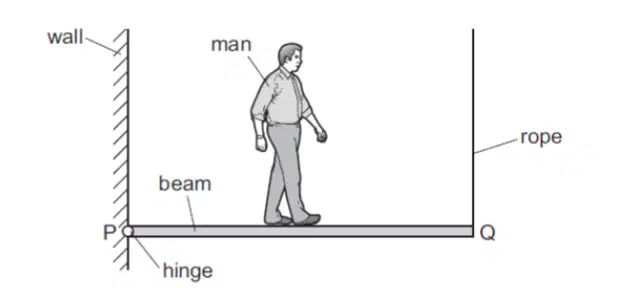
The diagram shows a wooden beam PQ, of negligible weight, which is attached to a wall by a hinge at P and kept in a horizontal position by a vertical rope attached at Q.
The beam is 3.0 m in length.
A man of weight 800 N walks along the beam from P to Q.
What is the distance of the man from P when the tension in the rope at Q becomes equal to 500 N?
0.53 m
1.1 m
1.9 m
2.5 m

