
 Worksheets
Magnetism Fundamentals Exam
Total questions: 58
Worksheet time: 29mins
Which of the following best describes magnetism?
A force that only affects non-metallic materials
One of the fundamental forces that allows materials to attract iron
A type of chemical reaction between metals
A property exclusive to liquids
An electron moving around the nucleus of an atom acts like a tiny loop of electric current. What does this loop create?
A gravitational field
A magnetic field
A chemical reaction
A light wave
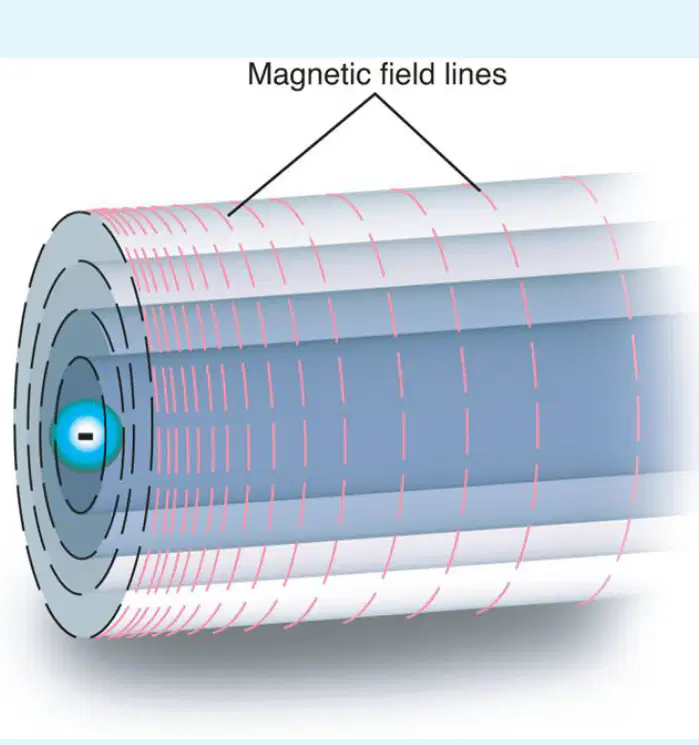
What do the lines in the diagram represent?
Electric current paths
Magnetic field lines
Paths of chemical reactions
Gravitational field lines
What is the term for atoms that have a significant number of protons and electrons that either spin or orbit, resulting in a net magnetic field moving in the same direction?
Magnetic Dipole
Electric Dipole
Gravitational Field
Thermal Domain
Atoms with a net magnetic field moving in the same direction are also known as what?
Magnetic Domain
Electric Domain
Thermal Dipole
Gravitational Dipole
What is a magnetic dipole?
A configuration where two magnetic poles of opposite polarity are separated by a distance, creating a magnetic field around them
A region within a magnetic material where the magnetic moments of atoms are aligned in the same direction
A group of atoms with their net magnetic field moving in different directions
A force field created by electric charges
What is a magnetic domain?
A region within a magnetic material where the magnetic moments of atoms are aligned in the same direction
A single atom with a magnetic field
A configuration of electric dipoles
A force field created by moving charges
What happens when groups of atoms with their net magnetic field move in the same direction?
They form a dipole
They create a magnetic domain
They lose their magnetic properties
They become electrically charged
What are the force fields created when magnetic dipoles orient called?
Lines of force or Lines of flux
Electric fields
Gravitational fields
Thermal fields
What is the SI unit of magnetic flux?
Weber (Wb)
Tesla (T)
Joule (J)
Ampere (A)
What is the direction of the force field energy flow outside a magnet?
South to North
North to South
East to West
West to East
Inside a magnet, in which direction does the force field energy flow?
North to South
East to West
South to North
West to East
Which of the following statements about lines of force in a magnetic field is correct?
Lines of force sometimes intersect
Lines of force always intersect
Lines of force never intersect
Lines of force only intersect inside the magnet
Explain why the flow of force field energy both inside and outside a magnet results in a three-dimensional field around the magnet.
Because the energy only flows in one direction
Because the flow creates a continuous loop, forming a 3D field
Because the lines of force intersect
Because the field is only present outside the magnet
What are the force fields in magnetism also known as?
Lines of flux
Electric currents
Magnetic poles
Magnetic domains
Which unit is used to measure magnetic flux density?
Tesla and Gauss
Joule and Watt
Newton and Pascal
Ampere and Volt
How many Gauss (G) are equivalent to 1 Tesla (T)?
10,000
1,000
100
100,000
What is the value of Earth's magnetic field in Tesla?
0.0001 T
1 T
0.01 T
10 T
Which of the following statements best explains the relationship between the strength of a magnetic field and flux density?
The stronger the magnetic field, the more lines of flux and the greater the flux density.
The weaker the magnetic field, the more lines of flux and the greater the flux density.
The stronger the magnetic field, the fewer lines of flux and the lower the flux density.
The strength of the magnetic field does not affect the flux density.
Which of the following is a natural magnet created when iron oxide remains in the earth's magnetic field for a long time?
Lodestone
Alnico
Neodymium
Electromagnet
What is the main purpose of manufacturing artificial permanent magnets from steel alloy called alnico?
To allow for easier orientation of magnetic dipoles
To increase electrical conductivity
To reduce weight
To improve thermal insulation
Which of the following is NOT a component of the steel alloy alnico used in artificial permanent magnets?
Aluminum
Nickel
Cobalt
Iron oxide
What happens to the magnetic field of an electromagnet when the flow of electrons stops?
The field becomes stronger
The field reverses direction
The field stops
The field becomes permanent
Which of the following is NOT one of the three laws of magnetism?
Repulsion-attraction
The inverse square law
Magnetic Poles
Law of Conservation of Energy
Which law of magnetism describes the relationship between the force of attraction or repulsion and the distance between two magnetic poles?
Repulsion-attraction
The inverse square law
Magnetic Poles
Law of Electromagnetic Induction
A student places two bar magnets so that the north pole of one faces the north pole of the other. What will happen according to the governing laws of magnetism?
The magnets will attract each other.
The magnets will repel each other.
The magnets will lose their magnetic properties.
The magnets will combine to form a larger magnet.
Which statement best summarizes the effect of distance on the influence of a magnetic force field?
The influence increases as the object moves away from the force field
The influence remains unchanged regardless of distance
The influence decreases as the object gets further away due to the increased area affected
The influence is not related to distance at all
If the strength of two magnetic fields increases, what happens to the force between them according to the inverse square law?
The force decreases
The force increases
The force stays the same
The force becomes zero
Explain why a magnet always has both a north and south pole, even after being broken into smaller pieces.
Because the magnetic domains realign to form new poles at the break
Because the material loses its magnetism
Because the poles disappear after breaking
Because only the north pole remains
What is magnetic induction?
The process by which a magnetic substance acquires magnetic properties temporarily due to the presence of a magnet close to it.
The process by which a magnet loses its magnetic properties permanently.
The process by which electricity is generated in a conductor.
The process by which a magnetic field is created by an electric current.
What happens when a non-magnetized iron bar is brought into an external magnetic field?
The dipoles temporarily align to create a magnetic bar.
The iron bar becomes permanently magnetized.
The iron bar loses all its magnetic properties.
The dipoles move randomly and do not align.
What will happen to the dipoles of an iron bar if the bar is removed from the magnetic field?
The dipoles will resume their original random movement.
The dipoles will remain aligned permanently.
The dipoles will become electrically charged.
The dipoles will disappear.
Explain, using reasoning, why magnetic induction is considered a temporary effect in iron bars.
Because the alignment of dipoles only lasts while the magnetic field is present.
Because the iron bar becomes a permanent magnet.
Because the dipoles are permanently aligned.
Because the iron bar changes its chemical composition.
Which of the following best defines permeability in the context of magnetic materials?
The ability of a material to become magnetized
The ability of a material to conduct electricity
The ability of a material to resist deformation
The ability of a material to hold its magnetic properties
What does retentivity refer to in magnetic materials?
The ability of a material to become magnetized
The ability of a material to hold its magnetic properties
The ability of a material to conduct heat
The ability of a material to reflect light
What is the relationship between permeability and retentivity in magnetic materials?
They are directly proportional
They are inversely proportional
They are unrelated
They are equal in all materials
According to Oersted's experiment, what will any moving electrical charge create?
A magnetic field
A gravitational field
A sound wave
A light beam
Which statement best describes the orientation of the magnetic field relative to the direction of a moving charge?
The magnetic field is always perpendicular to the direction of the moving charge
The magnetic field is always parallel to the direction of the moving charge
The magnetic field is always opposite to the direction of the moving charge
The magnetic field is always at a 45-degree angle to the direction of the moving charge
Who demonstrated the study of electromagnetic induction?
Michael Faraday
Isaac Newton
Albert Einstein
James Clerk Maxwell
Which of the following is NOT a required component to induce an electromagnetic field?
Magnetic field
Conductor
Relative motion
Light source
According to Michael Faraday, what must exist between the magnetic lines of force and the wire to create the electric current needed for a magnetic field?
Heat
Motion
Pressure
Light
Explain why relative motion is necessary between the magnetic field and the conductor to induce an electromagnetic field, according to Faraday’s findings.
Relative motion allows the magnetic field to interact with the conductor, generating an electric current.
Relative motion increases the temperature, which is needed for induction.
Relative motion changes the color of the conductor.
Relative motion is needed to align the atoms in the conductor.
Which two fields are inseparable components of an electromagnetic field (EMF)?
Electric field and gravitational field
Electric field and magnetic field
Magnetic field and sound field
Gravitational field and sound field
What is required to create an electromagnetic energy field?
Only a conductor and a magnetic field
Only a magnetic field and movement
A conductor, a magnetic field, and movement or motion
Only a conductor and movement
Why are electric and magnetic fields considered fundamentally linked in an EMF?
Because they are both invisible
Because they are inseparable components of a single unified field
Because they both require a conductor
Because they both require movement
Suppose you have a wire and a magnetic field but no movement. What will happen regarding electromagnetic induction?
An EMF will still be created
No EMF will be created
Only a magnetic field will be present
Only an electric field will be present
What causes electric current to flow in a wire when a magnet is moved near it?
The movement of the magnetic field
The color of the wire
The temperature of the magnet
The length of the wire
Why do electrons line up and move in the same direction when a magnet is moved near a wire?
Because the movement of the magnetic field induces electric current
Because the wire is heated
Because the wire is made of copper
Because the magnet is stationary
If you wanted to induce a current in a coil, which action would be most effective?
Moving a magnet in and out of the coil
Painting the coil
Cooling the magnet
Stretching the wire
Which law states that there are four factors that regulate the strength of the induced current?
Lenz's Law
Ohm's Law
Faraday's Law
Ampere's Law
According to Faraday's Law, what must magnetic lines of force and the wire have relative to each other to induce an electrical current?
The same direction
A motion relative to each other
The same temperature
No interaction
Which law is known as the second law of electromagnetics?
Faraday's Law
Lenz's Law
Newton's Law
Coulomb's Law
What does Lenz's Law determine?
The amount of current produced
The direction in which the current will flow
The resistance of the wire
The temperature of the conductor
Which of the following is a factor that regulates the strength of the induced electromagnetic field according to Faraday’s Law?
Temperature of the conductor
Strength of magnetic field
Length of the conductor
Type of insulation used
Which factor involves the relationship between the direction of the magnetic flux and the conductor in Faraday’s Law?
Angle between lines of flux and conductor
Resistance of the conductor
Length of the coil
Temperature of the coil
Which of the following best describes mutual induction?
The ability of a single coil to induce a current in itself
The results of two coils being placed in close proximity with a varying current supplied to the first coil, which then induces a similar flow in the second coil
The process of converting alternating current to direct current
The resistance of a coil to changes in temperature
What is self-induction?
The ability of a coil to increase its resistance
The ability of an alternating current to switch direction, causing an opposing potential difference to induce against the incoming supply of electrons
The process of generating heat in a conductor
The transfer of energy between two separate coils
When the current in a wire coil changes, what does the resulting magnetic field do?
It accelerates the change in current
It pushes back, trying to slow down the change
It has no effect on the current
It reverses the direction of the current

