
 Worksheets
IGCSE Physics MCQ Revision
Total questions: 498
Worksheet time: 9hrs 48mins


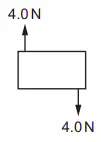
A car moves along a level road.
The diagram shows all of the horizontal forces acting on the car.
Which statement is correct?
The car is slowing down.
The car is speeding up.
The car is moving at a constant speed.
The car is moving backwards.
Which force and distance produce the smallest moment about a pivot?
a 6.0 N force at a perpendicular distance of 4.0m from the pivot
a 7.0 N force at a perpendicular distance of 6.0 m from the pivot.
a 10 N force at a perpendicular distance of 4.0 m from the pivot
a 12 N force at a perpendicular distance of 3.0 m from the pivot.

The diagram shows a tug-of-war between team X and team Y. The arrows show the forces exerted by the teams on the rope.
What is the size of the resultant force on the rope and in which direction does the resultant force act?
size of resultant force = 75 N; direction of resultant force = to the left
size of resultant force = 75 N; direction of resultant force = to the right.
size of resultant force = 725 N; direction of resultant force = to the left
size of resultant force = 725 N; direction of resultant force = to the right.
An object of mass 50 kg accelerates from a velocity of 2 m/s to a velocity of 10 m/s in the same direction. What is the impulse provided to cause this acceleration?
250 Ns
400 Ns
850 Ns
2500 Ns

A T-shaped girder is placed on the ground in position X. it is then turned over to position Y. What happens to the force on the ground and what happens to the pressure on the ground?
force increases, pressure increases
force increases, pressure remains the same
force remains the same, pressure increases
force remains the same, pressure remains the same
A cyclist travels down a hill from rest at point X, without pedalling. The cyclist applies his breaks and the cycle stops at point Y. which energy changes have taken place between X and Y?
Gravitational potential -> kinetic -> thermal (heat)
Gravitational potential -> thermal (heat) -> kinetic
kinetic -> gravitational potential -> thermal (heat)
kinetic -> thermal (heat) -> gravitational potential
A skier walks from the bottom of a ski slope to the top and gains 10,000J of gravitational potential energy. She skis down the slope. At the bottom of the slope, her kinetic energy is 2000J. How much energy is dissipated in overcoming friction and air resistance as the skier moves down the slope?
2000J
8000J
10,000J
12,000J
Which energy source is one that is used to boil water to make steam in power stations?
energy from tides
energy from waves
hydroelectric energy
nuclear energy
Which energy source is renewable and reliably available at all times?
coal
geothermal
nuclear
wind

The diagram shows a ball hanging on a string. The ball swings from point W to point Z and back to point W.
Which statement about the ball is correct?
The kinetic energy of the ball is greatest at point W.
The kinetic energy of the ball is greatest at point X
The kinetic energy of the ball is greatest at point Y.
The kinetic energy of the ball is the same at all points of the swing.

Diagram 1 shows a measuring cylinder containing water.
Five identical steel balls are now lowered into the measuring cylinder. Diagram 2 shows the new water level in the cylinder.
What is the volume of each steel ball?
6 cm3
14 cm3
30 cm3
70 cm3

A
B
C
D

A
B
C
D

A
B
C
D

A solar panel is used to recharge a battery. The solar panel produces 0.80 W of electrical power.
The panel is 20% efficient.
What is the power input of the sunlight onto the solar panel?
0.16 W
4.0 W
8.0 W
16 W
What is the formula to calculate speed?
Speed = Distance - Time
Speed = Distance / Time
Speed = Time / Distance
Speed = Distance x Time
What is the difference between speed and velocity?
Speed and velocity both have direction and magnitude
Velocity is a scalar quantity, while speed is a vector quantity
Speed and velocity are the same thing
Speed is a scalar quantity, while velocity is a vector quantity.
What is Newton's first law of motion?
An object at rest will stay at rest, and an object in motion will stay in motion with the same speed and in the same direction unless acted upon by an unbalanced force.
An object in motion will change direction without any external force
An object in motion will slow down and eventually stop
An object at rest will start moving on its own
What is the unit of force?
Second (s)
Meter (m)
Newton (N)
Kilogram (kg)
What is the formula to calculate work done?
Acceleration x Distance
Mass x Distance
Force x Distance
Velocity x Time
What is the relationship between force, mass, and acceleration?
F = m/a
F = am
F = a/m
F = ma
What is the principle of conservation of energy?
Energy cannot be created or destroyed, only transformed from one form to another.
Energy can only be transformed into one specific form
Energy can be destroyed completely
Energy can be created out of nothing
What is the difference between potential energy and kinetic energy?
Potential energy is always positive, while kinetic energy can be negative.
Potential energy is due to position or state, while kinetic energy is due to motion.
Potential energy is related to sound, while kinetic energy is related to light.
Potential energy is only found in living organisms, while kinetic energy is only found in non-living objects.
What is the formula to calculate gravitational potential energy?
mgh^2
mg/h
mgh
mgh+2
What is the law of conservation of energy?
Energy can only be transformed into matter
Energy can be destroyed completely
Energy can be created out of nothing
Energy cannot be created or destroyed, only transformed from one form to another.
What is the equation for average speed
average speed = distance / time
average speed = time / distance
average speed = distance x time
what is the unit of speed
m
s
m/s
m/s2
what is the unit of acceleration
m
s
m/s
m/s2
which 2 formula below are correct if using the acceleration equation?
v = a = ( v-u)
t = ( v -u) / a
a = ( v - u) / t
u = v + at
which formula links acceleration. mass and force?
a = Fm
F = ma
F = m/a
m = Fa
How do we calculate weight?
W = m t
W = m g
What is the unit of weight?
m/s
N
N/kg
kg
g has a value of 10 on Earth but which 2 units can be used for g
N/kg
m/s
m/s2
N
what is the equation for efficiency
= useful energy output / total energy output
= non useful energy output / total energy input
what is the unit of work done?
m
N
J
W
What is the equation for average speed
average speed = distance / time
average speed = time / distance
average speed = distance x time
what is the unit of speed
m
s
m/s
m/s2
what is the unit of acceleration
m
s
m/s
m/s2
which 2 formula below are correct if using the acceleration equation?
v = a = ( v-u)
t = ( v -u) / a
a = ( v - u) / t
u = v + at
which formula links acceleration. mass and force?
a = Fm
F = ma
F = m/a
m = Fa
How do we calculate weight?
W = m t
W = m g
What is the unit of weight?
m/s
N
N/kg
kg
g has a value of 10 on Earth but which 2 units can be used for g
N/kg
m/s
m/s2
N
what is the equation for efficiency
= useful energy output / total energy output
= non useful energy output / total energy input
what is the unit of work done?
m
N
J
W
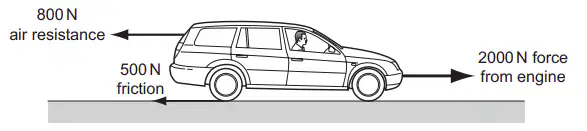
A car moves along a level road.
The diagram shows all of the horizontal forces acting on the car.
Which statement is correct? (2013 M/J)
The car is slowing down.
The car is speeding up.
The car is moving at a constant speed.
The car is moving backwards.
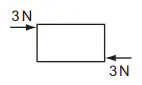
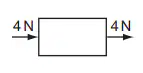
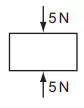
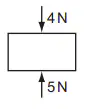
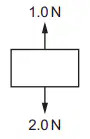
The diagrams show different objects, each being acted upon by only the two forces shown.
Which object is in equilibrium? (2013 M/J)
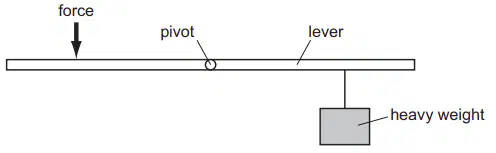
The diagram shows a force being applied to a lever to lift a heavy weight.
Which change would enable the heavy weight to be lifted with a smaller force? (2013 M/J)
Move the force to the right.
Move the heavy weight to the right.
Move the force to the left.
Move the pivot to the left.
A force acting on an object causes some properties of the object to change.
Which list contains only properties that can be changed by the action of the force? (2013 O/N)
mass, motion and shape
mass, motion and size
mass, shape and size
motion, shape and size
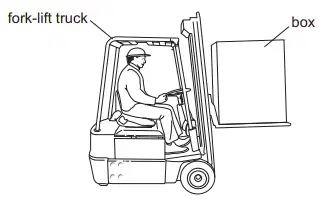
A box is being moved by a fork-lift truck. The total weight of the box is 3000N.
The force exerted by the fork-lift truck on the box is 3500N upwards.
What is the resultant force on the box? (2013 O/N)
500N downwards
500N upwards
6500N downwards
6500N upwards
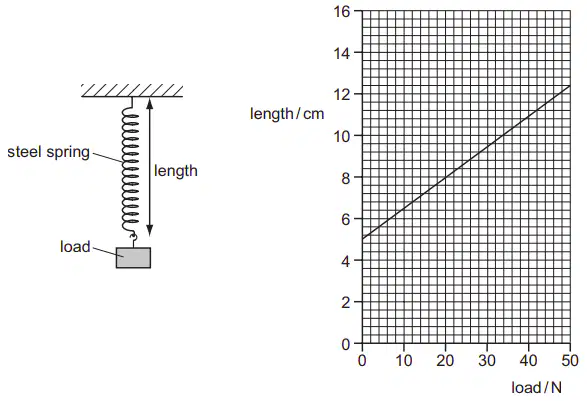
The diagrams show a steel spring and a graph of its length against the load applied to it.
What is the extension of the spring when a load of 20N is applied to it? (2013 O/N)
3.0 cm
4.5 cm
5.0 cm
8.0 cm
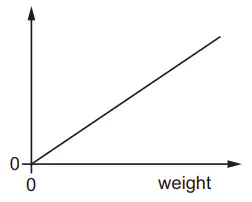
A student adds weights to an elastic cord. He measures the length of the cord for each weight.
He then plots a graph from the results, as shown.
What has he plotted on the vertical axis? (2014 M/J)
measured length
original length
(measured length + original length)
(measured length – original length)
Which situation is an example of a force acting over a large area to produce a small pressure? (2014 M/J)
a builder hammering a nail into a piece of wood
a cook using a sharp knife to cut vegetables
a nurse pushing a needle into a patient’s arm
a soldier marching in flat-soled boots
In which situation is no resultant force needed? (2014 O/N)
a car changing direction at a steady speed
a car moving in a straight line at a steady speed
a car slowing down
a car speeding up
Which properties of a body can be changed by applying a force to the body? (2014 O/N)
mass, motion and shape
mass and motion, but not shape
mass and shape, but not motion
motion and shape, but not mass
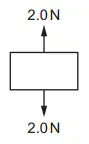
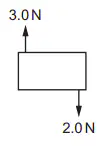
Four objects are each acted on by only two forces, as shown.
Which object is in equilibrium? (2015 M/J)
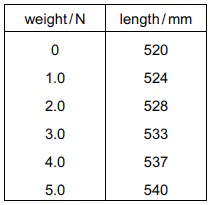
A student measures the length of a spring. She then hangs different weights from the spring. She measures the length of the spring for each different weight.
The table shows her results.
What is the extension of the spring when the weight hung from it is 3.0N? (2015 M/J)
4 mm
5 mm
12 mm
13 mm
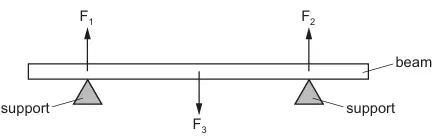
A heavy beam rests on two supports.
The diagram shows the only three forces F1, F2 and F3 acting on the beam.
The beam is in equilibrium.
Which statement is correct? (2015 O/N)
All the forces are equal in size.
The resultant force on the beam is in the opposite direction to the resultant turning effect.
The resultant force on the beam is zero and the resultant turning effect on the beam is zero.
The total upward force is twice the total downward force.
A feather falls through the air.
Its downward speed is constant.
Which statement about the feather is correct? (2016 M/J)
No energy is lost to the air as the feather falls.
The air resistance acting on the feather is greater than its weight.
The feather experiences no resultant vertical force.
There is a resultant downward force on the feather.
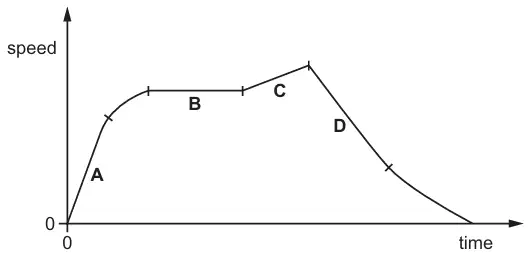
A car travels along a straight road.
The speed-time graph for this journey is shown.
During which labelled part of the journey is the resultant force on the car zero? (2016 M/J)
A
B
C
D
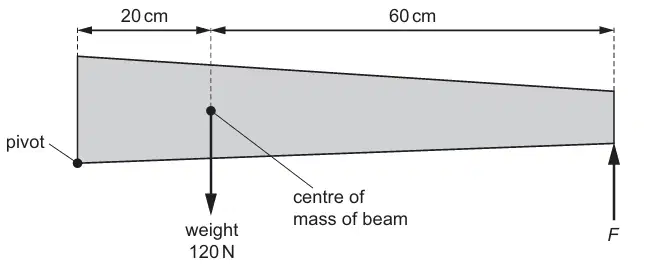
The diagram shows a non-uniform beam of weight 120 N, pivoted at one end.
The beam is kept in equilibrium by force F.
What is the value of force F? (2016 M/J)
30 N
40 N
360 N
480 N
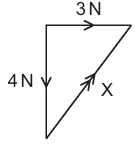
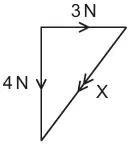
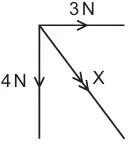
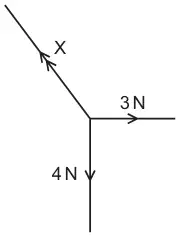
An object is acted upon by a 3 N force and by a 4 N force.
Each diagram shows the two forces.
Which diagram also shows the resultant X of these two forces? (2016 M/J)
The engine of a car produces a driving force of 5000 N on the car.
Resistive forces R also act on the car, as shown.
The car has a mass of 800 kg and an acceleration of 1.0 m/s2.
What is the value of R? (2016 M/J)
800 N
4200 N
5800 N
8000 N
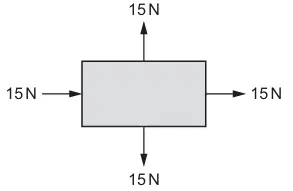
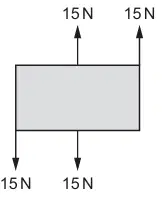
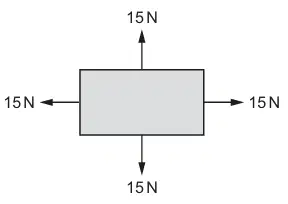
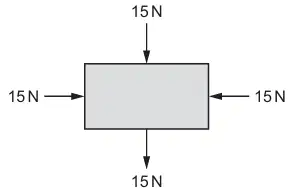
Each diagram shows all the forces acting on an object.
In which diagram is the object in equilibrium? (2016 O/N)
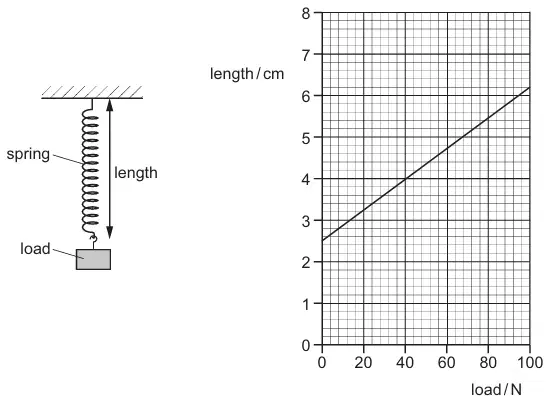
The diagrams show a spring and a graph of the length of the spring against the load applied to it.
What is the extension of the spring when a load of 40 N is applied to it? (2016 O/N)
1.5 cm
2.5 cm
4.0 cm
6.5 cm
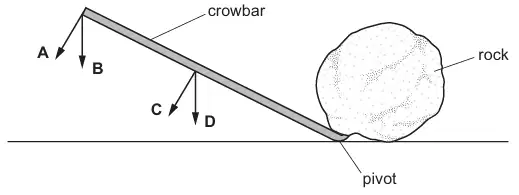
A force is applied to a long crowbar so as to move a large rock.
Which labelled arrow represents the smallest force needed to move the rock? (2016 O/N)
A
B
C
D


Which statement is correct
Energy cannot be created or destroyed
Energy can be destroyed but not created
Energy is always created but never destroyed
Energy cannot be created but never destroyed
4 m.

An arrow in a bow had 70J of PE. Assuming no loss of energy to heat, how much KE will it have after it has been shot?
0J
35J
50J
70J
The formula for power is
power = force × time
power = timechange energy
power = distancechange speed
power = 21mv2
Unit for power is
Watts (W)
Joules
Amperes
voltage


Near the ceiling of a room the air is warmer. The warm air rises because of
conduction
convection
radiation
The hotter an object the more infrared radiation is given off (T/F).
True
False


Hot air rises because it is ...?
Less dense than the surroundings
More dense than the surroundings
molecules expand and become ligher
molecules become lighter
A good insulator is made up of small air pockets. Why? More than 1 is correct.
Air is a good insulator against conduction
Small air pockets reduce the size of convection currents
Air is good at absorbing IR radiation
Air is great at reflecting IR radiation

Why do these marathon runners have silver foil around them after finishing the race? Choose two.
It reflects the IR radiation emitted by the body, keeping the runner warm
It absorbs the IR radiation, keeping the runner warm
It reduces conduction
It reduces the size of the convection current

A
B
C
D

A
B
C
D

A
B
C
D
Some gas in a sealed plastic bag is placed in a refrigerator to cool down. How do the gas molecules behave when this happens?
They move more quickly and are closer together.
They move more quickly and are further apart.
They move more slowly and are closer together.
They move more slowly and are further apart.

A measured mass of gas is placed in a cylinder at atmospheric pressure and is then slowly compressed.
If the temperature of the gas does not change, what happens to the pressure of the gas?
It drops to zero.
It decreases, but not to zero.
It stays the same.
It increases.
A mercury-in-glass thermometer is to be used to measure temperatures from 0 °C to 100 °C. Why is mercury suitable?
Mercury expands when heated.
Mercury has a boiling point below 100 °C.
Mercury has a melting point above 0 °C.
Mercury is a poor conductor.

A block of ice is heated at a constant rate. Eventually the melted ice boils. The graph shows how the temperature changes with time.
How many minutes did it take to melt all the ice?
4
7
11
13
How does thermal energy (heat energy) travel through the vacuum between the Earth and the Sun?
by conduction
by convection
by radiation
by radioactive decay

Two plastic cups are placed one inside the other. Hot water is poured into the inner cup and a lid is put on top as shown.
Which statement is correct?
Heat loss by radiation is prevented by the small air gap.
No heat passes through the sides of either cup.
The bench is heated by convection from the bottom of the outer cup.
The lid is used to reduce heat loss by convection.

Which line in the table correctly describes whether the molecules of a solid, liquid and gas are moving or stationary?
A
B
C
D
Driving a car raises the temperature of the tyres. This causes the pressure of the air in the tyres to increase. Why is this?
Air molecules break up to form separate atoms.
Air molecules expand with the rise in temperature.
The force between the air molecules increases.
The speed of the air molecules increases.

The diagram shows how the atoms in a substance rearrange themselves during a change of state.
Which change of state is shown?
gas to liquid
liquid to gas
liquid to solid
solid to liquid

Equal masses of two different liquids are put into identical beakers. They are heated from 20 °C to 30 °C by heaters of the same power. Liquid 2 takes twice as long to heat as liquid 1.
Which statement is correct?
Both liquids receive the same amount of energy.
Liquid 1 receives more energy than liquid 2.
The thermal capacity of liquid 1 is equal to the thermal capacity of liquid 2.
The thermal capacity of liquid 1 is less than the thermal capacity of liquid 2.
There is a vacuum between the double walls of a vacuum flask. Which types of heat transfer are reduced by the vacuum?
conduction and convection
conduction and convection
convection and radiation
conduction, convection and radiation
The diagrams show four identical pieces of ice that are heated in test-tubes of water. In which test-tube will the ice take the longest time to melt?


When water evaporates, some molecules escape. Which molecules escape?
the molecules at the bottom of the liquid with less energy than others
the molecules at the bottom of the liquid with more energy than others
the molecules at the surface with less energy than others
the molecules at the surface with more energy than others

Two metal boxes containing air are standing in a room. Box X is on top of a heater. Box Y is on a bench. The boxes are left for a long time.
Which line in the table best describes the average speed of the molecules in the containers?
box X fast
box Y zero
box X fast
box Y slow
box X slow
box Y fast
box X zero
box Y fast

The top of the mercury thread in a mercury-in-glass thermometer reaches point X at 0 °C and point Z at 100 °C.
point W
point X
point Y
point Z
The same quantity of heat energy is applied to four different blocks. The temperature rise produced is shown on each block. Which block has the highest thermal capacity?


A person holds a glass beaker in one hand and fills it quickly with hot water. It takes several seconds before his hand starts to feel the heat. Why is there this delay?
Glass is a poor conductor of heat.
Glass is a good conductor of heat.
Water is a poor conductor of heat.
Water is a good conductor of heat.

The diagram shows a heater used to heat a tank of cold water.
What is the main process by which heat moves through the water?
conduction
convection
evaporation
radiation

A student places his thumb firmly on the outlet of a bicycle pump, to stop the air coming out.
What happens to the pressure and to the volume of the trapped air as the pump handle is pushed in?
pressure decreases, volume decreases
pressure decreases, volume remains the same
pressure increases, volume decreases
pressure increases, volume remains the same
A balloon is inflated in a cold room. When the room becomes much warmer, the balloon becomes larger. How does the behaviour of the air molecules in the balloon explain this?
The molecules become larger.
The molecules evaporate.
The molecules move more quickly.
The molecules repel each other.

A glass flask full of cool water is placed in a container of hot water.
What will happen to the level of water at X as the cool water becomes warmer?
It will fall.
It will rise.
It will rise then fall.
It will stay the same.

An experiment is set up to find out which metal is the best conductor of heat. Balls are stuck with wax to rods made from different metals, as shown in diagram X. The rods are heated at one end. Some of the balls fall off, leaving some as shown in diagram Y. Which labelled metal is the best conductor of heat?
A
B
C
D

A substance is heated at a steady rate. It changes from a solid to a liquid, and then to a gas. The graph shows how its temperature changes with time.
Which parts of the graph show a change of state taking place?
P and R
P and S
Q and R
Q and S

An engineer wants to fix a steel washer on to a steel rod. The rod is just too big to fit into the hole of the washer.
How can the engineer fit the washer onto the rod?
cool the washer and put it over the rod
cool the washer and rod to the same temperature and push them together
heat the rod and then place it in the hole
heat the washer and place it over the rod

Thermometer X is held above an ice cube and thermometer Y is held the same distance below the ice cube. After several minutes, the reading on one thermometer changes. The ice cube does not melt.
Which thermometer reading changes and why?
X, cool air rises from the ice cube
X, warm air rises from the ice cube
Y, cool air falls from the ice cube
Y, warm air falls from the ice cube
Which statement about evaporation is correct?
evaporation causes the temperature of the remaining liquid to decrease
evaporation does not occur from a cold liquid near its freezing point
evaporation does not occur from a dense liquid, such as mercury
evaporation occurs from all parts of a liquid
Gas is stored in a sealed container of constant volume. The temperature of the gas increases. This causes the pressure of the gas to increase. What happens to the gas molecules during this pressure increase?
The average kinetic energy of the molecules increases
The average separation of the molecules decreases
The average separation of the molecules increases
The volume of each molecule increases
Which causes the random, zig-zag movement (Brownian motion) of smoke particles suspended in air?
air molecules colliding with smoke particles
convection currents as the hot smoke rises
smoke particles colliding with each other
smoke particles reacting with oxygen molecules in the air

A sealed gas cylinder is left outside on a hot, sunny day. What happens to the average speed of the gas molecules and to the pressure of the gas in the cylinder as the temperature of the gas rises?
A
B
C
D
A swimmer feels cold after leaving warm water on a warm, windy day. Why does she feel cold even though the air is warm?
the less energetic water molecules on her skin escape quickly
the more energetic water molecules on her skin do not escape quickly
the water on her skin does not evaporate quickly enough to keep her warm
the water on her skin evaporates quickly and cools her skin
A car tyre has a constant volume. Why does the pressure of the air in the tyre increase when its temperature increases?
the air molecules hit each other less often
the air molecules hit the inside of the tyre less often
the average speed of the air molecules in the tyre is greater
there are more air molecules in the tyre

A student places his thumb firmly on the outlet of a bicycle pump, to stop the air from coming out. What happens to the pressure and what happens to the volume of the trapped air as the pump handle is pushed in?
A
B
C
D

Some gas is trapped in a container of fixed volume. The temperature of the gas increases. Which graph shows how the pressure of the gas changes with temperature?
A
B
C
D

The volume of a gas in a sealed syringe is increased. The temperature of the gas does not change. After this change is made, what has happened to the gas molecules in the syringe?
they move more quickly
they move more slowly
they hit the syringe walls less often
the hit the syringe walls more often

The pressure of a fixed mass of a cylinder is measured. The volume of the gas in the cylinder is then slowly decreased. The temperature of the gas does not change. Which graph could show the change of pressure of the gas during this process?
A
B
C
D

A student suggests some uses for containers made from good thermal conductors and for containers made from poor thermal conductors? In which row are both suggested uses correct?
A
B
C
D

Two plastic cups are placed one inside the other. A small spacer keeps the two cups separated. Hot water is poured into the inner cup and a lid is put on top, as shown. Which statement is correct?
The bench is heated by convection from the bottom of the outer cup
The lid reduces the energy lost by convection
There is no thermal conduction through the sides of either cup
Thermal radiation is prevented by the small air gap

A solid is heated from room temperature. The graph shows how its temperature changes with time as it is heated constantly. At which time has it just become completely liquid?
A
B
C
D

The diagram shows a vacuum flask used to keep liquid hot. How does thermal energy pass through the vacuum?
conduction only
convection only
radiation only
conduction and convection

The diagram shows a block of ice placed in a warm room. At which point is the temperature the lowest?
A
B
C
D

The air in a room is heated by a heater. The diagram shows the circulation of the air in the room. Which statement about the air that is heated is correct?
The air contracts and become less dense
The air contracts and becomes more dense
The air expands and becomes less dense
The air expands and becomes more dense

In a refrigerator, the cooling unit can be fitted either at the top or at the bottom. In an oven, the heater can be fitted either at the top or at the bottom. Which row shows the best position for the cooling unit and the best position for the heater?
A
B
C
D

Ice is trapped by a metal gauze at the bottom of a tube containing water. The water is heated strongly at the top, but the ice only melts very slowly. Why does the ice melt so slowly?
heat energy always travels upwards
hot water is more dense than cold water
metal gauze does not allow heat to pass through
water is a poor conductor of heat

One type of double glazing consists of two panes of glass separated by a vacuum. Which method or methods of energy transfer are prevented by the vacuum?
conduction and convection
conduction and radiation
convection and radiation
radiation only

A substance loses thermal energy (heat) to the surroundings at a steady rate. The graph shows how the temperature of the substance changes with time. What could the portion PQ of the graph represent?
gas condensing
gas cooling
liquid cooling
liquid solidifying

Which row shows the surface that is the better absorber and the surface that is the better emitter of infra-red radiation?
A
B
C
D
One end of a copper rod is heated. What is one method by which thermal energy is transferred in the copper rod?
free electrons transfer energy from the cooler end to the hotter end
free electrons transfer energy from the hotter end to the cooler end
molecules of copper move from the cooler end to the hotter end
molecules of copper move from the hotter end to the cooler end
The same quantity of thermal energy is supplied to two solid objects A and Y. The temperature increase of object X is greater than the temperature increase of object Y. Which statement explains this?
X has a lower melting point than Y
X has a lower density than Y
X has a lower thermal capacity than Y
X is a better thermal conductor than Y
Which quantity gives the thermal capacity of a beaker?
the thermal energy required to change the state of the beaker at constant temperature
the thermal energy required to raise the temperature of the beaker by 1 degree Celsius
the total mass of hot liquid that the beaker can hold
the total volume of hot liquid that the beaker can hold

The table lists the melting points and the boiling points of four different substances. Which substance is a liquid at 0 degrees Celsius?
A
B
C
D

The diagram shows electricity cables being put up on a warm day. The cables are left loose between the poles, as shown in the diagram. Why are the cables left loose?
they will contract on cold days
they will contract on very warm days
they will expand on cold days
they will expand on very warm days

A long thin bar of cooper is heated evenly along its length. What happens to the bar?
it becomes less heavy
it becomes longer
it becomes shorter
it bends at the ends
A circular metal disc is heated. Which quantity decreases?
density
diameter
thickness
volume

In an experiment, a thermometer is placed in a test tube of hot liquid. The temperature of the liquid is recorded every half minute. The table shows the results. What is the melting point of the substance?
0 degrees Celsius
33 degrees Celsius
55 degrees Celsius
73 degrees Celsius

Equal masses of two different liquids are put into identical beakers. Liquid 1 is heated for 100s and liquid 2 is heated for 200s by heaters of the same power. The temperature of both liquids increases by the same amount. Which statement is correct?
both liquids receive the same amount of energy
liquid 1 receives more energy than liquid 2
both liquids have equal thermal capacity
the thermal capacity of liquid 1 is less than thermal capacity of liquid 2

Equal masses of two different liquids are heated using the same heater. The graph shows how the temperature of each liquid changes with time. What does the graph tell us about the liquids?
Liquid 1 has a higher melting point than liquid 2
Liquid 1 has a higher boiling point than liquid 2
Liquid 1 starts to melt sooner than liquid 2
Liquid 1 starts to boil sooner than liquid 2
Which pair contains only physical quantities that vary with temperature and so could be used in making a thermometer?
activity of a radioactive source, volume of a gas
mass of a liquid, volume of a liquid
activity of a radioactive source, mass of a solid
volume of a gas, volume of a liquid
A heater supplies 80J of energy to a block of metal. The temperature of the block rises by 20 degrees Celsius. What happens to the block of metal when its temperature falls by 10 degrees Celsius?
its internal energy decreases by 40J
its internal energy decreases by 160J
its internal energy increases by 40J
its internal energy increases by 160J
A solid object has a very large thermal capacity. What does this mean?
a large amount of energy is needed to make the object become hot
a large amount of energy is needed to make the object melt
a small amount of energy is needed to make the object become hot
a small amount of energy is needed to make the object melt
K = Degrees Celsius + __________
What is internal energy
the average kinetic energy of the particles
heat energy
the sum of the kinetic and potential energy
the average potential energy
Convert
450 K to Celsius723oC
277oC
177 oC
623oC
What is the boiling point of water on the Kelvin scale?
0K
373K
100K
212K
What is the freezing/melting point of water of the Fahrenheit scale?
−273oF
0oF
32oF
273oF


Waves on the surface of water travel from deep to shallow water. Which diagram shows the correct path of the waves in the shallow water?


Which change will increase the diffraction of a wave as it passes through a gap?
What is ultrasound?
sound waves that are so loud that they damage human hearing
sound waves that are too high-pitched for humans to hear
sound waves that are too low-pitched for humans to hear
sound waves that are too quiet for humans to hear

In the diagram, the mountaineer can hear the stream although he cannot see it. When he is closer to the gully, he can both hear and see the stream. When he is further from the gully, he can neither hear nor see the stream.
Which statement is NOT correct?
As he approaches the gully edge, the sound becomes louder.
As he approaches the gully edge, he hears first the short wavelength, higher frequencies and then the long wavelength, lower frequencies.
He hears the stream because some of the sound is diffracted.
He hears the stream because some of the sound is reflected from the opposite wall of the gully.

The diagrams show examples of wave motion. Which waves are longitudinal?
1 only
2 and 3 only
2, 3, and 4
2, and 4 only

The diagram shows compressions and rarefactions in air as a sound wave moves from left to right. A quieter sound of the same frequency is made.
What will happen to the number of particles in a region of rarefaction and in a region of compression?
Rarefaction: Decrease | Compression: Decrease
Rarefaction: Decrease | Compression: Increase
Rarefaction: Increase | Compression: Decrease
Rarefaction: Increase | Compression: Increase
A fire alarm is not loud enough and the pitch is too low. An engineer adjusts the alarm so that it produces a louder note of a higher pitch.
What effect does this have on the amplitude A and on the frequency F of the sound?
A: larger | F: greater
A: larger | F: smaller
A: smaller | F: greater
A: smaller | F: smaller
Two beams of light are both the same colour of red. One beam is travelling through air. The other beam is travelling through water. Each beam has a different brightness.
Which quantity is the same for both sets of waves?
Amplitude
Frequency
Speed
Wavelength

The diagram shows a ray of light in air incident on a glass block. Some of the light is refracted and some of the light is reflected. Two angles, p and q, are marked on the diagram.
Which answer gives the angle of incidence (p or q) and states whether total internal reflection occurs (yes/no)?
p, no
p, yes
q, no
q, yes

The diagram shows a ray of light in glass incident on the surface between the glass and air.
What happens if the angle of incidence is made larger than the critical angle for the glass?
The angle of refraction becomes equal to 90 degrees
There is a refracted ray, and a ray inside the glass.
There is a refracted ray only.
There is only a ray reflected inside the glass.

The diagram shows how a ray of light refracts when going from air to Perspex. The critical angle of Perspex is c. Which expression is correct?
sin x / sin z = sin c
sin z / sin x = sin c
sin w / sin y = sin c
sin y / sin w = sin c

The letter F is reflected in a mirror. What does the optical image look like?


In the diagram, the mountaineer can hear the stream although he cannot see it. When he is closer to the gully, he can both hear and see the stream. When he is further from the gully, he can neither hear nor see the stream.
Which statement is NOT correct?
As he approaches the gully edge, he hears first the short wavelength, higher frequencies and then the long wavelength, lower frequencies.
As he approaches the gully edge, the sound becomes louder.
He hears the stream because some of the sound is diffracted.
He hears the stream because some of the sound is reflected from the opposite wall of the gully.
Which diagram shows what happens when a ray of white light passes through a prism?


Light travels in a vacuum and then enters a glass block. The speed of the light in the glass block is 2.0 x 10^8 m/s.
Which statement about the speed of light is correct?
The speed in a vacuum is 1.5 times the speed in the glass.
The speed in the glass is the same as the speed in a vacuum.
The speed in the glass is 1.5 times the speed in a vacuum.
The speed in the glass is 1.0 x 10^8 times the speed in a vacuum.
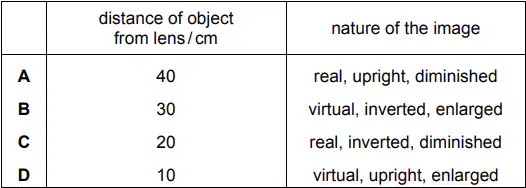

The speed of light in air is 3.0 x 10^8 m/s. The critical angle for light in a transparent plastic material placed in air is 37°. What is the speed of light in the plastic material?
A sound wave travels from air into water. Which row describes what happens to the frequency and the wavelength of the wave?
Frequency: decreases; Wavelength: increases
Frequency: decreases; Wavelength: stays the same
Frequency: stays the same; Wavelength: decreases
Frequency: stays the same; Wavelength: increases
The horn of a ship makes a sound. The captain on the ship hears an echo from a cliff 4.0 s later. When the speed of sound is 340m/s, what's the distance between the cliff and the ship?
170 m
340 m
680 m
1360 m
The diagrams represent water waves in a tank. Which diagram represents a wave that changes speed?

A

C

D

A tank contains water. Ripples are produced on the surface of the water. Refraction is observed. What causes the ripples to refract?
The cold water in the tank is replaced by warm water
The ripples change speed as they move from deep to shallow water
The ripples hit the wall of the tank
The ripples pass through a narrow gap
Infrared radiation from the Sun disappears before visible light and ultraviolet radiation.
Ultraviolet radiation from the Sun disappears before visible light and infrared radiation.
Visible light from the Sun disappears before ultraviolet radiation and infrared radiation
Infrared radiation, ultraviolet radiation and visible light from the Sun all disappear at the same moment.
light waves, radio waves, gamma-rays
light waves, sound waves, gamma-rays
radio waves, sound waves, alpha-particles
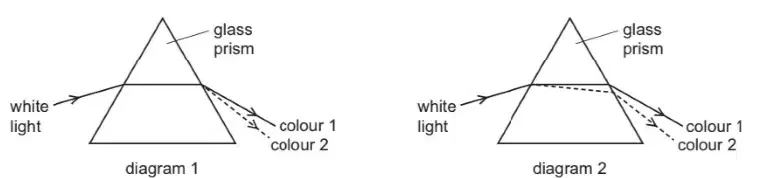
Path taken by the light: diagram 1; Color 1: red; Color 2: violet
Path taken by the light: diagram 1; Color 1: violet; Color 2: red
Path taken by the light: diagram 2; Color 1: red; Color 2: violet
Path taken by the light: diagram 2; Color 1: violet; Color 2: red
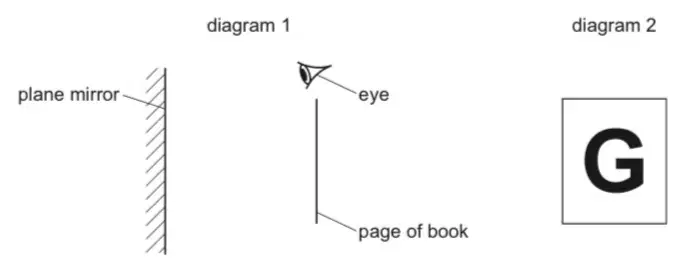
Diagram 1 shows the page of a book in front of a plane mirror. An eye is looking at the image of the page. Diagram 2 shows a large G on the page facing the mirror. What is the appearance of the image of G seen by the eye?


A remote controller emits microwave radiation adiation


Lead absorbs emissions from the radioactive sources
The units of frequency are...
metres
seconds
Hertz
degrees
Light is an example of a transverse wave
True
False
Sound is an example of a transverse wave
True
False
Which of the following statements describes the period of a wave?
Number of waves per second
Distance from crest to crest
Distance from resting position to top of the wave
Time taken to produce one wave
A microwave has a frequency of 300MHz. What is the wavelength of these waves?
1000 m
100 m
10 m
1 m
The period of a wave is 0.1 s. What is the frequency of this wave?
0.1 Hz
1 Hz
10 Hz
100 Hz
The lowest frequency form of visible light is...
Red
Yellow
Green
Violet
The correct order of the EM spectrum is...
R M IR UV V X G
G X UV V M R
R M IR V UV G
R M IR V UV X G
One use of radio waves is...
Broadcasting and communications
Heating
Observing internal structure of objects
Sterilising food and medical equipment
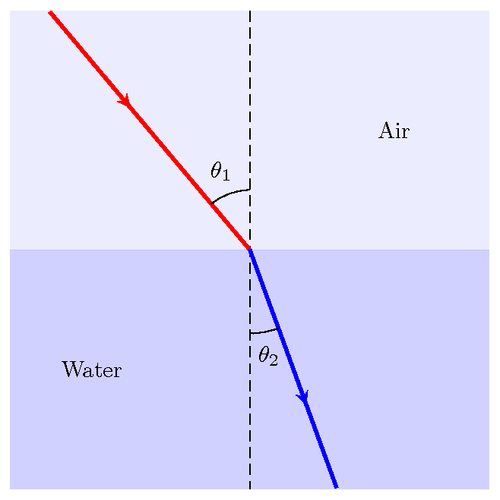
The following image demonstrates...
Reflection
Refraction
Interference
Diffraction

θ1 =35°, θ2=25° What is the refractive index, n, of water?
1.37
1.36
1.35
1.34
20 waves pass a point in 5 s. How is the frequency of these waves?
100 Hz
20 Hz
5 Hz
4 Hz
All waves can be reflected and refracted.
True
False

The critical angle in the diagram is 43 degrees. What is the angle of refraction at the critical angle?
Less than 43
Equal to 43
More than 43 but less than 90
Equal to 90 degrees
The critical angle of a block is 45 degrees. What is the refractive index of this block?
1.39
1.40
1.41
1.42


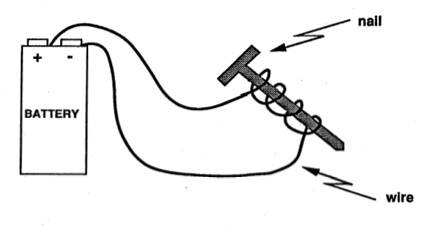
Magnets on refrigerator cannot be turned off. Which type of magnets they belong?
electromagnets
battery
permanent magnets
copper wire

Which electromagnet is stronger?
A
B
Which of these circuits will not allow the lightbulb to light up


Select BOTH of the parallel circuits.
There are two correct answers!


What voltage is needed to cause a 2amps current flow through a 10Ω resistor?
What voltage is needed to cause a 50amps current flow through a 10Ω resistor?
15V
500V
500 kV
0.2V
F=MA
Fg=MG
Which of these is caused by static electricity?
A magnet attracts a paper clip
Glue holds two pieces of paper together
Socks taken from a clothes dryer stick together
Ice sticks to a car’s windshield
Which choice describes the behavior of an electric charge?
Like charges attract. Unlike charges repel.
Like charges repel. Unlike charges attract.
Like charges attract. Unlike charges attract.
Like charges repel. Unlike charges repel.
What is the end result of charging by contact?
Both object have the same charge, so they will attract one another
Both object have the same charge, so they will repel one another
Both object have the opposite charge, so they will attract one another
Both object have the opposite charge, so they will repel one another
What happens when you split a magnet in half?
It becomes twice as strong
You end up with two smaller magnets
You end up with a North Pole magnet and a South Pole Magnet (as long as you split it perfectly in half)
Your magnet loses all of it's magnetism (it leaks out of the break)
What happens when an object with random magnetic domains is placed into a strong magnetic field?
It is attracted to the magnetic field
It aligns with the field and shoots off like superman
It aligns with the field and usually becomes a temporary magnet itself
Its domains start moving faster and it gets warmer
How are two ways that Earth's magnetic field is useful for us?
It allows us to know which direction is "Down" and allows for better navigation
It protects the surface of the earth from UV rays and causes tides
It produces the Auroras and causes the spin of the earth
It blocks the harmful Solar Wind and allows for more efficient navigation
What happens magnetically when electricity runs through a wire (or any charged particle moves).
Nothing, magnetism and electricity are separate phenomenon
The magnetic field matches that of the Earth
It generates a magnetic field around the wire
It uses magnetism to move the charge through the wire
This is when the magnetic domains within a piece of metal (like a nail) are oriented by an electrical current, making a very strong temporary magnet. (Vocab)
Magnetic Pole
Dipole
Electromagnet
Electric Motor
Magnetic Domain
These are the areas of a permanent magnet where the magnetic field is the strongest, usually one at each end of the magnet. (Vocab)
Magnetic Pole
Dipole
Electromagnet
Electric Motor
Magnetic Domain
Complete the sentence: An ammeter is a device that measures
voltage.
charge.
current.
resistance.
Which is the unit of measure for current?
amp
volt
coulomb
joule
Which of the following materials is not a conductor?
wire wool
ionic solution
steel
plastic
Complete the following sentence: A current is defined as
stationary electrons.
the energy in a cell.
a net flow of charge.
electrons.
Which of the following statements about conventional current is correct?
The electrons do not move.
The electrons flow in all directions.
Electrons flow from negative to positive.
Electrons flow from positive to negative.
A voltmeter measures the voltage across a component. Where should it be positioned in a circuit in order to measure voltage correctly?
in series with the component
in parallel with the component
over the cell
anywhere in the circuit
Where would you place an ammeter in a series circuit to get a reading?
next to the cell only
in parallel with the component
in parallel with the cell
anywhere in the circuit
Which of the following represents the definition of an amp?
Cs
s/C
C/s
J/C
Which of the following represents the relationship between charge, current and time?
Q = I × t
Q = I/t
Q = t/I
Q = V × t
A kettle requires a current of 2.1 A and takes 3 minutes to boil a litre of water. Calculate the charge through the wire in this time?
6.3 C
378 C
0.7 C
6.3 Q
Calculate the number of electrons passing through a wire in 5 seconds if the current through it is 2 A.
6 × 10^19
1.7 × 10^-18
10
2
Which of the following represents the definition of a volt?
C/s
J/C
JC
J
Which of the following represents the relationship between energy, voltage and charge?
E/V = Q
E = V/Q
E = V × I
E = V/I
The voltage across a kettle is 230 V. Calculate the energy supplied if 100 C of charge pass through the kettle’s wires.
0.44 J
2.3 J
440 kJ
23 kJ
The voltage across a cooker is 230 V. There is a current of 12 A for 10 minutes. Calculate the total amount of energy.
28 kJ
1.7 kJ
1.7 MJ
2 kJ

What does this circuit symbol represent?
resistor
diode
variable resistor
light dependent resistor

What does this circuit symbol represent?
Lamp/bulb
Cell
Motor
Voltmeter

What does this circuit symbol represent?
Lamp
Resistor
Fuse
Light-dependent resistor

What does this circuit symbol represent?
Variable resistor
Light emitting diode (LED)
Bulb/lamp
Diode

What does this circuit symbol represent?
Motor
Generator
Electric bell
Bulb/lamp

What does this circuit symbol represent?
Bulb/lamp
Battery
Resistor
Cell
Which component would you use to indicate that a current may be flowing?
voltmeter
buzzer
cell
resistor
In a parallel circuit, 0.8 A arrives at a junction between two wires. It splits with 0.2 A going down the first wire. What would the ammeter reading on the second wire be?
0.8 A
0.6 A
0.2 A
It will depend on the resistance of the components down that wire.
Which of the following statements about a parallel circuit that has bulbs on each wire is not correct?
If one bulb filament breaks the other bulbs will remain on.
Switches can be placed throughout the circuit so that different bulbs can be turned on and off.
The current around the circuit will be the same at all points.
Parallel circuits are used in the home for lighting.
Which of the following statements about a series circuit is not correct?
The current is the same throughout the circuit.
The voltage is shared across components.
Different bulbs can be turned on and off depending on where you place a switch.
When one bulb is broken the circuit will no longer work.

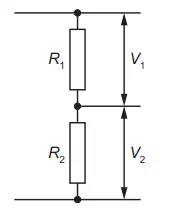
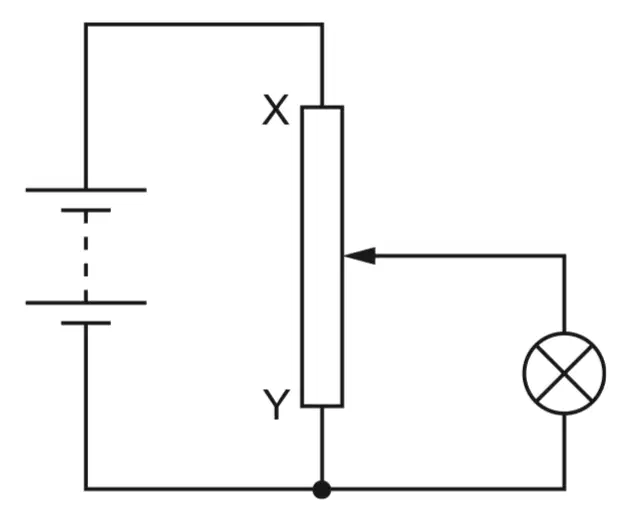
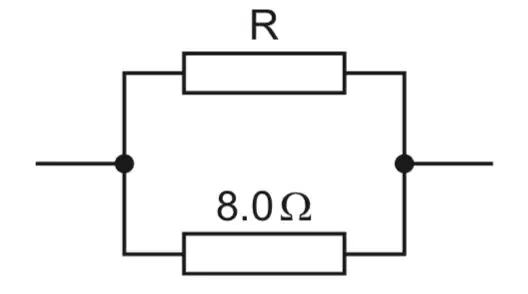
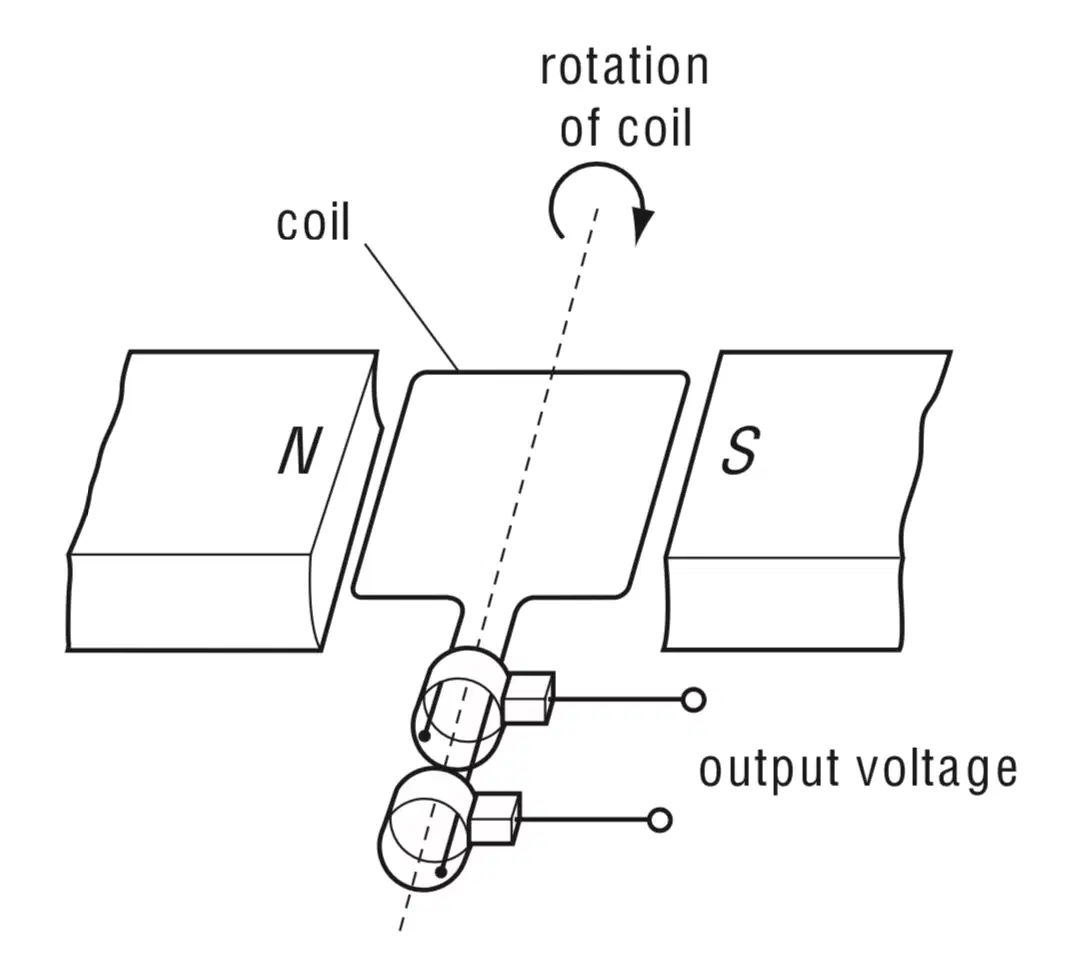
a d.c. motor
Which test could be used to find which end of the magnet is north pole?
A student has a bar magnet. He brings the magnet close to an object. The magnet and the object repel each other. What is the other object made from?
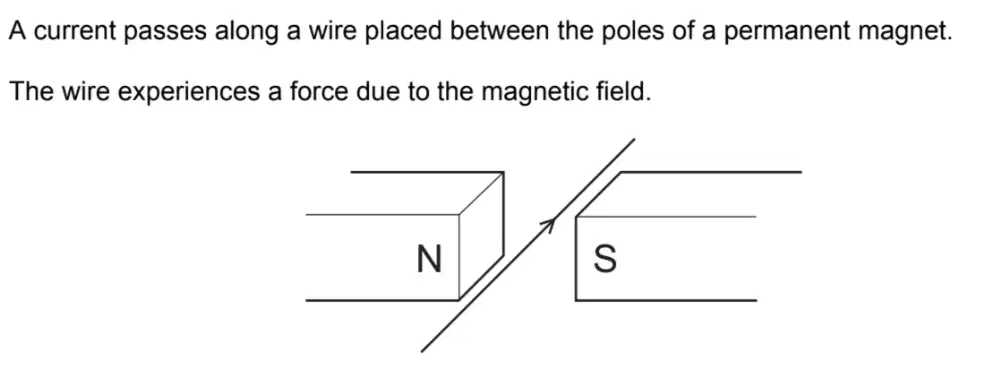
What will change the direction of this force?

A
B
C
D

A
B
C
D

A
B
C
D

A
B
C
D

A
B
C
D

A
B
C
D

A
B
C
D

A
B
C
D

A
B
C
D

A
B
C
D

A
B
C
D

A
B
C
D

A
B
C
D

A
B
C
D

A
B
C
D

A
B
C
D

A
B
C
D

A
B
C
D

A
B
C
D

A
B
C
D

A
B
C
D

A
B
C
D

A
B
C
D

A
B
C
D

A
B
C
D

A
B
C
D

A
B
C
D

A
B
C
D

A
B
C
D

A
B
C
D

A
B
C
D

A
B
C
D

A
B
C
D
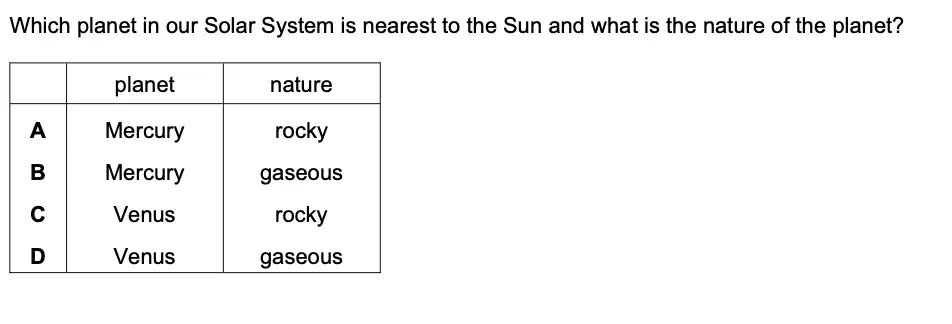
A
B
C
D

A
B
C
D

A
B
C
D

A
B
C
D

A
B
C
D

A
B
C
D

A
B
C
D

A
B
C
D

A
B
C
D

A
B
C
D
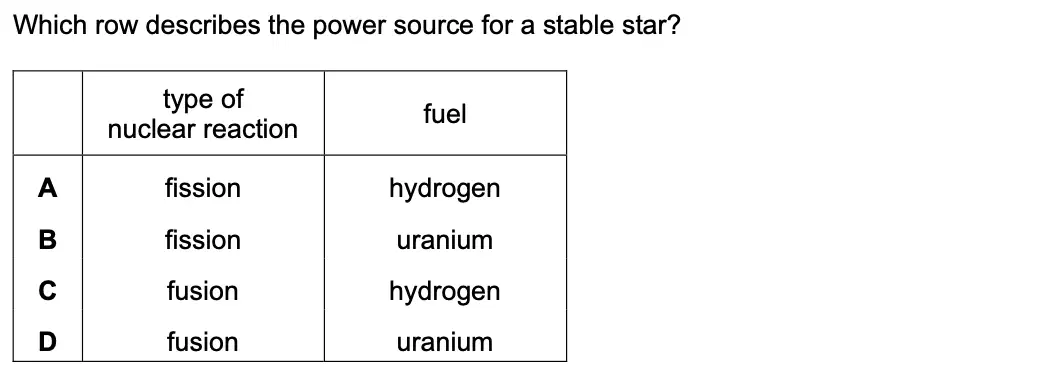
A
B
C
D

A
B
C
D
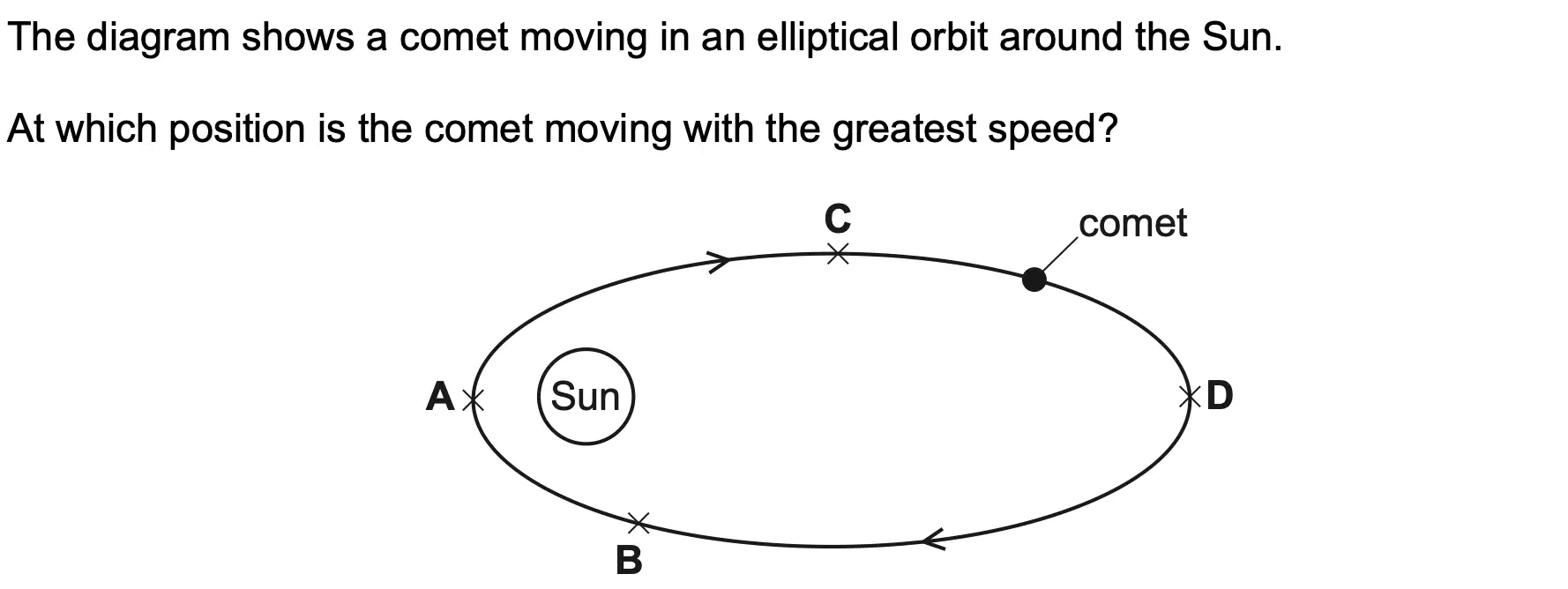
A
B
C
D

A
B
C
D

A
B
C
D
Which of the following is true of the Sun?
The Sun is the closest star to Earth.
The Sun is the smallest star in the Milky Way
The Sun is the largest planet in our Solar System.
The Sun is an example of a galaxy that gives off light energy.
What causes the day/night cycle?
Earth turning on its axis.
Earth revolving around the Sun.
The Sun revolving around the Earth.
The Moon revolving around the Earth.
When the Moon is directly between the Sun and the Earth, what phase would the Moon be in?
Full Moon
New Moon
Half Moon
Waxing Crescent
What evidence from the text supports why the Moon seems to change shape from night to night?
The Moon shines on Earth differently depending on the weather.
As the Moon travels around Earth, its distance from Earth changes.
The moonlight hits Earth at different places depending on the time of day.
As the Moon travels around Earth, sunlight hits it from different directions.
Which of the following stars has the highest surface temperature?
White
Yellow
Red
Bluish-white
Which of the following forms a star?
Nebulae
Supernova
White dwarf
Black hole
Which of the following characteristics can be used to classify stars?
I Age
II Shape
III Brightness
IV Colour
I and II
III and IV
II and III
I and IV
The following information shows the formation of a star.
P- The gas ball starts to shine and a new star is born.
Q- A lot of heat energy and light energy are released from the core.
R- The gases and dust particles in nebulae are pulled by a strong gravitational force until it becomes compact core.
S- The core becomes hotter causing a nuclear reaction to occur when the temperature and pressure are too high.
P,Q,R,S
P,Q,S,R
R,Q,S,P
R,S,Q,P

Diagram shows a galaxy. What is the type of this galaxy?
Elliptical
Spiral
Milky Way
Irregular
Why is the temperature of Venus higher than Mercury?
The density of Venus is higher
The gravitational force on Venus is higher
Venus does not have clouds to absorb and reflect heat
The atmospheric layer of Venus contains 96% of carbon dioxide gas that causes greenhouse effect

Diagram shows the planets in solar system. Which of the following are terrestrial planets?
Mercury, Saturn, Earth and Mars
Mercury, Venus, Earth and Mars
Mercury, Venus, Earth and Neptune
Jupiter, Saturn, Uranus and Neptune
Which of the following are gas planets?
Mercury, Venus, Earth and Mars
Jupiter, Saturn, Uranus and Earth
Mercury, Venus, Earth and Neptune
Jupiter, Saturn, Uranus and Neptune
Which of these objects is a dwarf planet?
Moon
Mercury
Pluto
Aris
What shape are the orbits of comets?
Rectangular
Irregular
Elliptical
Circle
Which of the following is a natural satellite?
International space station
Hubble space telescope
Communication satellite
Moon
Which body was the first stage in the formation of the Sun?
Protostar
Main sequence star
Supernova
Nebula
What is a comet?
An object that orbits the Earth, made from rocky material, dust and ice
An object that orbits the Sun, made from rocky material and metals
An object that orbits the Sun, made from rocky material, dust and ice
An object that orbits the solar system, made from rocky material and metals
What happens to the gravitational force of attraction between two objects if the distance between them increases?
Force of attraction increases
Force of attraction decreases
Force of attraction remains constant
Force of attraction cease to exist
What happens to the speed and velocity of a planet in a circular orbit?
velocity changes and the speed changes
velocity changes but the speed remains constant
speed changes but the velocity remains constant
speed increases but the velocity remains constant
What is a nebula?
A cloud of dust and gas
A collection of billions of stars
An early solar system, with a protostar, planets and moons
A core with abundant of hydrogen
Which two things balance and keep a main sequence star in equilibrium?
Gravity and friction
Gravity and air resistance
Gravity and radiation pressure
Gravity and electrostatic attraction
Where do elements of heavier than iron form?
In nuclear fusion in main sequence stars
In supernova
In the big bang
In nuclear fusion in planetary nebula
What will the Sun in the next stage of its life?
A red giant
A red supergiant
A black hole
A neutron star
Which type of star has supernova explosions?
Stars similar in size to our Sun
Stars much bigger than our Sun
All stars go through a supernova explosion
Medium stars
What happens when a white dwarf cools completely?
It stops emitting light and becomes a dark dwarf
It stops emitting light and becomes a neutron star
It stops emitting light and becomes a black hole
It stops emitting light and becomes a planetary nebula
What is red-shift?
The time when a star moves from the main sequence to be a red giant
The red filter used by astronomers to analyse the light from distant stars
The increase in wavelength of light from a distant galaxy moving away from Earth
The increase in wavelength of light from a distant galaxy moving away from Sun
Which of the following suggests that the solar system is made from the debris of old supernova explosions?
The Sun is a relatively small mass star
There is gold in the ground on Earth
The Sun is mostly hydrogen
There is hydrogen on Earth
Most distant galaxies show more red-shift. Which major theory does this support?
Theory of stellar evolution
The Big Bang theory
Fermi paradox
Kardashev scale
What is the basic idea of the Big Bang theory?
The universe expanded from a single tiny point, starting about 13.8 billion years ago
The universe will end in a giant dark energy explosion
The solar system began when a protostar started nuclear fusion reactions
Continous creation of matter throughout the universe
Which of the following is not evidence of the Big Bang theory
Cosmic microwave background radiation
Doppler red-shift of light observed from distant stars and galaxies
Galaxies are moving away from Earth
Models of Accretion Theory
The orbital period of a Moon around the Earth is about 30 days. The average radius of its orbit is 380000km. Calculate the orbital speed of the Moon in m/s.
920m/s
9200m/s
92 m/s
92000m/s
The Sun is 150 million km away from the Earth. Calculate the time, in minutes, it takes light to travel from the Sun to us.
7.2 minutes
8.3 minutes
9.4 minutes
6.3 minutes
A star is a distance of 3.6 x 10¹⁹ m from us. Calculate the distance in light years.
3689 light years
3789 light years
368.9 light years
378.9 light years
Estimate the Hubble constant given v= 11000 km/s and d= 5.0 x 1024 m.
2.2 x 10¹⁸
2.2 x 10⁻¹⁸
2.2 x 10²¹
2.2 x 10⁻²¹
Estimate the age of the Universe in years.
1.4 x10¹⁰
4.45 x 10¹⁷
4.45 x 10⁷
1.4 x10⁷
The unit of activity is...
Becquerel
Seconds
Metres
Sievert
The atomic number indicates how many...are found in the nucleus of an atom.
Neutrons
Protons
Electrons
Quarks
The most penetrating form of nuclear radiation is...
alpha
beta
gamma
heat
Which best describes the structure of a beta particle?
helium nucleus
slow moving proton
fast moving electron
high frequency light wave

What is the half-life of this radioactive substance?
5700 years
11400 years
17100 years
22800 years
The overall charge on an alpha particle is...
-1
0
+1
+2
The overall charge on a gamma ray is...
-1
0
+1
+2
A hydrogen atom has an atomic number of 1, mass number of 1. The first isotope of hydrogen has an atomic number of...
0
1
2
3
Atomic decay or the process of radioactivity is a random process.
True
False
The most ionising form of nuclear radiation is...
alpha
beta
gamma
infrared
Carbon-12 has an atomic number of 6 and a mass number of 12. How many electrons would be found in a neutral atom of carbon-12?
6
12
18
24
A radioactive source has an initial activity of 200kBq and a half-life of 15 days. How many days would it take for the activity to fall to 25kBq?
15
30
45
60
A source of background radiation is...
cosmic rays from the Sun
radon gas in the air
radioactive isotopes in food
radioactive minerals in the earth
Why isotopes tend to be radioactive?
An excess of neutrons in the nucleus
An excess of electrons in the nucleus
The nucleus being too heavy
•The nucleus being too light
A decay process causes deduction in number of mass number of the parent element.
name the decay process.
alpha decay
beta decay
gamma decay
A decay process causes additional in number of atomic number of the parent element.
name the decay process.
alpha decay
beta decay
gamma decay

name the X.
Helium nucleus
electron
proton
Hydrogen nucleus

The diagram shows a decay equation. What is the value of A and Z?
A: 206
Z: 80
A: 210
Z: 81
A: 210
Z: 80
A: 210
Z: 83

Determine the radioactive rays that are emitted in each stage of the above series of the decay
α, β, α
α, β, β
β, α, α
β, α, β
Why gamma decay do not alter atomic and mass number of the radioisotope?
Because
gamma ray is an energy
gamma ray is a nucleon
gamma ray is a particle
"Time required for mass / activity/ number of nuclei of a radioactive substance to fall to half its initial value."
This is definition of
radioactivity
decay process
half-life
isotope
A sample of radioactive material stored in the laboratory has an initial activity
of 20 s-1 . If its half-life is 9 minutes, how much is its activity after 45 minutes?
2.5 s-1
1.25 s-1
0.625 s-1
5 s-1
A radioactive material stored in the laboratory has a half-life of 4 days. Calculate the number of days taken for the activity of a sample of radioactive material to reduce to 6.25% of its initial activity.
12 days
9 days
16 days
20 days
A radioactive material stored in the laboratory has a half-life of 6 days. Calculate the number of days taken for the radioactive material to decayed 75 % of its initial decay rate.
12 days
9 days
18 days
24 days
A radioactive material stored in the laboratory has a half-life of 12 hours. Calculate the number of days taken for the radioactive material to decayed 15/16 of its initial decay rate.
2.5 days
1 days
1.5 days
2 days

Diagram shows comparison between non-irradiated food and irradiated food. State type of the rays used to the irradiated food
alpha radiation
beta radiation
gamma radiation

Diagram shows a household fire alarm. State type of the rays used in the alarm
alpha radiation
beta radiation
gamma radiation

Diagram shows a way to inspect thickness of a paper. State type of the rays used
alpha radiation
beta radiation
gamma radiation
exposure to high doses of radioactive radiation may causes
tissue damage
mutation
diabetes
heart attack
the followings procedures can minimise the risk of radioactive radiation EXCEPT
Store the sources in lead-lined boxes
Minimise the amount of time with the source
keep yourself (and other people) as far from the sources
Use hands to handle the source
Velocity is?
a helium nucleus
rate of change of distance moved with the direction
the energy store in a body due to its height
the amount of matter that an object is made of
Work done?
Force x distance moved in the direction of the force
force per uint area
number of complete oscillations per unit of time on the wave
the force exerted by the Earth
Kinetic energy?
Energy stored in chemical substances
Energy that an object has due to its position (height)
Energy that an object has due to its motion
Power?
the amount of energy transfer
Force/cross-sectional area
Current x time
the rate at which work is done (work done/time taken)
The law of Conservation of energy states that:
"Energy cannot be .......... or .........., it only changes from one form to another."
created - destroyed
changed - transfered
stored - moved
Pressure?
rate of change of velocity
force per unit of area (force/area)
vibration of the particles are parallel to the direction that energy transfers.
force x distance moved in the direction of the force
acceleration
a scalar quantity has magnitude only
rate of change of distance moved
rate of change of velocity
number of oscillations per unit time of a point on the wave
mass
position where zero amplitude
the amount of matter in an object
the force exerted by the Earth
force/area
Weight
Current in a circuit
Force exerts on a body due to gravity
the amount of matter in a body
energy of a mass due to its motion
Gravitational potential energy
Energy stored in chemical substances
Energy of an object due to its motion
Energy of an object due to its position (height)
rate of change of velocity
Hooke's law
rate of change of velocity
Force due to gravity
Force/area
force is proportional to the extension unless the limit of proportionality is exceeded
Electric field
proton
electron
region of space where a force acts on a stationary charge
the amount of energy converted from chemical to electrical
Pressure
region of space where a force acts on a stationary charge
Force/area
vibrations of the particles are perpendicular to the direction of the propagation of energy
potential difference/current
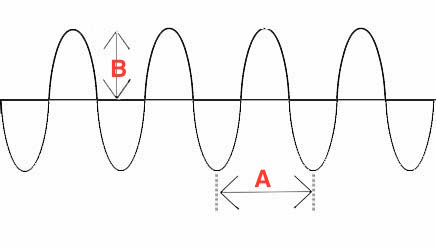
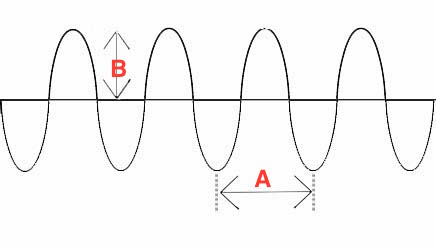
What property of this wave is represented by the letter "A"
amplitude
crest
trough
wavelength
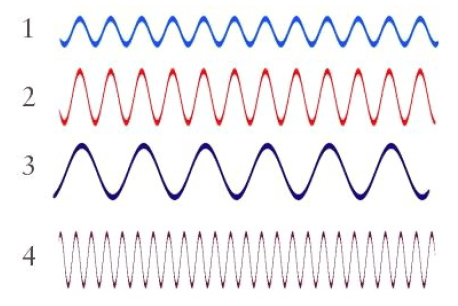
An object has which color for being a good absorber?
Black
White
Yellow
Green
__________ is a phenomenon that the light is reflected when it hits a shiny surface such as a mirrior.
Diffraction
Refraction
Reflection
Turning effect
What is the correct equation for refractive index
n = sinr / sini
n = sini / sinr
c = sini / sinr
Sinc = sini / sinr
What is the correct equation for acceleration
a = (v - u) / t
a = d / t
a = f x m
What is the correct equation linking speed of a wave frequency and wavelength
v = f x λ
v = f / λ
v = λ / f
How do you find the number of neutrons in an element
Mass number - atomic number
Atomic number - mass number
Mass number / atomic number
What is the correct equation for electrical power
P = I x V
P = V / I
P = I / V
What is the correct equation linking charge current and time
Q = It
I = Qt
t = QI

