
 Worksheets
Macromolecules Quiz
Total questions: 14
Worksheet time: 7mins
Name
Class
Date
1.

An advertisement for a health supplement for dogs claims to build lean muscle and strengthen tendons and ligaments, as well as provide energy. Which two biomolecules must the supplement contain to provide these benefits?
a)
Carbohydrates and lipids
b)
Proteins and carbohydrates
c)
Nucleic acids and carbohydrates
d)
Lipids and nucleic acids
2.
Fructose is a simple sugar that can be a source of energy for the body. What type of organic molecule is fructose?
a)
carbohydrate
b)
lipid
c)
protein
d)
nucleic acid
3.

Meteorites that contain organic compounds have been found on Earth. Some scientists think the organic compound in meteorites may have provided the elements needed for life on Earth. Which element forms the backbone of organic compounds?
a)
carbon
b)
nickel
c)
phosphorus
d)
sodium
4.
Glycogen is a polysaccharide stored in animal cells. When glycogen is broken down, glucose is produced. Some people's cells are unable to break down glycogen. Which of the following would most likely be observed in a person who is unable to break down glycogen?
a)
a swelling of the joints
b)
an inability to digest proteins
c)
a low energy level and muscle weakness
d)
a rapid heartbeat and fast metabolism
5.
Waxes create a waterproof layer on the outside of some living organisms. To which group of organic molecules do waxes belong?
a)
carbohydrates
b)
lipids
c)
proteins
d)
nucleic acids
6.
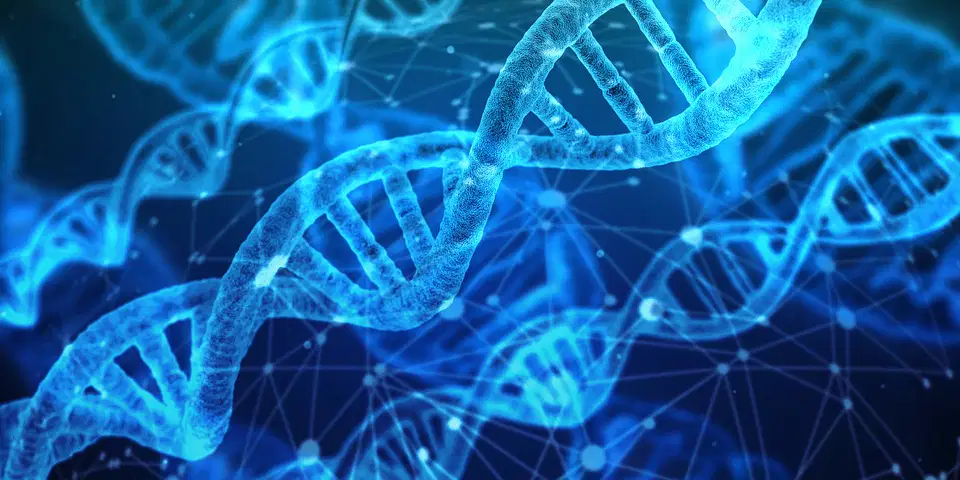
Which best summarizes the role of DNA in the production of proteins?
a)
DNA moves to the cytoplasm to destroy proteins
b)
DNA transports lipids to the ribosomes to make proteins
c)
DNA contains the instructions used to make proteins
d)
DNA breaks hydrogen bonds between amino acids.
7.
Which best explains why the rate of biochemical reaction decreases at high temperatures?
a)
The activation energy increases.
b)
The shape of the enzyme changes.
c)
The enzyme-substrate complex forms.
d)
The bonds between the substrates are broken.
8.
Living cells use ____________ as their main source of energy.
a)
carbohydrate
b)
lipids
c)
proteins
d)
nucleic acids
9.
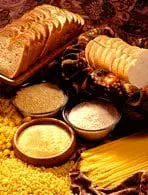
Living things require specific organic molecules in order to survive. The picture above represents some specific examples of foods that are mainly composed of one of these necessary organic molecules. The organic molecules found in these types of food are
a)
nucleic acids
b)
proteins
c)
lipids
d)
carbohydrates
10.
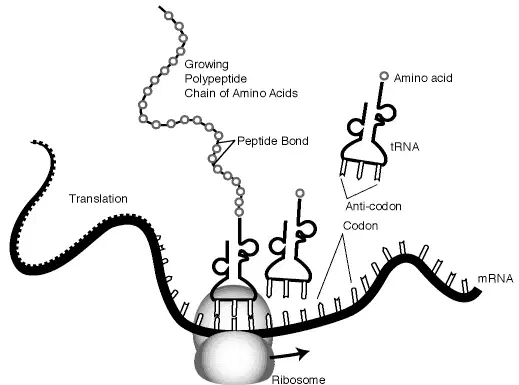
Proteins are important biomolecules that build organisms and direct chemical reactions. Proteins are MONOMERS composed of long chains of
a)
nucleotides
b)
amino acids
c)
phospholipids
d)
monosaccharides
11.

Animals store most of their excess energy reserves as _______, and this is explained because __________________.
a)
glucose; it is easy to break down.
b)
fat; they store twice as much energy per gram.
c)
protein; it is a compact source of energy in their bodies.
d)
carbohydrates; they store twice as much energy per gram of glucose.
12.
Which type of macromolecules has the function of storing and transmitting hereditary or genetic information?
a)
carbohydrates
b)
lipid
c)
proteins
d)
nucleic acids
13.
A teacher assigns the following experiment to a class. Draw an outline of a bird’s feather, and color one half of the outline with a thick coat from a wax crayon. Leave the other half uncolored. Next, sprinkle a few drops of water on both halves of the feather. You will observe that the water soaks into the plain paper. The waxy coat, however, allows the paper to remain dry. Water forms tiny beads on top of the wax instead of soaking through it. The results of the experiment are MOST USEFUL for explaining which of these functions of lipids in organisms?
a)
forming a waterproof covering on feathers, leaves, and fruits.
b)
providing energy for the cell
c)
allowing water to pass through the cell membrane
d)
replacing water in dry environments
14.
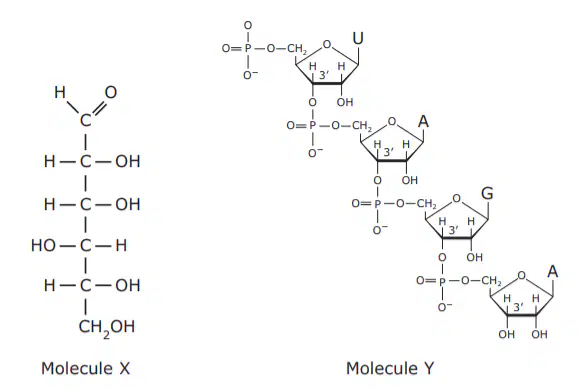
Which of the following best describes these biomolecules? (Hint: Look at the elements.)
a)
Molecule X and Molecule Y are both carbohydrates.
b)
Molecule X is a nucleic acid, and Molecule Y is a carbohydrate.
c)
Molecule X and Molecule Y are both nucleic acids.
d)
Molecule X is a carbohydrate, and Molecule Y is a nucleic acid
100 %

