
 Worksheets
Central Processing Unit
Total questions: 70
Worksheet time: 35mins
The CPU reads an instruction from memory (register, cache, main memory) is refer to:
Fetch instructions
Interpret instructions
Fetch data
Process data
________ : The instruction is decoded to determine what action is required
Fetch instructions
Interpret instructions
Fetch data
Process data
________ : The execution of an instruction may require reading data from memory or an I/O Module
Fetch instructions
Interpret instructions
Fetch data
Process data
________ : The execution of an instruction may require performing some arithmetic or logical operation on data.
Fetch instructions
Interpret instructions
Fetch data
Process data
________ : –The results of an execution may require writing data to memory or an I/O Module
Fetch instructions
Interpret instructions
Fetch data
Write data
The major components of the processor are
arithmetic and logic unit (ALU)
control unit (CU)
Input/Output
memory
______ does the actual computation or processing of data.
arithmetic and logic unit (ALU)
control unit (CU)
______ controls the movement of data and instruction into and out of the processor and controls the operation of the ALU
arithmetic and logic unit (ALU)
control unit (CU)
Which one is NOT correct about Arithmetic & Logic Unit (ALU)
Performs arithmetic and logical operations on data
Controls the movement of data and instruction into and out of the processor
Everything else in the computer is there to service this unit
Handles integers and floating point (real) numbers
CPU carries out a cycle called___.
Execute-decote-fetch
Fetch-decode-execute
Fetch-execute-decode
Decode-execute-fetch
The part of the CPU that gets instructions from the memory is...
Storage
Fetch
Decode
Execute
The part of the CPU that carries out instructions is...
Storage
Fetch
Decode
Execute
Which below is not part of the CPU?
Storage
Fetch
Decode
Execute
The part of the CPU that understand what the instructions mean is...
Storage
Fetch
Decode
Execute
CPU stands for...
Central Processing Unit
Central Programming Unit
Core Processing Unit
Centrally Processing Universally
The purpose of the CPU is to ____.
Process data
Input data
Output Data
Store data
Performing instruction is the beginning of the ?
fetch phase
retrieve phase
execute phase
login phase
what part or the CPU is where individual decoded circuits are packaged into a single unit
overclock
frequency
hertz
control unit
What is the function of the Control Unit?
to direct all of the different parts of the CPU
to direct some of the parts of the CPU
has nothing to do with the CPU
What is the clock of a CPU do?
it is like a conductor of an orchestra
its signal is used by the Control Unit to show the time and date on your computer screen
it is used by the Control Unit to advance the internal operation of the CPU which keeps everything in lock-step
The speed at which a CPU can carry out each step of the fetch-decode-execute cycle and this is called its
clock speed
RAM speed
CPU speed
driving spped
What is a unit of frequency?
minute
milligram
hertz
amp
What is being referred to when you modify the clock to speed up the tempo of the CPU?
overrun
overheated
too slow
overclocked
What does the ALU do?
Keeps the computer cool
Works out the best way to do something
Carries our calculations and logical comparisons
Carries information
What is the role of a bus?
You can use the school bus to go to school or to do the grocery shopping.
Which three main factors affect the CPU performance? (Select all responses that are appropriate)
Clock speed
number of cores
cache size
CPU brand
What is the part of the CPU that contains all the components used to perform the fetch-decode-execute cycle?
Core
RAM
ROM
Cache
What is a thread?
Virtual version of a CPU core that allow a CPU to perform multiple things at once
Physical version of a CPU core that only allows a CPU to perform one thing at a time
Virtual version of memory that allows RAM to perform multiple things at once
What are the three types of bus?
Address, control and instruction
Address, control and data
Address, data and instruction
What is Central Processing Unit (CPU) overclocking?
Overclocking is installing more physical cores and threads into a CPU
Overclocking is the unit within a CPU that allows a computer system to tell the time
Increasing number of pulses the CPUs clock generates per second by increasing power sent from the PSU
What is the purpose of LOAD instruction?
Load memory from register
Load register from memory
Load main memory from secondary memory
Load secondary memory from main memory
Which register stores the address of the next instruction to be executed?
MAR
MDR
MCR
PC
Program counter is also known as
Instruction counter
Program register
Instruction register
Address counter
Instructions are placed in -----------------------------.
Instruction counter
Instruction pointer
Instruction register
Program counter
Which instruction stores the contents of ALU to memory?
STO
LOAD
JMP
JNE
This register acts as a buffer allowing to microprocessor and memory unit to act independently without being affected by minor differences in operation
Instruction register
Memory buffer register
Data register
Program counter
Results after processing in ALU are stored in
Index register
Accumulator register
Data register
Buffer
This register holds the address of memory location from where a memory word is to be fetched or where data is to be stored
Memory address register
Instruction register
Memory buffer register
Program counter
This register holds program instructions that are fetched from memory for execution
Instruction register
memory address register
Memory buffer register
Program counter
Results after processing in ALU are stored in
Index register
Accumulator register
Data register
Buffer
What does the program counter contain when an instruction is fetched?
The address of the next instruction
The opcode of the current instruction
The data for the current instruction
The address of the previous instruction
What is the purpose of the memory address register?
To store the address of the next instruction
To store the opcode of the current instruction
To store the data for the current instruction
To store the address of the data needed for the current instruction
What is the purpose of the current instruction register?
To store the address of the next instruction
To store the opcode of the current instruction
To store the data for the current instruction
To store the address of the data needed for the current instruction
What happens to the program counter after an instruction is fetched?
It is incremented by one
It is decremented by one
It remains the same
It is reset to zero
What is the purpose of the memory data register?
To store the address of the next instruction
To store the opcode of the current instruction
To store the data for the current instruction
To store the address of the data needed for the current instruction
What is the purpose of the accumulator?
To store the address of the next instruction
To store the opcode of the current instruction
To store the data for the current instruction
To store the result of the current instruction
What happens during a program branch?
The program counter is incremented
The program counter is decremented
The program counter is changed to the operand
The program counter remains the same
How does the program counter remember how to get back to the previous instruction after a program branch?
Through a data structure called a stack
Through a data structure called a queue
Through a data structure called a linked list
Through a data structure called a tree
Where is the instruction being followed by the CPU stored?
MAR
MDR
CIR
PC
When something is loaded from memory, where is it first stored?
The CIR
The MAR
The MDR
The ALU
In the FDE Cycle
Once the instruction is understood, the instruction will be executed. The control unit will tell the other components what they need to do in order for the instruction to work.
Fetch
Decode
Execute
Store
In the FDE Cycle
The binary representation of an instruction needs to be decoded before it can be run. This is the process the control unit uses to work out what the other components need to do.
Fetch
Decode
Execute
Store
In the FDE Cycle
Instructions are loaded into memory (RAM) before the processor starts running the program.
Fetch
Decode
Execute
Store
Select all types of the CPU registers
Memory Address Register (MAR)
Memory Data Register (MDR)
Current Instruction Register (CIR)
Program Counter (PC)
Random Access Memory (RAM)
These are fast action memory locations in the CPU
Buses
Clock
Control Unit
Arithmetic Logic Unit
Registers
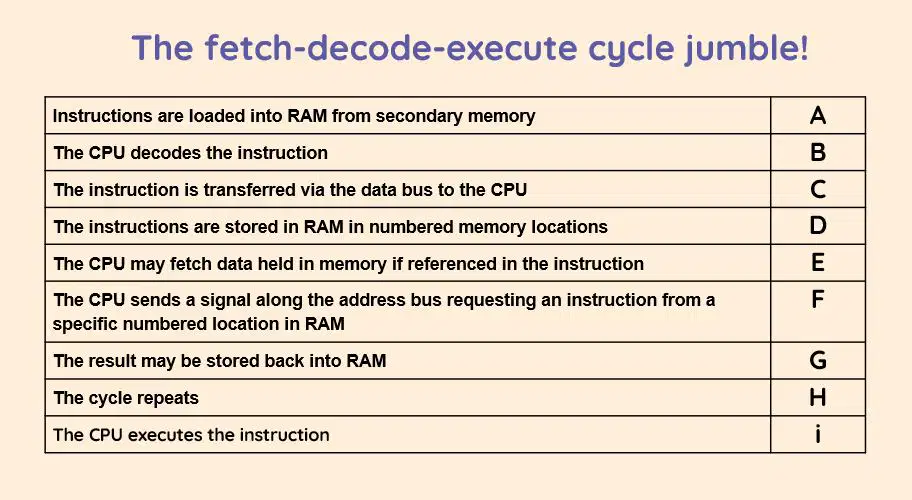
Click on the image and determine which among the choices in the correct order for the FETCH - EXECUTE - DECODE Cycle
A,D,F,C,B,E,i,G,H
H,A,D,F,C,B,E,i,G
A,B,D,F,B,E,i,G,H
A,D,F,C,B,E,G,i,H
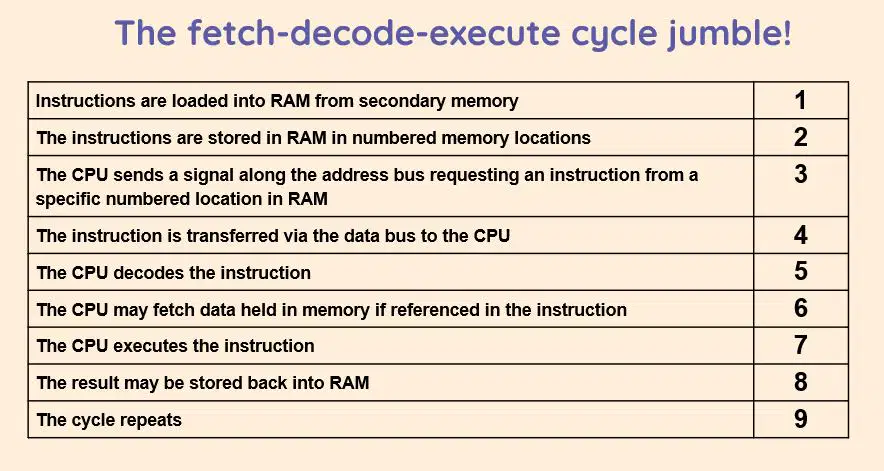
click on the image and determine which part of the numbered instructions is the FETCH in the FDE Cycle
1, 2, 3, 4
3 and 4
5 and 6
7 and 8
5,6,7,8
click on the image and determine which part of the numbered instructions is the EXECUTE in the FDE Cycle
1, 2, 3, 4
6,7, and 8
5 and 6
7 and 8
5,6,7,8
click on the image and determine which part of the numbered instructions is the DECODE in the FDE Cycle
1, 2, 3, 4
4,5, and 6
5 and 6
7 and 8
6 and 7

The Arithmetic Logic Unit (ALU)
Carries out numerical calculations and logical decisions
Calculates the different items of number data stored within the Accumulator and converts them into logical decisions
Calculates graphic data as they are only found within GPU units.
Calculates the flow of execution in a program and decodes instructions into small steps to be carried out by the program counter.
The Control Unit
Controls the flow of data around the CPU and also decodes instructions
Only controls the flow of data around the CPU
Only decodes instructions
Controls how much power is directed to all components within the computer
Accumulator
Stores the address of the next instruction in memory
Stores the address of where the next item will be fetched from
Stores data fetched from memory, or waiting to be stored in memory
Stores the result of arithmetic calculations
Memory Data Register (MDR)
Stores the address of the next instruction in memory
Stores the address of where the next item will be fetched from
Stores data fetched from memory, or waiting to be stored in memory
Stores the result of arithmetic calculations
Memory Address Register (MAR)
Stores the address of the next instruction in memory
Stores the address of where the next item will be fetched from
Stores data fetched from memory, or waiting to be stored in memory
Stores the result of arithmetic calculations
The Program Counter
Stores the address of the next instruction in memory
Stores the address of where the next item will be fetched from
Stores data fetched from memory, or waiting to be stored in memory
Stores the result of arithmetic calculations
What is the second step in the FDE cycle?
The processor fetches an instruction from the program.
The processor executes one instruction at a time.
The instruction is decoded by the processor.
The processor stores the result.
The MDR is part of the CIR, it stands for what Instruction Register?
Main
Memory
Current
Control
What happens after the PC is copied to the MAR in the FDE cycle?
PC is then incremented by 1
Copy MDR contents into the CIR
Lookup MAR and get contents. Copy contents into the MDR
Repeat
![Tin [Chuyên] - 11 - CKI](https://cf.quizizz.com/image/image-loader.svg)
