
 Worksheets
Anatomy Nervous system
Total questions: 26
Worksheet time: 33mins
What organ(s) is in the central nervous system (CNS)?
Brain
Spinal cord
Peripheral nerves
What neurons carry impulses to the spinal cord and brain from all parts of the body? (a)
What is the name of the cell that does not transmit impulses but holds the neuron together and protects it?
Dendrites
Glia
Axon
Schwann
What is the name of the myelin sheath damaged autoimmune disorder?
Glioma
Neuroma
Multiple scleorsis
Neurofibromatosis
Along with the blood vessels, astrocyte branches forms what two-layer structure?
Microglia
Blood-brain barrier
Schwann cells
Fascicle
Where is the hypothalamus?

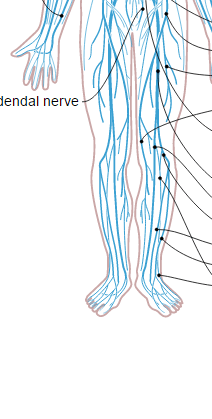
This is a picture of the
peripheral nervous sysyem
central nervous system
respiratory system
circulatory system
Match the following
Endoneurium
Thin wrapping of fibrous connect tissue
Epineurium
Fibrous sheath that covers the nerve
Perineurium
Thin fibrous surrounds each fascicles
Fascicle
Group of wrapped axons
A ganglion is a group of neuron cell bodies located in the PNS
What are the thre types of neurons that respond in a reflex? Select all that apply
Motor neuron
Sensory neuron
Interneuron
E
C
Neurotransmitters are chemicals by which neurons communicate. Which are neurotransmitters? Select all that apply
Acetylcholine
Synapsis
Norepinephrine
Serotonin
Action potential
How do neurons communicate with each other?
Through direct physical contact
By releasing hormones into the bloodstream
By transmitting electrical signals through their axons
By releasing neurotransmitters into the synaptic cleft
What is the gap between two neurons called?
Axon hillock
Synaptic cleft
Dendritic spine
Myelin gap
What is the role of acetylcholine in the nervous system?
It primarily inhibits neural activity.
It is involved in the regulation of mood and sleep.
It plays a key role in muscle activation.
It modulates pain perception.
What neurotransmitter is deficient when a client has Parkinson disease? (a)
What drug increases dopamine levels in Parkinson disease clients (a)
What three parts of the brain are in the brainstem?
Hypothalamus, thalamus, pineal gland
Medulla oblongata, pons, midbrain
Cerebellum, diencephalon, cerebrum
Medulla oblongata, pons, cerebellum
What part of the brain controls autonomic (involuntary) functions such as breathing, heart and blood vessel function, digestion, sneezing, and swallowing.
Hypothalamus
Medulla Oblongata
Corpus Callosum
Hipocampus
Organize these options into the right categories
Spastic paralysis
Lesions on the cortex
Accumulation of protein in the brain
Inherited chorea involuntary purposeless movements
Mostly hemiplegia
Treated with Aricept
From repeated trauma to the brain
Initial symptoms 30-45 yrs old death by 55
EEG is the graphic representation of what activity?
Heart conduction
Brain actitivy
Muscle activity
Nerve actitivy
The ascending tracts conduct impulses down the spinal cord from the brain and the descending tracts conduct impulses up the spinal cord to the brain
Reorder the following list from the inner most area to the outer most area of meninges
pia mater
arachnoid mater
dura mater
Match the cranial nerve to the function
Cranial nerve I
Sense of smell
Cranial nerve II
Vision
Cranial nerve VII
Sense of taste and facial expressions
Cranial nerve IX
Swallowing movement secretions of saliva
Cranial nerve X
Slowing of heartbeat, increase gut move
Organize these options into the right categories
Dilate pupils
Constrict pupils
Slow down heartrate
Speed up heart rate
Decrease motility
Increase motility
Dilate bronchi
Increase sweat production
Redirect blood flow to muscles
Inhibit digestion
Release adrenaline
Stimulate saliva production
Constrict bronchi
Promote urination
Stimulate digestion
Decrease sweat production

