
 Worksheets
AI Lit Framework
Total questions: 98
Worksheet time: 49mins
What is the main purpose of the AI Literacy Framework for Primary and Secondary Education (AILit Framework)?
To promote AI research
To support the development of AI literacy in primary and secondary education
To regulate AI companies
To replace teachers with AI
Which organizations are leading the development of the AILit Framework?
United Nations and World Bank
European Commission and OECD
NASA and ESA
Google and Microsoft
Fill in the blank: The AILit Framework contributes to the PISA 2029 ______ & Artificial Intelligence Literacy assessment.
Media
Science
Mathematics
Technology
The EU AI Act is the first comprehensive legislation on AI in the world.
True
False
What is the intended outcome of this draft framework?
To elicit feedback from educators and stakeholders
To ban AI in schools
To create new AI systems
To replace textbooks
Who is the Professor of Educational Computing at the University of Alberta, Edmonton, Canada?
Cathy Adams
Romina Cachia
Kari Kivinen
Victor Koleszar
Romina Cachia is the Scientific Team Leader at the Joint Research Centre of the European Commission, located in ________, Spain.
Seville
Madrid
Barcelona
Valencia
Which expert is associated with the European Intellectual Property Observatory in Alicante, Spain?
Kari Kivinen
Lidija Kralj
Victor R. Lee
Tara Nattrass
Victor Koleszar is the Pedagogical Coordinator for Computational Thinking and Artificial Intelligence in Montevideo, Uruguay.
True
False
Who is the Managing Director of Innovation Strategy at ISTE+ASCD, Arlington, Virginia, USA (participated until March 2025)?
Tara Nattrass
Joseph South
Florian Rampelt
Pati Ruiz
Fill in the blank: The development team was responsible for overall project management, hosting focus groups, conducting research, drafting versions of the framework for review, processing feedback, and ________ the draft document and website.
designing
destroying
ignoring
delaying
What is the purpose of AI Literacy?
To help individuals understand and effectively engage with artificial intelligence technologies.
To replace all human jobs with robots.
To make computers smarter than humans in every way.
To eliminate the need for human decision-making.
What does AI stand for?
Artificial Intelligence
Automated Input
Analog Interface
Advanced Innovation
Why do young people need guidance when experimenting with AI?
Because AI technologies can be complex and have significant impacts, requiring responsible and informed use.
Because AI is only for adults and not suitable for young people.
Because AI always makes mistakes and cannot be trusted at all.
Because young people are not allowed to use any technology without supervision.
Why is AI Literacy considered an educational priority?
Because understanding AI is essential for participating in a technology-driven world.
Because AI literacy is only important for computer scientists.
Because AI will replace all teachers in the future.
Because AI is not used in everyday life.
Who is the intended audience for the AI Literacy framework?
Educators, students, and other stakeholders interested in AI education.
Only professional AI researchers.
Government officials only.
Medical professionals exclusively.
How can feedback be provided on the draft of the AI Literacy framework?
By following the instructions provided in the draft document.
By sending a letter to the Ministry of Education.
By posting comments on unrelated social media posts.
By contacting local schools directly.
What does 'Building on Existing Frameworks' mean in the context of AI Literacy?
It means using and adapting established educational frameworks to develop AI Literacy.
It means creating entirely new educational systems from scratch.
It refers to ignoring previous educational research in AI.
It means focusing only on technical skills without considering existing knowledge.
What is the importance of the research process and themes in developing the AILit Framework?
They guide the development and ensure the framework is evidence-based and relevant.
They are only used for documentation purposes.
They are not necessary for the framework's success.
They limit the creativity of the framework developers.
What are the AILit Framework Development Principles?
The guiding values and standards used to create the AI Literacy framework.
A set of programming languages for AI development.
A list of AI-powered applications for education.
The hardware requirements for running AI models.
What is the role of educators in AI Literacy?
To teach, guide, and support learners in understanding and using AI responsibly.
To discourage the use of AI in all educational settings.
To replace all traditional teaching methods with AI tools.
To ignore AI developments and focus only on conventional subjects.
What are learner personas in the context of AI Literacy?
Examples or profiles that illustrate what AI Literacy looks like in action for different types of learners.
A type of AI algorithm used to personalize learning.
A certification required to teach AI concepts.
A set of rules for ethical AI development.
What are the four domains of AI Literacy?
The specific areas or categories of knowledge and skills related to AI Literacy (details would be in the main document).
The four main programming languages used in AI development.
The four types of neural networks in AI.
The four ethical principles of AI design.
Why is ethics important in the AI Literacy framework?
Because ethical considerations are crucial for the responsible use and development of AI technologies.
Because ethics makes AI systems faster.
Because ethics is only about following laws.
Because ethics is not relevant to technology.
Which of the following is NOT listed under 'Knowledge, Skills, and Attitudes'?
Knowledge
Skills
Attitudes
Competences
Fill in the blank: The three components listed under 'Knowledge, Skills, and Attitudes' are Knowledge, Skills, and ________.
Attitudes
Abilities
Values
Beliefs
Which of the following is a competence listed in the table of contents?
A) Engaging with AI
B) Attitudes
C) References
D) Knowledge
Fill in the blank: The competences listed include The Anatomy of a Competence, Engaging with AI, Creating with AI, Managing AI, and ________.
Designing AI
Teaching AI
Selling AI
Repairing AI
Which section comes immediately after 'Competences' in the table of contents?
Knowledge, Skills, and Attitudes
What’s Coming Next?
References
Creating with AI
Fill in the blank: The section 'What’s Coming Next?' includes the topic 'Use AI to ________ the Framework.'
Explore
Ignore
Destroy
Replace
Which of the following is NOT a competence listed in the table of contents?
Creating with AI
Managing AI
Designing AI
Skills
Fill in the blank: The section 'References' is found on pages ________.
40-42
10-12
25-27
50-52
Which section covers pages 18-23 in the table of contents?
Competences
Knowledge, Skills, and Attitudes
What’s Coming Next?
References
Why is AI literacy important?
It helps learners and educators understand both the risks and opportunities that AI presents, and to make meaningful and ethical decisions about its use.
It is only useful for computer scientists.
It is not relevant to daily life.
It is only about programming.
Fill in the blank: A key barrier to implementing AI literacy is a lack of a shared understanding of what AI literacy is and how to ______ it.
teach
define
ignore
avoid
What does AI literacy represent?
The ability to use social media
The technical knowledge, durable skills, and future-ready attitudes required to thrive in a world influenced by AI, enabling learners to engage, create with, manage, and design AI, while critically evaluating its benefits, risks, and ethical implications.
The ability to code in Python
The ability to use a smartphone
Fill in the blank: Artificial Intelligence (AI) is a ______-based system that, for explicit or implicit objectives, infers, from the input it receives, how to generate outputs such as predictions, content, recommendations, or decisions that can influence physical or virtual environments.
machine
human
animal
chemical
According to the passage, why do young people need guidance when using AI?
To understand what AI means, how it works, and how to use it responsibly.
To learn how to create new AI languages.
To avoid using technology altogether.
To replace teachers with AI in schools.
What percentage of 17- to 27-year-olds struggle with critically evaluating and identifying AI’s shortfalls, such as whether AI systems can invent facts?
12%
15%
35%
49%

How does Gen Z primarily learn about AI?
News/Media
Social Media
Educators
Employers/Colleagues

Fill in the blank: According to the image, ___% of Gen Z learn about AI from educators.
15%
5%
25%
40%

According to a 2024 study of 12- to 17-year-olds across Europe, what percentage believe that AI will play a significant role in their professional lives?
44%
46%
49%
74%

According to a 2024 study of 12- to 17-year-olds across Europe, what percentage think their schools adequately prepare them for AI?
44%
46%
49%
74%
According to a 2024 study of 12- to 17-year-olds across Europe, what percentage perceive their teachers as well prepared to work with AI applications?
44%
46%
49%
74%

According to a 2024 study of 12- to 17-year-olds across Europe, what percentage worry that AI could widen gaps in academic success among peers?
44%
46%
49%
74%
Making AI literacy an educational priority is important because:
it prepares individuals to understand and interact with AI technologies responsibly.
it guarantees everyone will become an AI expert.
it eliminates the need for traditional education.
it ensures AI will never make mistakes.
Who is the intended audience for the AI literacy framework?
Only students
Only teachers
Teachers, education leaders, education policymakers, and learning designers
Only policymakers
Which role is described as needing to know how AI can help students learn and how to integrate AI literacy into the curriculum during the full school day?
Teacher
Education Leader
Education Policymaker
Learning Designer
Fill in the blank: The Education Leader wants to develop AI literacy initiatives for their school or professional organization and is looking for __________ guidance.
easy-to-follow
complex
irrelevant
outdated
Which audience member helps shape AI literacy initiatives to ensure learners and educators are ready for the age of AI and wants practical, research-backed advice to guide policies?
Teacher
Education Leader
Education Policymaker
Learning Designer
Who is responsible for designing instructional content and training teachers, with a focus on including AI literacy as a key feature in resources?
Teacher
Education Leader
Education Policymaker
Learning Designer

Which framework influenced the AILit Framework's competence categorization and emphasis on learner agency?
UNESCO's AI Competencies
The European Commission’s Digital Competence Framework for Citizens (DigComp)
The Digital Promise AI Literacy Framework
AI4K12 5 Big Ideas in AI

UNESCO’s AI Competencies for Students and AI Competencies for Teachers influenced the AILit Framework’s focus on ______ relevance and implementation.
global
local
personal
technical

The Digital Promise AI Literacy Framework provided a foundation for how the AILit Framework defines competences and frames learners’ specific interactions with emerging technologies.
True
False
Which framework informed the technical aspects of the AILit Framework, including the nature of AI and the role of data in the AI training process?
The European Commission’s Digital Competence Framework for Citizens
UNESCO’s AI Competencies
The Digital Promise AI Literacy Framework
AI4K12 5 Big Ideas in AI
The AILit Framework emphasizes what to ensure its relevance as AI continues to evolve?
Continuous adaptation and learning
Strict adherence to initial guidelines
Limiting AI development
Focusing only on current technologies
According to the text, what is NOT a method used in the research process for developing the draft?
Literature reviews
Expert interviews
Focus groups
Laboratory experiments
Fill in the blank: AI models 'learn' not through authentic understanding, but by adjusting _______ weights based on datasets.
statistical
physical
emotional
chemical
Which of the following is a key theme that emerged from the research process?
Financial management
Technical knowledge
Physical fitness
Artistic skills
The AllLit Framework emphasizes the importance of human skills such as communication, questioning, and perspective-taking for successful collaboration with AI tools.
True
False
Fill in the blank: Traditional computational thinking skills, such as abstraction, decomposition, and _______ formulation, assume additional relevance beyond the computer science classroom.
problem
solution
pattern
data
Fill in the blank: The Interdisciplinary principle of the AILit Framework means to _________
Integrate AI literacy into a wide range of subjects and educational settings.
Focus only on computer science classes.
Limit AI literacy to extracurricular activities.
Teach AI concepts exclusively through online courses.
Fill in the blank: The Foundational principle of the AILit Framework means to _________.
Define a core set of competences needed to demonstrate proficiency in AI literacy.
Ignore the importance of ethical considerations in AI.
Focus solely on advanced AI programming skills.
Limit AI education to theoretical concepts only.
Fill in the blank: The Illustrative principle of the AILit Framework means to _________
Include scenarios and exemplars that bring AI literacy to life.
Focus only on technical details of AI systems.
Avoid using real-world examples in teaching AI.
Limit AI literacy to theoretical concepts only.
Fill in the blank: The Global principle of the AILit Framework means to _________
Incorporate insights from educators, researchers, and AI experts worldwide.
Focus only on local educational standards.
Limit collaboration to a single country.
Exclude international perspectives.
Fill in the blank: The Practical principle of the AILit Framework means to _________
Make AI literacy manageable and attainable in various classroom contexts.
Focus only on advanced AI concepts.
Ignore the needs of diverse learners.
Implement AI without any guidelines.
Fill in the blank: The Durable principle of the AILit Framework means to _________
Identify knowledge and skills that will remain relevant as AI evolves.
Focus only on current AI technologies.
Ignore changes in AI trends.
Prioritize short-term learning goals.
Teachers and educators play a key role in developing learners’ _______ by integrating AI concepts into concrete classroom practice.
AI literacy
mathematical skills
physical fitness
musical talent
According to the passage, what do educators need to build to guide students through the learning journey of AI literacy?
Their own AI competences
More classroom rules
New textbooks
More homework assignments
The ALLit Framework offers ways for educators to introduce AI literacy to their learning environments.
True
False
What do the knowledge statements in the ALLit Framework emphasize?
Understanding of AI’s technical foundations
Memorizing AI vocabulary
Ignoring AI in the classroom
Focusing only on traditional subjects
Fill in the blank: Educators’ long-term success in teaching AI literacy depends on integrating new learning goals with existing priorities and having access to high-quality initial _______ and continuous professional development.
teacher training
student feedback
curriculum materials
technology upgrades
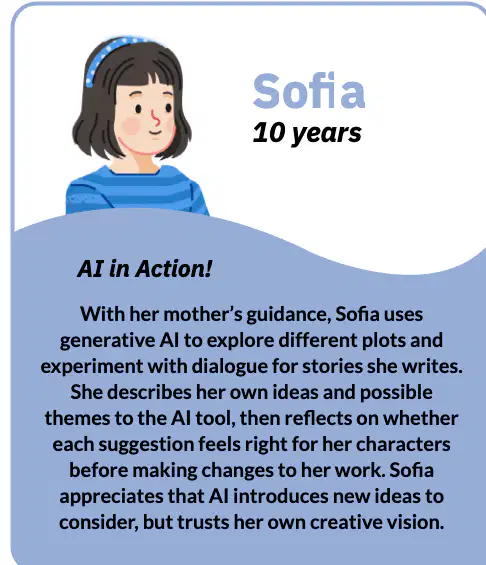
What does Sofia use generative AI for?
To play games
To explore different plots and experiment with dialogue for stories she writes
To solve math problems
To create music
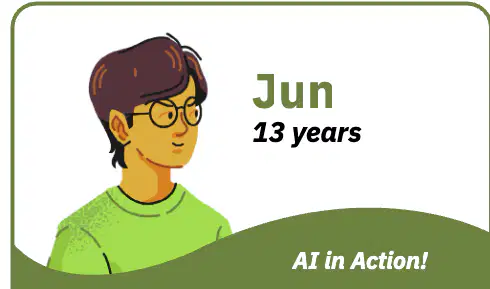
How does Jun use AI to help organize a school volunteering event?
By creating posters
By collecting availability, scheduling the day, managing last-minute changes, drafting schedules, and assigning volunteers based on classmates’ personalities and strengths
By cooking food
By cleaning the venue
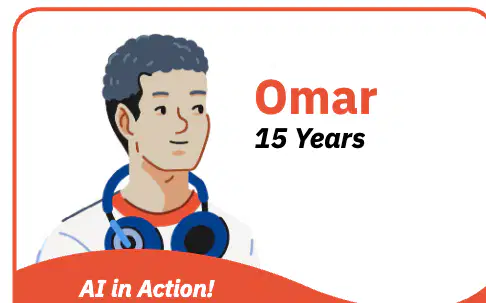
What did Omar do when he saw specific product recommendations on his social media feeds?
Ignored them
Changed his account settings to prevent the system from using his family’s information for targeted advertising
Bought the products
Deleted his account
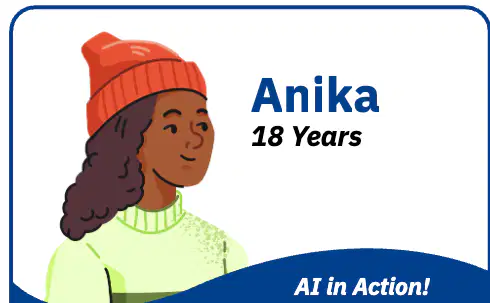
What did Anika notice while testing the wellness app that uses an AI model?
It was perfect
It sometimes recommended options that reinforce gender stereotypes
It was too slow
It had no recommendations
Fill in the blank: ________ involves using AI as a tool to access new content, information, or recommendations. Learners must develop a fundamental understanding of AI’s technical foundations in order to critically analyze its capabilities and limitations.
Engaging with AI
Ignoring AI
Avoiding AI
Distrusting AI
Rejecting AI
Fill in the blank: ________ consists of collaborating with an AI system in a creative or problem-solving process. It involves guiding and refining AI output through prompts and feedback, while ensuring the content remains fair and appropriate.
Creating with AI
Ignoring AI
Competing with AI
Restricting AI
Fill in the blank: ________ requires intentionally choosing how AI can support and enhance human work. This includes assigning structured tasks to AI, such as organizing information, so humans can focus on areas requiring creativity, empathy, and judgment.
Managing AI
Ignoring AI
Limiting Human Input
Automating Everything
Fill in the blank: ________ empowers learners to understand how AI works and connect it to its social and ethical impacts by shaping how AI systems function. The goal is to build the confidence and capacity to shape AI for human good by understanding the principles underpinning the design of AI from an early age.
Designing AI
Using AI Tools
Learning Programming
Data Collection
What do the knowledge statements in the AI literacy framework focus on?
Technical and societal understandings needed to apply and engage with AI systems
Only technical skills for programming AI
The history of computers
How to use social media
Fill in the blank: The skills in the AI literacy framework demonstrate fundamental abilities such as critical thinking, creativity, and __________ thinking, applied in an AI context.
computational
emotional
mechanical
historical
Which of the following is NOT mentioned as an attitude that prepares learners to engage with AI?
Curiosity
Adaptability
Readiness to question outputs
Ignoring AI's impact on others
According to the framework, why is it important for learners to apply critical thinking when interacting with AI outputs?
To detect misleading outputs and adopt a responsible attitude to ensure AI is used ethically
To memorize AI algorithms
To avoid using AI altogether
To make AI work faster
Fill in the blank: Ethical principles in the AI literacy framework are reflected in multiple __________.
competences
algorithms
devices
languages
The main message of the quote by Romina Cachia regarding AI literacy for educators is:
Educators need to develop AI literacy to effectively guide students in a digital world.
AI literacy is only important for technology professionals.
Students should learn AI without any guidance from educators.
AI literacy is not relevant to modern education.

According to the diagram and text, which of the following is NOT a discipline related to AI Literacy?
Computer Science
Media Literacy
Physical Education
Data Science
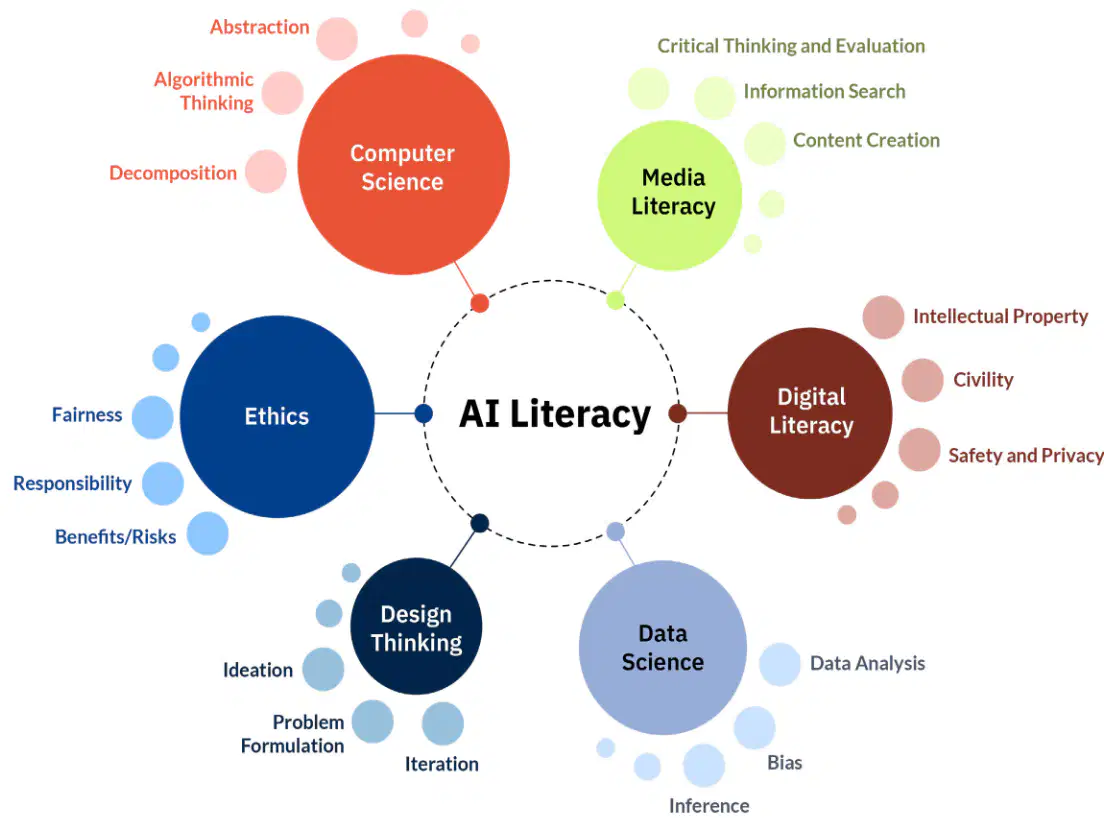
Fill in the blank: The AI Lit Framework reflects relevant knowledge, skills, and attitudes found across multiple topics and ________.
disciplines
machines
algorithms
languages
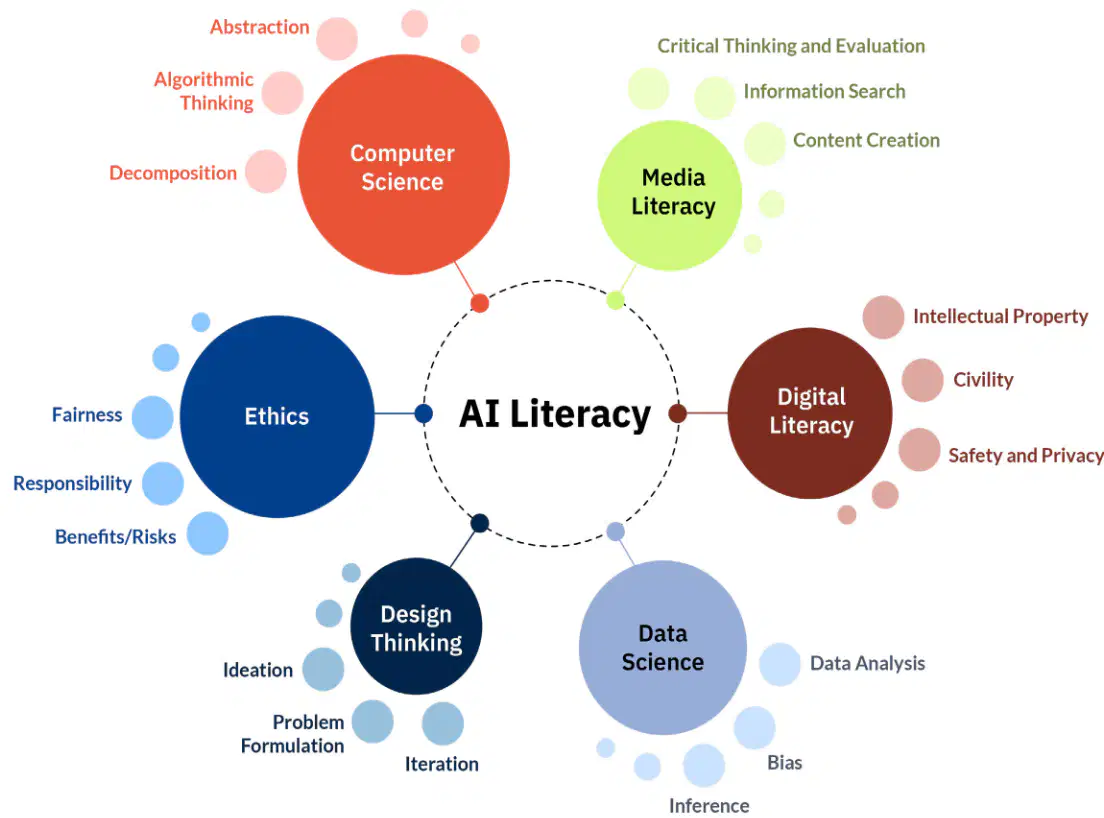
Which of the following is a subtopic of Ethics in the context of AI Literacy?
Decomposition
Fairness
Content Creation
Data Analysis

Which of the following is NOT listed as a subtopic of Design Thinking in the AI Literacy diagram?
A) Ideation
B) Iteration
C) Inference
D) Problem Formulation
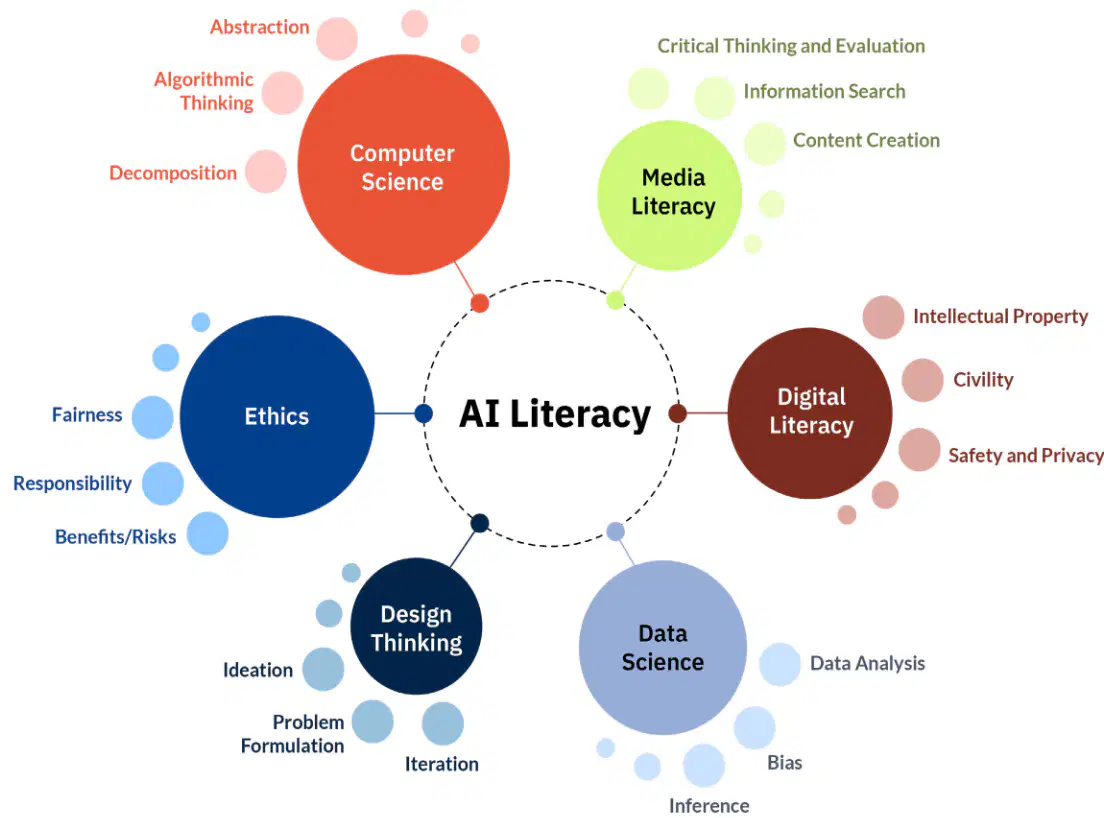
The AI Literacy framework connects technical understanding with critical evaluation, responsible use, and creative problem-solving.
True
False

Fill in the blank: In the context of AI Literacy, ________ is a subtopic of Data Science.
Bias
Photosynthesis
Gravity
Metamorphosis
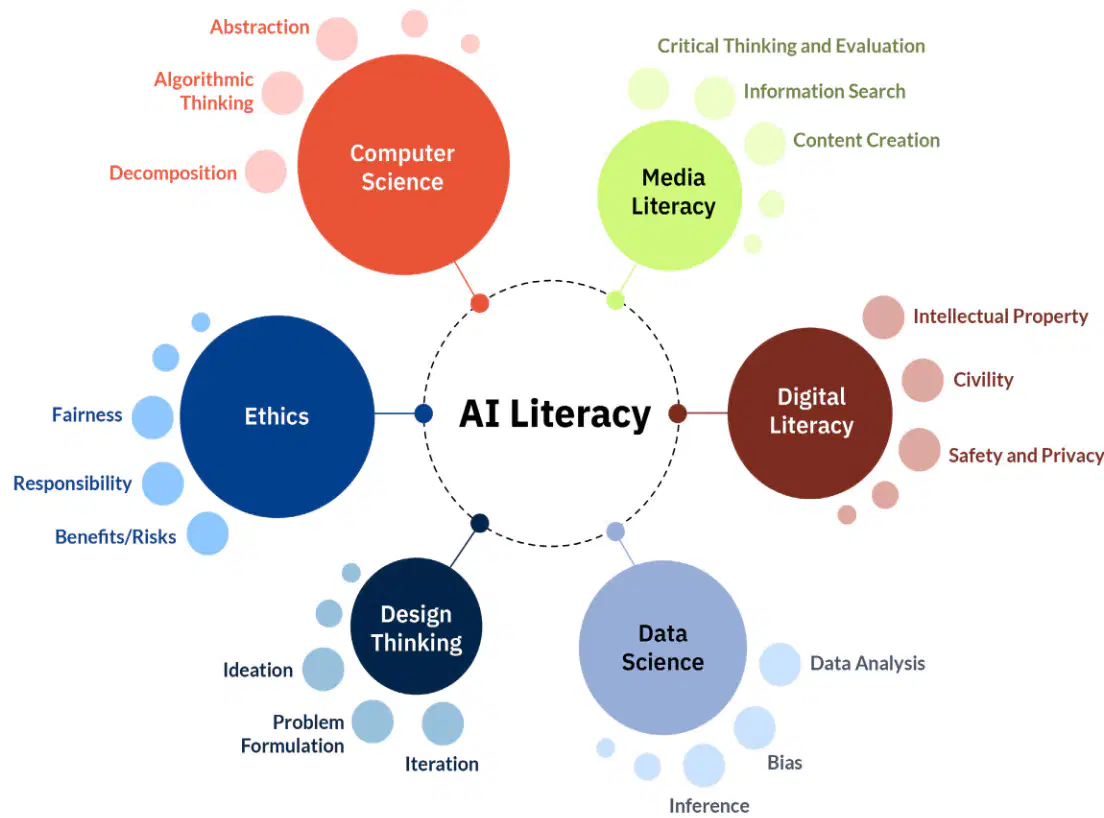
Which of the following is a subtopic of Digital Literacy according to the diagram?
Civility
Decomposition
Fairness
Ideation
Fill in the blank: The Nature of ___ refers to understanding what artificial intelligence is and how it functions.
AI
Biology
Mathematics
Physics
Fill in the blank: AI Reflects Human Choices and ___
Perspectives
Errors
Machines
Animals
Fill in the blank: AI Reshapes ___ and Human Roles.
Work
Nature
Weather
Music
Fill in the blank: AI’s Capabilities and ___.
Limitations
Possibilities
Advantages
Applications
Fill in the blank: AI’s Role in ___.
Society
Furniture
Weather
Sandwiches

