
Font size
 Worksheets
Periodic Table and Rates of Reaction - REVISION QUIZ
Total questions: 33
Worksheet time: 36mins
Which sub-atomic particle is much lighter than the others?
electron.
neutron.
nucleus.
proton.
The nucleus of the atom contains:
only neutrons.
only protons.
electrons and neutrons.
neutrons and protons.
The columns of the periodic table are called:
series.
families.
groups.
isotopes.
The elements in the first column of the periodic table react with water to form basic solutions and are called:
alkali metals.
alkaline earth metals.
halogens.
noble gases.
transition metals.
The elements helium and neon are both classified as:
alkali metals.
alkaline earth metals.
halogens.
noble gases.
In the periodic table, elements with similar properties can be found in
every second row.
every fourth column.
the same group.
the same period.
The elements in the periodic table are sequentially organised based on their
atomic number.
boiling point.
melting point.
mass number.
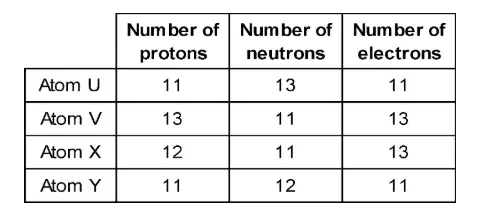
Which of the following are atoms of the same element?
U and Y
U and X
X and Y
U and V
Different isotopes of the same element contain different numbers of
electrons.
neutrons.
protons.
nuclei.
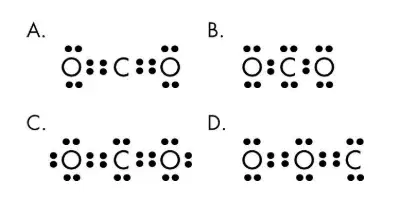
Which of the following shows the correct electron dot structure of carbon dioxide?
A
B
C
D
Select the full name of the element: Cu
Copper
Carbon
Cobalt
Calcium
How did the periodic table help scientists between its development in the nineteenth century and 1925, when the last of the naturally occurring elements was identified?
It allowed scientists to predict the existence and properties of undiscovered elements.
It helped scientists to create new synthetic elements before 1925.
It provided a way to measure atomic mass with perfect accuracy.
It enabled scientists to discover all elements through chemical reactions alone.
A sodium atom has 11 protons and 12 neutrons. What is its atomic number?
11
12
23
1
A sodium atom has 11 protons and 12 neutrons. How many electrons does a sodium atom have?
11
12
10
13
What is the mass number of a sodium atom?
23
11
16
20
Write down the chemical symbol for sodium.
Na
So
Sd
S
State the chemical symbol for iron.
Fe
Ir
In
Io
How does concentration affect the rate of reaction?
Increasing concentration increases the rate
Increasing concentration decreases the rate
Why does adding a catalysts increase the rate of reaction?
There is a lower activation energy
The particles have higher energy
There are more frequent collisions
The particles have a higher surface area

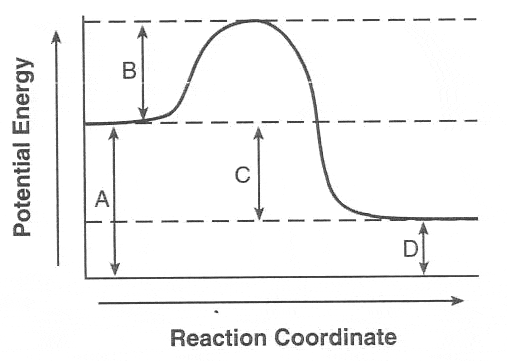
Which of these is the activation energy?
A
B
C
D
Which one shows that a chemical reaction has occurred?
dissolving
melting
formation of a gas
bending
The speed of a reaction is called the ______ of the reaction.
Rate
Activation Energy
Catalyst
Frequency
Which is NOT an example of an exothermic reaction
Combustion
Photosynthesis
Respiration
Corrosion
Which of the following is a sign of a chemical change has occurred?
Adding a catalyst ___________ the activation energy.
Raises
Lowers
Doesn't affect
Inreases
Grinding a effervescent tablet into powder increases the rate of reaction due to increased
concentration
surface area
temperature
reactants
The ________ refers to the amount of product produced in the reaction.
.
Production
Yield
Result
Amount
The percent yield of the reaction indicates
The mass of product that should be obtained
How quickly the reaction is completed
The mass of product actually obtained
The efficiency of the chemical reaction
Some product may be lost during filtration causing your actual yield to be less than your theoretical yield.
true
false

