
 Worksheets
Control System Q3
Total questions: 34
Worksheet time: 17mins
What is the primary characteristic of an open-loop control system?
Uses feedback to control output
Corrects its own error
Operates independently of output
Always unstable
Which of the following is an example of a (Multiple Input Multiple Output) MIMO system?
Thermostat
Audio system with stereo output
Noise-cancelling headphones
Four wheeler driving (steering + speed control)
In a closed-loop control system, which component is responsible for measuring the output?
Controller
Sensor
Actuator
Comparator
What type of signal does a continuous-time system process?
Signals at discrete intervals
Signals encoded in binary
Smoothly varying analog signals
Time-invariant signals only
The transfer function of a system is valid under what condition?
Non-zero initial conditions
When the system is nonlinear
Zero initial conditions
For only digital systems
If a function has all the poles in the left half of the s plane, it is:
stable
unstable
marginally stable
Which of the following indicates a Linear Time-Invariant (LTI) system?
y(t) = 2x(t) + sin(t)
y(t) = 3x(t)
y(t) = x(t²)
y(t) = x(t) + t

In the following transfer function, what are the poles?
-2 only
-2 and -1
-1 and 2
0 and -2
The process of simplifying interconnected control blocks is called:
Root locus method
Bode analysis
Block diagram reduction
Routh stability test
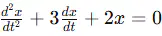
In the following equation, what is the order?
1
2
3
0
What distinguishes a lumped parameter system from a distributed one?
Signal type
Dependence on time and space
Use of AI
Mechanical vs electrical nature
What is the purpose of a controller in a control system?
Measure output
Convert signals into physical form
Compare input with output
Compute and send control action
Which system uses feedback to automatically correct its behavior?
Open-loop
Manual control
Closed-loop
Passive system
What type of control system is a washing machine without sensors?
Closed-loop
Adaptive
Open-loop
Semi-automatic
Which of the following increases in a closed-loop system due to negative feedback?
Error
Disturbance
Accuracy
Loop gain
In which of the following systems does time variance appear?
Volume knob on analog radio
RLC circuit
Equation with time-dependent coefficients
Linear system with constant coefficients
A system with both linearity and time-invariance is called:
Stable system
Passive system
LTI system
Nonlinear system
Which of these represents a linear time-invariant (LTI) system?
y(t) = 2x(t) + t
y(t) = x²(t)
y(t) = x(t − 2)
y(t) = x(t) + sin(t)
What is the primary condition for determining stability of a system from its transfer function?
Zeros on right-hand side
Poles on left-hand side
Zeros in origin
High feedback gain
In transfer function N(s)/D(s), zeros are roots of:
D(s)
N(s)
1 + D(s)
Feedback path
The block diagram reduction rule for blocks in series is:
Add the transfer functions
Multiply the transfer functions
Subtract the transfer functions
Use Laplace transform
For parallel blocks in a block diagram, the combined transfer function is:
Product
Reciprocal
Sum
Zero
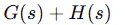
Closed loop feedback transfer function is given by:



In a differential equation, what does 'degree' represent?
Highest derivative present
Number of terms
Power of highest order derivative
Total number of derivatives
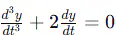
The order and degree of the differential equation is :
Order=3, Degree=1
Degree=3, Order=1
Order=0, Degree=1
Order=3, Degree=3
What is the physical meaning of a pole in a transfer function?
Value of s that makes output zero
Frequency of oscillation
Frequency where system becomes unstable
Value of s for infinite output
A distributed parameter system differs from a lumped one by:
Use of discrete signals
Time-only dependency
Space and time dependency
No dependency
Which modeling technique is typically used for RLC circuits?
Partial Differential Equation
Lumped parameter Ordinary Differential Equation(ODE)
An adaptive control system can:
Only follow pre-programmed rules
Self-adjust in real time
Be operated only manually
Be used only in power systems
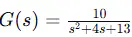
Consider a system with the following transfer function, The system is:
Overdamped
Underdamped
Critically damped
Unstable

A system described by the following DE has which transfer function?


Which of the following systems violates the superposition principle?
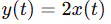



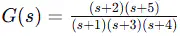
For the following transfer function, how many poles and zeros does the system have ?
3 poles, 2 finite zeros
2 poles, 3 zeros
3 poles, 3 zeros (including one at infinity)
2 poles, 2 zeros
A system has a transfer function G(s)=1/(s+3), What is its pole and what does it indicate?
Pole at +3 → system is unstable
Pole at –3 → system is stable
Pole at 0 → marginal stability
No pole

