
 Worksheets
Chemistry of Life
Total questions: 60
Worksheet time: 1hrs 3mins
20-25% of the 98 natural elements are known to be essential to life. Which 4 of these 25 elements make up approximately 96% of living matter?
oxygen, hydrogen, calcium, nitrogen
carbon, sodium, hydrogen, nitrogen
carbon, oxygen, phosphorus, hydrogen
carbon, hydrogen, nitrogen, oxygen
A nitrogen atom has 7 protons, and the most common isotope of nitrogen has 7 neutrons. A radioactive isotope of nitrogen, nitrogen-15, has a greater mass number than nitrogen-14 because the atomic nucleus of nitrogen-15 contains
8 protons
15 protons
7 neutrons
8 neutrons
Why does the structure H-C=C-H fail to make sense chemically?
Carbon has 4 bonding electrons and will form 4 bonds, the formula provided shows each carbon only making 3 bonds
Carbon has 6 bonding electrons and will form 6 bonds, the formula provided shows each carbon only making 4 bonds
Carbon has 2 bonding electrons and will form 4 bonds, the formula provided shows each carbon only making 3 bonds
Carbon has 4 bonding electrons and will form 4 bonds, the formula provided shows each carbon making 8 bonds

How many electrons does Fluorine have?
9
7
19
17

How many valence electrons does fluorine have?
7
9
10
18
How many energy levels does fluorine have?
7
3
9
10
How many electrons are needed to fill Fluorine's valence energy shell?
7
1
8
2

Using the Bohr model of Fluorine, which correctly describes the reactivity of the atom?
Fluorine is most likely to gain one electron when bonding
Fluorine is most likely to lose one electron when bonding
Fluorine is most likely to lose seven electrons when bonding
Fluorine has a full valence and will not bond

If two or more elements are in the same horizontal row, what do they have in common?
They have the same number of energy levels and a similar atomic radius.
They have the same number of valence electrons and react the same way.
They have the same number of electrons and have similar electronegativity.
They have the same number of protons and electrons, but varying neutrons making them isotopes of each other.
If two or more elements are in the same vertical column, what do they have in common?
They have the same number of energy levels and a similar atomic radius.
They have the same number of valence electrons and react the same way.
They have the same number of electrons and have similar electronegativity.
They have the same number of protons and electrons, but varying neutrons making them isotopes of each other.
What does the formation and function of a molecule depend upon?
the location of the atom on the periodic table
how the atoms bond together
how many energy levels the atoms have
how many total electrons each atom has
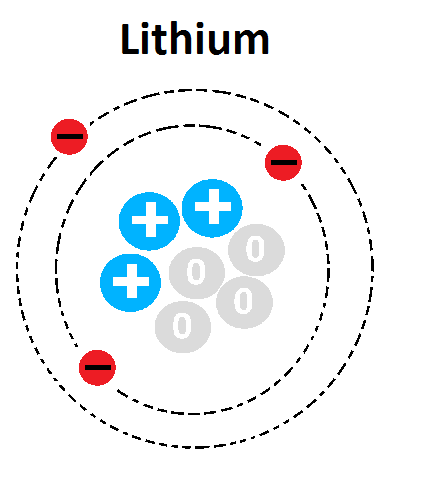
How many electrons can fit on the 1st energy level (orbital) for any Bohr Model?
2
6
8
10

How many valence electrons?
2
3
4
5
What is a valence electron?
A positive electron
An electron in the outer ring
An electron in the nucleus
A neutral electron

How many valence electrons does this element have?
3
4
2
1
What is the octet rule?
it states atoms need to be happy
it states atoms need 8 valence electrons to be stable
it states atoms need 6 valence electrons to be stable
it states atoms need to share electrons to be stable
What happens to the valence electrons of an atom when it is a covalent bond?
transfers electrons
shares electrons
does nothing
What happens to the valence electrons of an atom that uses an ionic bond?
transfers electrons
shares electrons
nothing
The nucleic acid DNA is double stranded. The two strands are held together by
hydrogen bonds
covalent bonds
proteins
fats
A water molecule is a _______ since the negative end of one water molecule is attracted to the positive end of another water molecule.
polar molecule
sustain life
surface tension
specific heat
Which of these elements does not prefer to react with other elements?
beryllium
helium
hydrogen
both hydrogen and helium
Oxygen has an atomic number of 8 and, most commonly, a mass number of 16. Thus, what is the atomic mass of an oxygen atom?
approximately 16 daltons
approximately 16 grams
approximately 8 grams
approximately 8 daltons
Can the atomic mass of an element vary?
Yes. Adding or losing electrons will substantially change the atomic mass.
Yes. Adding or losing protons will change the atomic mass without forming a different element.
Yes. Adding or losing neutrons will change the atomic mass without forming a different element.
No, it is fixed; otherwise a new element will be formed.
When are atoms most stable?
when all the valence shells are filled
when they have the maximum number of unpaired electrons
when they have the fewest possible valence electrons
when all electrons are paired
Which one of the atoms shown would be most likely to form a cation with a charge of +1?


Which one of the atoms shown would be most likely to form a anion with a charge of -1?
What is the maximum number of covalent bonds that an oxygen atom with atomic number 8 can make with hydrogen?
6
2
1
4
What are the bonds between two atoms that are equally electronegative called?
ionic
polar covalent
nonpolar covalent
hydrogen bonds
When is a covalent bond considered to be polar?
when the two atoms sharing electrons are of the same elements
when the two atoms sharing electrons are equally electronegative
when carbon is one of the two atoms sharing electrons
one of the atoms sharing electrons is more electronegative than the other atom
Which of the following is broken when water evaporates?
ionic bonds
nonpolar covalent bonds
hydrogen bonds
polar covalent bonds
What is the maximum number of hydrogen atoms that can be covalently bonded in a molecule containing two carbon atoms?
6
2
4
8
Which of the following are compounds?
H2O and CH4, but not O2
O2 and CH4
H2O, O2, and CH4
H2O and O2
When the atoms involved in a covalent bond have the same electronegativity, what type of bond results?
ionic bond
polar covalent bond
nonpolar covalent bond
hydrogen bond
Neutral atoms have no electric charge because they have:
an equal number of charged and uncharged subatomic particles
an equal number of protons and electrons
an equal number of protons and neutrons
uncharged neutrons in their nuclei
Which of the following correctly describes chemical equilibrium?
There are equal concentrations of products and reactants while forward and reverse reactions continue.
Forward and reverse reactions continue with no net effect on the concentrations of the reactants and products.
Concentrations of products are higher than the concentrations of the reactants.
There are equal concentrations of reactants and products, and the reactions have stopped.
Which of the following correctly compares Carbon-14 and Carbon-12 atoms?
They have the same atomic number, thus their number of neutrons are the same.
They have the same number of protons, but C-14 has more neutrons than C-12.
They have the same atomic number and atomic mass.
They have the same atomic mass, but different number of neutrons
In the term trace element, the adjective trace means that
the element can be used as a label to trace atoms through an organism's metabolism.
the element is very rare on Earth.
the element enhances health but is not essential for the organism's long-term survival.
the element is required in very small amounts.
What is the difference in the two isotopes 31P and 32P?
one more neutron
a different atomic number
one more electron
one more proton
The reactivity of an atom arises from
the average distance of the outermost electron shell from the nucleus.
the sum of the potential energies of all the electron shells.
the potential energy of the valence shell.
the existence of unpaired electrons in the valence shell.
Which statement is true of all atoms that are anions?
The atom has fewer protons than does a neutral atom of the same element.
The atom has more electrons than protons.
The atom has more neutrons than protons.
The atom has more protons than electrons.
Which of the following statements correctly describes any chemical reaction that has reached equilibrium?
The rates of the forward and reverse reactions are equal.
The reaction is now irreversible.
The concentrations of products and reactants are equal.
Both forward and reverse reactions have halted.
The atomic number of sulfur is 16. Sulfur combines with hydrogen by covalent bonding to form a compound, hydrogen sulfide. Based on the number of valence electrons in a sulfur atom, predict the molecular formula of the compound.
HS
H2S
H4S
HS2
What coefficients must be placed in the following blanks so that all atoms are accounted for in the products? (Remember that we cannot create or destroy matter.)
C6H12O6 → ___ C2H6O + ___ CO2
3; 1
2; 1
1; 3
2; 2

Which of the following best describes the relationship between the atoms shown?
They are isotopes
they contain 1, 2 and 3 protons, respectively.
they each contain 1 neutron
they are isomers
An atom has 12 protons and 13 neutrons in its nucleus. Which is the correct symbol?


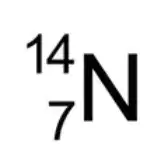
Which of the following best shows the electron configuration of Nitrogen-14


Which of the following atoms would be considered chemically unreactive?
Which of the following is NOT an element?
water
carbon
chlorine
oxygen
What are the four elements that build life?
carbon
hydrogen
nitrogen
oxygen
hydrogen
nitrogen
sodium
carbon
oxygen
hydrogen
calcium
nitrogen
nitrogen
carbon
oxygen
phosphorus
hydrogen
The atomic number of nitrogen is 7. Nitrogen-15 has a greater atomic mass than nitrogen-14 because nitrogen-15 contains ___ in its nucleus.
8 protons
7 neutrons
15 protons
8 neutrons
The left to right order of elements in the periodic table is based on their ________.
atomic number
atomic mass
the number of neutrons
electric charge of atom
A neutral atom has two, eight, eight electrons in its first, second, and third energy levels. This information ________.
does not tell us about the chemical properties of the element
does not tell us about the atomic mass of the element
does not tell us about the atomic number of the element
does not tell us about the size of the element
What is the difference between covalent bonds and ionic bonds?
Covalent bonds involve the sharing of pairs of electrons between atoms; ionic bonds involve the sharing of single electrons between atoms.
Covalent bonds involve the sharing of electrons between atoms; ionic bonds involve the sharing of protons between charged atoms.
Covalent bonds involve the sharing of electrons between atoms; ionic bonds involve the electrical attraction between charged atoms.
Covalent bonds involve the transfer of electrons between charged atoms; ionic bonds involve the sharing of electrons between atoms.
How many electrons are involved in a triple covalent bond?
6
9
3
12
Choose the answer that balances this equation.
H2 + O2 --> H2O
2H2 + O2 --> 2H2O
2H2 + 2O2 --> H2O
H2 + 2 O2 --> 2H2O
balanced already
Choose the Answer that shows this equation balanced:
Na + O2 ----> Na2O2
Na + 3O2 ----> Na2O2
2Na + O2 ----> Na2O2
Na + 2O2 ----> Na2O2
3Na + 2O2 ----> Na2O2
The _______ are on the left side of the equation and the _______ are on the right.
products; reactants
reactants; solutions
solvents; products
reactants; products

