wayground logo

Free Printable Worksheets

NEW

Font size

S
M
L
XL
Worksheets

Cell Membrane and Transport and Spiral Back 2021

Total questions: 57

Worksheet time: 48mins

Name
Class
Date
1.
What is another term for "selectively permeable"?
a)
porous
b)
completely permeable
c)
permanent
d)
semipermeable
2.
True or false:  Regulating what enters and leaves the cell helps the cell maintain homeostasis. 
a)
True
b)
False
3.
What forms the channels and pumps in the phospholipid bilayer?
a)
carbohydrates
b)
proteins
c)
hydrophilic heads 
d)
lipids
4.
What does "bilayer" mean?
a)
one layer
b)
two layers
c)
laminated
d)
bilateral
5.
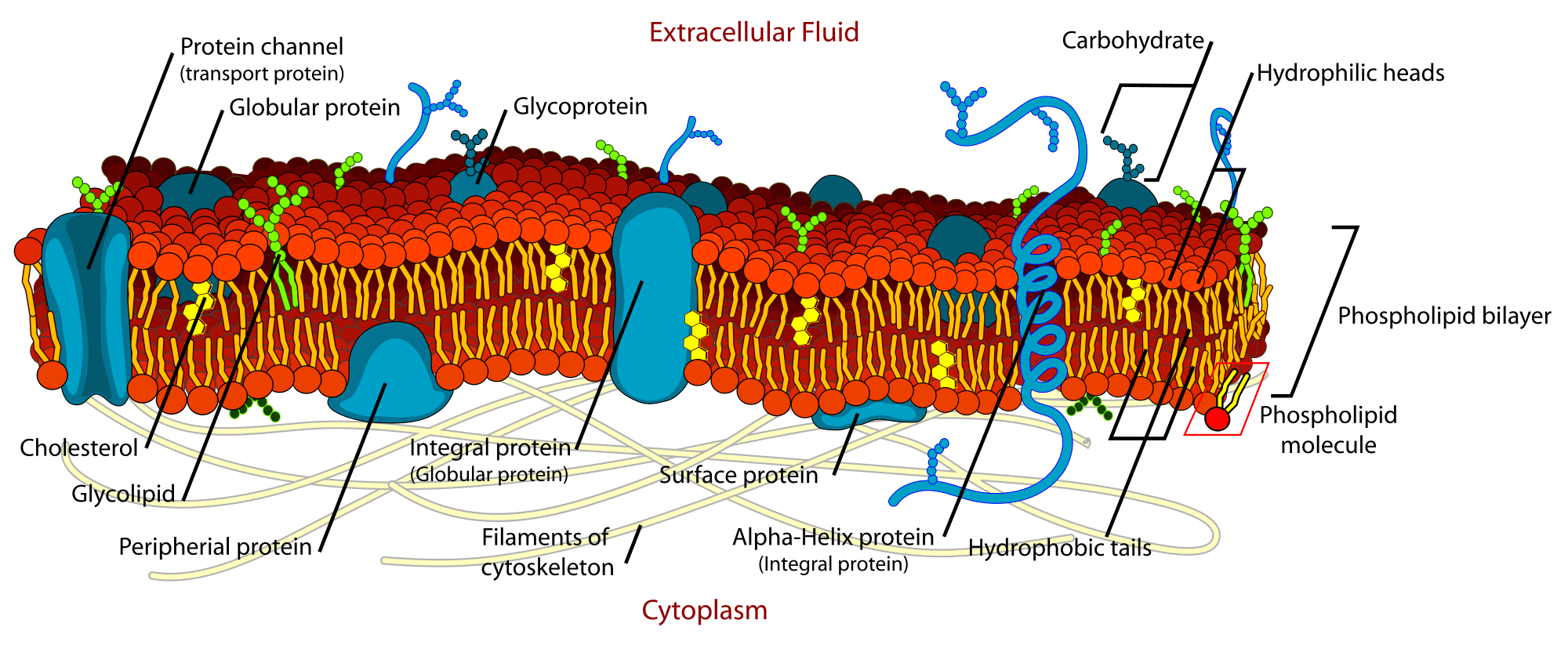
Hydrophobic region of the cell membrane?
a)
E
b)
B
c)
C
d)
6.
Special proteins help move particles, but NO energy is needed. This is..
a)
facilitated diffusion
b)
exocytosis
c)
active transport
d)
equilibrium
7.
What is this image?
a)
cell membrane
b)
proteins
c)
carbohydrates
d)
lipids
8.
Osmosis is the movement of _____ across a membrane.
a)
food
b)
energy
c)
oxygen
d)
water
9.
The diagram is an example of 
a)
diffusion
b)
active transport
c)
osmosis
d)
equilibrium
10.
This is a diagram of...
a)
exocytosis
b)
active transport
c)
osmosis
d)
equilibrium
11.
The cell below is in a _____________ solution.
a)
Hypertonic
b)
Hypotonic
c)
Isotonic
12.
The cell below is in a _________ solution.
a)
Hypotonic
b)
Hypertonic
c)
Isotonic
13.
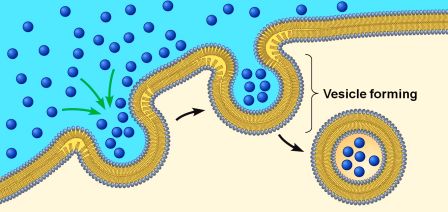
This picture represents which type of cellular transport?
a)
passive transport
b)
endocytosis
c)
exocytosis
d)
osmosis
14.
A cell in an isotonic solution will
a)
swell
b)
shrink
c)
stay the same size
d)
impossible to tell
15.
why do cells move things in and out?
a)
they are bored
b)
why not
c)
homeostatis, yo! 
d)
kittens
kittens
16.
Which is true about active transport?
a)
It requires energy
b)
it does not require energy
c)
It moves substances down the concentration gradient
d)
it moves material from high to low concentration
17.
What are two types of passive transport?
a)
endo and exocytosis 
b)
cookies and milk
c)
active and passive 
d)
Osmosis and diffusion
18.
A person would never have pure water put into their veins in a hospital because their cells would...
a)
Shrink/Dehydrate
b)
Expand
19.
A slug passes away when salt is put on it from their cells
a)
expanding
b)
shrinking
20.
The picture is an example of...
a)
active transport
b)
passive transport
c)
diffusion
d)
osmosis
21.
This type of transport requires NO ENERGY and goes from HIGH to LOW concentration?
a)
Active
b)
Cellular
c)
Passive
22.
 If a cell containing 5% salt is placed into a glass of water with 20% salt, the water is _______ compared to the cell.
a)
hypertonic-
b)
hypotonic
c)
isotonic
23.
In a solution, salt is considered the _______.
a)
solvent
b)
solute
c)
solution
24.
Which cell is placed into a hypotonic environment? 
a)
A
b)
B
c)
C
d)
D
25.
An animal cell placed in a hypertonic (salty) solution will
a)
Shrink
b)
Swell
c)
Stay the same
26.
Which form of active transport is being shown?
a)
Facilitated Diffusion
b)
Exocytosis
c)
Endocytosis
d)
Protein Pumps
27.
What are 3 types of active transport?
a)
Riding a bike, Running through the mountains, walking on the beach
b)
Osmosis, Diffusion, Facilitated Diffusion
c)
Sodium/potassium Pump, Endocytosis, Exocytosis
d)
Throwing a ball, Playing tennis, driving a car
28.
What is the difference between active and passive transport?
a)
Active does not need energy and passive uses ATP (energy)
b)
Active uses ATP (energy) and passive does not need energy
c)
Active stores transport proteins and passive releases 
d)
Active uses hormones and passive does not 
29.

What type of transport is pictured here?

a)

endocytosis

b)

exocytosis

c)

facilitated diffusion

d)

osmosis

30.

What type of transport is pictured here?

a)

endocytosis

b)

exocytosis

c)

diffusion

d)

osmosis

31.

What type of transport is this? Be specific:

When an amoeba captures bacteria.

a)

endocytosis

b)

exocytosis

c)

diffusion

d)

osmosis

32.

What are the two main macromolecules in a cell membrane?

a)

carbohydrates & lipids

b)

lipids & proteins

c)

proteins & carbohydrates

d)

nucleic acids & lipids

33.

Why is the cell membrane selectively permeable?

a)

large, polar molecules can pass easily

b)

small, nonpolar molecules pass easily

c)

there is a doorman that lets molecules cross

d)

only water can cross the cell membrane

34.

Which form of cellular transport requires the use of energy?

a)

active transport

b)

passive transport

35.

In a hypertonic solution, water will move ____ the cell, causing the cell to ________.

a)

out of; shrink

b)

out of; swell

c)

into; shrink

d)

into; swell

36.

In a hypotonic solution, water will move ____ the cell, causing the cell to ________.

a)

out of; shrink

b)

out of; swell

c)

into; shrink

d)

into; swell

37.

What is the function of a contractile vacuole in the paramecium (unicellular protist usually found in freshwater ecosystems)?

a)

Takes in extra water for the cell to drink

b)

Pump out excess water that is brought in by osmosis

c)

Make energy for the paramecium

d)

to allow it to move around in its environment

38.

What energy molecule is used in active transport?

a)

ADP

b)

Enzymes

c)

ATP

d)

Glucose

39.

If there is 85% water inside a cell, then how much solutes are dissolved in it? (hint: % water and solutes should equal 100%)

a)

5%

b)

90%

c)

85%

d)

15%

40.
The plant cell wall is made up of
a)
chitin
b)
peptidoglycan
c)
cellulose
d)
glycogen
41.
All cells have a:
a)
Nucleus
b)
Plasma membrane
c)
Cell wall
d)
Buddy
42.
The function of the plasma membrane is....
a)
to regulate what enters and leaves the cell.
b)
fight bacteria and viruses that enter the cell.
c)
provide rigid support and protection to the cell.
d)
make sure each cell can move
43.
What is NOT TRUE about the cell membrane
a)
It controls what enters and leaves the cell
b)
Semipermeable
c)
Phospholipid bilayer
d)
Contains digestive enzymes
44.
What do the brown structures represent?
a)
Phospholipids
b)
Glycoproteins
c)
Channel Proteins 
d)
Cyctoskeleton Filaments
45.
In which direction will these molecules diffuse?
a)
from right to left
b)
from left to right
c)
they will not move at all
d)
they will move in both directions equally
46.

The cell membranes of all living things (prokaryotes and eukaryotes) are made up of a double layer of what molecules?

a)

phospholipids

b)

Protein channels

c)

Carbohydrate chains

d)

Nucleic Acids

47.

A virus's genetic material is surrounded by

a)

a protein capsid

b)

DNA

c)

a tail fiber

d)

nothing

48.

Which cycle of a virus is most destructive to the host?

a)

lytic cycle

b)

lysogenic cycle

49.

Choose the correct order of lytic cycle steps

a)

attachment, injection, assembly, synthesis, lysis

b)

attachment, injection, synthesis, assembly, lysis

c)

attachment, injection, assembly, lysis, synthesis

d)

attachment, lysis, assembly, synthesis, injection

50.

Viruses attach only to a particular host because of the presence of

a)

DNA

b)

magnetic attraction

c)

surface receptors

d)

other viruses

51.

viruses are non-living because

a)

they cannot reproduce on their own

b)

they do not evolve

c)

they have no DNA

d)

they cannot be destroyed

52.
Special proteins produced by the body to attack foreign invaders.
a)
antibodies
b)
antigen
53.

Vaccines contain weakened or dead parts of viruses.

a)

True

b)

False

54.
Vaccinations are used for
a)
Curing the illness
b)
Preventing the Illness
c)
Getting the illness
55.
He belived that having cowpox gave people ___________ from smallpox
a)
Immunity
b)
Vaccinaton
c)
Innoculation
d)
Innocence
56.
What body system is attacked by the HIV virus?
a)
The reproductive system
b)
The respiratory system
c)
The endocrine system
d)
The immune system
57.
What is the job of the immune system?
a)
Makes red blood cells
b)
Allows humans to reproduce
c)
Protects body from foreign invaders like germs.
d)
Helps the body digest food