
 Worksheets
Cosmos
Total questions: 104
Worksheet time: 5hrs 47mins
Each planet's orbit about the Sun is an ellipse. The Sun's center is always located at one focus of the orbital ellipse.
Kepler's 1st Law
Kepler's 2nd Law
Kepler's 3rd Law
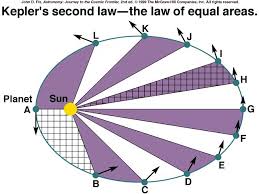
A planet moves in its ellipse so that the line between it and the Sun placed at a focus sweeps out equal areas at equal times.
Kepler's 1st Law
Kepler's 2nd Law
Kepler's 3rd Law
The square of a planet's orbital period is proportional to the cube of the length of the semi-major axis of its orbit.
Kepler's 1st Law
Kepler's 2nd Law
Kepler's 3rd Law
The mean distance from the center of the earth to the center of the sun.
Astronomical Unit
Heliocentric Theory
Kepler's 1st Law
Planetary Revolution
The path of the earth around the sun, which is one complete cycle of an orbit, is approximately 365.2425 days in length.
Astronomical Unit
Heliocentric Theory
Kepler's 1st Law
Planetary Revolution
There are two points inside of an ellipse. The sun is one point in our solar system.
Astronomical Unit
Heliocentric Theory
Foci
Planetary Revolution
Planets revolving around a fixed point, the sun.
Astronomical Unit
Heliocentric Theory
Foci
Geocentric Theory
Planets revolving around a fixed point, the earth.
Astronomical Unit
Heliocentric Theory
Foci
Geocentric Theory
The combining of several small nuclei into one large nucleus with the subsequent release of huge amounts of energy.
Astronomical Unit
Nuclear Fusion
Foci
Nuclear Fission
The splitting of an atom into smaller parts.
Astronomical Unit
Nuclear Fusion
Foci
Nuclear Fission
Energy that is transferred by electromagnetic radiation, such as light, X-rays, gamma rays, and thermal radiation, which may be described in terms of either discrete packets of energy, called photons, or continuous electromagnetic waves.
Astronomical Unit
Nuclear Energy
Radiant Energy
Nuclear Fission
The northern lights, one of several astronomical phenomena called polar lights (aurora polaris), are shafts or curtains of colored light visible on occasion in the night sky.
Astronomical Unit
Nuclear Energy
Aurora Borealis
Nuclear Fission
A change in the orientation of the rotational axis of a rotating body.
Nutation
Precession
Barycenter
Nuclear Fission
Is the center of mass of two or more bodies that orbit one another and is the point about which the bodies orbit.
Nutation
Precession
Barycenter
Nuclear Fission
A periodic oscillation of the earth's axis that causes the precession of the poles to follow a wavy rather than a circular path.
Nutation
Precession
Barycenter
Nuclear Fission
Earth's spin around its own axis. Causes day and night.
Nutation
Rotation
Barycenter
Revolution
The Earth's orbital motion around the sun. Takes 365 days.
Nutation
Rotation
Barycenter
Revolution
A tide just after the first or third quarters of the moon when there is least difference between high and low water.
Neap
Rotation
Spring
Revolution
A tide just after the new or full moon when there is the greatest difference between high and low water.
Neap
Rotation
Spring
Revolution
The orbits of the planets are ellipses with the Sun at one focus, though all except Mercury are very nearly circular.
Planetary Orbit
Kepler's 3rd Law
Neap Tide
Rotation
the shape of the planets' orbits.
the speed/area the planet travels.
the length of time it takes the planet to orbit the sun.
the sun being the center point.
The value of the eccentricity of ANY orbit can range from ________ to ________.
0.1 to 0.9
-1 to 0
0 to 100
0 to 1
Kepler's 3rd Law states....
...the square of the orbital period of a planet is directly proportional to the cube of the semi-major axis of its orbit.
...all planets travel in an elliptical orbit.
...line joining a planet and the Sun sweeps out equal areas during equal intervals of time.
...that the sun is at the center of the universe.


The period of revolution measures what?
Time it takes to make one complete spin.
Time it takes to go around the Sun once.
Distance from the Sun to the planet

What do Kepler's Laws help explain?
Planetary motion
The order of the Universe
The Big Bang Theory
Hubble's Law

What does Kepler's 1st Law (Law of Ellipses) help explain?
The shape of Earth's orbit
The directly proportional relationship between Earth's distance from the sun & its orbital speed
The area covered by Earth's sweeping orbit in equal time periods
The order of the planets in our solar system

What does Kepler's 2nd Law (Law of Equal Area) help explain?
The shape of Earth's orbit
The area covered by Earth's sweeping orbit in equal time periods
The directly proportional relationship between Earth's distance from the sun & its orbital speed
The order of the planets in our solar system

What does Kepler's 3rd Law (Harmonic Law) help explain?
The shape of Earth's orbit
The area covered by Earth's sweeping orbit in equal time periods
The directly proportional relationship between Earth's distance from the sun & its orbital speed
The order of the planets in our solar system
Which of the following has an eccentricity of zero?
a straight line
a large ellipse
a circle
a small ellipse

Which of the these would have an eccentricity of 1
a straight line
a large ellipse
a circle
a small ellipse
Which of the following is more elliptical based off of its eccentricity?
.0035
.035
.35
.53
How would the orbit of a satellite change if its mass increased?
Its orbit would become more elliptical.
Its orbit would become less elliptical.
Its orbit would stay the same.
If a space shuttle orbiting Earth wanted to orbit closer to the surface (decrease the orbit) would they need to speed up or slow down?
Speed up
Slow down
The sun is in the ________________________ of our solar system.
outside
circle
center
moon
Which planet is the largest planet in our solar system
Jupiter
Saturn
Mars
Earth
What planet do we live on?
Mars
Venus
Earth
Saturn
What planet has thousands of beautiful, tiny rings made of chunks of ice and rock?
Jupiter
Saturn
Uranus
Neptune
Which of the following lists the correct order of the planets from the sun?
Mercury, Venus, Mars, Earth, Jupiter, Saturn, Uranus, Neptune
Mercury, Venus, Earth, Mars, Jupiter, Saturn, Uranus, Neptune
Mercury, Venus, Earth, Mars, Saturn, Jupiter, Uranus, Pluto
Mars, Venus, Earth, Mercury, Jupiter, Saturn, Uranus, Neptune
Which particle has a positive electrical charge?
proton
neutron
electron
Which of the three particles has the smallest mass?
proton
neutron
electron
What is a pure substance made of 2 or more elements chemically combined in a specific ratio (Ex. Water)?
Element
Compound
Mixture
Solution
What is a type of mixture in which different parts can easily be seen (Ex. Vegetable soup)?
Heterogeneous mixture
Homogeneous mixture
Solution
Colloid
What is a well-mixed mixture containing a solvent and at least one solute that has the same properties throughout (Ex. Sugar water)?
Heterogeneous mixture
Colloid
Suspension
Solution
What is a type of mixture that is evenly mixed so you cannot see the parts and it looks all the same (Ex. Paint)
Element
Compound
Heterogeneous mixture
Homogeneous mixture
What is a pure substance that cannot be broken down into any other substances by chemical or physical means (Ex. Oxygen)?
Element
Compound
Colloid
Suspension

What Planet is closest to the Sun?
Earth
Mars
Saturn
Mercury
What Planet has the shortest trip around the Sun?
Mercury
Mars
Pluto
Uranus
The hottest planet in the solar system?
Earth
Mars
Neptune
Venus
How many miles is Earth from the Sun?
83 million
92 million
94 million
93 million
True or False: A day on Mars is SHORTER than a day on Earth.
True
False
Why does Mars have a pinkish color?
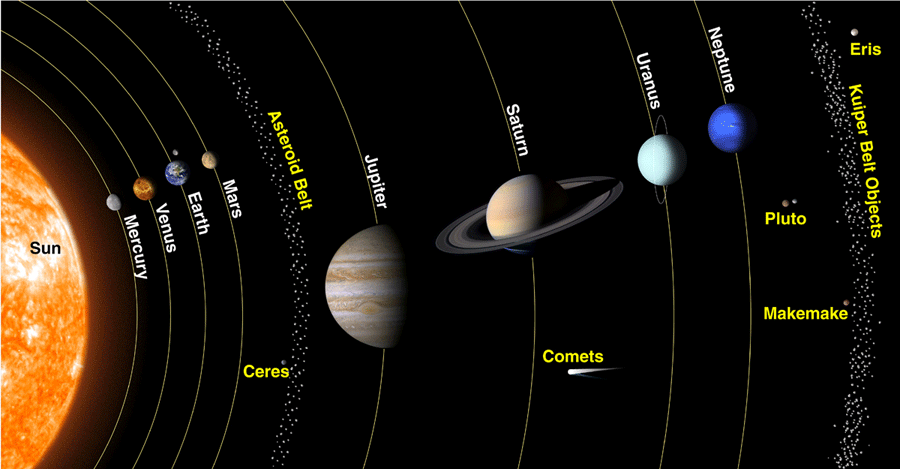
What belt is between Mars and Jupiter?
Kuiper Belt
Black Belt
Asteroid Belt
What planet comes after Saturn?
Neptune
Saturn
Uranus
Jupiter
How do the planets stay in place?
The Sun
Gravity
Tennis Ball
Inertia
The largest planet.
Jupiter
Saturn
Uranus
Neptune
What is a true statement about the four planets closest to the Sun?
They are all small and rocky.
They are made of gases.
They all have four moons.
They are cold and covered in ice.
Which planet has liquid water and supports life?
Mars
Earth
Saturn
Uranus
Which planet is known as the 'Red Planet'?
Earth
Mars
Jupiter
Venus
What is the main component of the Sun?
Oxygen
Hydrogen
Carbon
Helium
Which planet has the most extensive ring system?
Earth
Mars
Saturn
Jupiter

