
 Worksheets
How Reading Develops: Week 2
Total questions: 75
Worksheet time: 38mins
Before Reading: Word recognition skills must be mastered before language comprehension can be effectively taught.
True
False
Word recognition skills must be mastered before language comprehension can be effectively taught. Language comprehension and word recognition can develop simultaneously; one does not have to be fully mastered before the other. Is this statement true or false?
True
False
Cannot be determined
Only for advanced learners
Before Reading: Constrained reading skills are easier to assess because they have a finite ceiling.
True
False
Constrained reading skills are easier to assess because they have a finite ceiling. True or false?
True
False
Only for advanced readers
Only in oral assessments
Before Reading: Metacognition is an important skill for strategic readers to master.
True
False
Metacognition is an important skill for strategic readers to master. Why is this statement true or false?
Because metacognition helps readers plan, monitor, and evaluate their understanding.
Because metacognition is unrelated to reading strategies.
Because metacognition only applies to mathematics, not reading.
Because strategic readers do not need to reflect on their thinking.
After Reading: Word recognition skills must be mastered before language comprehension can be effectively taught.
True
False
After Reading: Constrained reading skills are easier to assess because they have a finite ceiling.
True
False
After Reading: Metacognition is an important skill for strategic readers to master.
True
False
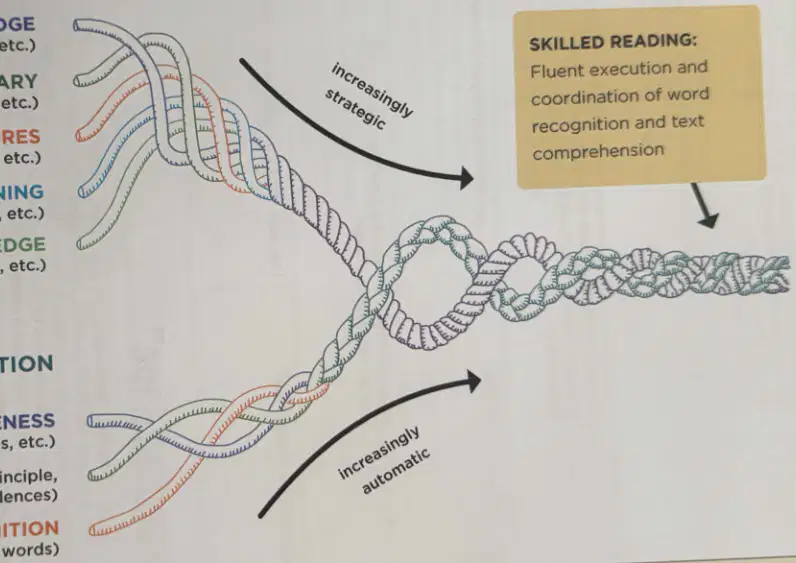
What is the definition of 'Skilled Reading' according to Scarborough's Reading Rope?
Fluent execution and coordination of word recognition and text comprehension.
The ability to memorize and recite texts without understanding.
Reading quickly without regard to accuracy or comprehension.
Recognizing words by their shape alone without decoding.
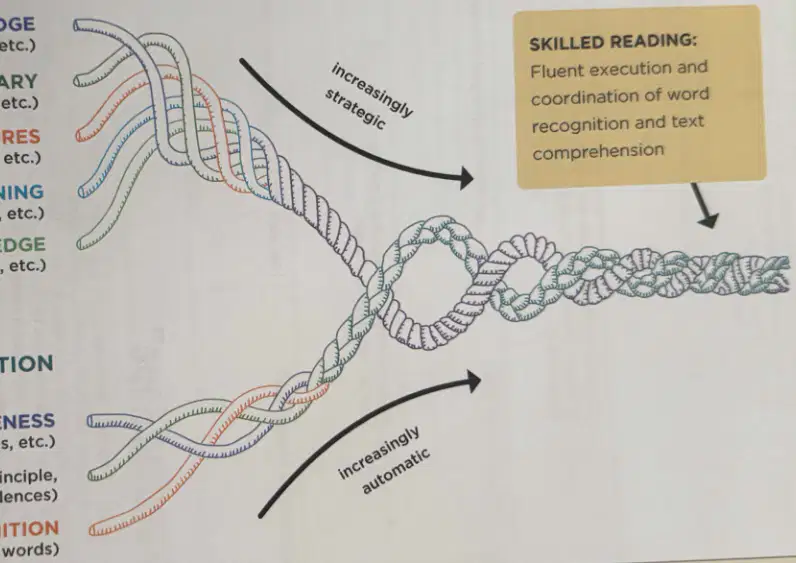
Which of the following is NOT a component of Language Comprehension in Scarborough's Reading Rope?
Background Knowledge
Phonological Awareness
Vocabulary
Verbal Reasoning
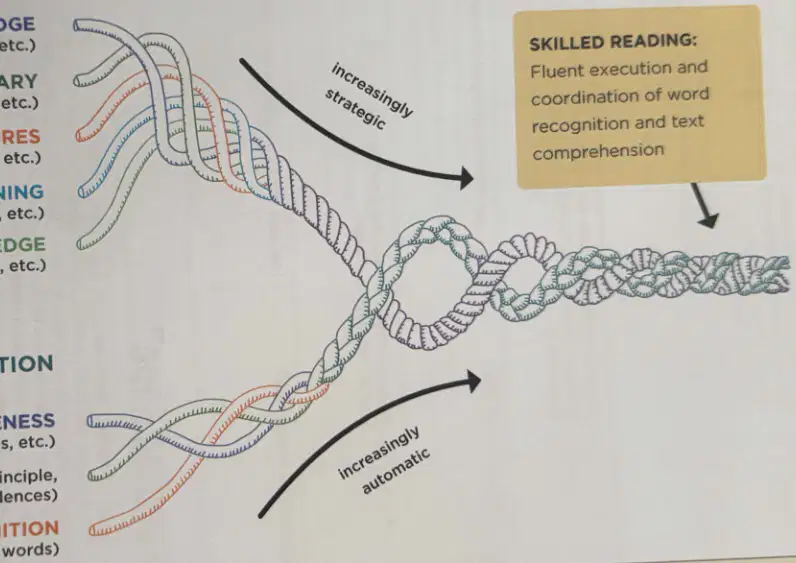
Fill in the blank: 'Phonological Awareness' is a component of __________ in Scarborough's Reading Rope.
Word Recognition
Language Comprehension
Fluency
Vocabulary
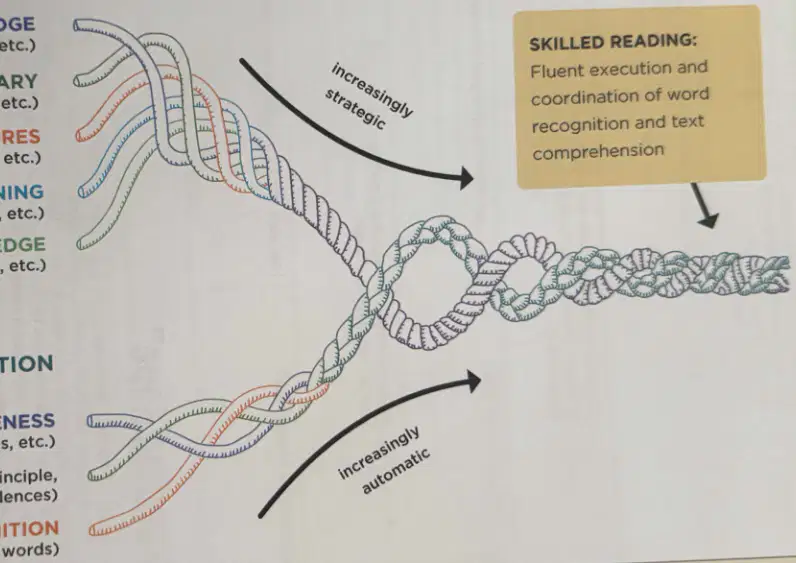
Which of the following is described as 'breadth, precision, links, etc.' in Scarborough's Reading Rope?
Decoding
Vocabulary
Literacy Knowledge
Sight Recognition
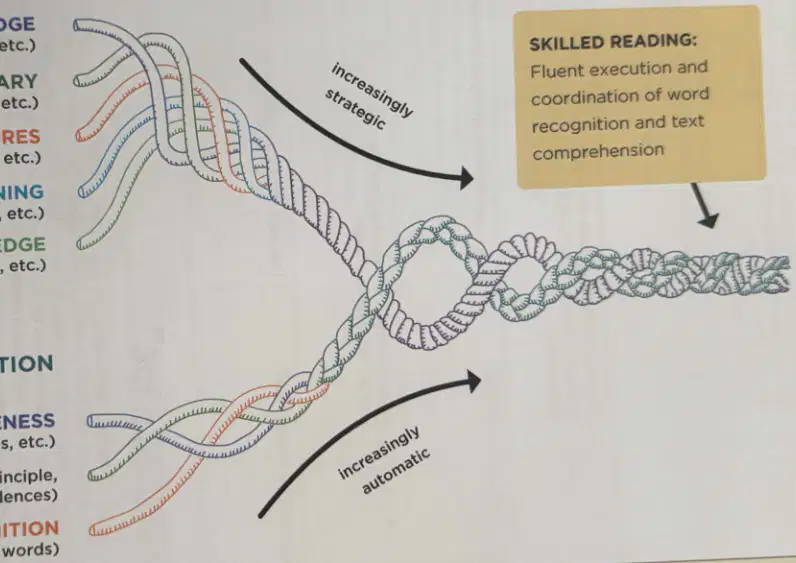
'Decoding' is a part of Language Comprehension in Scarborough's Reading Rope.
True
False
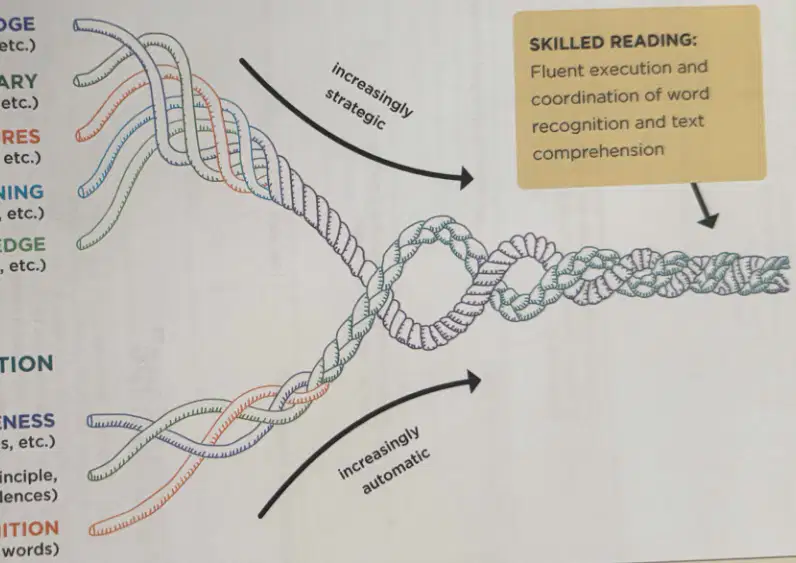
What does 'Sight Recognition' refer to in Scarborough's Reading Rope?
Recognition of familiar words.
Ability to decode nonsense words.
Understanding the meaning of complex texts.
Identifying the main idea in a passage.
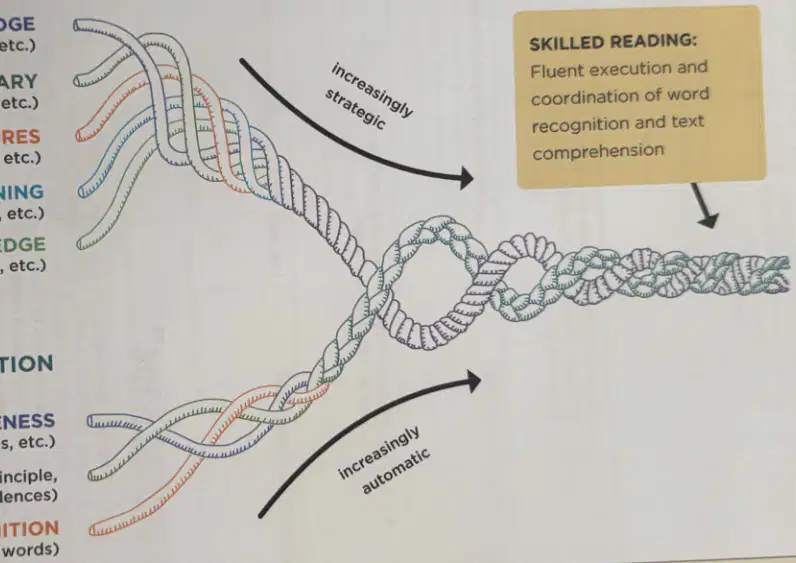
Which of the following best describes 'Verbal Reasoning' in Scarborough's Reading Rope?
Syllables, phonemes, etc.
Inference, metaphor, etc.
Print concepts, genres, etc.
Spelling-sound correspondences
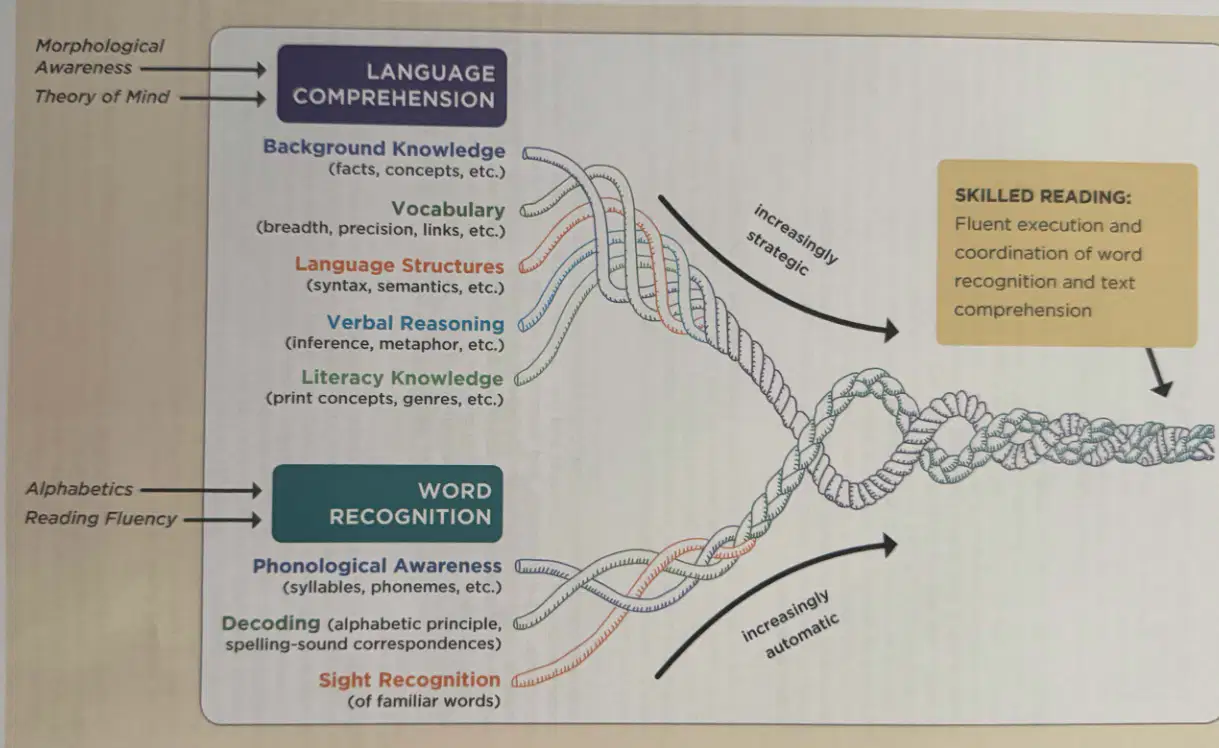
What are the components of Language Comprehension according to the Reading Rope diagram?
Background Knowledge, Vocabulary, Language Structures, Verbal Reasoning, Literacy Knowledge
Phonological Awareness, Decoding, Sight Recognition
Morphological Awareness, Theory of Mind, Alphabetics
Reading Fluency, Skilled Reading, Decoding

Fill in the blank: According to the Reading Rope diagram, 'Phonological Awareness' is a component of _________?
Word Recognition
Language Comprehension
Fluency
Vocabulary

Match the following components to their respective categories as shown in the Reading Rope diagram:
Background Knowledge
Language Comprehension
Decoding
Word Recognition
Verbal Reasoning
Language Comprehension
Sight Recognition
Word Recognition

Which of the following is NOT listed as a component of Word Recognition in the Reading Rope diagram?
Phonological Awareness
Decoding
Sight Recognition
Verbal Reasoning

According to the Reading Rope diagram, what is the definition of 'Skilled Reading'?
Fluent execution and coordination of word recognition and text comprehension
The ability to memorize and recite text without understanding
Reading quickly without regard for accuracy or meaning
Recognizing individual words without comprehending the text

Fill in the blank: 'Vocabulary' in the Reading Rope diagram refers to ________.
breadth, precision, links, etc.
phonological awareness and decoding
sentence structure and syntax
reading fluency and speed
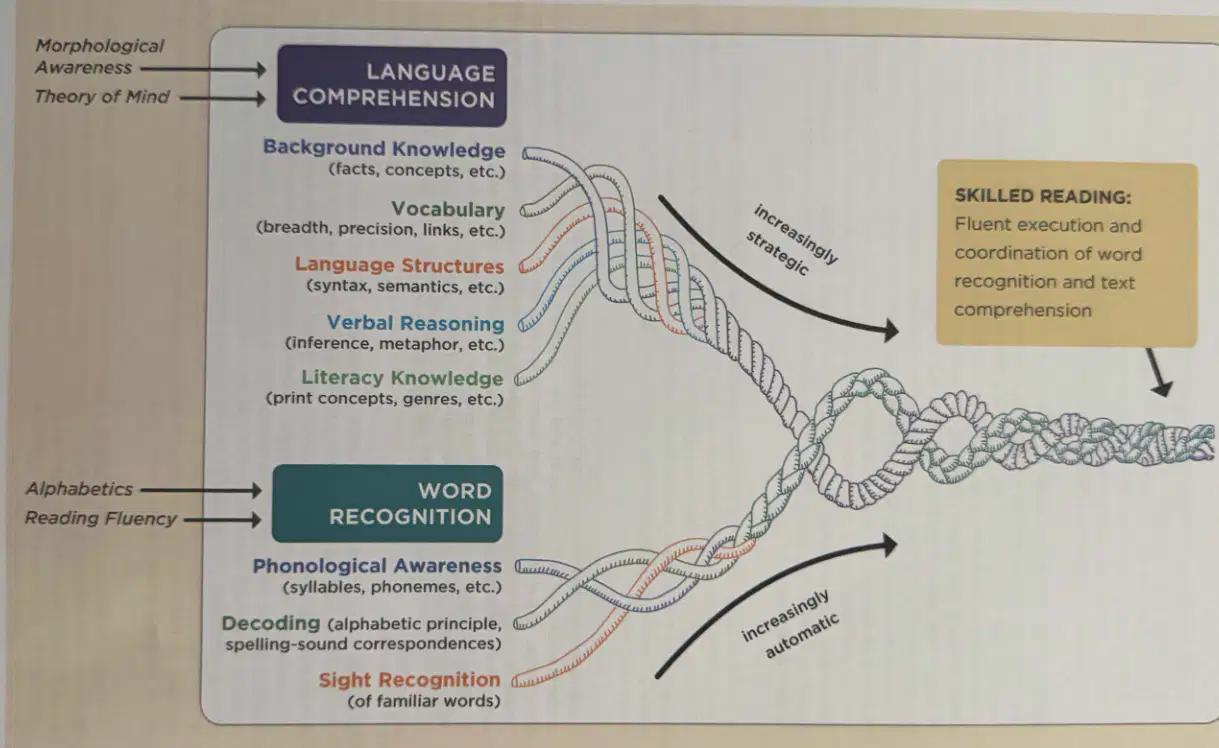
According to the Reading Rope diagram, 'Decoding' is a part of Language Comprehension.
True
False

Which of the following best describes 'Literacy Knowledge' as shown in the Reading Rope diagram?
A) Print concepts, genres, etc.
B) Syllables, phonemes, etc.
C) Fluent execution and coordination
D) Alphabetic principle
According to the passage, what is the benefit of being strong on the lower strands of Scarborough's reading rope?
It enables faster and more accurate decoding of unfamiliar words.
It makes reading more enjoyable.
It eliminates the need for background knowledge.
It reduces the importance of fluency.
Fill in the blank: The passage states that if any of the strands in Scarborough's reading rope gets frayed, it can hold back development of the other strands and by extension can eventually weaken the entire _____
rope
book
lesson
thread
What new elements have been added to the original Scarborough's reading rope model according to the passage?
Phonological awareness and vocabulary development
Fluency and comprehension strategies
New elements such as motivation and engagement
Decoding and background knowledge
The passage suggests that word recognition is not important for reading comprehension.
True
False
According to the passage, what is the focus of the upper bundle in language comprehension?
Phonological awareness and decoding
Understanding of print concepts, background knowledge, vocabulary, language structures, verbal reasoning, and literacy knowledge
Sight words and fluency
Automatic word recognition
The passage compares the chemistry of reading comprehension to:
a chemical reaction
a mathematical equation
a physical exercise
a musical composition
Noticing the various strands involves observing their differences and similarities.
They have different thicknesses and textures.
All strands are identical in every way.
The strands are all the same color.
There are no visible differences among the strands.
Review our adaptation of the reading rope. Note that each strand is one component of reading and that the strands combine into two bundles that are braided together into the rope. Which of the following best describes the strands in your classroom?
Each strand is one component of reading.
Each strand represents a different subject.
The strands are unrelated to reading.
The strands are not combined into bundles.
Identify the strands that need more attention or are not yet clear to you.
The strands that are not yet clear to me need more attention.
The strands that are already mastered need more attention.
All strands are equally clear to me.
No strands need more attention.
How might you respond to a colleague who says that literacy develops naturally in children or that there is no need to teach students to map sounds onto letters?
Explain that explicit instruction in mapping sounds to letters is essential for literacy development.
Agree that literacy develops naturally and no instruction is needed.
Suggest that children will learn to read on their own without guidance.
State that teaching letter-sound mapping is unnecessary for reading.
Identify which of the following should not be in each column.
The item that does not belong in each column.
The item that is most common in each column.
The item that is first in each column.
The item that is last in each column.
What does the term 'metacognition' mean according to the passage?
Below cognition
Above cognition
Parallel cognition
Simple cognition
Fill in the blank: The ability to reflect upon and think about one's thinking and monitor one's thinking are essential for _______.
learning
eating
sleeping
running
The importance of metacognition in reading is:
It helps readers monitor and regulate their understanding.
It makes reading faster without comprehension.
It eliminates the need for background knowledge.
It focuses only on memorizing text.
Match the reading strategy with its correct definition:
Questioning
Engaging in learning dialogues with text (authors), peers, and teachers through self-questioning, question generation, and questions answering
Searching-Selecting
Searching a variety of sources in order to select appropriate information to answer questions, define words and terms, clarify misunderstandings, solve problems, or gather information
Summarizing
Restating the meaning of text in one's own words—different words from those used in the original text
Visualizing-Organizing
Constructing a mental image or graphic organizer for the purpose of extracting and constructing meaning from the text
Reading is a complex process, and each brain needs to be taught to read, because there is no reading gene that is passed down from one generation to the next.
True
False
Readers need to develop their automatic and strategic processes.
True
False
Fill in the blank: There are two major bundles of strands, ________ and language comprehension, that are braided together to develop skilled readers.
word recognition
phonics
spelling
vocabulary
Some skills have a ceiling, meaning that there isn't more to learn once the content is mastered. There are other skills that continue to develop across the life span.
True
False
Which of the following is NOT a module under Word Recognition Strands?
Phonological Awareness
Sight Word Recognition
Verbal Reasoning
Phonics and Decoding
What are the three NAEP Achievement Levels and their descriptions?
Basic: partial mastery of knowledge and skills fundamental for proficient academic performance
Proficient: solid academic performance
Advanced: superior academic performance
Identify two sources of reading failure mentioned in the passage.
Lack of vocabulary and poor teaching methods
Excessive reading and high motivation
Advanced comprehension and strong memory
Frequent library visits and group discussions
The main focus of the Common Core State Standards for English Language Arts is:
to develop critical reading, writing, speaking, and listening skills
to teach only grammar rules
to focus solely on literature analysis
to prepare students for math assessments
The passage states that the majority of students can learn to read regardless of their backgrounds.
True
False
What is dyslexia? Fill in the blank: Dyslexia... ___________________________________.
a specific learning disability that is neurobiological in origin; characterized by difficulties with accurate and/or fluent word recognition and by poor spelling and decoding abilities
a speech disorder caused by hearing loss; characterized by difficulty in understanding spoken language
a visual impairment that affects the ability to see colors; characterized by color blindness and blurred vision
a motor disorder that affects coordination; characterized by involuntary muscle movements and tremors
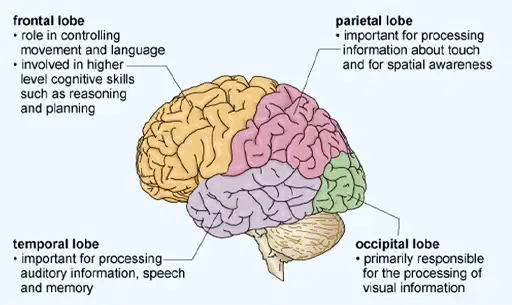
Which lobe of the brain is associated with speech, language processing, and reading?
Frontal lobe
Parietal lobe
Temporal lobe
Occipital lobe
According to Shaywitz (2005), which area of the brain is the 'express pathway to reading'?
Parieto-temporal area
Occipito-temporal area
Broca's area
Frontal lobe
Fill in the blank: The ___ analyzes words by pulling them apart and linking the letters to their sounds—conscious, effortful decoding.
parieto-temporal area
occipital lobe
frontal cortex
cerebellum
Good readers show a consistent pattern of strong activation in the back of the brain with lesser activation in front.
True
False
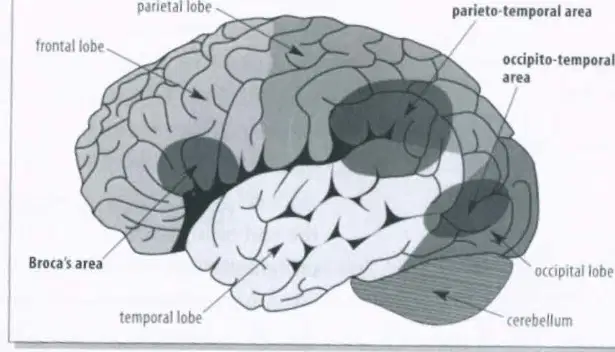
Match the following brain areas with their functions:
Organization, production, and manipulation of language and speech
Broca’s Area
Step-by-step decoding function
Parieto-Temporal Area
Rapid and automatic identification of words
Occipito-Temporal Area
What is print awareness?
Print awareness is knowing about the forms and the functions of print; it is a child's earliest introduction to literacy and includes knowledge about the conventions of print.
Print awareness is the ability to solve complex mathematical equations mentally.
Print awareness is the skill of recognizing musical notes and rhythms.
Print awareness is the understanding of computer programming languages.
What is letter knowledge?
Letter knowledge is knowing the components of written words, including recognizing and naming uppercase and lowercase letters and associating them with their shapes.
Letter knowledge is the ability to write full sentences without any spelling errors.
Letter knowledge is understanding the meaning of words in a sentence.
Letter knowledge is the skill of reading aloud with perfect pronunciation.
What is phonological awareness?
Phonological awareness is the understanding of spoken words, syllables, and phonemes, and is an umbrella term for awareness of the larger and smaller parts of spoken language.
Phonological awareness is the ability to write words with correct spelling and punctuation.
Phonological awareness is the skill of understanding written texts and their meanings.
Phonological awareness is the process of learning new vocabulary words in a foreign language.
Phonics is a method of instruction that teaches students the systematic relationship between the letters and letter combinations (graphemes) in written language and the individual sounds (phonemes) in spoken language and how to use these relationships to read and spell words. What is this process called?
Phonics
Morphology
Syntax
Semantics
What are the two types of irregular words within a reading program?
Permanently irregular words and temporarily irregular words
Phonetically regular words and sight words
Common words and rare words
Short vowels and long vowels
What must a student learn to 'see' to read multisyllabic words fluently and accurately?
Common letter patterns and recurring word parts (such as syllables, affixes, or phonograms)
The meaning of every word in a sentence
The author’s purpose for writing the text
The number of paragraphs in a passage
According to Hudson, Lane, and Pullen (2005), reading fluency is made up of at least three key elements: accurate reading of connected text at a conversational rate with appropriate prosody or expression. Which of the following is NOT one of these elements?
A) Accuracy
B) Rate
C) Prosody
D) Spelling
Vocabulary is the knowledge of words and word meanings. According to Michael Graves (2000), which of the following is NOT a component of an effective vocabulary program?
A) Wide or extensive independent reading
B) Instruction in specific words
C) Instruction in independent word-learning strategies
D) Memorizing spelling rules
What is the process of extracting and constructing meaning from written texts called?
Reading comprehension
Reading assessment
Progress monitoring
Diagnostic evaluation
Fill in the blank: Good comprehension instruction requires teachers to consider all of these factors:
the text, the reader, and the activity and related tasks
the classroom environment only
the teacher's preferences and teaching style
the students' handwriting skills
Which of the following is NOT one of the four types of reading assessments?
Screening
Progress Monitoring
Curriculum Embedded
Homework Review
What is the main purpose of screening assessments?
To provide a bottom-line evaluation of the overall effectiveness of a reading program
To identify students who are at risk for reading difficulty and may benefit from additional support
To measure the extent to which students have learned the material taught in a specific reading program
To provide in-depth information about students' skills and instructional needs
Fill in the blank: Diagnostic assessment is usually reserved for ___.
students who, according to progress monitoring, fail to respond to additional support
all students at the beginning of the year
students who excel in all subjects
students who have perfect attendance
Which type of assessment is administered only after other forms of assessment reveal that an individual student is reading below the expected level or not making sufficient progress?
Screening
Progress Monitoring
Diagnostic
Outcome
What is the purpose of outcome assessments?
To provide in-depth information about students' skills
To provide a bottom-line evaluation of the overall effectiveness of a reading program
To identify students at risk for reading difficulty
To measure critical reading skills
According to Torgesen (2006), what are the four main objectives of a comprehensive assessment plan? List them.
1) To identify students at the beginning of the school year who are at risk for reading difficulties and who may need extra support or intervention. 2) To monitor students' progress during the school year to determine whether the at-risk students are making adequate progress and to identify any other students who may be falling behind. 3) To collect student assessment data that inform instruction. 4) To assess whether instruction is sufficient enough to ensure that all students achieve grade-level expectations.
1) To assign students to different classrooms based on their reading levels. 2) To evaluate teachers' performance based on student test scores. 3) To focus only on students who are already performing at grade level. 4) To reduce the number of assessments given throughout the year.
1) To provide extra-curricular activities for students struggling with reading. 2) To assess students only at the end of the school year. 3) To use assessment data solely for administrative purposes. 4) To focus on standardized testing as the main measure of progress.
1) To identify students for gifted programs. 2) To monitor teacher attendance. 3) To collect data for school funding purposes. 4) To assess the effectiveness of after-school programs.
What does CBM stand for in the context of reading assessment?
Curriculum-Based Measurement
Content-Based Mastery
Classroom-Based Monitoring
Cognitive Benchmark Measure
Which of the following is NOT listed as a stumbling block to becoming a proficient reader?
Difficulty learning to read words accurately and fluently
Insufficient vocabulary, general knowledge, and reasoning skills
Excellent comprehension of written language
Absence or loss of initial motivation to read, or failure to develop a mature appreciation of the rewards of reading
The 'Matthew effects' refers to a phenomenon in which good readers get increasingly 'richer' in reading ability, while nonproficient readers get increasingly 'poorer.'
True
False
What is the 'Fourth-Grade Slump' according to Jeanne Chall's stages of reading development?
The 'Fourth-Grade Slump' refers to the period when students transition from 'learning to read' (Grades 1-3) to 'reading to learn' (Grades 4 and above), often facing more demanding academic texts and complex concepts beyond their oral vocabulary and knowledge base.
The 'Fourth-Grade Slump' is when students begin to develop phonemic awareness and basic decoding skills in early elementary school.
The 'Fourth-Grade Slump' describes a temporary decline in students' interest in reading due to summer vacation.
The 'Fourth-Grade Slump' refers to the period when students transition from reading fiction to reading only non-fiction texts.
The “Matthew Effect” in reading refers to:
Students who struggle early often catch up quickly when given more books to read independently.
Students who begin as strong readers continue to improve, while struggling readers fall further behind.
Students who receive explicit phonics instruction will always outperform their peers in comprehension.
Students’ reading ability plateaus after 4th grade, regardless of background or instruction.

