
 Worksheets
Preface - Geography: A Very Short Introduction
Total questions: 96
Worksheet time: 48mins
According to the preface, what is the aim of 'Geography: A Very Short Introduction'?
To provide a succinct and lively, yet authoritative, account of the nature of geography as a field of study.
To offer a comprehensive guide to world travel destinations.
To present a detailed history of cartography.
To focus exclusively on physical geography and its processes.
Geography is divided into two main parts: ______ and human.
physical
chemical
biological
cultural
Geography is only about the location of countries, rivers, mountains, and capital cities on maps.
True
False
Which of the following issues is mentioned in the preface as being addressed by geographers?
The spread of diseases such as HIV and AIDS
The study of ancient languages
The invention of new technologies
The history of art
Physical geographers study the Earth's surface as a ______ entity.
physical
chemical
historical
political
According to the passage, what is one of the strengths of geography?
Its ability to act as a bridge between nature and society.
Its focus solely on economic development.
Its exclusive study of ancient civilizations.
Its disregard for human-environment interaction.
What does the passage say about the integration of geography as a single discipline?
It was explicit and strong through the earlier decades of the 20th century, but has become less so in modern times.
It has always been fragmented and never unified as a discipline.
It became a single discipline only in the 21st century.
It was never considered a single discipline at any point in history.
Who prepared the satellite images of the Aral Sea, as mentioned in the passage?
Seitste Los
NASA
European Space Agency
Indian Space Research Organisation
The passage states that physical and human geographers tend to follow the same agendas and refer to the same sets of academic literature and scholarship.
True
False
Who wrote the following lines about exploration and discovery?
William Wordsworth
T. S. Eliot
Julius Caesar
Robert Frost
Fill in the blank: The essence of geography includes the desire to discover more about the world in which we _____.
live
eat
sleep
drive
According to the passage, what is one essential characteristic of geography?
The desire to discover more about the world in which we live and to record its many parts.
The ability to predict future weather patterns with accuracy.
The study of ancient civilizations exclusively.
The creation of fictional maps for entertainment purposes.
Geography has always been important throughout history, as shown by the historical record.
True
False
According to Julius Caesar in Gallic War, into how many parts was Gaul divided, and who inhabited each part?
Gaul was divided into three parts: one inhabited by the Belgae, a second by the Aquitani, and a third by a people called Celts in their own language and Gauls in ours.
Gaul was divided into four parts: one inhabited by the Romans, a second by the Greeks, a third by the Germans, and a fourth by the Celts.
Gaul was divided into two parts: one inhabited by the Belgae and the other by the Aquitani.
Gaul was divided into five parts: each inhabited by different tribes including the Belgae, Aquitani, Celts, Romans, and Germans.
What natural features confined the Helvetii according to Julius Caesar?
The Rhine River, the Jura range, Lake Geneva, and the Rhone River confined the Helvetii.
The Danube River, the Alps, the Black Sea, and the Seine River confined the Helvetii.
The Tiber River, the Apennine Mountains, the Adriatic Sea, and the Po River confined the Helvetii.
The Loire River, the Pyrenees, the Mediterranean Sea, and the Garonne River confined the Helvetii.
What is the main purpose of early geographies as described in the passage?
To inform a 'home population' about lesser-known parts of the world and their cultural occupation.
To provide detailed weather forecasts for travelers.
To promote trade agreements between nations.
To describe only the physical features of the earth.
Which society, founded in 1830 in London, became a key forum for the reporting and dissemination of the great expeditions of that time?
The Royal Geographical Society.
The Linnean Society.
The Royal Society of Arts.
The Geological Society of London.
Name two explorers mentioned in the passage whose reports captured the popular imagination during the age of exploration and discovery.
Livingstone and Stanley (other acceptable answers: Burton, Speke, Nansen, Shackleton, Scott).
Columbus and Magellan.
Marco Polo and Ibn Battuta.
Cook and Vespucci.
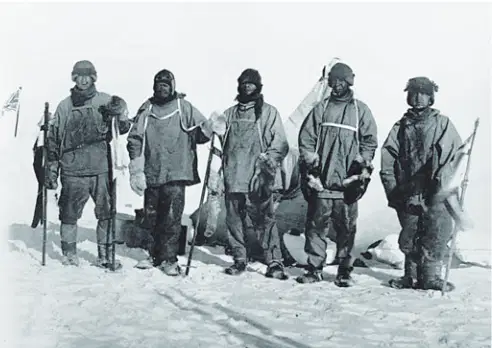
Who was part of Robert Falcon Scott’s party at the South Pole on 18 January 1912?
Captain Scott
Dr Oates
Lieutenant Bowers
Seaman (Taff) Evans
Dr Wilson

The negative of the photograph of Scott’s party was found inside the tent in which Scott and three of his companions perished.
True
False
Name two explorers mentioned in the passage who became icons of the age of discovery.
Columbus, Vasco da Gama (also acceptable: Cook, Amundsen)
Newton, Einstein
Shakespeare, Dickens
Pasteur, Curie
In what year did David Livingstone sail down the Zambesi River and name Victoria Falls?
1856
1860
1845
1872
According to David Livingstone’s account, what natural phenomenon did he see rising at a distance of five or six miles, which he compared to large tracks of grass burning in Africa?
Columns of vapour (appropriately called 'smoke')
A flock of birds flying in formation
A sandstorm approaching rapidly
A herd of elephants raising dust
A rainbow forming after rainfall
What was David Livingstone's main purpose in Africa according to the passage?
Commercial activities
Political activities
Missionary activities
Scientific research
Fill in the blank: The process of geographical exploration, its reporting and depiction of the Earth's surface, had major significance for the history of _______.
science
music
literature
sports
According to the passage, what inspired Charles Darwin to produce his theory of evolution?
Political changes
Geographical variations in species
Economic needs
Maps and charts
Fill in the blank: The primary purpose of Darwin's voyage on the Beagle was to produce maps and charts and descriptions of _______.
this part of the world
ancient civilizations
the animal kingdom
the solar system
According to the passage, what was the primary practical purpose of geography in earlier times?
To entertain people
To aid navigation, produce an accurate record, and pave the way for later expeditions
To teach mathematics
To create art
Fill in the blank: The kind of fundamental geography described in the passage was characterized by its _______ and fact-finding that helped build up our knowledge of the world.
empiricism
romanticism
speculation
intuition
According to Stuart Cloete's autobiography, what color were the countries painted in children's school atlases to represent British dominion?
Blue
Red
Green
Yellow
In 1875, what percentage of Africa was in foreign hands according to the passage?
10%
50%
75%
90%
By 1900, the percentage of Africa in foreign hands had risen to _______.
90%
50%
30%
70%
Which countries, besides Britain, played a part in redrawing the map of Africa during the Age of Imperialism according to the passage?
Germany, Belgium, Portugal, Spain, and Italy
Russia, China, Japan, and Greece
United States, Canada, Mexico, and Brazil
Sweden, Norway, Denmark, and Finland
According to the passage, what event in 1847 is described as revealing the essence of geography?
The Mormons’ 1,300-mile pioneer trail across the United States led by Brigham Young in 1847.
The discovery of gold in California by James W. Marshall.
The signing of the Treaty of Guadalupe Hidalgo.
The founding of Salt Lake City by early settlers.
Who highlighted an important dimension of the essence of geography, as mentioned in the passage?
George Perkins Marsh
Carl Ritter
Paul Vidal de la Blache
Alexander von Humboldt
The passage states that both positive and negative human impacts have always been a feature of the exploitation of resources.
True
False
Fill in the blank: The passage quotes George Perkins Marsh as saying, 'The Earth is fast becoming an unfit home for its ______ inhabitant.'
noblest
largest
oldest
smallest
According to the passage, what is as much a part of geography as the factual descriptions of the Earth's surface that cartographers seek to portray?
The significance of a place, which varies through time depending on the people who see, interpret, and use it.
The physical boundaries of continents and oceans.
The measurement of distances between cities.
The classification of climate zones.
What does the expression 'geography is everywhere' mean according to the passage?
It means that geography affects our everyday lives in many ways and everything has a location on the Earth's surface.
It means that geography is only about maps and globes.
It means that geography is only important for scientists.
It means that geography is not related to our daily activities.
Name two examples of goods mentioned in the passage and their places of origin.
Bananas from the Caribbean and citrus fruits from Florida and South Africa.
Apples from Alaska and grapes from Antarctica.
Pineapples from Canada and oranges from Greenland.
Mangoes from Russia and pears from Iceland.
What is meant by 'food governance' as mentioned in the passage?
'Food governance' refers to the power supermarkets have in setting standards for food safety, quality, and ethics, similar to how empires governed.
'Food governance' is the process of cooking food in a hygienic manner at home.
'Food governance' means the government’s control over all restaurants in a city.
'Food governance' refers to the nutritional value of food items sold in supermarkets.
According to the passage, what are some reasons people travel to major cities?
Some people travel as tourists or visitors on short stays, while others are immigrants or refugees seeking a new life.
People travel to major cities only for business meetings.
Most people visit major cities to escape from rural life permanently.
People go to major cities mainly to enjoy the local cuisine.
According to the passage, what does the study of geography examine?
The study of geography examines locations, connections, territories, environments, and places, and seeks to understand their significance.
The study of geography examines only the history of ancient civilizations.
The study of geography focuses solely on weather patterns and climate.
The study of geography is limited to the study of maps and globes.
What is the subject matter of geography as described in the passage?
The Earth's surface, including the envelope of atmosphere immediately above it, the structures that lie immediately below it, and the social and cultural environments contributed by the people who occupy it.
The study of celestial bodies and their movements.
The analysis of economic trends and financial markets.
The exploration of ancient civilizations and their artifacts.
Which of the following is NOT mentioned as a current big issue with considerable geographical dimensions?
Global warming
Environmental change
Space exploration
Natural hazards
Geography is only about maps and not about understanding the world and its places.
True
False
Who are some of the historical figures mentioned in the passage as contributors to the development of geographical concepts?
Greek philosophers
Roman historians
Sumerian cartographers
All of the above
According to the passage, in which century did evidence of the coherent practice of geography in British universities first appear?
16th century
17th century
18th century
19th century
Which society is mentioned as offering support for the study of geography in Britain, but focusing on mapmaking, discovery, and exploration?
Royal Geographical Society (RGS)
British Cartographic Society
Geographical Association
Ordnance Survey Society
Who was the first Professor of Geography at Oxford?
Halford Mackinder
David Livingstone
Richard Chorley
Andrew Goudie
What was the main focus of Halford Mackinder's 'Geographical Experiment' as described in the passage?
Integration of the study of society and the environment, and the maintenance of culture and nature under one umbrella.
Development of new navigation techniques for global exploration.
Promotion of industrialization over agricultural practices.
Establishment of political boundaries based solely on physical geography.
Which two German geographers led movements towards a new geography in Germany?
Alexander von Humboldt and Karl Ritter
Friedrich Ratzel and Alfred Hettner
Immanuel Kant and Carl Troll
Walter Christaller and Johann Heinrich von Thünen
French geographers were interested in cultural landscapes and regions that reflected traditions and ways of life, according to the passage.
True
False
According to the passage, what was both a strength and a weakness of the Geographical Experiment in establishing geography as a university discipline?
The breadth of its terms of reference.
The lack of qualified faculty.
The limited funding available.
The absence of student interest.
What is the main difference between physical geography and human geography as described in the passage?
Physical geography evolves within the research framework of the natural and mathematical sciences, while human geography draws upon and interrelates with the traditions of the humanities and social studies.
Physical geography focuses on the study of ancient civilizations, while human geography studies only modern societies.
Physical geography is concerned with economic activities, while human geography deals with weather patterns.
Physical geography is a branch of literature, while human geography is a branch of engineering.
The passage states that geography is now a well-established university discipline and is commonly found in European universities.
True
False
Which organization lists members in 75 different countries, according to the passage?
United Nations
International Geographical Union
World Health Organization
European Union
How many institutions in the United States offer degree schemes in geography?
217 institutions
150 institutions
320 institutions
95 institutions
What is the current trend regarding geography departments in universities, as described in the passage?
The current trend is for mergers of geography departments with others into schools with titles such as Earth, human, or environmental sciences/studies.
Geography departments are being completely eliminated from all universities.
Geography departments are expanding and becoming independent from other sciences.
Geography departments are focusing solely on physical geography and dropping human geography.
According to the passage, what is the first core concept in geography?
Space
Time
Region
Climate
What does geographical space comprise?
Location
Distances
Directions
All of the above
Maps, cartography, and satellite images are tools for what kind of analysis according to the passage?
Geographical analysis
Chemical analysis
Literary analysis
Economic analysis
The passage states that it is possible to opt for both true distance and true area at the same time when depicting the Earth's surface.
True
False
According to the passage, what mediates distances for human geographers?
Accessibility
Longitude
Climate
Population Density
According to the passage, what is 'Place' in geography? Fill in the blank: Place is not independent of space because it involves an area or territory; it is a form of ________ space.
bounded
open
virtual
dynamic
Which of the following is NOT mentioned as a type of boundary for places in geography?
A) Rivers
B) Mountain ranges
C) Human decision-makers
D) Oceans
The passage states that physical boundaries are always unambiguous.
True
False
According to the passage, why might residents of a neighbourhood be asked to sketch the boundaries of their home area?
To define places subjectively and construct their mental map of the city in which they live.
To determine the official property lines for legal purposes.
To plan the construction of new roads and buildings.
To allocate government resources based on population density.
What is one reason mentioned in the passage for the growing interest in literary places?
They provide the settings for fictional novels or were the locations where writers lived and worked.
They are popular tourist destinations for their natural beauty.
They are known for their historical monuments unrelated to literature.
They offer unique culinary experiences.
According to the passage, what is the third core concept for geography?
Environment
Culture
Economy
Politics
Which of the following is NOT mentioned as an example of a place with special meaning in the passage?
The Brontë family home
The Cobb at Lyme Regis
The Eiffel Tower
A football field
Fill in the blank: The environment, like place, encompasses human perceptions and aspirations as well as the ________ characteristics that can be measured and monitored.
biophysical
cultural
economic
historical
According to the passage, the reciprocal relationship between the natural environment and people has always been and remains a key question in geography.
True
False
What are some current issues mentioned in the passage that relate to the environment?
Sustainability, custodianship of the environment, protocols to reduce holes in the ozone layer, world summits to limit the use of carbon fuels.
The development of new video games and entertainment platforms.
The popularity of fast food restaurants in urban areas.
The increase in online shopping and home delivery services.
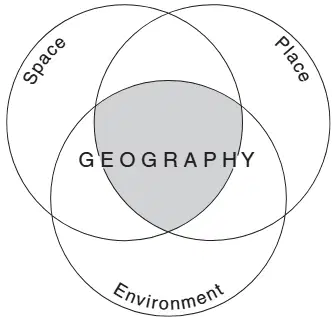
What are the three core concepts of geography?
Space, Place, and Environment
Land, Water, and Air
Continents, Oceans, and Mountains
People, Animals, and Plants
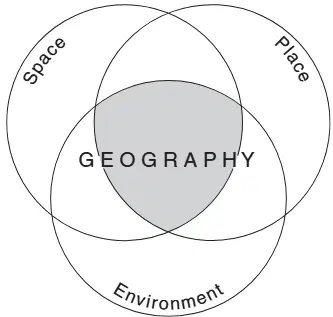
The essence of geography (shaded in the diagram) is an integration of spatial variation over the Earth's surface with the distinctiveness of places and interactions between people and their _________?
environments
cultures
languages
technologies
According to the passage, geography is the study of the surface of the Earth.
True
False
What is the basic division of geography according to the definition provided in the passage?
A) Physical geography and human geography
B) Local geography and global geography
C) Natural geography and artificial geography
D) Urban geography and rural geography
Fill in the blank: According to D. T. Herbert and J. A. Matthews in The Encyclopaedic Dictionary of Environmental Change (2001), human geography focuses on the _______ of an area.
human occupancy
climate patterns
soil composition
ocean currents
Who stated that 'The goal of Geography is nothing less than an understanding of the vast interacting system comprising all humanity and its natural environment on the surface of the Earth'?
D. T. Herbert and J. A. Matthews
E. A. Ackerman
G. F. White
G. L. Gaile and C. J. Willmott
Fill in the blank: According to a review in Science of Harm de Blij’s Geography Book (1995), geography is the science of ______, its vision is grand, its view is panoramic.
place
time
motion
matter
According to G. F. White in the Encyclopedia of Global Environmental Change (2002), geography is a discipline concerned with understanding the spatial dimensions of ______ and social processes.
environmental
economic
technological
political
Who defined geography as 'the study and science of environmental and societal dynamics and society-environment interactions'?
E. A. Ackerman
G. F. White
G. L. Gaile and C. J. Willmott
D. T. Herbert and J. A. Matthews
According to the passage, what gives geography its special meaning?
The integrative role that gives geography its special meaning.
The study of only physical features.
The focus on economic activities alone.
The exclusive analysis of population growth.
In modern times, what is there greater awareness of regarding the 'facts' of geography?
That the 'facts' of geography are not unambiguous; they mean different things to different people at varying points in time.
That the 'facts' of geography are universally agreed upon and never change.
That the 'facts' of geography are only relevant to scientists.
That the 'facts' of geography are based solely on physical features and not human interpretation.
What are the three core concepts that overlap to form the nexus of geography?
Space, place, and environment.
Latitude, longitude, and altitude.
Weather, climate, and seasons.
Culture, economy, and politics.
Which concept comes close to defining the nexus that is geography, according to the passage?
The concept of landscape.
The concept of climate.
The concept of population.
The concept of economy.
The passage states that a single term is sufficient, on its own, to define geography.
True
False
According to the passage, what does the study of regions as integrated parts of the Earth's surface combine?
Nature and culture
Economics and politics
History and mathematics
Art and technology
Which discipline focuses on the space-place-environment nexus throughout its history?
Geography
Biology
Economics
Linguistics
The passage states that satellite remote sensing is sometimes known as Earth Observation (EO).
True
False

Phase 1 in the development of geography is known as _________.
Exploration of the World
Industrial Revolution
Age of Satellites
Digital Mapping Era
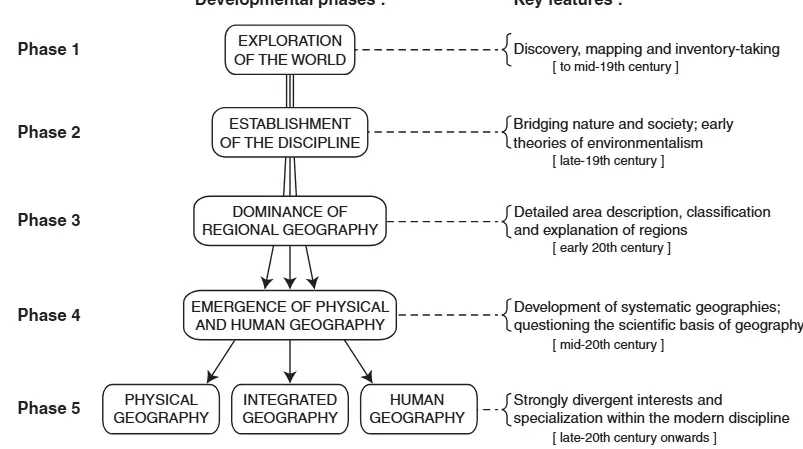
Which phase in the development of geography is characterized by 'Bridging nature and society; early theories of environmentalism'?
Phase 1: Exploration of the World
Phase 2: Establishment of the Discipline
Phase 3: Dominance of Regional Geography
Phase 4: Emergence of Physical and Human Geography
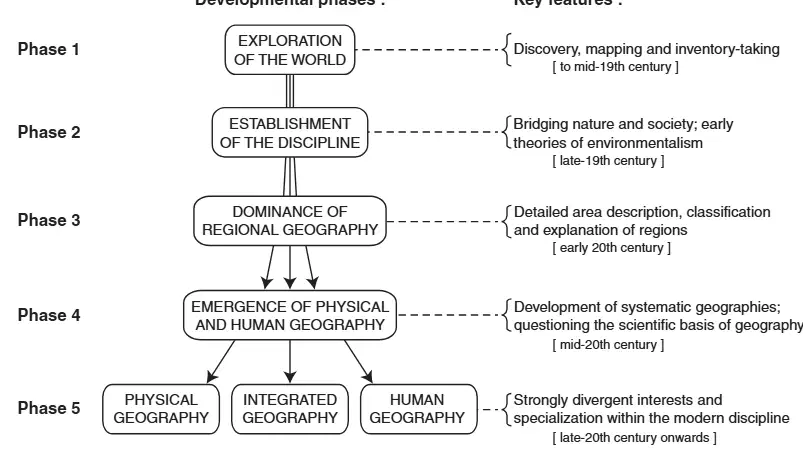
The key feature of Phase 3 (Dominance of Regional Geography) is _________
Detailed area description, classification and explanation of regions
Emphasis on quantitative techniques and models
Focus on environmental determinism
Development of aerial photography techniques
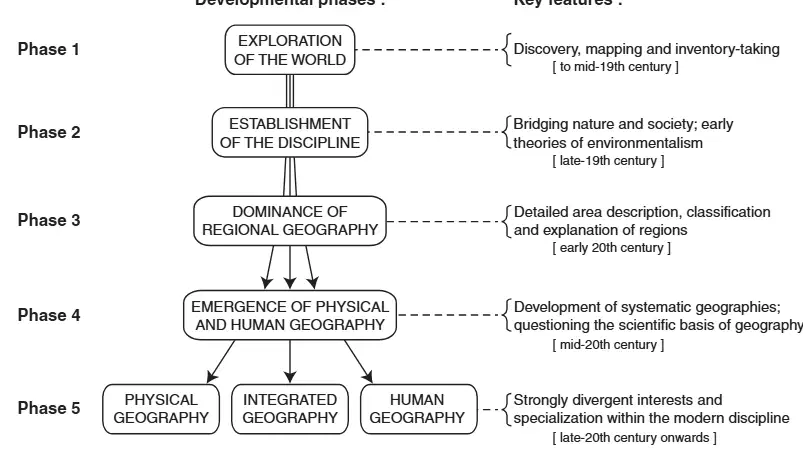
Which phase is associated with the development of systematic geographies and questioning the scientific basis of geography?
Phase 1
Phase 2
Phase 3
Phase 4
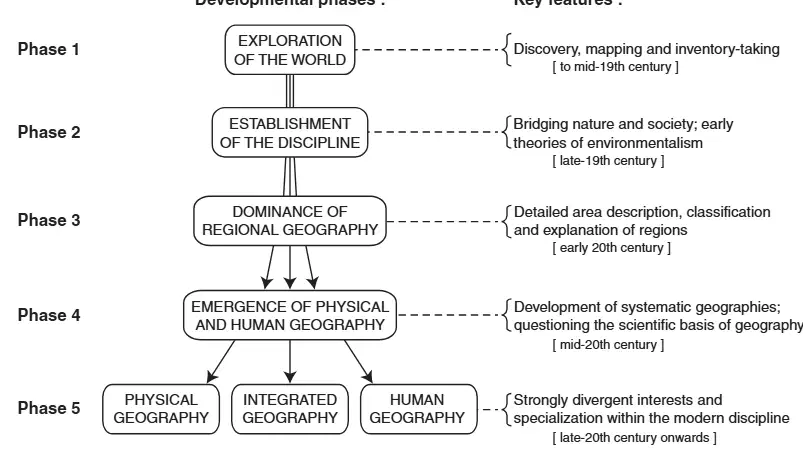
Phase 5 in the development of geography includes Physical Geography, Integrated Geography, and Human Geography.
True
False

