
 Worksheets
Pain Definition and Components
Total questions: 49
Worksheet time: 25mins
Fill in the blank: Pain is an _______ sensation occurring in varying degrees of severity as a consequence of injury, disease, or emotional disorder.
unpleasant
pleasant
neutral
exciting
Which of the following components are involved in pain?
Sensory
Motor
Emotional
All of the above
Why do we have pain? Fill in the blank: One reason is that it is the body's line of _________?
self-defense
communication
nutrition
transportation
Fill in the blank: ________ (pain receptors) are stimulated as the first step in the process of feeling pain.
Nociceptors
Photoreceptors
Chemoreceptors
Thermoreceptors
What is sent to the brain after nociceptors are stimulated?
Pain impulse
Blood cells
Digestive enzymes
Hormones
What does the brain do after receiving the pain impulse?
Interprets and evaluates signals
Sends pain directly to the muscles
Ignores the impulse completely
Stores the impulse for future use
What is determined after the brain interprets and evaluates signals?
What action is needed to end stimulus
How much energy is produced by the brain
The color of the stimulus
The size of the brain
What is sent to the nerves to move in order to stop harm?
Motor impulse
Sensory impulse
Hormone
Enzyme
What happens after nociceptors are activated? They send a signal to the brain through the _________.
spinal cord
arteries
lymph nodes
trachea
If the pain from a pin prick is strong enough, what does the spinal cord do? Fill in the blank: The spinal cord sends ________ signals right away.
motor
sensory
visual
auditory
Fill in the blank: The level of noxious stimuli required to alert of possible tissue damage is called _________
Threshold
Tolerance
Sensation
Perception
Fill in the blank: The amount of time an individual can endure pain is called _________.
Tolerance
Threshold
Intensity
Duration
How could you describe pain?
Tingling
Burning
Stabbing
Throbbing
Pain can be used to _______ the presence of injury according to clinicians.
confirm
ignore
deny
reduce
According to clinicians, pain can show which of the following in rehab?
Progression
Regression
Both progression or regression
None of the above
Pain is _______ subjective according to clinicians.
completely
rarely
partially
never
Fill in the blank: Where is your ____? (This is a question clinicians can ask in regard to pain.)
pain
book
car
phone
Fill in the blank: When did your ____ begin? (This is a question clinicians can ask in regard to pain.)
pain
appointment
doctor
medicine
Fill in the blank: How long have you ____ it? (This is a question clinicians can ask in regard to pain.)
had
did
made
felt
Fill in the blank: Have you ever experienced this ____ before? (This is a question clinicians can ask in regard to pain.)
pain
weather
color
music
Fill in the blank: Can you describe how it ____? (This is a question clinicians can ask in regard to pain.)
feels
runs
jumps
flies
Fill in the blank: Is it getting ____ or worse? (This is a question clinicians can ask in regard to pain.)
better
colder
louder
faster
Fill in the blank: Does it increase with ____? (This is a question clinicians can ask in regard to pain.)
activity
sleep
hydration
medication
Fill in the blank: Does it get better with ____? (This is a question clinicians can ask in regard to pain.)
rest
exercise
food
heat
Do you have pain at ____? (This is a question clinicians can ask in regard to pain.)
night
breakfast
work
school
Fill in the blank: Is it bad in the ____? (This is a question clinicians can ask in regard to pain.)
morning
evening
afternoon
night
What does CNS stand for?
Central Nervous System
Central Nutrition System
Cranial Nerve Structure
Cerebral Network System
What does PNS stand for?
Peripheral Nervous System
Primary Nervous System
Partial Neural System
Peripheral Neuron Structure
Which nerve carries signals to the brain?
Afferent nerve
Efferent nerve
Which nerve carries signals away from the brain?
Afferent nerve
Efferent nerve
What is the term for the body's response to injury or infection?
Inflammation
Digestion
Respiration
Circulation
Which type of fibers have a small diameter?
Pain fibers (C)
Other fibers (A)
Which type of fibers have fast nerve conduction?
Pain fibers (C)
Other fibers (A)
List the three types of Pain fibers (C).
Pressure, Chemical, Heat
A-beta, A-delta, C
Sharp, Dull, Burning
Fast, Slow, Intermediate
Which receptor type is responsible for detecting movement?
Baroreceptor
Chemoreceptor
Mechanoreceptor
Proprioceptor
Proprioceptor is responsible for detecting ________.
Position
Temperature
Light
Sound
What is pain?
Positive sensations from afferent nerves
Negative sensations from stressors of the afferent nerves (C fibers)
Sensations from efferent nerves
None of the above
What are the 4 main components of inflammation?
Swelling, Redness, Heat, Pain
Spasm, Cell Death, Pain, ROM
Redness, Bruising, Bleeding, Edem
Fever, Chills, Nausea, Bleeding
Cell death increases _________?
inflammation
cell division
oxygen production
energy storage
What is the body's mechanism for splinting and protecting an injured area called?
Spasm
Fracture
Sprain
Bruise
Can a neurological dysfunction or trauma cause a spasms?
True
False
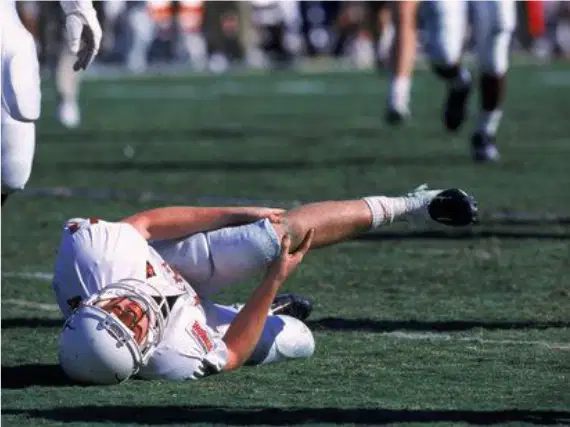
Fill in the blank: The first step in the Pain-Spasm-Pain Cycle is that ______ occurs.
trauma
relaxation
healing
exercise
Define chronic pain.
Chronic pain is pain that lasts for less than a week.
Chronic pain is a type of pain that only occurs during exercise.
Chronic pain is pain that is always accompanied by swelling.
Chronic pain is pain that lasts for more than three months, often persisting beyond the normal healing time.
Sensations are described as perceptions that an individual experiences relating to a limb or an organ that is not physically part of the body.
Referred Pain
Phantom Pain
Chroinc Pain
Placebo Effect
If the athlete thinks the treatment is beneficial reguardless of treatment
Referred Pain
Phantom Pain
Chroinc Pain
Placebo Effect
A brain freeze is an example of what
Referred Pain
Phantom Pain
Chroinc Pain
Placebo Effect
Endorphins are 10,000 times more potent than morphine
Gate Control Theory says the C fibers (pain) get through before the A fibers (non pain)
C fibers (pain) are slow and small vs. A fibers (non pain) that are fast and larger

