
Font size
 Worksheets
Histology of the Human Body Review
Total questions: 46
Worksheet time: 24mins
Which of the following describes the key characteristic of epithelial tissue?
It is composed of widely spaced cells in a large extracellular matrix.
It is highly vascularized and innervated.
It is characterized by tightly packed cells with little to no extracellular matrix.
It is specialized for contraction and movement.
Which type of connective tissue provides flexible support and reduces friction between bones, and is found in the nose, ears, and articular joints?
Adipose tissue
Bone
Cartilage
Dense fibrous connective tissue
Which of the following statements are true regarding skeletal muscle tissue? (Select all that apply)
It is characterized by intercalated discs.
It is under voluntary control.
Its cells are multinucleated.
It lacks striations.
Nervous tissue is primarily composed of which two types of cells?
Erythrocytes and leukocytes
Chondrocytes and osteocytes
Neurons and neuroglia
Fibroblasts and adipocytes
The lining of the urinary bladder and ureters is specialized to stretch. What is this type of epithelial tissue called?
Pseudostratified columnar epithelium
Simple squamous epithelium
Stratified cuboidal epithelium
Transitional epithelium
Which of the following is an example of dense regular connective tissue?
Blood
Tendons and ligaments
Adipose tissue
The dermis of the skin
Match each muscle type with its correct characteristic.
involuntary muscles
Cardiac muscle tissue and smooth muscle tissue are both:
striated muscles
Cardiac muscle tissue and skeletal muscle tissue are both:
attached to bones
Skeletal muscles are:
under conscious control
Skeletal muscle tissue is:
Which of the following is a function of nervous tissue?
Providing structural support and protection to organs.
Generating heat and causing movement.
Transmitting electrical signals and coordinating body activities.
Storing energy in the form of lipids.
Which of the following tissues are characterized by a large amount of extracellular matrix?
Epithelial tissue
Connective tissue
Muscle tissue
Nervous tissue
Which types of muscle tissue are striated?
Smooth muscle only
Skeletal muscle only
Cardiac muscle only
Skeletal and smooth muscle
What is the primary function of adipose tissue?
To produce blood cells.
To store energy and insulate the body.
To provide rigid support for the body.
To transmit nerve impulses.
Which of the following accurately describes the difference between simple and stratified epithelium?
Simple epithelium has a single layer of cells, while stratified epithelium has multiple layers.
Simple epithelium is found in the skin, while stratified is found in the stomach.
Simple epithelium is specialized for protection, while stratified is specialized for absorption.
Simple epithelium is composed of cuboidal cells, while stratified is composed of squamous cells.
Which of the following is a component of nervous tissue? (Select all that apply)
Neurons
Collagen fibers
Neuroglia
Myofibrils
Which of the following is a distinguishing characteristic of smooth muscle tissue?
The cells are spindle-shaped with a single nucleus.
The cells are multinucleated and striated.
The cells are branched and contain intercalated discs.
The tissue is under voluntary control.
A medical student is examining a slide of tissue from the inner lining of the small intestine. They observe a single layer of tall, column-shaped cells with microvilli on their apical surface. What type of tissue are they most likely observing?
Simple squamous epithelium
Stratified columnar epithelium
Simple columnar epithelium
Pseudostratified columnar epithelium
During a biopsy of a patient's lung, a doctor finds tissue with a delicate single layer of flattened cells. This tissue, which facilitates gas exchange in the alveoli, is called (a) .
Simple squamous epithelium
Stratified squamous epithelium
Simple cuboidal epithelium
Transitional epithelium
Match each tissue description with its correct tissue category.
Epithelial tissue
Tissue that covers body surfaces and lines cavities.
Muscle tissue
Tissue responsible for movement and contraction.
Nervous tissue
Tissue specialized for transmitting electrical impulses.
Connective tissue
Tissue with abundant extracellular matrix, widely spaced cells, highly vascularized, and connects other tissues.
During a workout, an athlete feels a strong contraction in their bicep. What type of muscle tissue is responsible for this voluntary movement, and what are its key characteristics?
Smooth muscle: involuntary, non-striated, single nucleus
Skeletal muscle: voluntary, multinucleated, striated
Cardiac muscle: involuntary, striated, with intercalated discs
Skeletal muscle: involuntary, non-striated, single nucleus
A pathologist is examining a sample of a patient's heart tissue. They notice branched cells with striations and special junctions that allow for synchronized contractions. What is the name of these junctions?
Gap junctions
Desmosomes
Tight junctions
Intercalated discs
An individual is diagnosed with a disease that affects their brain's ability to transmit nerve impulses. The disease specifically targets the cells that provide support and protection for the neurons. Which of the following cells are likely being affected?
Neurons
Neuroglia
Fibroblasts
Erythrocytes
A patient suffers a severe sprain, damaging the ligament in their knee. A ligament is primarily composed of parallel bundles of collagen fibers. What type of connective tissue is the ligament?
Adipose tissue
Dense regular connective tissue
Dense irregular connective tissue
Reticular connective tissue
Which of the following scenarios would most likely involve smooth muscle tissue?
Kicking a soccer ball
The blinking of an eye
Peristalsis in the esophagus
The pumping action of the heart
An anatomy student is examining a slide and observes a tissue with cells that are closely packed and form a barrier. The tissue has no blood vessels but is highly innervated. What is a possible location for this tissue?
The biceps brachii muscle
The dermis of the skin
The lining of the trachea
The femur (thigh bone)
A person has a genetic disorder that affects the production of collagen and elastin fibers in their body. Which of the following tissue types would be most severely impacted by this disorder?
Epithelial tissue
Connective tissue
Muscle tissue
Nervous tissue
In a laboratory, a scientist is studying a tissue that is specialized for transmitting information throughout the body. The cells are highly excitable and can generate and conduct electrical signals. Which of the following cell types would be present in this tissue?
Adipocytes and leukocytes
Neurons and neuroglia
Myocytes and chondrocytes
Osteocytes and fibroblasts
A forensic team identifies a tissue sample from a crime scene. The tissue has no striations, is involuntary, and its cells are spindle-shaped with a single nucleus. Where is this tissue most likely found?
Skeletal muscle
Cardiac muscle
Smooth muscle
Nervous tissue
A patient is suffering from a condition that leads to a breakdown of cartilage in their joints. What are the key characteristics of the tissue being affected, and what cell type is responsible for its maintenance?
Dense tissue with a solid, rigid matrix; osteocytes
Flexible tissue with a semisolid matrix; chondrocytes
Liquid tissue with a fluid matrix; erythrocytes
Dense tissue with a liquid matrix; fibroblasts
During a lecture, a professor describes a tissue that forms a waterproof barrier and protects the body from abrasion and pathogens. It consists of multiple layers of cells, with the outermost layers being flattened and dead. What tissue is this?
Simple columnar epithelium
Simple squamous epithelium
Transitional epithelium
Stratified squamous epithelium
A scientist is studying a tissue that consists of widely spaced cells suspended in a liquid extracellular matrix. This tissue is responsible for transporting oxygen, nutrients, and waste throughout the body. What is this tissue?
Adipose tissue
Cartilage
Blood
Bone
A patient presents with a severe burn, and the doctor explains that the second layer of their skin, the dermis, has been damaged. The dermis is composed of collagen fibers arranged in a random, irregular pattern, which allows it to resist stress from multiple directions. What type of tissue is the dermis?
Dense regular connective tissue
Dense irregular connective tissue
Areolar connective tissue
Reticular connective tissue
A biopsy is taken from a patient's thyroid gland. The tissue sample shows a single layer of cube-shaped cells that are specialized for secretion and absorption. What type of tissue is this?
Simple squamous epithelium
Simple cuboidal epithelium
Stratified cuboidal epithelium
Transitional epithelium
A person has a rare disease that causes the degeneration of their neurons. Which of the following would be a direct consequence of this condition?
Impaired transmission of nerve signals
Increased muscle strength
Enhanced memory retention
Improved coordination
Match the following tissue types with the structures or organs they primarily form the framework of.
Hyaline cartilage
Forms the supportive tissue in the nose and trachea
Areolar connective tissue
Provides a loose packing material around blood vessels and organs
Reticular connective tissue
Forms the framework of the spleen and lymph nodes
Elastic connective tissue
Provides elasticity to structures like the walls of large arteries
During a lab practical, a student is asked to identify a tissue that is composed of a solid, calcified matrix with cells located in small cavities called lacunae. The student correctly identifies it as a tissue that provides support and protection for the body. What tissue is it?
Cartilage
Bone
Blood
Adipose tissue

Identify:
Pseudostratified
Smooth Muscle
Transitional
Stratified Squamous
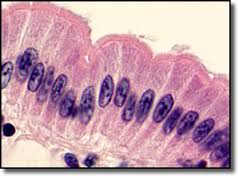
Identify:
Columnar
Cuboidal
Pseudostratified
Transitional

A specialized cell that is associated with columnar tissue, that releases mucus.
Adipocyte
Goblet Cell
Mast Cell
Plasma Cell

The muscle tissue shown is called ______.
Skeletal
Cardiac
Smooth

The tissue type shown in the photomicrograph below is a (a) tissue.
Blood
Bone
Areolar
Adipose
Hyaline Cartilage

The tissue typeshown in the line drawing is ___tissue
Blood
Reticular
Adipose
Bone
Reticular Connective

What tissue is this?
CNS (nervous)
Karyocyte (nervous)
Nerve (cross section)
Pacinian Corpuscle (nervous)

Match the following blood components with their correct names.
erythrocytes
Red blood cells
plasma
Liquid part of blood
thrombocytes
Platelets
leukocytes
White blood cells


Identify the type of connective tissue from the picture above.
Spongy Bone
bone (osseous)
reticular
dense irregular

Skeletal
Dense Regular
Smooth
Elastic

Name the Tissue Type:
Fibrocartilage
Hyaline cartilage
Elastic cartilage
Dense regular

