
Font size
 Worksheets
10_Transformer
Total questions: 38
Worksheet time: 10hrs 30mins
The function of the transformer in the transmission of
electricity is to......................... (choose ALL that apply)
change the voltage magnitude
increase the power
increase the resistance
reduce the time to transmit the electricity
transfer power from one point to another
If a transformer reduces voltage, it is called a/an ....................... transformer.
step left
step right
step up
step down
decrease
If a transformer increases voltage, it is called a/an ......... transformer.
step right
step left
step up
step down
increase
Step-up transformers...
increase the voltage
decrease the voltage
increase current
decrease current
Which number of turns of primary and secondary of transformer is suitable in order to stepped up the voltage from 25 kV to 132 kV ?
primary: 1000 turns
secondary: 52,800 turns
primary : 55,000 turns
secondary : 1000 turns
primary: 2,500 turns
secondary: 13,200 turns
primary : 13,200 turns
secondary : 20,500 turns
Which number of turns of primary and secondary of transformer is suitable in order to stepped down the voltage from 11 kV to 240 V ?
Primary : 11,0000 turns
Secondary: 240 turns
Primary : 240 turns
Secondary: 11,000 turns
Primary : 1100 turns
Secondary: 240 turns
Primary : 240 turns
Secondary : 24 turns
Which number of turns of primary and secondary of transformer is suitable in order to stepped down the voltage from 132 kV to 33 kV ?
Primary : 13,200 turns
Secondary: 3,300 turns
Primary : 3,300 turns
Secondary: 13,200 turns
Primary : 13,200 turns
Secondary: 1300 turns
Primary : 1300 turns
Secondary : 13,200 turns
The windings of a transformer which is connected to a source of energy is called the ....... winding.
primary
secondary
input
output

Ahmad charged his hand phone using battery charger.
The charger has a transformer as in the diagram.
What is the number of turns of the secondary coil?
The following formula may be useful;
VSVP=NSNP=IPIS
2 160
1 333
450
27
A transformer has 500 turns on its primary coil, and 100
turns on its secondary coil. An a.c voltage of 25 V is
connected across the primary coil.
What is the voltage across the secondary coil?
The following formula may be useful;
VSVP=NSNP=IPIS
5.0 V
12.5 V
50.0 V
175.0 V

Diagram shows a step up transformer. Which step will increase the efficiency of the transformer?
Use laminated steel core
Use thicker coil wire
Increase the number of turns of the primary coil
Decrease the number of turns of the secondary coil
A transformer consists of
Metal Core
Metal core and coiled wire
Metal core and polymer wire
Polymer core and metal wire
Transformer is device that
converts AC voltage to current
converts electrical energy to kinetic energy
converts AC voltage to a different level at the same amplitude
converts AC voltage to a different level at the same frequency
Select the facts about transformer.
Will not work with DC and AC
Will not work with DC
AC will produce change in magnetic field
AC will induce current
Is the core insulated?
Yes
No
Primary loop is connected to the supply while secondary loop is connected to the load.
True
False
A secondary coil of a transformer has 500 windings. It was supplied with 200 V. How many windings needed at primary coil to produce 100 V.
(a)
A secondary coil of a transformer is supplied with voltage source, while the primary coil induces voltage (emf).
True
False
This picture is an example of a ________________.
Motor
Generator
Step-up transformer
Step-down transformer
Which transformer loss increases the most as the frequency increases?
Copper loss
Eddy current loss
Hysteresis loss
Leakage flux loss
Laminated insulation are normally used in the transformer:
To reduce the hysteresis effect
To increase the hysteresis effect
To reduce the effect of eddy current
To increase the effect of eddy current
A transformer has:
primary and secondary windings, both of which are considered inputs
a primary winding used as an output and a secondary winding used as an input
primary and secondary windings, both of which are considered outputs
a primary winding used as an input and a secondary winding used as an output
A Transformer______________
Changes dc to AC
Steps up or down AC Voltages & Current
Changes ac to DC
Steps up or down DC Voltages & Current
Increasing the number of turns of wire on the secondary of a transformer will:
decrease the secondary current
increase the primary current
increase the secondary current
have no effect on the secondary current
If the primary power of an ideal transformer having a 2:1 voltage ratio is 100 W, the secondary power is:
200 W
75 W
50 W
100 W
The function of a transformer is to ...
raise and lower the apparent power levels
transfer DC voltage from the primary winding to the secondary winding
increase or decrease A.C voltage or A.C current levels
transform mechanical energy into electrical energy
What is created continuously when current is flowing through the primary coil?
changing magnetic field
charging secondary coil
step-up the secondary voltage
increase the output power
The thin sheets of steel from which transformer cores are made are called...................
lamination
transformer
copper
Primary winding of a transformer is determined by _________.
which winding has more turns
which winding is nearer to the load
which winding is connected to the source
which side has the highest voltage
Why transformers work with A.C. current but not D.C.
A.C current produces changing magnetic field.
D.C current produces changing magnetic field.
D.C current is weak
A.C current is powerful
Ratio of voltages is equal to ratio of _______________________.
number of iron sheets in core
number of coil
number of turns in coil
number of electromagnetic
A transformer has 100 turns in the primary coil and 25 turns in the secondary coil. When a 120 V is applied to the primary coil, what is the voltage in the secondary coil?
480V
30V
20V
450V
Transformer works on which of the following principle:
Fleming's Law
Faraday's Law of Electromagnetic induction
Ampere's Law
Lenz Law

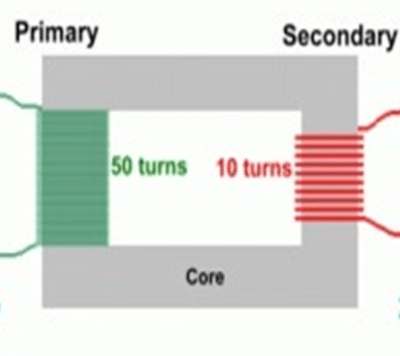
What type of transformer is this?
Step up
Step down
Primary winding = 400 turns
Secondary winding = 200 turns
If there's 240V @ 8A on primary, the secondary will have...
240V @ 4A
120V @ 4A
480 V @ 4 A
120V @ 16 A
Primary = 600 V and Secondary = 150 V
This transformer ratio is...
1:4
6:1.5
4:1
600: 150
Choose the correct statement:
The ratio of the secondary voltage to the primary voltage is equal to the ratio of the primary turn to the secondary turn
The ratio of the primary current to the secondary current is equal to the ratio of the primary voltage to the secondary voltage
The ratio of the primary apparent power to the secondary apparent power is equal to the ration of the primary voltage to the secondary voltage
The ratio of the secondary current to the primary current is equal to the ratio of the primary turn to the secondary turn
12V bulb connected to a 240V power source that through a transformer.
What should be the number of turns in the secondary coil?
(a)

