
Font size
 Worksheets
REVIEW Do1 WEEK 3 QUIZ 2
Total questions: 45
Worksheet time: 25mins
The adverse effects that occur during corticosteroid use include all of the following, except:
suppression of the hypothalamic-pituitary-adrenal (HPA) axis
hypercorticism with changes in fat distribution and posterior cervical hump formation
Hypertension, congestive heart failure, emotional changes, thinning of skin, petechiae, diabetes, Menstrual irregularities
increased muscle mass, decreased appetite, improved bone density, or lower blood pressure,
electrolyte imbalances, liver and pancreatic dysfunction, exophthalmos, glaucoma, loss of muscle mass, osteoporosis, muscle weakness
What is the main function of Cyclosporine?
inhibits the synthesis of insulin in pancreatic beta cells.
Stimulates the production of red blood cells in the bone marrow.
Acts as a broad-spectrum antibiotic against bacterial infections.
Reversibly suppresses T helper cells in the G0 or G1 phase of the cell cycle without killing them.
Histamine binds to H1 (histamine 1), H2, H3, and H4 receptors, which are located on many types of cells. Which white blood cell expresses predominantly H2 receptors?
neutrophils
Basophils
Eosinophils
Monocytes
The H3 receptors are located? select all that apply
the brain
Human skin
in the spinal cord
gastrointestinal tract
on sensory neurons such as postganglionic cholinergic nerves in lung bronchi
This medication inhibits the synthesis of DNA and are used in multiple autoimmune diseases. Side effects include increased risk of malignancy, bone marrow suppression, nausea, and vomiting. Name the medication.
Cyclophosphamide (an alkylating agent)
Methotrexate (a folate analog)
Azathioprine (a purine analog)
Cyclosporine (a calcineurin inhibitor)
Therapeutic plasmapheresis has been effective in the management of following diseases, EXCEPT;
Goodpasture's syndrome
Myasthenia gravis
Rheumatoid arthritis
Guillain-Barre syndrome
Intravenous immunoglobulin (IVIg) can also be used for the following disorders, Except;
Kawasaki disease
Immune thrombocytopenic purpura
Guillain-Barre syndrome
Hypertension
This type of hypersensitivity reaction is mediated by the IgG/IgM immune complex, as in immune complex glomerulonephritis and SLE.
Type III hypersensitivity
Type I hypersensitivity
Type II hypersensitivity
Type IV hypersensitivity
This type of hypersensitivity reaction is a T cell–mediated and has all of the following categories except; Select all that apply.
Type I: Atopic, Anaphylactic
Type II: Cytotoxic, Cytolytic
Type III: Immune Complex (Arthus Reaction)
Type IV: Delayed Hypersensitivity
Which type is mediated by IgE and leads to mast cell degranulation?
Type I: Atopic, Anaphylactic
Type II: Cytotoxic, Antibody-dependent
Type III: Immune Complex-mediated
Type IV: Delayed-type, Cell-mediated
One of the most important mediators of type I hypersensitivity is _________.
Bradykinin
Serotonin
Histamine
Prostaglandin
The leukotrienes can cause ________ and increase vascular permeability.
smooth muscle contraction
decreased heart rate
bone resorption
increased urine output
The following are possible causes of human allergic reactions or anaphylaxis, EXCEPT: Select the option that is NOT a possible cause.
Pure Inorganic Chemicals
Medications
Insect Venom
Foods
Biological Agents
The removal of this organ reduces serum IgM and the antibody response to encapsulated bacteria.
Kidney
Liver
Spleen
Pancreas
Some protective, proactive actions taken during pregnancy are thought to decrease the likelihood that type I hypersensitivity will develop in children from families with a history of allergies. These actions include all of the following: avoiding foods to which the mother is allergic, limiting excesses of one type of food during the last trimester of pregnancy, avoiding whole eggs during the last month before delivery and while breast feeding, and limiting cow’s milk to two glasses per day. Other actions that may be helpful during the child’s infancy include avoiding exposure to environmental pollution, breast feeding for a minimum of 6 months, supplementing the child’s diet with non–cow’s milk products such as soy milk, giving solid foods only after the infant is 6 months old, keeping the infant’s room as free of dust and molds as possible, and keeping pets (dogs, cats, birds) out of the home.
True
False
The goal of pharmacologic immunotherapy or desensitization therapy is giving a person an antigen (allergen) in gradually increasing dosages weekly or biweekly over a course of months or years to induce tolerance.
True
False
The RhoGAM vaccine is effective if the mother already has a positive antibody titer for fetal Rh antigens.
True
False
Which is false about Myasthenia gravis?
Myasthenia gravis is only an autoimmune disease and not a type II hypersensitivity reaction.
Myasthenia gravis is an autoimmune disease of the neuromuscular junction.
Which is true about Graves' Disease? select all that apply
Type IIb hypersensitivity reaction that occurs as a result of an immune attack on the thyroid gland.
a form of hypothyroidism (an underactive thyroid)
This causes the cells to malfunction, stimulating the receptor and producing excess thyroxine (T4) and triiodothyronine.
Circulating IgG autoantibodies (called anti-TSHR antibodies) attack the thyroid-stimulating hormone receptor.
This type of hypersensitivity includes “farmer’s lung” and the interstitial pneumonitis seen in pigeon breeders. Type III hypersensitivity results.
Type II hypersensitivity
Type I hypersensitivity
Type III hypersensitivity
Type IV hypersensitivity
Which is false about clinical manifestations of Immune Complex Glomerulonephritis? This deposition causes glomerular basement membrane of mesangial cells, and ultimately damages the glomerular basement membrane with resultant proteinuria, hematuria, hypertension, oliguria, and red cell casts in the urine.
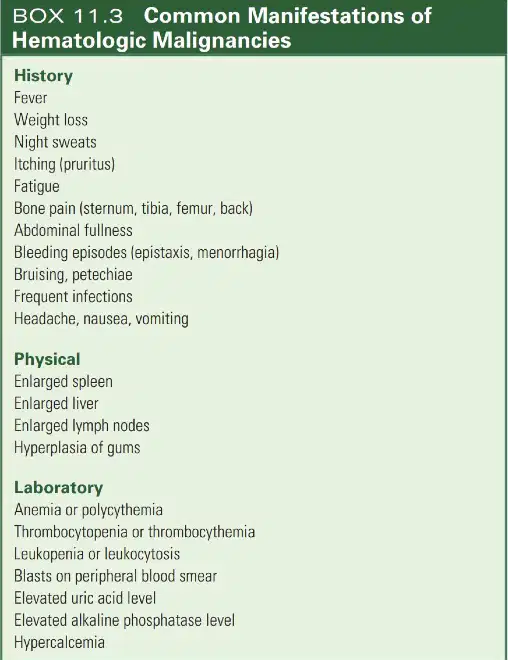
The following are some common Manifestations of Hematologic Malignancies, EXCEPT:
Fever
Weight loss
Hypertension
Enlarged spleen
22. Neutropenia is an absolute neutrophil count less than ________.
2000 cells/μL
1000 cells/μL
500 cells/μL
1500 cells/μL
Sternal tenderness is frequently present in chronic myeloid leukemia (CML).
True
False
A complete remission (CR) is defined as a return to normal hematopoiesis with normal red blood cell, neutrophil, and platelet counts and no detectable neoplastic cells. For leukemia, the bone marrow must have less than ___% blasts, which are the most immature bone marrow cells, and be maintained for at least ________ for a complete remission (CR).
5; 3 weeks
10; 5 weeks
5; 4 weeks
2; 4 weeks
Which ones are correct about Acute Myeloid Leukemia?
AML is primarily a disease of adults ranging in age from 64-71 with 20%-25% in children.
Bone marrow aspirate must have more than 20% blasts to be classified as AML.
The overall 5 year survival for adults with AML is 28%, for children is 60-70%. A total of 85%-90% of children will achieve remission with induction chemo; however, only 50% of adult patients older than 50 will do so.
Acute granulocytic leukemia is not the most common type of AML.
Myeloblastic cells have a segmented nucleus and coarse chromatin.
This is the most curable of all AML subtypes, with a 70% to 80% 5-year disease-free survival.
acute erythroid leukemia
acute myelomonocytic leukemia
acute monocytic leukemia
acute promyelocytic leukemia (APL)
Which of the following is false about Pathogenesis and Clinical Manifestations of Chronic Lymphoid Leukemia?
CLL is the most common adult leukemia in the Western world.
CLL is common before age 30.
CLL cells are characterized by defective apoptosis and have extended life spans.
CLL is the same disease process as small lymphocytic lymphoma (SLL).
Which of the following is false about Pathogenesis and Clinical Manifestations of Hairy Cell Leukemia?
Hairy cell leukemia is a rare, chronic type of leukemia.
The median age at presentation is approximately 55 years.
There is a 5-to-1 predominance of males.
Patients have 'hairy cells' in the peripheral blood.
Splenomegaly is a common finding, being present in 90% of patients.
Which of the following is false about Pathogenesis and Clinical Manifestations of Plasma Cell Myeloma?
malignant disorder of mature, antibody-secreting B lymphocytes, called plasma cells
have a predilection to invade bone and form multiple tumor sites
myeloma occurs exclusively in the adult population, usually affecting individuals older than 40 years, with a median age at presentation of 65 years
women are effected more than men
Which is false about Platelets?
Platelets are essential in the formation of blood clots and in the control of bleeding.
Platelets are cells that are capable of mitotic division.
Platelets contain cytoplasmic granules that release biochemical mediators involved in the hemostatic process.
The average life span of platelets in the peripheral blood is approximately 8 to 10 days.
The normal platelet count is 150,000 to 400,000 cells/mm3
Fill in the blank: The normal platelet count is ________ cells/mm3.
150,000 to 400,000
10,000 to 50,000
500,000 to 1,000,000
50,000 to 100,000
Fill in the blank: Platelets are produced in the bone marrow from ________, which are derived from the pluripotent stem cell.
erythrocytes
megakaryocytes
osteoclasts
lymphocytes
Fill in the blank: The average life span of a platelet is ________ days.
15 to 20
1 to 3
7 to 12
30 to 40
Fill in the blank: Approximately ________% of platelets are sequestered in the liver and spleen.
70
10
50
25
Fill in the blank: The divalent cation that is a cofactor for most enzyme-activated processes in blood coagulation is _________.
Calcium (Ca2+)
Sodium (Na+)
Potassium (K+)
Magnesium (Mg2+)
The factor that, together with activated factor IX, enzymatically activates factor X and helps platelets adhere to capillary walls is _________.
factor V
factor VII
factor VIII
factor XII
The following are factors/proteins that are dependent on vitamin K for synthesis and normal activity, EXCEPT:
Factor X
Factor IX
Factor VII
Factor II
Factor VIII
The Protein C, a plasma protein, inactivates which factors in the prevention of clot formation?
Factor V
Factor VII
Factor VIII
Factor IX
Factor X
Which of the following is FALSE about the etiology and pathogenesis of the Vascular Purpura?
Vascular purpura is a disorder in which purpura—patches of petechiae, or pinpoint hemorrhages, on the skin—are present.
it is a single disease with a singular, well-understood cause
The allergic purpuras are thought to result from an autoimmune process that produces inflammation or vasculitis of small vessels
is an abnormality of the vessels or the tissues that support them
Structural abnormalities of vessels and perivascular supportive tissue provide the mechanism for bleeding in many of the vascular purpuras
Which is false about CLINICAL MANIFESTATIONS of Hereditary Hemorrhagic Telangiectasia?
Bright red or purple lesions, ranging from pinpoint to 3 mm in diameter, can be found on the nasal mucous membranes, lips, palate, tongue, face, trunk, palms of the hands, and the soles of the feet
A hallmark symptom is recurrent nosebleeds (epistaxis), with increasing frequency as the patient ages. The severity of the disorder is linked to age of onset
lesions are bumpy and blanch with pressure
The most common clinical problem is mucous membrane bleeding, especially epistaxis
Frequent bleeding episodes may result in anemia
Which is false about the etiology and pathogenesis of thrombocytosis?
Thrombocytosis is defined as a platelet count greater than 400,000/mm3.
Transitory thrombocytosis is seen after stress or physical exercise.
Secondary thrombocytosis is seen with polycythemia vera.
These are all true about etiology and pathogenesis of thrombocytosis.
Which is CORRECT about the etiology and pathogenesis of Qualitative Platelet Disorders?
The number of platelets is always decreased in qualitative platelet disorders.
Qualitative platelet disorders only affect platelet count, not function.
Qualitative platelet disorders may have normal platelet count but abnormal function.
Qualitative platelet disorders do not result in bleeding tendency.
Which is false about Hemophilia A?
Hemophilia A is a bleeding disorder.
Hemophilia A is caused by a deficiency of clotting factor VIII.
Hemophilia A is inherited in an X-linked recessive manner.
These are all true about Hemophilia A.
Which is false about the etiology of the Disseminated Intravascular Coagulation?
DIC is an acquired hemorrhagic syndrome in which both clotting and bleeding occur simultaneously.
DIC is not associated with both clotting and bleeding.
DIC is seen mainly in cancer patients with malignancy.
DIC is not seen in cancer patients.
DIC is estimated to occur in approximately 1% of hospital admissions. Death rates are reported to range from 20% to 50%

