
 Worksheets
GENETICS 2
Total questions: 49
Worksheet time: 2hrs 55mins
Who first observed lampbrush chromosomes?
a) Balbiani
b) Painter
c) Flemming
d) Morgan
Polytene chromosomes are found in:
a) Salamander oocytes
b) Drosophila salivary glands
c) Human somatic cells
d) Barr bodies
Which stage of meiosis shows lampbrush chromosomes?
a) Pachytene
b) Diplotene
c) Zygotene
d) Anaphase
True or False
Heterochromatin is transcriptionally active.
TRUE
FALSE
Incomplete linkage produces recombinants
TRUE
FALSE
Polytene chromosomes show puffing due to RNA synthesis.
TRUE
FALSE
Crossing over occurs during prophase I.
TRUE
FALSE
A Drosophila geneticist observes the following offspring from a three-point test cross:
Parental: 400, 390
Single crossovers (A-B): 60, 55
Single crossovers (B-C): 50, 45
Double crossovers: 5, 5
Tasks:Determine the gene order.
Calculate recombination frequencies.
Compute coefficient of coincidence and interference.
Two linked genes show 5% recombination frequency. If you perform a test cross, what proportion of offspring will be recombinant? Why?
A geneticist finds that two traits in maize always co-segregate with a frequency of 99%. What does this imply about linkage? Suggest an experiment to confirm.
Propose a modern experimental design combining fluorescence in situ hybridization (FISH) and polytene chromosome banding to identify chromosomal rearrangements.
Compare the usefulness of giant chromosomes (lampbrush & polytene) with normal metaphase chromosomes in cytogenetic studies.
In eukaryotic cells, the DNA molecule is extremely long and must be compacted to fit inside the nucleus. This is achieved through a highly organized process called chromosome packaging. The basic unit of this packaging is the nucleosome, which consists of DNA wrapped around a core of histone proteins. Approximately 146 base pairs of DNA coil around a histone octamer, forming a “beads-on-a-string” appearance under the microscope.
The nucleosomes further coil and fold into chromatin fibers. Depending on the stage of the cell cycle and transcriptional activity, chromatin exists in two forms: euchromatin and heterochromatin. Euchromatin is less condensed, replicates early, and is transcriptionally active, whereas heterochromatin is highly condensed, replicates late, and is transcriptionally silent.
At higher levels of organization, chromatin loops attach to the nuclear scaffold, forming looped domains. These loops are further compacted during cell division, ultimately forming the visible metaphase chromosomes. The degree of packaging not only ensures that DNA fits within the nucleus but also regulates gene expression, as tightly packed regions are generally inaccessible to transcription machinery.
Thus, chromosome packaging is a dynamic process that balances the need for DNA compaction with the need for gene accessibility.
What is the basic unit of chromosome packaging in eukaryotes?
How many base pairs of DNA are wrapped around a histone core in a nucleosome?
Differentiate between euchromatin and heterochromatin in terms of activity and replication timing.
Why do regions of heterochromatin remain transcriptionally silent?
If nucleosomes were absent, what problems would a cell face in managing its DNA?
Gene order? → Determined by
HAT medium- expand
The phenomenon where observed double crossovers are fewer than expected is called
(a)
The ratio of observed to expected double crossovers is called the
(a)
Show homologous chromosomes during pachytene of prophase I with exchange of segments between non-sister chromatids.

The coefficient of coincidence (c.o.c.) is 0.5. What does this mean?
Interference is complete
Observed double crossovers are half the expected
Crossing over does not occur
No recombination is possible
What is the primary function of lampbrush chromosomes during meiosis?
Chromosome segregation
DNA replication
RNA synthesis
Protein synthesis
In which organism are polytene chromosomes most commonly studied?
d) Arabidopsis thaliana
a) Caenorhabditis elegans
b) Drosophila melanogaster
c) Mus musculus
What does a coefficient of coincidence of 1 indicate?
Complete interference
High recombination frequency
No interference
Partial interference
What type of chromosomes are characterized by their distinct banding patterns and are often used in genetic studies?
a) Lampbrush chromosomes
d) Acrocentric chromosomes
b) Polytene chromosomes
c) Metacentric chromosomes
During which phase of meiosis do homologous chromosomes undergo recombination?
d) Telophase I
c) Anaphase I
b) Metaphase I
a) Prophase I

The following karyotype shows an individual with...
Down's syndrome
Kleinfelter's syndrome
Turner's syndrome
Someone exposed to UV light

The following karyotype shows an individual with...
Down's syndrome
Kleinfelter's syndrome
Turner's syndrome
Someone exposed to UV light

The following karyotype shows an individual with...
Down's syndrome
Kleinfelter's syndrome
Turner's syndrome
Someone exposed to UV light
You are viewing a patients karyotype. You see 23 chromosomes total. There are no homologous chromosomes. Which type of cell are you viewing?
Egg cell
Zygote
Skin cell
White blood cell

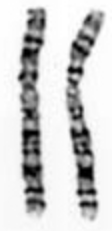

Linkage is a phenomenon seen during.....
Mitosis
Meiosis
DNA replication
During a mutation
How many genes can be mapped with the help of a double crossover?
3
2
4
either 2 or 3
If Crossing over is a tool for generating variation in the population, then what is the purpose of the S phase in the cell cycle
S phase is the phase in which mutations mostly occur in the DNA of the cell
S phase is the phase during which DNA is getting condensed to form a chromosome
S phase is the phase during which DNA is replicated in the cell
S phase is the phase during which the proteins needed for mitosis are prepared
The progeny of a test cross is not in a 1:1 ratio, this means
Independent assortment failed to occur
Segregation failed to occur
There was some error in data analysis, the progeny of a test cross are always 1:1
This is because of a lethal gene influence
Why is a test cross always performed when we need to map the gene distance? (2 marks)
If the distance between A/B is 0.12 mu and gene C is on the opposite side of A with respect to B at a distance of 0.23 mu, What is the order of the gene linkage map
A - B - C
C - A - B
both A - B - C and C - B - A are possible
The linkage map cannot be detemined as the ratio is not 1:1
A - C - B
What Chromosomes are to Mitosis, Chromatin is to (a)
Technique is used for identification of criminal on the basis of repetitive DNA sequence
PCR
ELISA
DNA fingerprinting
Chromatography
Hybridoma technology, hybrid cell obtained by fusion of ________ cell with myeloma cell
B lymphocyte
Basophil
Neutrophil
Eosinophil
Natural humoral immune response against a pathogen leads to the production of
a) polyclonal antibodies
b) monoclonal antibodies
c) macrophages
d) none of these
Hybridoma technology was developed by
a) Kohler and Milstein
b) Khorana and Nirenberg
c) Khorana and Korenberg
d) Beedle and Tautum
Which of the following statement is incorrect regarding HAT medium
a) HAT medium is a selective medium
b) Aminiopterin in the HAT medium blocks de novo pathway of nucleotide synthesis
c) Salvage pathway requires aminopterin and thymidine
d) Hypoxanthin is converted to guanine by HGPRT enzyme
Name the drug which is used to isolate hybridoma cells from the media?
a) Amphetamine
b) Opium
c) Aminopterin
d) Cocaine
Which of the following statement is incorrect regarding HAT selection
a) B cells are HGPRT + and can grow in HAT medium but undergoes normal cell death
b) Myeloma cells cannot grow in HAT medium as these cells lack HGPRT
c) Hybrid cell survive in HAT medium as it inherits HGPRT form B cells
d) Aminopterin in HAT medium blocks de novo pathway of nucleotide synthesis only in myeloma cells
The word chromosomes was coined by
Waldeyer
Strasberger
Robert Brown
Boberi
Nucleolus is formed by
(a)
When centromere is present at terminal end the chromosome is called.....
Acrocentric
Acentric
Metacentric
Telocentric

