
 Worksheets
GEMPUR CHAPTER 6: EXPRESSION OF BIOLOGICAL INFORMATION
Total questions: 50
Worksheet time: 27mins
The backbone of polynucleotide is made up of
amino acids and sugars
nucleotide bases, including thymine
nucleotide bases, including uracil
sugar-phosphate molecules
What is the complimentary mRNA sequence to the DNA sequence
5' A-T-T-G-C-A 3'
3' T-A-A-C-G-T 5'
5' U-A-A-C-G-T 3'
3' U-A-A-C-G-U 5'
5' T-A-A-G-C-U 3'
The region on mRNA that non as non-coding region
introns
exons
codons
anticodons

Which enzyme joins the Okazaki fragments in the lagging strand?
Helicase
DNA Polymerase
Ligase
Primase

This picture is illustrating the ____ nature of DNA.
antiparallel
semiconservative
helical
radioactive
How do the leading and the lagging strands differ?
The leading strand is synthesized in the same direction as the movement of the replication fork, and the lagging strand is synthesized in the opposite direction.
The leading strand is synthesized at twice the rate of the lagging strand.
The leading strand is synthesized in short fragments that are ultimately stitched together, whereas the lagging strand is synthesized continuously.
The leading strand is synthesized by adding nucleotides to the 3' end of the growing strand, and the lagging strand is synthesized by adding nucleotides to the 5? end.
Which enzyme is responsible for adding the RNA primer to the template strand?
Helicase
DNA Polymerase
Ligase
Primase
What is the result of transcription?
The synthesis of RNA from protein
The synthesis of protein from RNA
The synthesis of protein from DNA
The synthesis of RNA from DNA
What is the result of translation?
The synthesis of RNA from protein
The synthesis of protein from RNA
The synthesis of protein from DNA
The synthesis of RNA from DNA
Which organelle does required in translation?
Nucleus
Ribosome
Mitochondria
Golgi apparatus
What is the role of tRNA?
To treat the DNA strand
To transfer codons
To transfer amino acids
To tackle mutations
What is the start codon?
UAC
TAC
AUG
GUA
How many codons are required for one amino acid?
1
2
3
4
How many codons are required for three amino acids?
1
2
3
4
Which of the following is the major enzyme that involved in DNA
replication?
I. Helicase
II. Reverse transcriptase
III. Topoisomerase
IV. DNA polymerase
V. Aminoacyl-tRNA synthetase
I, III and IV
I, III and V
I,II, III and IV
II, III, IV and V
The following events occur in the replication of DNA.
1. Bonds between complementary bases break
2. Bonds between complementary bases form
3. DNA molecule uncoils
4. Opposite strands separate
5. Sugar-phosphate backbone form
6. Free nucleotides align with complementary nucleotides on each strand
In which order do these events take place?
1 3 6 4 2 5
3 1 4 6 2 5
3 6 1 4 5 2
4 3 1 6 5 2
What is the role of DNA ligase in DNA replication?
Synthesize of short RNA primer by adding RNA nucleotide
Replaces the RNA primer by adding the DNA nucleotide
Join Okazaki fragment at lagging strand forming phosphodiester bond
Unwind the double stranded DNA to become single stranded DNA
In DNA
replication, new DNA nucleotides are added to a growing DNA by…………………
DNA helicase
DNA polymerase
RNA polymerase
RNA primer

AATCATGGA
What enzyme does transcription use?
DNA polymerase
ligase
RNA polymerase
helicase
Which RNA forms part of the ribosomes?
tRNA
mRNA
rRNA

Transcribe the following DNA strand: CTG AAT
GAC TTA
CTG AAT
GAC UUA
CUG AAU
ATG GGA ACT CCA
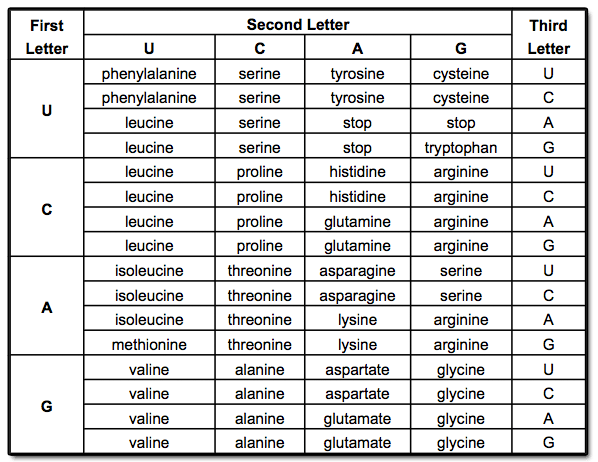


What is a gene?
A segment of RNA that encodes for a protein
The portion of the chromosome that does not get transcribed
A segment of DNA that encodes for a protein
The collection of your chromosomes
lac operon was proposed by
Meselson and Stahl
Jacob and Monod
Hershey and Chase
Watson and Crick
For a repressible operon to be transcribed, which of the following must be true?
A corepressor must be present.
RNA polymerase and the active repressor must be present.
RNA polymerase must bind to the promoter, and the repressor must be inactive and not blocking the promoter region.
RNA polymerase cannot be present, and the repressor must be inactive.
The sequence where lac repressor binds on operon is called_______
promoter
lac z
operator
lac I
Which of the following is not a structural gene?
lac z
lac y
lac a
lac I
In the lac operon the inducer is
allolactose
glucose
galactose
all of the above

What is 1 in the diagram?
RNA polymerase
Inducer
Repressor
Operator

