wayground logo

Free Printable Worksheets

Font size

S
M
L
XL
Worksheets

Ca # 4 Review

Total questions: 50

Worksheet time: 41mins
Name
Class
Date
1.
Which biomolecule is made of nucleotides and contain you DNA?
a)
Carbohydrate
b)
Lipids
c)
Protein
d)
Nucleic Acid
2.
Which biomolecule has sugars and starches?
a)
Lipids
b)
Proteins
c)
Carbohydrates
d)
Nucleic Acid
3.
Which biomolecule functions include enzymes­ which speeds the rate of chemical reactions, structural components in cells, mechanical functions in muscles and cytoskeleton, cell signaling, and immune response; provides structure and helps with chemical reactions 
a)
Protein
b)
Lipids
c)
Carbohydrate
d)
Nucleic Acid
4.
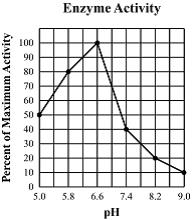
Which of the following conclusions can be drawn from this graph?
a)
The optimum pH of the enzyme is 6.6.
b)
The optimum pH of the enzyme is 5.8
c)
The enzyme’s activity increases as pH increases 5.0 to 9.0
d)
The enzyme’s activity is greater around pH of 8.0 .
5.
What is the purpose  of an enzyme?
a)
give permission for the reaction
b)
raise activation energy
c)
speed up reactions
d)
control how many reactions occur
6.

Which table headings should the student use for the two groups?

a)

1. Animal cells………..2. Plant Cells

b)

1. Prokaryotic cells…..2. Eukaryotic cells

c)

1. Mobile cells………..2. Motile cells

d)

1. Fungal cells………..2. Bacterial cells

7.

What are the reactants of photosynthesis?

a)

carbon dioxide, water, and sunlight

b)

oxygen and glucose

c)

carbon dioxide and glucose

d)

carbon dioxide, water, and ATP

8.

What are the products of photosynthesis?

a)

carbon dioxide, water, and sunlight

b)

oxygen and glucose

c)

carbon dioxide and glucose

d)

carbon dioxide, water, and ATP

9.

What are the reactants of cellular respiration?

a)

carbon dioxide, water, and sunlight

b)

oxygen and glucose

c)

carbon dioxide and glucose

d)

carbon dioxide, water, and ATP

10.

What are the products of cellular respiration?

a)

carbon dioxide, water, and sunlight

b)

oxygen and glucose

c)

carbon dioxide and glucose

d)

carbon dioxide, water, and ATP

11.

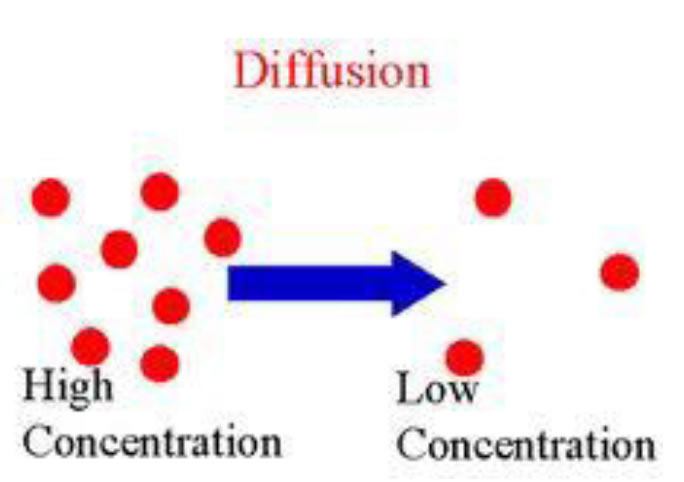
The movement of particles from an area of high to low concentration is known as--

a)

Passive Transport

b)

Active Transport

12.

How does a cell maintain homeostasis?

a)

By controlling what enters and leaves the cell

b)

Flexibility

c)

Protective barrier

d)

Structure and support

13.
What is the difference between active and passive transport?
a)
Active does not need energy and passive uses ATP (energy)
b)
Active uses ATP (energy) and passive does not need energy
c)
Active stores transport proteins and passive releases 
d)
Active uses hormones and passive does not 
14.
Which part of the Cell Cycle takes the longest?
a)
Interphase
b)
Mitosis
c)
Prophase
d)
Cytokinesis
15.
What phase is this cell in?
a)
Cytokinesis
b)
Mitosis
c)
Prophase
d)
Metaphase
16.
What phase is this cell in?
a)
Mitosis
b)
Interphase
c)
Anaphase
d)
Telophase
17.
What phase is this cell in?
a)
Mitosis
b)
Cytokinesis
c)
Prophase
d)
Telophase
18.
What part of the cell cycle is this cell in?
a)
Mitosis
b)
Interphase
c)
Telophase
d)
Cytokinesis
19.
Which process and type of resulting cells are represented?
a)
mitosis, gametes
b)
mitosis, body cells
c)
meiosis, gametes
d)
meiosis, body cells
20.
A male shark has 40 chromosomes in each of its sex cells. How many would be present in its body cells?
a)
20
b)
40
c)
80
d)
160
21.
What causes genetic variation in meiosis?
a)
chromosomes lining up
b)
crossing over of chromosomes
c)
separation of chromosomes
d)
chromosomes pulling apart
22.

What is a phenotype?

a)

A bunch of letters

b)

The physical appearance of the genes

c)

The genes an organism has

d)

Different forms of the same gene

23.
Which sequence of complementary DNA bases would pair with this partial strand
ATG TGA CAG?
a)
ATG TGA CAG
b)
TAC ACT GTC
c)
GTA AGT GAC
d)
CAT TCA CTG
24.
What determines the code, or information, of a DNA molecule?
a)
the shape (structure) of the nitrogen bases
b)
the order (sequence) of the nitrogen bases
c)
the color of the nitrogen bases
d)
the frequency (number) of nitrogen bases
25.
What are the three components of a nucleotide?
a)
sugar, hydrogen, nitrogen base
b)
sugar, oxygen, nitrogen base
c)
sugar, phosphate, nitrogen base
d)
sugar, phosphate, protein
26.
How would the DNA sequence GCTATA be transcribed to mRNA?
a)
GCUAUA
b)
CGATAT
c)
CGAUAU
d)
GCUTUT
27.
Where do mutations occur?
a)
DNA and RNA
b)
DNA 
c)
RNA
d)
mRNA and tRNA
28.
Why are insertion and deletion mutations so harmful?
a)
They change all of the codons from the mutation on down the line, which changes the amino acid sequence
b)
They insert things that an organism doesn't need.
c)
They often delete things that organisms need.
d)
Insertion and deletions are not any more harmful than substitution mutations.
29.
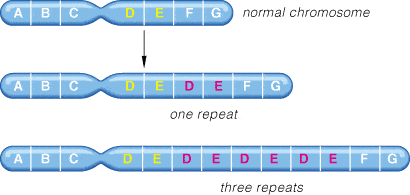
Identify the mutation in the picture.
a)
Inversion
b)
Duplication
c)
Deletion
d)
Translocation
30.
Trisomy 21 means you have what?
a)
Three copies of chromosome 21
b)
Twenty one copies of chromosome 3
c)
Three omies and 21 means
d)
Two copies of chromosome 21
31.
DNA molecule segment is : TTACGCAAG
The mutated DNA segment is TTACGCAAC. This is an example of ___ mutation.
a)
Base Substitution
b)
Base Insertion
c)
Base Inversion
d)
Translocation
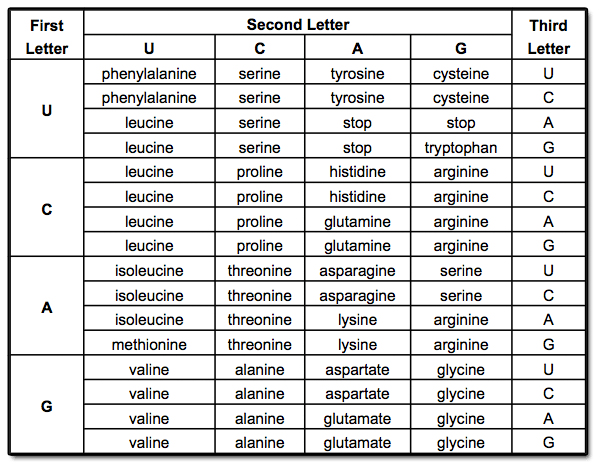
32.
What amino acid is represented by the codon UUA?
a)
Phenylalanine
b)
Tyrosine
c)
Leucine
d)
Stop codon
33.
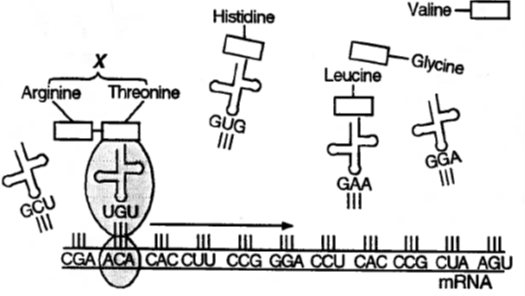
What process is going on in this photo? 
a)
Transcription 
b)
Translation 
c)
Replication 
d)
All the above 
34.

What process is going on in this photo?

a)

DNA Replication

b)

Transcription

c)

Translation

d)

Mitosis

35.
The inherited combination of alleles is known as the offspring's
a)
heredity
b)
phenotype
c)
genotype
d)
redigree
36.
If T=Tall & t=short, what is the genotypic ratio?
a)
1:3
b)
3:1
c)
1:2:1
d)
2:2
37.
A corn plant heterozygous for tall sprouts mates with a corn plant with short sprouts. If tall sprouts are dominant, how many different phenotypes are possible in the offspring?
a)
1
b)
2
c)
3
d)
4
38.
If a heterozygous tall pea plant is crossed with a short pea plant, what are the possible genotypes of the future offspring?
a)
100% Tt
b)
50% Tt, 50% tt
c)
75%Tt, 25%tt
d)
25%TT, 50%Tt, 25%tt
39.
What gamete possibilities could come from this parent's genotype?
a)
AB, AB, aB, aB
b)
Ab, AB, Ab, ab
c)
Ab, Ab, Ab, Ab
d)
AB, aB, ab, aB
40.

What goes in box 3

a)

Aabb

b)

AABB

c)

AAbb

d)

aaBb

41.
Based off this punnett square, what fraction of the offspring will have wrinkled, yellow seeds?
a)
9/16
b)
3/16
c)
1/16
d)
16/16
42.

What type of inheritance pattern does the diagram represent?

a)

Incomplete Dominance

b)

Codominance

c)

Multiple Alleles

d)

Polygenic Inheritance

43.

If the image were real, it would represent what type of inheritance pattern?

a)

Incomplete Dominance

b)

Codominance

c)

Multiple Alleles

d)

Polygenic Inheritance

44.

A roan (RW) bull mated with a red (RR) cow. What is the probability or producing a white (WW) cow?

a)

25%

b)

50%

c)

100%

d)

0%

45.

Mama Suga has a blood type of AB. What are Papa Daichi's possible blood types if their son has a blood type of B? Select all that applies.

a)

A

b)

B

c)

AB

d)

O

46.
Why is the gene for a disease or disorder more likely to be found on the X chromosome than Y?
a)
The X chromosome has many more genes
b)
The Y chromosome has many more genes
47.
Males are more likely to suffer from a sex-linked disease or disorder because
a)
males are the weaker sex
b)
males have less DNA
c)
males have 1 X chromosome, so the disorder is more likely to be expressed
48.
Hemophilia is a recessive x-linked disorder.
Which genotype represents a female who is a carrier for hemophilia?
a)
XHXh
b)
XhXh
c)
XHXH
d)
XhY
49.
Hemophilia is a recessive x-linked disorder.
Which genotype represents a male with hemophilia?
a)
XHXh
b)
XhXh
c)
XHY
d)
XhY
50.

Colorblindness is a sex-linked recessive trait. A colorblind woman marries a male with normal color vision. What is the percent chance of them having a color blind son?

a)

0%

b)

25%

c)

50%

d)

75%