
 Worksheets
1st Art Movements
Total questions: 39
Worksheet time: 20mins
What is the time period associated with Postmodernism Art?
1800-1850
1900-1950
1970-1990
2000-2020
Postmodernism Art was a reaction against which art movement?
Modernism
Impressionism
Cubism
Baroque
Postmodernism Art is characterized by its rejection of rigid, unified styles and universal truths in favor of ________, contradiction, and pluralism.
complexity
simplicity
uniformity
monotony
Which of the following is NOT a characteristic of Postmodernism Art?
Rejection of rigid, unified styles
Emphasis on universal truths
Favoring complexity
Acceptance of contradiction
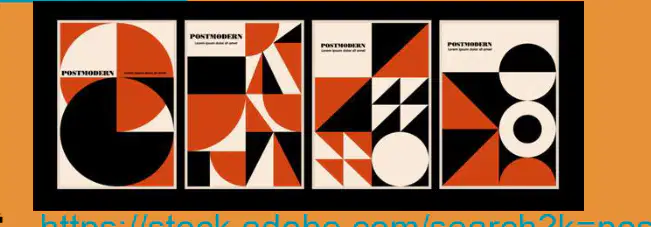
Look at the images of Postmodernism Art provided. Which of the following best describes the visual style?
Simple and realistic
Geometric and abstract
Monochromatic
Minimalist
What is the time period of the Baroque Era?
1400 — 1500's
1600 — 1750's
1800 — 1900's
1200 — 1300's
Baroque art is characterized by its use of drama, movement, and strong emotional expression to overwhelm the senses of the viewer.
True
False
Fill in the blank: In the 1600s and 1750s, Baroque was seen as a dramatic, full of passion, emotional piece of art during the _________
Renaissance
Industrial Revolution
Modern Era
Classical Period
Which era, known for a 'Rebirth', inspired the art in the Baroque period?
Renaissance
Medieval
Modern
Romantic
What is the main focus of Romanticism Art as described in the passage?
Rationality and logic
Individual imagination and intuition
Scientific discovery
Political power
During which years did the Romanticism Art movement primarily take place?
1600-1700
1780-1850
1900-1950
2000-2020
Fill in the blank: Romanticism celebrated the enduring search for individual rights and _______.
liberty
wealth
obedience
technology
Which of the following artists is NOT mentioned as a Romanticism painter in the image?
J.M.W. Turner
Ivan Aivazovsky
John Constable
Pablo Picasso
Romanticism Art was a reaction against the sober style of Neoclassicism preferred by most countries' academies.
True
False
What is Art Nouveau?
A) A form of art using floral, decorative patterns that often feature women, popularized in the 1890-1910 era.
B) A form of art using geometric shapes and abstract forms, popularized in the 1920s.
C) A form of art focused on landscapes and natural scenery, popularized in the 1800s.
D) A form of art using only black and white colors, popularized in the 1700s.
Who is credited with 'inventing' Art Nouveau?
Gustav Klimt
Alphonse Mucha
James Ensor
Aubrey Beardsley
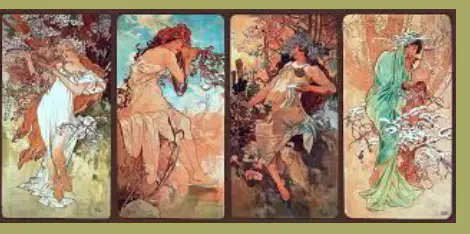
This artwork depicts the 4 different seasons utilizing floral and female patterns, similar to many other art pieces in the Art Nouveau realm. What feeling is it meant to convey?
Sadness and despair
Happiness and excitement for the next season
Anger and frustration
Confusion and mystery
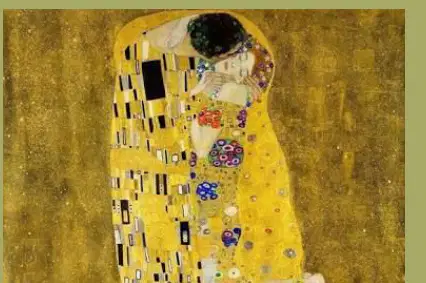
By Gustav Klimt, 'The Kiss': This artwork depicts a loving couple that are embracing each other, likely meant to convey feelings of ______ and love. They are covered in golden robes and have floral patterns, connecting the floral parts of Art Nouveau.
compassion
anger
confusion
fear
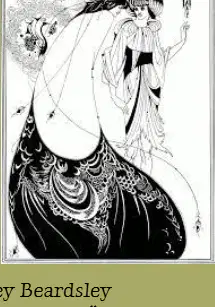
By Aubrey Beardsley, 'The Peacock Skirt': This painting depicts a woman wearing a skirt with peacock print on it, likely meant to convey feelings of beauty and a source of awe. Peacocks are normally seen as beautiful creatures. True or False: The woman in the painting likely feels proud and maybe even arrogant because of her beauty, and is likely happy as well.
True
False
What is Post Impressionism?
A) A style that focuses only on realistic colors
B) An art style used to move past naturalism and impressionism, expressing emotions, symbols, and spiritual ideas
C) A style that only uses black and white colors
D) A style that started in the 1600s
Which of the following artists is NOT mentioned as a notable Post Impressionist in the text?
A) Van Gogh
B) Cezanne
C) Gauguin
D) Picasso
Fill in the blank: Post impressionism was used to move past the natural and the impressionism, making it used as a plate to express _______ and personal experiences, conveying symbols and spiritual idea.
emotions
colors
landscapes
objects
Post impressionism is an art style made and used in the late ______ by a few notable artists including Van Gogh, Cezanne, and Gauguin. Fill in the blank.
1800s
1700s
1900s
1600s
What is Expressionism?
A late 19th and early 20th-century art movement emphasizing subjective experience and emotional expression over objective reality
A scientific theory
A type of music
A form of government
Expressionism emerged in the late 19th century and peaked in the early 20th century, roughly from the 1890s to the end of World War I (1918), though its classical phase is often dated from ______ to 1920.
1905
1910
1880
1925
Expressionism is characterized by:
Intense, subjective use of color and distorted forms
Realistic depiction of the external world
Focus on scientific accuracy
Use of only black and white colors
Expressionism originated in which country?
France
Germany
Italy
Spain
Expressionism conveys the artist’s inner world, moods, and ideas rather than a literal depiction of the external world.
True
False
What is feminist art? Fill in the blank: Feminist art is a broad term encompassing artwork and art movements created in the 1970s and beyond that challenge male dominance in art and society, highlight women's experiences, and advocate for gender equality and societal change.
Feminist art is a broad term encompassing artwork and art movements created in the 1970s and beyond that challenge male dominance in art and society, highlight women's experiences, and advocate for gender equality and societal change.
Feminist art is a style of painting that only uses pink colors and floral patterns to represent femininity.
Feminist art refers to any artwork created by women, regardless of its message or intent.
Feminist art is a movement that focuses solely on abstract art forms and avoids any social commentary.
What is the main purpose of feminist art?
To challenge the dominance of men in both art and society
To gain recognition and equality for women artists
To highlight women's experiences
All of the above
What is Neo-Impressionism?
A long-lasting art movement in the 18th century
A short-lived art movement in the late 19th century
A type of sculpture
A form of digital art
Who were the leaders of the Neo-Impressionism movement?
Claude Monet and Edgar Degas
Georges Seurat and Paul Signac
Pablo Picasso and Henri Matisse
Vincent van Gogh and Paul Cézanne
Neo-Impressionism reacted against Impressionism by applying scientific optical theories of ______ and ______ to painting.
light, color
shape, texture
form, perspective
movement, balance
What painting technique is associated with Neo-Impressionism?
Large brush strokes
Tiny, pure dots of color
Collage
Watercolor washes
The use of tiny, pure dots of color in Neo-Impressionism allows the viewer's eye to optically blend the colors and create vibrant, shimmering effects.
True
False
What does the 'Pictures Generation' refer to?
A) A group of American artists in the late 1970s and 1980s who used images and media from popular culture to create their own art
B) A group of musicians from the 1960s
C) A television show from the 1980s
D) A photography club from the 1950s
Fill in the blank: The 'Pictures Generation' artists critiqued and appropriated images from ________ rather than creating original content.
popular culture
ancient manuscripts
scientific journals
personal diaries
The 'Pictures Generation' movement questioned originality, authorship, and the power of mass media to shape our perception of reality.
True
False
Who curated the influential 1977 exhibition 'Pictures' that helped coin the term 'Pictures Generation'?
Douglas Crimp
Mary Boone
Hal Foster
Cindy Sherman

