
 Worksheets
ExCPT Module 1: Pharmacy Technician Overview: Overview
Total questions: 90
Worksheet time: 45mins
Dispose of medications based on ________ requirements. (Fill in the blank)
product-specific
state
federal
general
Access and use ________ and resources as needed to perform job duties. (Fill in the blank)
references
vehicles
uniforms
decorations
Which of the following tasks can pharmacy technicians perform?
Clinical judgement
Tasks under license, registration, or certification
Prescribing medication
Diagnosing patients
Technician responsibilities do not require ________.
clinical judgement
attention to detail
following protocols
record keeping
Answer the telephone and handle questions that do not require a pharmacist's expertise or judgment. Triage all other phone calls to the ________ to answer. (Fill in the blank)
pharmacist
technician
customer
manager
What should you do with written prescriptions or telephoned refill requests according to pharmacy procedures?
Process them by entering into the database and filling them. Refill requests are submitted to providers’ offices via fax or phone. Authorization for additional refills is added after physician approval.
Ignore them until the end of the day and then process all at once.
Only process written prescriptions and discard telephoned refill requests.
Process them only after receiving a physical copy from the patient.
What type of information must be gathered to complete patient profiles, and why is it important?
Protected health information (PHI) and other necessary information must be gathered to complete patient profiles. It is important to ensure patient confidentiality and for the pharmacist to perform the final product verification.
Only billing information must be gathered to complete patient profiles. It is important solely for insurance purposes.
Only demographic information must be gathered to complete patient profiles. It is important to send promotional materials to patients.
Only medication history must be gathered to complete patient profiles. It is important to track prescription refills.
Why is it important to scan and store written prescription forms in appropriate files?
It is important because hard copies of prescriptions are stored in different files based on controlled substance categories.
It is important because it allows patients to access their prescriptions online instantly.
It is important because it reduces the need for doctors to sign prescriptions.
It is important because it eliminates the need for pharmacists to verify prescriptions.
What is the purpose of entering data into the pharmacy’s computer system?
To ensure prescription labels are accurate by paying attention to detail during data entry.
To increase the speed of internet browsing in the pharmacy.
To allow customers to play games while waiting for prescriptions.
To automatically order lunch for pharmacy staff.
What should you do if you notice any drug utilization review (DUR) warnings or concerns?
Notify the pharmacist of any drug utilization review (DUR) warnings or concerns.
Ignore the warning and continue processing the prescription.
Only notify the patient about the warning.
Wait until the end of your shift to address the warning.
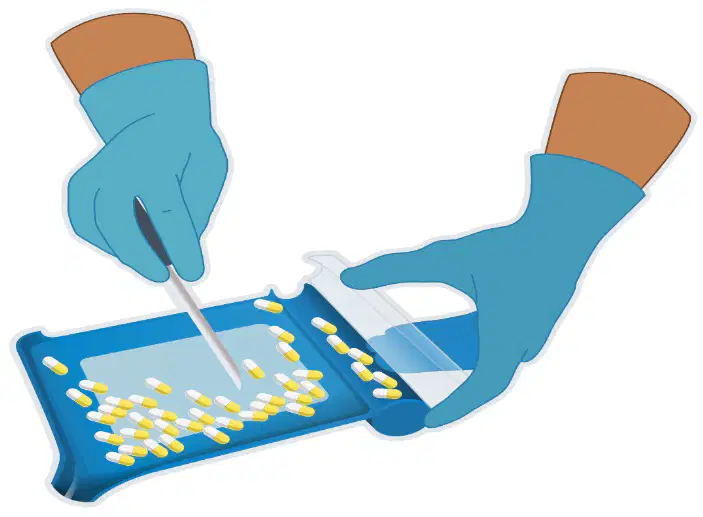
The image below shows a pharmacy technician counting pills. What is the technician likely doing as part of their responsibilities?
Counting and preparing medication for prescriptions as part of processing written prescriptions or refill requests.
Administering vaccines to patients as part of immunization services.
Diagnosing illnesses and prescribing medication to patients.
Performing surgical procedures in a hospital setting.
What are some tasks involved in preparing prescriptions in a pharmacy?
Counting or pouring medications, labeling containers, pricing prescriptions, performing calculations, reconstituting powders, and compounding preparations.
Sweeping the pharmacy floor, organizing magazines, and watering plants.
Scheduling patient appointments, conducting physical therapy, and performing surgeries.
Designing medication advertisements, managing pharmacy social media, and hosting community events.
What should be done at the end of each shift to keep pharmacy department supplies adequately stocked?
Restock supplies and make note of items that need to be reordered.
Leave supplies as they are for the next shift to handle.
Only restock if a supervisor requests it.
Wait until supplies run out before restocking.
How should completed prescriptions be organized in the pick-up area?
Alphabetically by the patient's last name.
By the date the prescription was filled.
By the type of medication.
By the prescribing physician's name.
What should be compared against medications received as soon as they arrive from suppliers?
Invoices.
Patient charts.
Temperature logs.
Prescription pads.
What does the term 'adjudication' refer to in pharmacy operations?
The process of preparing insurance claims for online submission and calling insurance companies as necessary for help.
The process of dispensing medication to patients.
The process of compounding medications in the pharmacy lab.
The process of inventory management and stock ordering.
What does OTC stand for in pharmacy operations?
Over-the-counter.
On-the-call.
Order-to-cash.
Official treatment center.
What must be documented when completing purchase transactions on cash registers in a pharmacy?
Behind-the-counter sales of pseudoephedrine and some Schedule V drugs.
All over-the-counter vitamin purchases.
Every prescription refill regardless of drug class.
The sale of bottled water and snacks.
What is used to clean counting trays in the community pharmacy throughout the day?
70% isopropyl alcohol.
Distilled water.
Hand sanitizer.
Soap and water.
What should be checked when restocking medication dispensing machines and floor stock requests?
Expiration dates and inventory adjustments based on the unit's needs.
The color of the medication packaging only.
The temperature of the storage room only.
The number of staff present during restocking.
Fill in the blank: _______ sterile and nonsterile products, including eye drops, antibiotics, chemotherapy, and total parenteral nutrition.
Compound
Dispense
Prescribe
Administer
Fill in the blank: Remove recalled, discontinued, expired, and overstocked products from inventory. _______ products to prevent accidental dispensing.
Quarantine
Dispense
Label
Distribute
Identify medication prescribing and use patterns requiring pharmacist intervention (abnormally large prescription quantities, multiple early refills on _______ medications).
controlled
over-the-counter
herbal
vitamin
Fill in the blank: Repack bulk medication in _______ dose packaging.
unit
multiple
random
bulk
Fill in the blank: Perform unit inspections of all areas in an institution where medications are stored _______.
monthly
annually
weekly
daily
Fill in the blank: Document hospital patients’ lists of medications prescribed and medications taken through medication _______ process.
reconciliation
distribution
dispensation
authorization
Fill in the blank: Offer vaccines to patients and complete the associated paperwork. Draw up vaccines in appropriate size _______.
syringes
needles
vials
bandages
Fill in the blank: Ensure adherence to policies, procedures, laws, and _______ bodies.
regulatory
musical
athletic
culinary
Fill in the blank: Receive oral prescriptions from prescribers or prescribers’ authorized designees. This refers primarily to new telephone prescriptions and refill authorizations with which there are changes to the prescriptions. _______ prescriptions are given to the pharmacy technician to process.
Transcribed
Written
Faxed
Electronic
Fill in the blank: Pharmacists should consult with prescribers or prescribers’ designees about patient prescriptions and recommend changes to prescriptions based on ____, insurance formularies, and patient request.
DUR
BMI
CBC
ECG
Fill in the blank: Pharmacists must perform and document final product ____ prior to dispensing to patients.
verification
preparation
labeling
transportation
Fill in the blank: Pharmacists should consult with patients about prescribed medication use, ____, and other health issues.
adherence
temperature
insurance number
favorite color
Fill in the blank: Pharmacists perform ____ therapy management (MTM) as necessary.
medication
physical
nutritional
surgical
Pharmacists recommend ____ medications based on patients’ symptoms.
OTC
prescription-only
herbal
experimental
Fill in the blank: Pharmacists oversee all of the functions performed by the pharmacy ____.
technician
manager
assistant
clerk
Only pharmacists are permitted in the pharmacy according to the security precautions.
True
False
Fill in the blank: Pharmacy doors must be ____ at all times. Any time a pharmacist is not on duty, the pharmacy should be closed and locked.
locked
open
painted
decorated
Fill in the blank: Unauthorized people should not have ready access to the pharmacy. Verify the identification badges of law enforcement, state ____ inspectors, and Food and Drug Administration (FDA) personnel before allowing entrance.
board of pharmacy (BOP)
fire department
health insurance
postal service
Fill in the blank: Codes to gain access to the pharmacy should not be shared with ____ personnel. Access codes should be changed regularly and upon termination or resignation of personnel.
unauthorized
authorized
trained
licensed
Controlled substances can be stored either in a ________ or spread among other medications on the shelf in the pharmacy.
locked in a secure cabinet
refrigerator with food items
drawer with over-the-counter drugs
container labeled for vitamins

It is the pharmacy technician's responsibility to check and update each patient's profile.
True
False
What are the two new areas in which pharmacy technicians are playing a critical role?
Medication reconciliation and medication therapy management (MTM)
Inventory management and drug compounding
Patient billing and insurance claims processing
Pharmaceutical sales and marketing
Medication reconciliation and MTM require pharmacy technicians to communicate with patients and caregivers.
True
False
Where do medication reconciliation technicians primarily work?
Hospital emergency departments and surgical centers
Retail pharmacies
Long-term care facilities
Community health clinics
What is documented on a form for providers to review upon admission to the hospital?
A list of the medications the patient is taking
The patient's favorite foods
The patient's family tree
The hospital's visitor policy
Who performs the clinical tasks associated with MTM using information gathered by the pharmacy technician?
The pharmacist
The pharmacy technician
The patient
The pharmacy manager
Which of the following is NOT a responsibility of the pharmacy technician according to the passage?
Verifying and documenting a list of prescription medications
Scheduling and confirming appointments
Prescribing medications
Notifying physicians of the service being provided
MTM can affect pharmacy revenue through star ratings and direct and indirect remuneration (DIR).
True
False
What could result from the loss of a Centers for Medicare & Medicaid Services contract for a pharmacy?
Significant loss of revenue, which could lead to fewer pharmacy technician positions or hours.
Increased government funding for the pharmacy.
Guaranteed job security for all pharmacy staff.
Expansion of pharmacy services to new locations.
Which of the following is a common condition treated with maintenance medications?
Attention-deficit/hyperactivity disorder
Influenza
Common cold
Migraine
Which of the following is a common condition treated with maintenance medications?
Allergies
Fractures
Sprains
Appendicitis
Which of the following is a common condition treated with maintenance medications?
Cancer
Chickenpox
Food poisoning
Asthma attack
Which of the following is a common condition treated with maintenance medications?
Contraceptives
Ear infection
Sore throat
Sinusitis
Which of the following is a common condition treated with maintenance medications?
Diabetes
Broken bone
Stomach flu
Headache
What is one way to assist patients in medication adherence according to the passage?
Enrolling them in automatic refill programs and phone reminders.
Encouraging patients to skip doses occasionally.
Advising patients to stop medication when they feel better.
Suggesting patients take medication only when they remember.
According to the passage, what is the purpose of a phone call reminder for patients who do not refill maintenance medications on time?
To review any problems the patient might be having with the medication.
To schedule a follow-up appointment with the doctor.
To offer discounts on future prescriptions.
To update the patient's contact information.
Fill in the blank: __________ is a mental health medical condition characterized by persistent sadness and loss of interest.
Depression
Table
Window
Mountain
Fill in the blank: __________ is a cardiovascular medical condition characterized by consistently high blood pressure.
Hypertension
Asthma
Anemia
Pneumonia
Fill in the blank: __________ is a urological disorder that causes enlargement of the prostate gland.
Benign prostatic hyperplasia
Osteoporosis
Alzheimer's Disease
Ulcerative Colitis
Fill in the blank: __________ is a medical condition characterized by high levels of lipids (fats) in the blood.
Hyperlipidemia
Photosynthesis
Osmosis
Evaporation
Fill in the blank: __________ is an eye-related medical condition that can damage the optic nerve.
Glaucoma
Appendicitis
Chickenpox
Migraine
Fill in the blank: __________ is a medical condition that occurs when the thyroid gland does not produce enough thyroid hormone.
Hypothyroidism
Hyperlipidemia
Diabetes
Asthma
Fill in the blank: __________ is a medical condition caused by a virus that weakens the immune system.
HIV
Asthma
Migraine
Diabetes
Fill in the blank: __________ is a medical condition that weakens bones, making them fragile and more likely to break.
Osteoporosis
GERD
Diabetes
Asthma
Fill in the blank: __________ are sudden, uncontrolled electrical disturbances in the brain that can cause changes in behavior, movements, or awareness.
Seizures
Hypertension
Migraine
Diabetes
Fill in the blank: __________ is a digestive medical condition that occurs when stomach acid frequently flows back into the esophagus.
Gastroesophageal reflux disease (GERD)
Photosynthesis
Newton's First Law
Pythagorean theorem
Fill in the blank: __________ is a symptom and medical condition that can indicate injury or illness.
Pain
Anemia
Hypothryoidism
Asthma
What is the meaning of the abbreviation 'ad'?
Right ear
Left ear
Before meals
After meals
What is the meaning of the abbreviation 'as'?
Left ear
Right ear
Before sleep
After meals
What is the meaning of the abbreviation 'au'?
Both ears
Left ear
Right ear
Each ear
What is the meaning of the abbreviation 'bu'?
Buccal
Bunion
Bursa
Bulbous
What is the meaning of the abbreviation 'im'?
Intramuscular
Intravenous
Intraocular
Intramedullary
What is the meaning of the abbreviation 'it'?
Intrathecal
Intravenous
Intradermal
Intubation
What is the meaning of the abbreviation 'os'?
Left eye
Right eye
Mouth
Nose
What is the meaning of the abbreviation 'ou'?
Both eyes
One ear
Right eye
Left eye
What is the meaning of the abbreviation 'po'?
By mouth
After meals
Before sleep
By injection
What is the meaning of the abbreviation 'pr'?
Rectal
Pulse rate
Per rectum
Patient record
What is the meaning of the abbreviation 'pv'?
Vaginal
Pulmonary vein
Pressure volume
Peripheral vision
What is the meaning of the abbreviations 'sc, sq, sub q'?
Subcutaneous
Sublingual
Supra-cardiac
Subclavian
What is the meaning of the abbreviation 'od'?
Right eye
Left eye
Once daily
Overdose
What is the meaning of the abbreviation 'sl'?
Sublingual
Subcutaneous
Subliminal
Subluxation
What does the abbreviation 'ac' stand for?
Before meals
After meals
At bedtime
With food
What does the abbreviation 'bid' stand for?
Twice daily
Before meals
Once daily
After meals
What does the abbreviation 'hs' stand for?
At bedtime
After meals
Before noon
With food
What does the abbreviation 'pc' stand for?
After meals
Before meals
With water
At bedtime
What does the abbreviation 'prn' stand for?
As needed
Before meals
After meals
Every hour
What does the abbreviation 'qh' stand for?
Every hour
Every day
Every week
Every month
What does the abbreviation 'qid' stand for?
Four times daily
Every other day
Once daily
Every week
What does the abbreviation 'tid' stand for?
Three times daily
Once daily
Twice weekly
Every hour
What does the abbreviation 'wa' stand for?
While awake
With assistance
Wide area
Work assignment

