wayground logo

Free Printable Worksheets

Font size

S
M
L
XL
Worksheets

Hillaree Bio Quiz Review #1

Total questions: 84

Worksheet time: 1hrs 7mins

Name
Class
Date
1.
How are covalent bonds formed?
a)
Sharing of electrons
b)
Transfer of electrons
2.
What two types of atoms make a covalent bond?
a)
2 Nonmetals
b)
1 Nonmetal and 1 Metal
c)
2 Metals
d)
2 Noble Gases
3.

Which bond involves an unequal sharing of electrons?

a)

Ionic bond

b)

Nonpolar covalent bond

c)

Polar covalent bond

d)

Metallic bond

4.

If sodium and oxygen formed a bond, it would be classified as --

a)

polar covalent

b)

nonpolar covalent

c)

ionic

d)

metallic

5.

Which electrons are involved in a chemical bond?

a)

Valence electrons

b)

Inner shell electrons

c)

Electrons are not involved in bonding

6.

__________ bonds involve an unequal sharing of electrons, while __________ bonds involve an equal sharing of electrons.

a)

Nonpolar, polar

b)

Polar, metallic

c)

Metallic, nonpolar

d)

Polar, nonpolar

7.

The difference in electronegativity affects the type of bond will be formed. What type of bond would be formed with a difference of 0.8?

a)

Nonpolar Covalent

b)

Polar Covalent

c)

Ionic

8.

True or False: The smaller the difference in electronegativity, the more polar the bond

a)

True

b)

False

9.

If carbon forms a covalent bond with chlorine, which end of the bond will be partially negative?

a)

the carbon end

b)

the chlorine end

10.
In this Lewis structure, the symbol above F means...
a)
electrons are being transferred to Fluorine
b)
electrons are less attracted to F than H
c)
electrons are more attracted to F than H
d)
Fluorine has formed a cation
11.
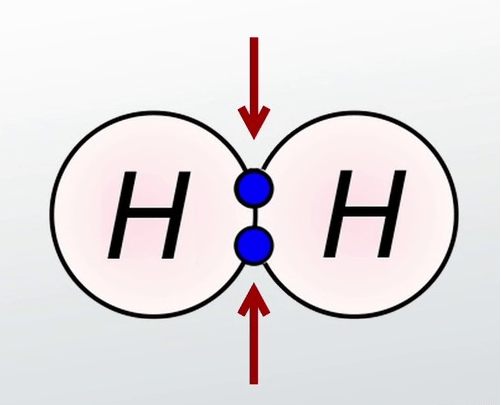
What type of bond is shown in this image?
a)
Ionic
b)
Polar Covalent
c)
Nonpolar Covalent
d)
Van der Waals Force
12.
Why are macromolecules also known as "polymers?"
a)
They are large molecules made up of many monomers. 
b)
They are large molecules added together. 
c)
There are many types of macromolecules. 
d)
Many organisms have macromolecules.
13.
Which of the following is NOT a biological macromolecule?
a)
Water
b)
Lipid
c)
Carbohydrate
d)
Nucleic Acid
14.
All biological macromolecules are organic, meaning they have ________ and hydrogen bonds.
a)
Carbon
b)
Hydrogen
c)
Nitrogen
d)
Oxygen
15.
True or False: The building blocks of macromolecules are also known as "monomers".
a)
True
b)
False
16.
What are the monomers (building blocks) of CARBOHYDRATES?
a)

Monosaccharides/Glucose (simple sugars)

b)
Amino Acids
c)
Nucleotides
d)
Triglycerides/No true monomer
17.
What are the monomers (building blocks) of PROTEINS?
a)
Monosaccharides (simple sugars)
b)
Amino Acids
c)
Nucleotides
d)
Triglycerides/No true monomer
18.
What are the monomers (building blocks) of NUCLEIC ACIDS?
a)
Monosaccharides (simple sugars)
b)
Amino Acids
c)
Nucleotides
d)
Triglycerides/No true monomer
19.
What are the monomers (building blocks) of LIPIDS?
a)
Monosaccharides (simple sugars)
b)
Amino Acids
c)
Nucleotides
d)

Triglycerides(made of 3 fatty acids)/No true monomer

20.
What is the primary function of CARBOHYDRATES?
a)
Source of energy
b)
Long term storage of energy
c)
Transmitting genetic information
d)
Cell processes and cell signaling
21.
What is the primary function of PROTEINS?
a)
Source of energy
b)
Long term storage of energy
c)
Transmitting genetic information
d)
Cell processes and cell signaling
22.
Which major macromolecule is being represented in this image? 
a)
carbohydrate
b)
lipid
c)
protein
d)
nucleic acid
23.
What type of macromolecule is being represented in this image? 
a)
carbohydrate
b)
lipid
c)
protein
d)
nucleic acid
24.
Waxes, oils and fats are examples of
a)
Carbohydrates
b)
Lipids
c)
Proteins
d)
Nucleic Acids
25.

Which macromolecule is shown?

a)

lipid

b)

protein

c)

nucleic acid

d)

carbohydrate

26.
What word describes when water is attracted to other substances?
a)
cohesion
b)
adhesion
c)
capillary action
d)
surface tension
27.
Attractions between the negative Oxygen atom of one water molecule and the positive Hydrogen atom of another water molecule are called
a)
Covalent bonds
b)
Ionic bonds
c)
Polar bonds
d)
Hydrogen bonds
28.
Why does ice float?
a)
As water freezes, it expands and its density decreases.
b)
As water freezes, it takes up more hydrogen from the atmosphere, causing it to have a greater buoyancy.
c)
As water freezes, air becomes trapped between the hydrogen bonds of water molecules.
d)
As water freezes, it takes up more oxygen from the atmosphere, causing it to have a greater buoyancy.
29.
Large bodies of water, such as lakes and oceans, do not quickly fluctuate in temperature. What is the reason for this phenomenon?
a)
Water is an acid.
b)
Water is a versatile solvent.
c)
Water has a high heat capacity.
d)
 Water acts as a buffer.
30.

Diffusion is a form of __________ transport.

a)

Passive

b)

Active

c)

Easy

d)

Free

31.

Passive Transport uses ____ energy

a)

no

b)

a lot of

c)

a little bit of

d)

some

32.

_____________ is the free movement of particles across the membrane with the concentration gradient

a)

diffusion

b)

facilitated diffusion

c)

active transport

d)

fusion

33.

What is the movement of particles with the concentration gradient using protein "helpers"?

a)

diffusion

b)

facilitated diffusion

c)

active transport

d)

enzymatic reactions

34.

The general name for movement of substances across cell membranes without need of energy input

a)

passive transport

b)

active transport

35.
Osmosis is the movement of _____ across a membrane.
a)
food
b)
energy
c)
oxygen
d)
water
36.

Some cells move large particles out of the cell through the process of:

a)

Protein Synthesis

b)

Endocytosis

c)

Exocytosis

d)

Cytoplasmic Streaming

37.
In this image, the cell is using which type of molecular transport?
a)
Osmosis
b)
Diffusion 
c)
Endocytosis
d)
Exocytosis 
38.

Human red blood cells contain 0.9% sodium chloride as a component of their cytoplasm. What would happen if an IV solution containing 3.5% sodium chloride is introduced into a person? 

a)

The red blood cell would get bigger and burst.

b)

The red blood cell would stay the same size.

c)

The red blood cell would shrink.

d)

The red blood cell would first loose water and then absorb water.

39.

If the body can no longer make ATP, which type of transport would be impacted?

a)

Facilitated Diffusion

b)

Osmosis

c)

Active Transport

d)

Simple Diffusion

40.
The function of the plasma membrane is....
a)
to regulate what enters and leaves the cell.
b)
fight bacteria and viruses that enter the cell.
c)
provide rigid support and protection to the cell.
d)
make sure each cell can move
41.
Hydrophilic means...
a)
water-loving
b)
water-fearing
c)
nonpolar
d)
lipid soluble
42.
Most of the cell membrane is made of...
a)
Lipids
b)
Carbohydrates
c)
Proteins
d)
Nucleic acids
43.
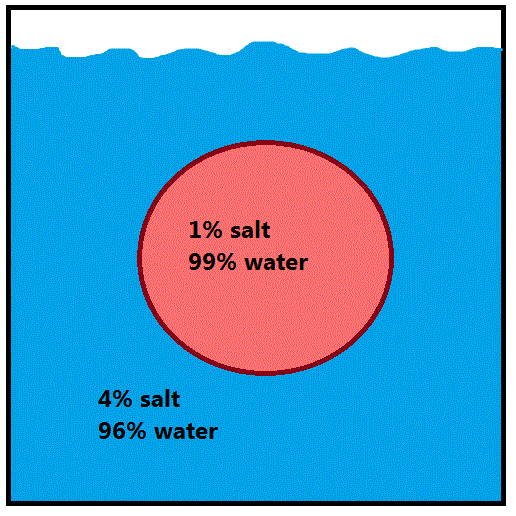
Where will the water go?
a)
Into the cell
b)
Out of the cell
c)
Equally in & out - it's isotonic
d)
There is no water
44.
A blood cell is placed into the jar, as seen. Where will the water go?
a)
Into the cell
b)
Out of the cell
c)
Equally in & out - it's isotonic
d)
The water is a lie
45.
 If a cell containing 5% salt is placed into a glass of water with 20% salt, the water is _______ compared to the cell.
a)
hypertonic
b)
hypotonic
c)
isotonic
46.
 An animal cell placed in a hypertonic (salty) solution will
a)
Stay the same
b)
Shrink- get smaller
c)
Swell- get bigger
47.
HYPO means...
a)
Low
b)
High
c)
Equal
d)
Fat
48.
ISO means...
a)
Low
b)
A lot
c)
Equal
d)
Mammal
49.
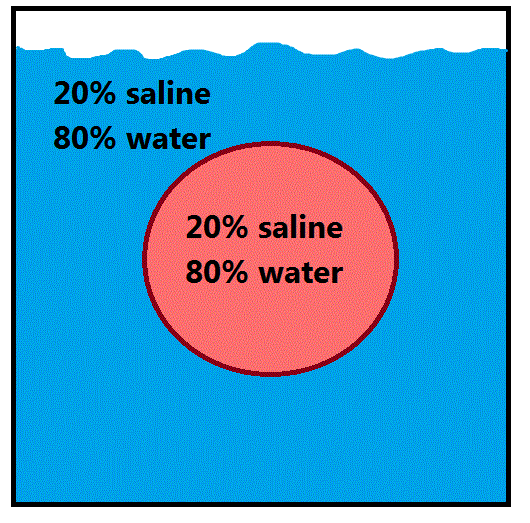
The cell below is in a _________ solution.
a)
Hypotonic
b)
Hypertonic
c)
Isotonic
50.
The cell below is in a _____________ solution.
a)
Hypertonic
b)
Hypotonic
c)
Isotonic
51.

The head of phospholipids are

a)

hypotonic

b)

hydrophbic

c)

hypertonic

d)

hydrophilic

52.
Which is true of prokaryotic and eukaryotic cells?
a)
Prokaryotic cells are larger than eukaryotic cells.
b)
Eukaryotic cells do not have nuclei, and prokaryotic cells do have nuclei.
c)
Prokaryotic cells lack membrane-bound organelles, and eukaryotic cells contain membrane-bound organelles.
d)
Eukaryotic cells are simpler than prokaryotic cells.
53.

Which do BOTH prokaryotes and eukaryotes contain?

a)

nucleus

b)

mitochondria

c)

ribosomes

d)

cell wall

54.

Which does only eukaryotic cells contain?

a)

nucleus

b)

DNA

c)

cell membrane

d)

ribosomes

55.

Prokaryotic cells do not have…….

a)

membrane bound organelles

b)

cell membrane

c)

DNA or RNA

d)

life

56.

You can distinguish a prokaryote apart from a nucleus by--

a)

The presence of a ribosome

b)

The presence of a cell membrane

c)

The presence of DNA

d)

The presence of a nuclear membrane

57.
Which of the following is not a characteristic of a Prokaryotic cell?
a)
unicellular
b)
floating DNA
c)
very small
d)
complex
58.
A fossilized cell is discovered, and evidence suggests it reproduced on its own and had DNA, but a membrane did not enclose its DNA. Which type of organism would this most likely be?
a)
prokaryote
b)
eukaryote
c)
plant cell
d)
animal cell
59.

Which of the following structures is ALWAYS found in both eukaryotic and prokaryotic cells?

a)

nucleus

b)

mitochondria

c)

ribosomes

d)

cell wall

60.

Bacteria is an example of a(n)

a)

prokaryotic cell.

b)

eukaryotic cell.

61.

Thick peptidoglycan in cell wall

a)

Gram positive bacteria

b)

Gram negative bacteria

62.

Thin peptidoglycan in cell wall

a)

Gram positive bacteria

b)

Gram negative bacteria

63.

Has an outer membrane (2nd cell membrane)

a)

Gram positive bacteria

b)

Gram negative bacteria

64.

Stained pink

a)

Gram positive bacteria

b)

Gram negative bacteria

65.

Stains purple

a)

Gram positive bacteria

b)

Gram negative bacteria

66.

Which statement best distinguishes plant cells and animal cells?

a)

There are more ribosomes in animal cells than in plant cells.

b)

Plant cells have more lysosomes than animal cells have.

c)

Plant cells have large vacuoles, and animal cells do not.

d)

The position of the nucleus in the cells is different in plants and animals.

67.

Which organelle should be listed under “Animal Only” in a Venn diagram?

a)

Nucleus

b)

Centriole

c)

Ribosome

d)

Cell wall

68.

Which organelle is used as temporary storage for water, waste products, food, and other cellular material in plants?

a)

Mitochondrion

b)

Lysosome

c)

Centriole

d)

Vacuole

69.

Which term describes an extensive network of tubes, sacs, and vesicles throughout a cell that has as its main function to provides transport to the Golgi Apparatus or to the outside of the cell?

a)

Cell Membrane

b)

Endoplasmic Reticulum

c)

Centriole

d)

Cell Wall

70.

Which organelle captures the energy from sunlight and converts it to chemical energy, and in which cells could it be found?

a)

The Golgi apparatus, which can be found in lung cells of animals

b)

Lysosomes, which can be found in all cells of grasses

c)

Ribosomes, which can be found in muscle cells of humans

d)

Chloroplasts, which can be found in leaf cells of trees

71.

Which organelle is responsible for producing the energy for cellular processes?

a)

D, the lysosome

b)

A, the cell membrane

c)

E, the mitochondria

d)

F, DNA

72.

Which is a structure that directs the cell's activities?

a)

Nucleus

b)

Golgi Apparatus

c)

Ribosomes

d)

Mitochondrion

73.

A student is examining leaf cells. Which organelles are most likely to be missing from the cells?

a)

Ribosomes

b)

Chloroplasts

c)

Lysosomes

d)

Mitochondria

74.

Which is a tough and rigid layer that surrounds plant cells, as well as some algal and bacterial cells?

a)

Cell Wall

b)

Centriole

c)

Nucleus

d)

Cell Membrane

75.

What does it mean for a membrane to be selectively permeable?

a)

Only certain molecules are allowed to pass through.

b)

The membrane is rigid and only allows water to pass through.

c)

All types of molecules are able to pass into the cell.

d)

The membrane is rigid and nothing can enter or leave the cell.
76.
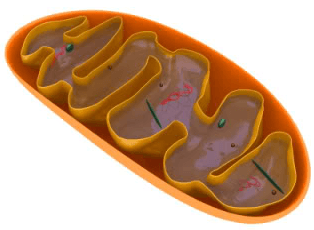
What are tiny organelles that convert glucose into ATP?
a)
Ribosomes
b)
Vesicles
c)
Cytoskeleton
d)
Mitochondria
77.
A rigid layer that lies outside the cell's  membrane is...
a)
Cytoskeleton
b)
Cilia
c)
Cell Wall
d)
Flagella
78.

Both a plant and animal cells have a cell wall

a)

True

b)

False

79.
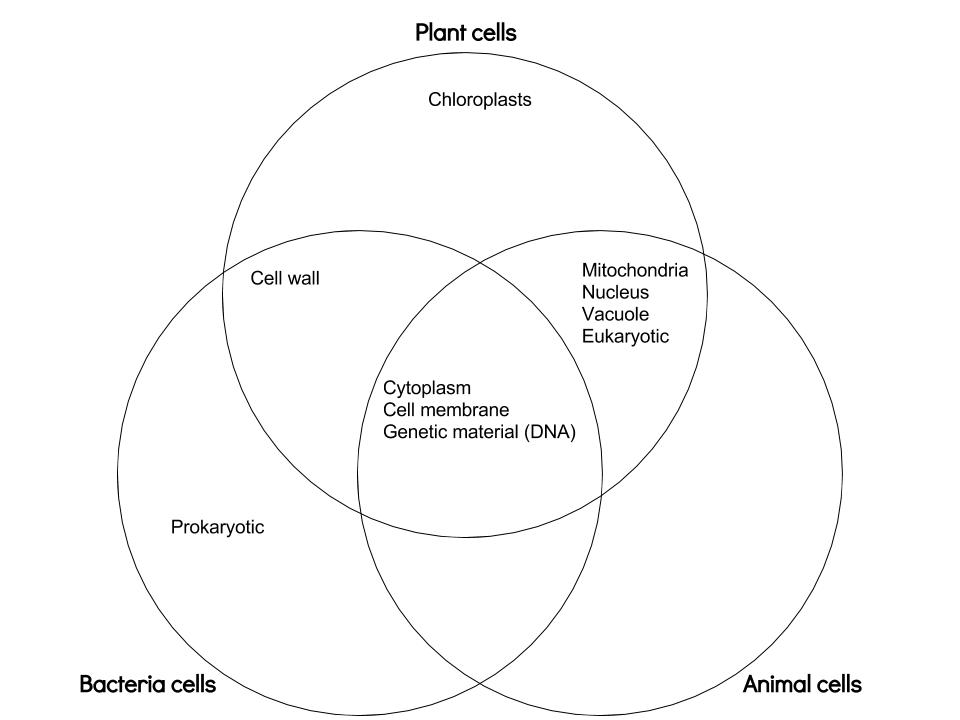
Observe the Venn diagram. Which structures do both prokaryotic and eukaryotic cells have in common?
a)
cell membrane, cytoplasm, genetic material (DNA)
b)
cell wall
c)
mitochondria, nucleus, vacuole
d)
chloroplasts
80.
it uses sunlight to create food, photosynthesis (only found in plant cells),
a)
smooth ER
b)
golgi body
c)
cell wall
d)
chloroplasts
81.
It is the processing, packages and secretes proteins; proteins are transported in vesicles  .
a)
Ribosomes
b)
Lysosomes
c)
Golgi apparatus
d)
Mitochondria
82.
It is the  jelly-like fluid interior of the cell
a)
cytoplasm
b)
nucleus
c)
endoplasmic reticulum
d)
golgi bodies
83.
Letter D represents which cell organelle?
a)
smooth ER
b)
rough ER
c)
golgi body
d)
vacuole
84.
Letter E represents which cell organelle?
a)
smooth ER
b)
rough ER
c)
golgi body
d)
vacuole