
 Worksheets
Year 9 - Baseline Assessment
Total questions: 73
Worksheet time: 39mins
Name
Class
Date
1.
Name (as it appears in SIMs)
4 lines
2.
Surname (as it appears in SIMs)
4 lines
3.
Please type your form: 9Y, 9G, 9B, 9S, 9R, 9P, 9O
4 lines
4.

1. Is this device an input or an output
a)
Input
b)
Output
5.

2. Is this device an input or an output
a)
Input
b)
Output
6.

3. Is this device an input or an output
a)
Input
b)
Output
7.

4. Is this device an input or an output
a)
Input
b)
Output
8.
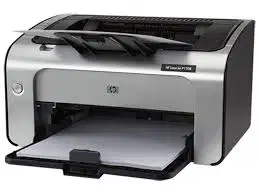
5. Is this device an input or an output
a)
Input
b)
Output
9.

6. Is this device an input or an output
a)
Input
b)
Output
10.

7. Is this device an input or an output
a)
Input
b)
Output
11.

8. Is this device an input or an output
a)
Input
b)
Output
12.

9. Is this device an input or an output
a)
Input
b)
Output
13.

10. What is this?
a)
Power supply
b)
Motherboard
c)
CPU
d)
RAM
14.

11. What is this?
a)
Power supply
b)
Motherboard
c)
CPU
d)
RAM
15.
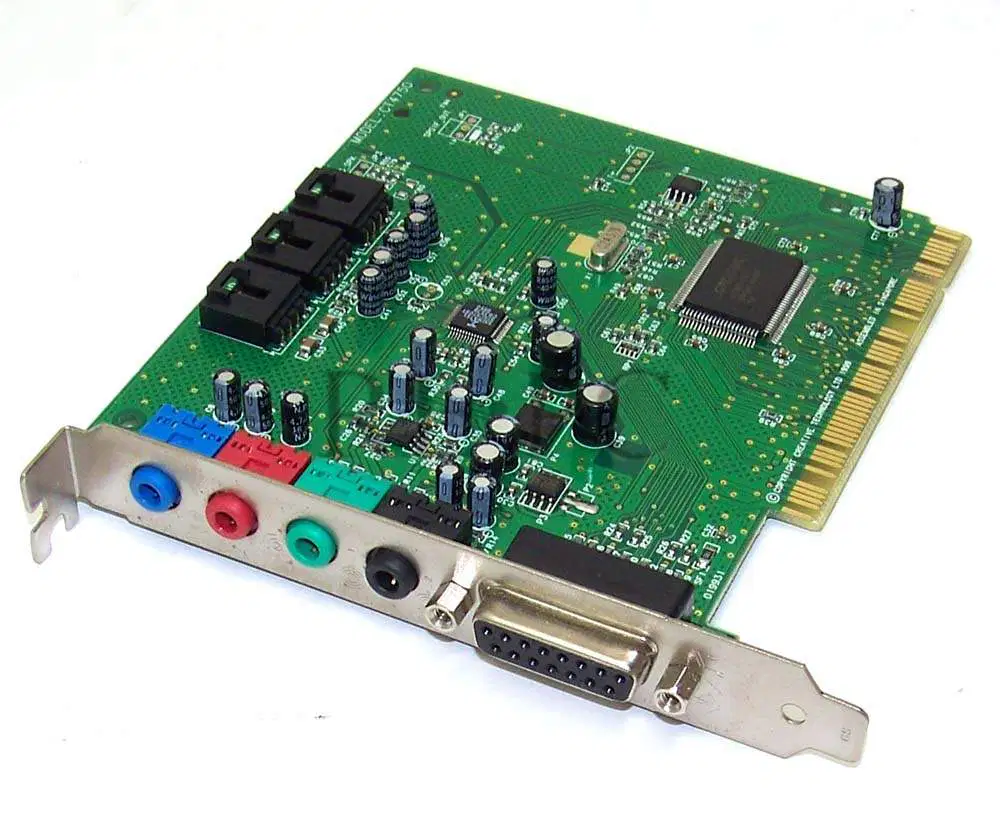
12. What is this?
a)
Power supply
b)
CPU
c)
RAM
d)
Sound Card
16.

13. What is this?
a)
Power supply
b)
CPU
c)
RAM
d)
Sound Card
17.

14. What is this?
a)
Video Card
b)
CPU
c)
RAM
d)
Sound Card
18.

15. What is this?
a)
Video Card
b)
CPU
c)
RAM
d)
Hard disk
19.
16. True or False: An input device sends information "into" the computer.
a)
True
b)
False
20.
17. A storage device is used for _____________.
a)
storing information
b)
making sound
c)
typing words
21.
18. Which of these is known as the brain of a computer?
a)
Mouse
b)
Motherboard
c)
CPU
d)
Printer
22.
19. What is an input device?
a)
Any piece of computer hardware that is used to communicate the results of data that has been processed by a computer system
b)
Any piece of computer hardware used to enter data into a computer system
c)
A piece of computer equipment on which data can be stored
23.
20. What is an output device?
a)
Any piece of computer hardware that is used to communicate the results of data that has been processed by a computer system
b)
Any piece of computer hardware used to provide data to a computer system
c)
A piece of computer equipment on which data can be stored
24.
21. What is a storage device?
a)
A piece of computer equipment on which data can be stored
b)
Any piece of computer hardware that is used to communicate the results of data that has been processed by a computer system
c)
Any piece of computer hardware used to provide data to a computer system
25.
1. What programming language did you learn?
a)
Python
b)
Java
c)
C++
d)
Visual Basic
26.
2. Which of the following is an integer?
a)
7.6
b)
7
c)
"Hello World"
d)
print
27.
3. Which of the following is a string in python?
a)
7.6
b)
7
c)
"Hello World"
d)
print
28.
4. Which of the following would store a name entered by a user in python?
a)
input("What is your name?")
b)
name <= input("What is your name?")
c)
name = input("What is your name?")
d)
input = "What is your name?"
29.
5. What code would display the message "Hello world" on the screen?
a)
print("Hello world")
b)
Print("Hello world")
c)
print = ("Hello world")
d)
print "Hello world"
30.
6. In python, what key word makes the same steps repeat over and over again?
a)
selection
b)
iteration
c)
sequence
31.
7. Data stored in a computer program that changes; is stored in a....
a)
variable
b)
string
c)
print
32.
8. What is wrong with this code? Print ("Hello World")
a)
Too long
b)
capital p
c)
needs a sem icolon
33.
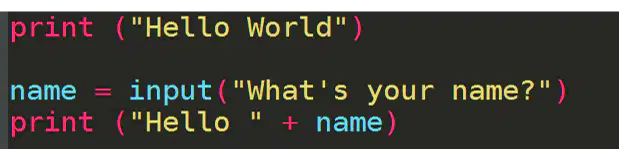
9. What does this code do?
a)
It says "Hello World", asks you what your name is and then it say hello and your name.
b)
It says "Hello World", and it prints your name.
c)
It says "Hellow World" and then it says hello
34.

10. What does the 3rd line of this code display?
a)
Ron
b)
Hermione
c)
Harry
35.

11. What index number would the 4th line of the code display?
a)
2
b)
1
c)
3
36.
1. What application do you use to create spreadsheets?
a)
Excel
b)
Powerpoint
c)
Word
d)
Access
37.
2. What do we start formula with?
a)
=
b)
+
c)
*
d)
/
38.
3. Which of these is the correct formula to add two numbers?
a)
A1 + A2 =
b)
= A1 + A2
c)
A1:A2
d)
=A1:A2
39.
4. Which of these is the correct formula to multiply two numbers?
a)
= A1 x A2
b)
A1 x A2
c)
= A1 * A2
d)
A1 * A2
40.
5. Which of the following can you create on excel?
a)
Charts
b)
Tables
c)
Calculations
d)
All of the above
41.
6. What function would you use to add numbers in a range of cells?
a)
=SUM(range)
b)
Range=SUM
c)
SUM(range)=
d)
=SUM(range)=
42.
7. What is D4?
a)
Letter
b)
Room number
c)
Number
d)
Cell reference
43.
8. What function should you use when adding up a lot of numbers?
a)
MIN
b)
SUM
c)
AVERAGE
d)
MAX
44.
9. What function should you use to find the largest number?
a)
MAX
b)
SUM
c)
AVERAGE
d)
MIN
45.
10. Money in cells should be formatted as what?
a)
Currency
b)
Date/time
c)
Text
d)
Number
46.
11. What is the symbol used when writing a formula to multiply?
a)
*
b)
x
c)
.
d)
/
47.
12. What is a spreadsheet used for?
a)
Delete all the data in rows and columns
b)
Organizing, calculating, and analysing data in rows and columns
c)
Not to organizing, calculating, and analysing data in rows and columns
48.
1. What does AI stand for?
a)
Artificial Intelligence.
b)
Artificial Intel.
c)
Artificial Internet.
49.
2. Give one example of AI in everyday life.
a)
Virtual assistants like Siri or Alexa.
b)
Sir
c)
Alexandra
50.
3. What is machine learning?
a)
A type of AI where systems don't learn from data.
b)
A type of AI where systems learn from data and improve without explicit programming.
c)
A type of AI where systems are corrupted.
51.
4. What is a chatbot?
a)
An AI program that repeats once.
b)
An AI program that doesn't simulates conversation with users.
c)
An AI program that simulates conversation with users.
52.
5. How does AI impact transportation?
a)
Not used in self-driving cars and traffic prediction systems.
b)
Used in self-driving cars and traffic prediction systems.
c)
Increase in travel fare.
53.
6. How is AI used in fraud detection?
a)
By analysing transaction patterns and alerting unusual activity.
b)
Not analysing transaction patterns and not alerting unusual activity.
c)
Ai is not good with fruad.
54.
7. What is bias in AI systems?
a)
When AI makes fair decisions.
b)
When AI makes unfair decisions due to biased training data.
55.
8. Why is data important for AI systems?
a)
AI doesn't learn from data, so high-quality data is wasted time.
b)
AI learns from data, so high-quality data ensures accurate performance.
56.
9. What ethical issue arises with facial recognition AI?
a)
No potential misuse for surveillance.
b)
No privacy concerns.
c)
Privacy concerns and potential misuse for surveillance.
57.
1. What does AR stand for?
a)
Augmented Reactivity.
b)
Augmented Reality.
c)
Augmented Relation.
58.
2. What device is commonly used to experience AR?
a)
Smartphones or AR glasses.
b)
Smart glass.
c)
AR book.
59.
3. What is one use of AR in retail?
a)
Virtual try-on of clothes or furniture.
b)
No virtual try-on of clothes or furniture.
60.
4. Name one popular AR app.
a)
Snapchat filters.
b)
Youtube.
c)
Google.
61.
5. How does AR improve training in industries?
a)
Not simulating real-world scenarios.
b)
By simulating real-world scenarios without risks.
62.
1. What is computational thinking?
a)
A problem-solving approach using computer science concepts.
b)
Not a problem-solving approach.
63.
2. Name the four main techniques of computational thinking.
a)
Decomposition, Pattern Recognition, Abstraction, Algorithms.
b)
Decorate, Pat Realisation, Abie, Algorithms.
c)
Descend, Pattern Recognition, Addition, Algae.
64.
3. What is decomposition?
a)
Breaking a problem into smaller parts.
b)
Not breaking a problem into smaller parts.
c)
Breaking a dance.
65.
4. What is pattern recognition?
a)
Identifying similarities or trends in problems.
b)
Not identifying similarities or trends in problems.
c)
Identification simulation.
66.
5. What is abstraction?
a)
Retyping information.
b)
Focusing on important details and ignoring unnecessary information.
c)
Focusing not on important details and ignoring unnecessary information.
67.
6. What is an algorithm?
a)
Not a step-by-step set of instructions to solve a problem.
b)
A step-by-step set of instructions to solve a problem.
68.
7. Give one example of decomposition in real life.
a)
Breaking down the task of cooking dinner into smaller steps.
b)
Breaking down the task of cooking a cake into smaller steps.
c)
Breaking down the task of making a LEGO car set into smaller steps.
d)
All of the above.
69.
8. Why is computational thinking important?
a)
It doesn't help in solving complex problems systematically.
b)
It helps in solving complex problems systematically.
70.
9. Explain how abstraction is used in map design.
a)
Not key details like roads and landmarks are shown, unnecessary details are removed.
b)
Only key details like ice-cream van are shown.
c)
Only key details like roads and landmarks are shown, unnecessary details are removed.
71.
10. Give an example of an algorithm in everyday life.
a)
A recipe for baking a cake.
b)
A recipe for making a pizza.
c)
A recipe for baking biscuits.
d)
All of the above.
72.
11. What is the difference between iteration and selection in algorithms?
a)
Iteration repeats steps (loops), selection makes decisions (if/else).
b)
Iteration not repeats steps (no loops), selection makes no decisions (if/else).
73.
12. What is flowcharting?
a)
A visual way of representing algorithms with symbols and arrows.
b)
Not a visual way of representing algorithms with symbols and arrows.
100 %

