
 Worksheets
Conservation of Mass & Chemical Reactions.
Total questions: 29
Worksheet time: 19mins
In a chemical equation, the total number of atoms on the reactants' side is [BLANK] the total number of atoms on the products' side.
Less Than
Equal To
Unrelated to
Greater Than
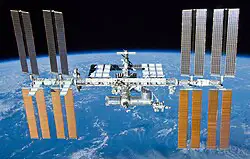
Think about astronauts aboard the International Space Station (ISS). They can’t just haul up endless supplies of water and oxygen, so they rely on recycling. When astronauts breathe out carbon dioxide, machines split it into oxygen (which they can breathe again) and hydrogen.
The hydrogen can then react with leftover carbon dioxide to make water. That same water gets filtered and purified, even from sweat and urine, and reused for drinking. Nothing is wasted because the system is designed around the conservation of mass: the atoms of hydrogen, oxygen, and carbon don’t disappear in space—they cycle through different molecules.
This passage demonstrates the Law of [BLANK] of Mass.
(a)
The equation that represents Hydrogen reacting with Carbon Dioxide to form water is as follows:
CO2 + 4H2 ⟶ CH4 + 2H2O
How many hydrogen atoms are in the products' side?
2
6
4
8
Balanced equations show that atoms are always [BLANK.]
Created
Duplicated
Rearranged
Destroyed
In Photosynthesis:
(6CO2 + 6H2O ⟶ C6H12O6 + 6O2)
How many Oxygen atoms are on the products' side?
18
6
12
8
TRUE OR FALSE:
Chemical reactions can change the type of atoms/elements that are present in a substance.
True
False
Carbonic acid (H2CO3) forms when Carbon Dioxide dissolves in water, usually found in soda.
How many total atoms are there in Carbonic acid?
2
3
5
6
Absorbic Acid, or Vitamin C, is an essential nutrient and antioxidant found in many fruits and vegetables:
C6H8O6
How many Carbon atoms are there?
1
6
8
3
The symbol Na represents:
(a)
In Al2O3, how many total atoms are present?
3
2
5
6
A group of elements located on the right side of the periodic table, characterized by being nonconducting and sometimes brittle.
(a)
The element Boron (B) is classified as a:
Noble Gas
Metal
Nonmetal
Metalloid
Melting ice is an example of a:
Physical Change
Chemical Change
Baking a cake is an example of a:
Physical Change
Chemical Change
Breaking glass into small pieces is a:
Physical Change
Chemical Change
Cooking an egg denatures the protein, turning it white in the process.
This is an example of a:
Chemical Change
Physical Change
Which of these is a Metal?
Sulfur
Oxygen
Neon
Aluminum
Which of these is a Nonmetal?
Magnesium
Calcium
Chlorine
Sodium
Metalloids often have properties of:
Nonmetals
Both
Neither
Metals
Rare Earth elements are important in:
Electronics
Cooking
Farming
Jewelry
Which of the following is a rare Earth element?
Hydrogen
Helium
Neodymium
Oxygen
An object with a density less than water (1.0g/mL) will:
Float
Evaporate
Sink
Dissolve
If a liquid has a density of 1.3g/mL, it will:
Float on water
Sink in water
Which is more dense?
A 15g object with a volume of 5mL
A 20g object with a volume of 5mL
True or False:
Density represents volume divided by mass.
True
False
True or False:
All color changes mean a chemical reaction has occurred.
True
If a chemical reaction feels warmer, then the reaction is:
Exothermic
Both
Endothermic
Neither
A white solid forms when two clear solutions are mixed. This is evidence of:
Precipitation
Evaporation
Condensation
Freezing
Which of the following is NEVER evidence of a chemical change?
Change in Color
Production of Gas
Melting
Formation of Precipitate
Of the following, which is evidence of a chemical change:
Changes Shape
Produces Light
Breaks Apart
Changes States

