
Font size
 Worksheets
Progressive Tax in Australia
Total questions: 87
Worksheet time: 44mins
What is a progressive tax, and give an example of where it is used in Australia?
A progressive tax means higher-income earners pay a higher proportion of their income in tax than lower-income earners; Australia’s income tax system is an example of a progressive tax.
A progressive tax means everyone pays the same amount of tax regardless of income; Australia’s GST is an example of a progressive tax.
A progressive tax means lower-income earners pay a higher proportion of their income in tax than higher-income earners; Australia’s company tax is an example of a progressive tax.
A progressive tax means only businesses are taxed, not individuals; Australia’s payroll tax is an example of a progressive tax.
Which of the following best describes the meanings of economic growth, full employment, inflation/price stability, and external stability in economic terminology?
Economic growth is the increase in output, full employment is when all resources are used, inflation/price stability is stable prices, and external stability is a balanced relationship with other economies.
Economic growth is a decrease in output, full employment is high unemployment, inflation/price stability is rapidly rising prices, and external stability is a trade deficit.
Economic growth is the reduction of government spending, full employment is when only some people have jobs, inflation/price stability is unpredictable prices, and external stability is ignoring international trade.
Economic growth is the increase in imports, full employment is when there is no labor force, inflation/price stability is falling prices, and external stability is a surplus in all accounts.
Australia's current targets for GDP growth, unemployment rate, inflation, and trade balance are:
GDP growth 2-3%, unemployment 4-5%, inflation 2-3%, balanced trade.
GDP growth 5-6%, unemployment 2-3%, inflation 4-5%, large trade deficit.
GDP growth 1-2%, unemployment 6-7%, inflation 0-1%, large trade surplus.
GDP growth 3-4%, unemployment 7-8%, inflation 5-6%, trade deficit.
Aggregate demand is calculated as the sum of consumption, investment, government spending, and net exports. Which of the following best describes the factors influencing economic growth and unemployment?
Technological progress, capital accumulation, and labor force growth influence economic growth and unemployment.
Only government spending affects economic growth and unemployment.
Aggregate demand does not impact economic growth or unemployment.
Unemployment is only influenced by changes in net exports.
This question asks you to connect new vocabulary to what you already know about a topic. What should you do?
Relate new vocabulary to your existing knowledge.
Ignore the new vocabulary.
Only memorize the new vocabulary without context.
Focus only on what you already know and not the new words.
Which of the following is an example of encountering specific terms in real-life situations?
Hearing technical jargon at a workplace meeting
Watching a movie for entertainment
Going for a walk in the park
Eating at a restaurant
These terms might be used differently in various contexts such as business, science, and everyday life. Which of the following best explains this difference?
The meaning of terms can change depending on the context in which they are used.
Terms always have the same meaning regardless of context.
Terms are only used in scientific contexts.
Terms are never used in everyday life.
Fill in the blank: One of the main economic objectives is _________.
Economic Growth
Personal Happiness
Physical Strength
Artistic Talent
Fill in the blank: Achieving _________ is considered an important economic objective.
Full Employment
Inflation
Trade Deficit
Stagflation
Fill in the blank: Maintaining _________ is a key economic objective.
Inflation/Price Stability
Unemployment Growth
Trade Deficit
Currency Devaluation
Fill in the blank: Ensuring _________ is one of the economic objectives.
External Stability
Internal Instability
Fiscal Deficit
Technological Monopoly
What is economic growth?
The decrease in a country's GDP
The increase in a country's real growth domestic product (GDP)
The total value of imports
The reduction of inflation
Economic growth reflects genuine increases in ______ from one year to the next, rather than changes in prices.
production volume
interest rates
tax levels
government spending
By focusing on real GDP, economic growth reflects genuine increases in production volume from one year to the next, rather than changes in prices.
True
False
When more goods and services are produced, what is a likely outcome?
Lower standard of living
Higher standard of living
Decreased availability of products
Fewer resources and opportunities
Economies generally experience growth each year.
True
False
What is the target growth rate for the Gross Domestic Product (GDP) in Australia?
1-2%
3-4%
5-6%
7-8%
Australia's economy is dominated by the _______ sector, accounting for approximately 65 percent of total GDP.
service
agricultural
manufacturing
mining
Which sector contributes about 12.2 percent of Australia's GDP?
Agriculture
Mining
Manufacturing
Construction
Agriculture represents what percentage of Australia's GDP?
2 percent
10 percent
5 percent
15 percent
The manufacturing sector makes up about _______ percent of Australia's GDP.
5.9
15.2
10.4
22.7
Construction accounts for roughly _______ percent of Australia's GDP.
7.5
15.2
3.1
12.8
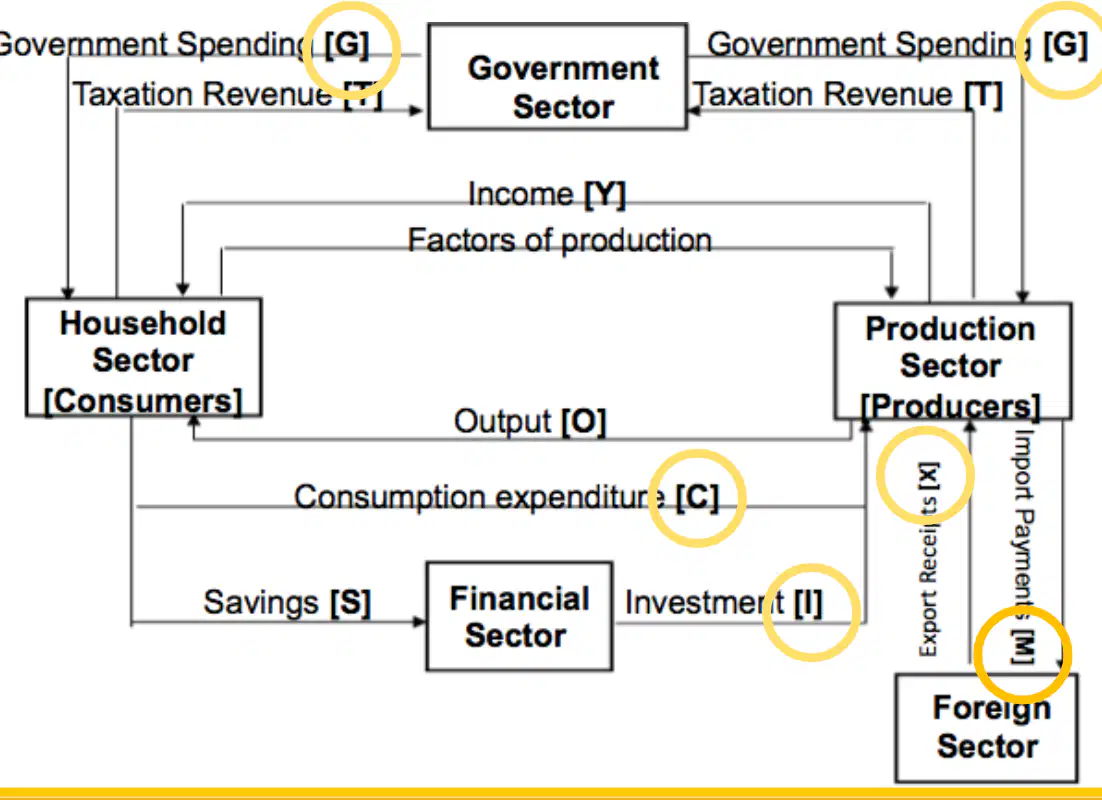
What is the formula for calculating aggregate demand (AD)?
AD = C + I + G + X - M
AD = C + I + G + M - X
AD = C + G + X - M
AD = C + I + G

In the context of aggregate demand, what does 'C' stand for?
Consumption expenditure
Capital formation
Corporate taxes
Currency reserves

In the context of aggregate demand, what does 'I' stand for?
Investment
Imports
Income
Inflation
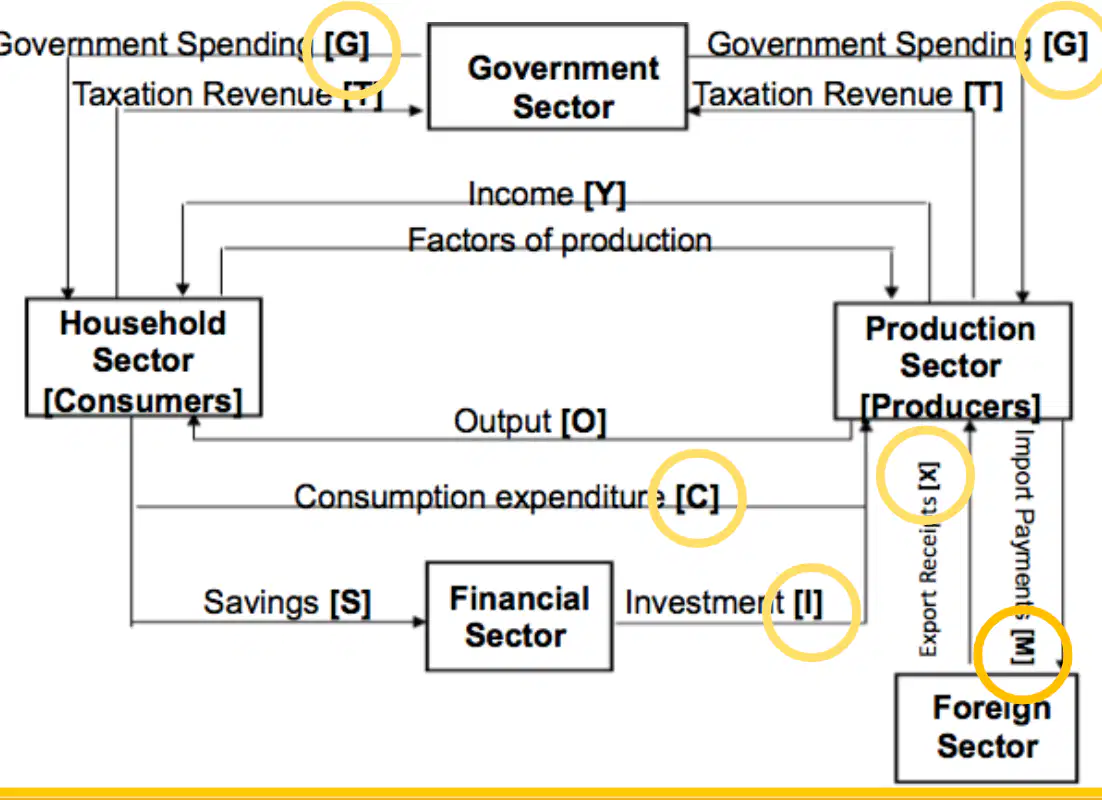
In the context of aggregate demand, what does 'G' stand for?
Government Spending
Gross Income
Goods Sold
General Output
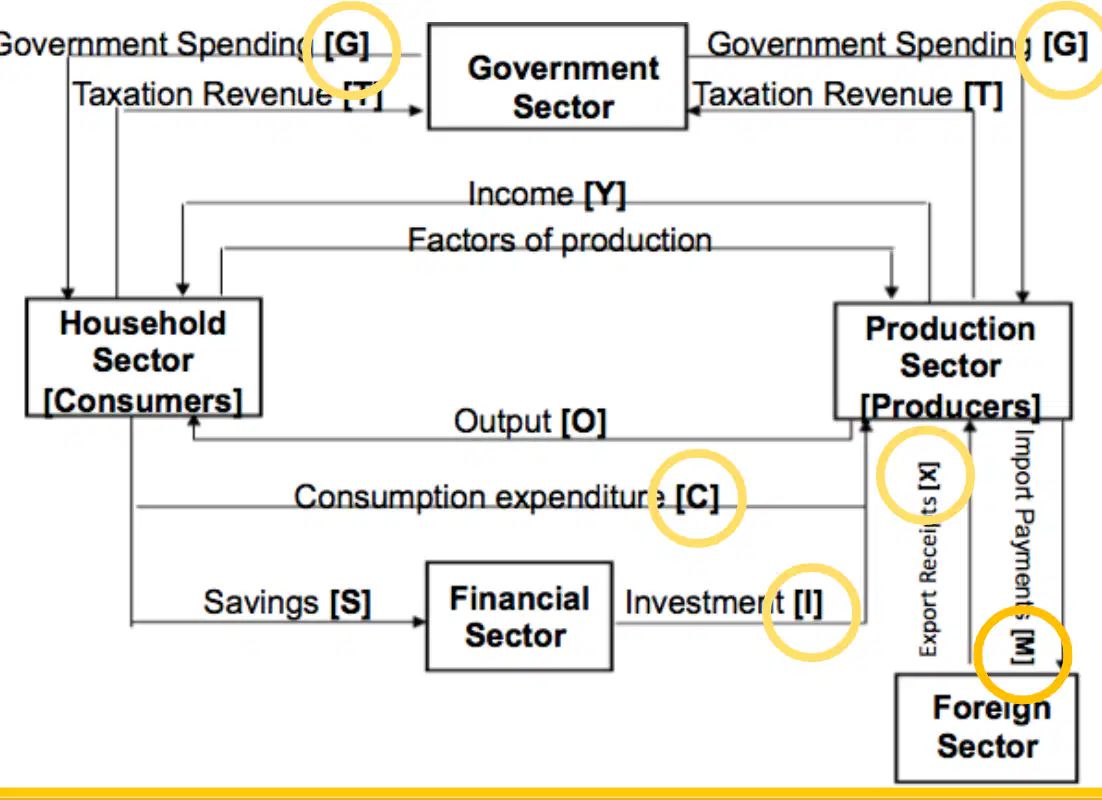
In the context of aggregate demand, what does 'X' stand for?
Export Receipts
Exchange Rate
Excise Duty
External Debt
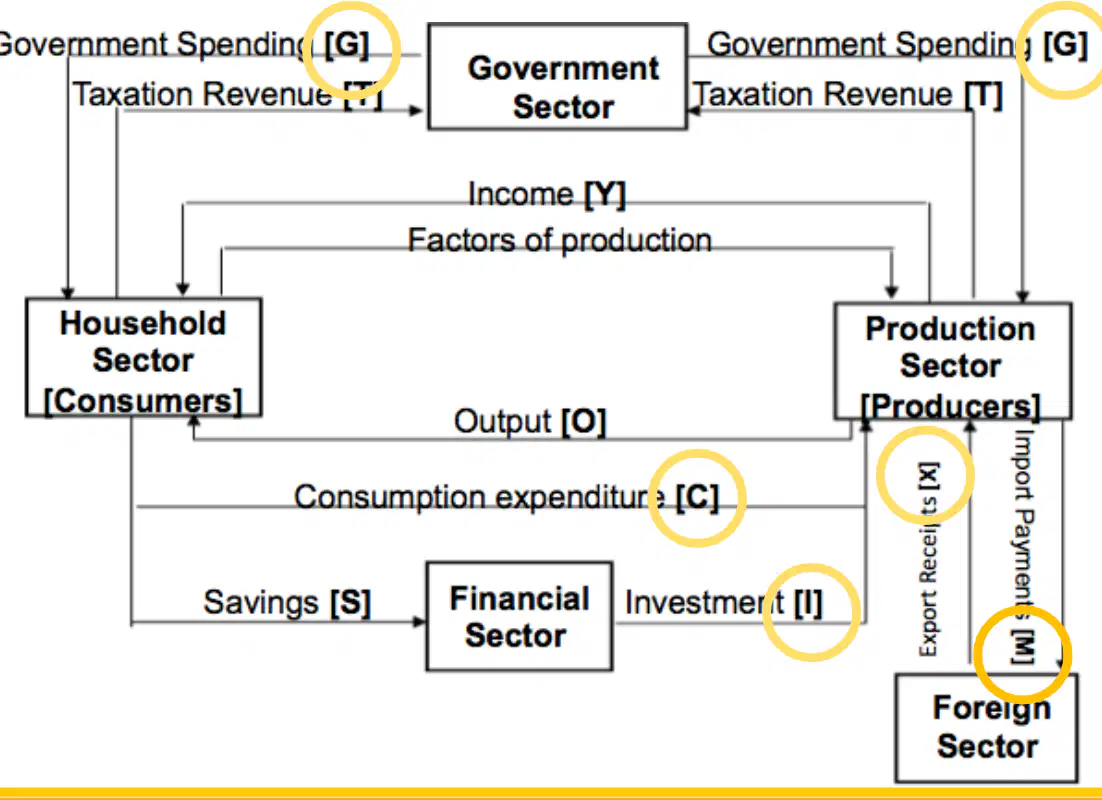
In the context of aggregate demand, what does 'M' stand for?
Import Payments
Money Supply
Market Value
Marginal Cost
A change in any of the components (C, I, G, X, M) will affect aggregate demand and therefore affect the level of ECONOMIC GROWTH.
True
False
Consumption: ________ is driven by consumer sentiment and expectations.
Consumption
Investment
Government Spending
Net Exports
Consumption: Consumption is affected by ________ and income distribution.
interest rates
tax rates
government spending
exchange rates
Investment: Investment is dependent on ________.
cost of capital equipment
level of exports
population growth
weather conditions
Investment is influenced by ________ and expectations.
business sentiment
government spending
consumer income
tax rates
Government Spending and Taxation: The aim is to maintain a ________, stable growth rate.
strong
weak
erratic
declining
Government spending and taxation decisions can ________ or restrain growth.
stimulate
ignore
delay
reduce
Exports and imports are impacted by the ________ exchange rate.
AUD
USD
Euro
Yen
Exports and imports are shaped by ________ and global market conditions.
trade agreements
weather patterns
local cuisine
fashion trends
Which of the following is an impact of economic growth?
A) Living Standards
B) Climate Change
C) Urbanization
D) Technology
Which of the following is an impact of economic growth?
Employment
Migration
Education
Healthcare
Which of the following is an impact of economic growth?
Inflation
Pollution
Transportation
Communication
Which of the following is an impact of economic growth?
A) Income Distribution
B) Urban Planning
C) Water Supply
D) Energy Consumption
Which of the following is an impact of economic growth?
External Stability
Population Growth
Technological Innovation
Social Media
Which of the following is an impact of economic growth?
A) Business Environment
B) Natural Disasters
C) Cultural Diversity
D) Tourism
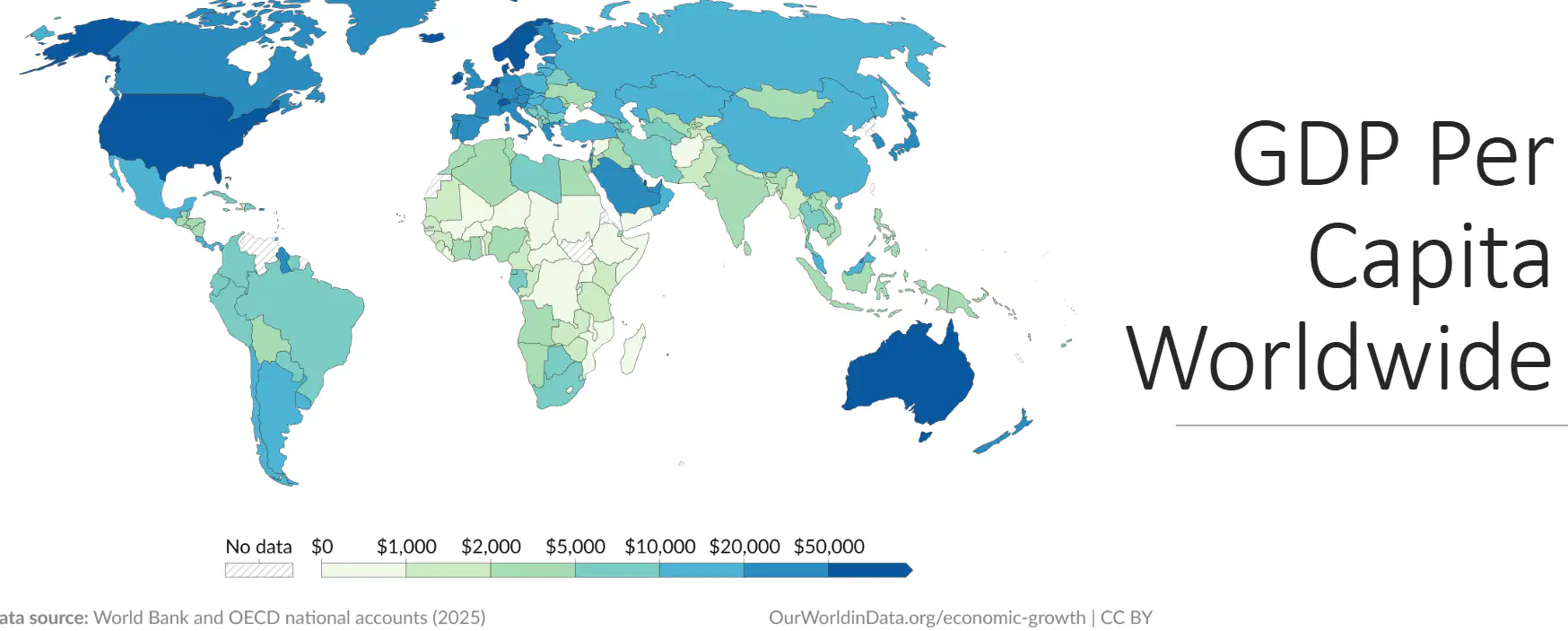
What does GDP per capita represent in the context of this map?
The total population of a country
The average income per person in a country
The total exports of a country
The land area of a country

According to the map, which of the following regions has the highest GDP per capita?
Sub-Saharan Africa
Western Europe
South Asia
Central America

Fill in the blank: The data in this map is expressed in ________ dollars and is adjusted for inflation.
US
Canadian
Australian
Singapore

According to the legend, what is the GDP per capita range for countries colored in the darkest blue?
0− 1,000
2,000− 5,000
10,000− 20,000
$50,000 and above
The latest real GDP growth figure reported is:
2.1%
0.5%
4.0%
-1.2%
The latest real GDP growth figure is compared to the typical target of 3-4%. What does this mean for living standards and business confidence?
It indicates whether the economy is growing at a healthy rate, which can affect living standards and business confidence.
It shows the unemployment rate is decreasing, leading to higher living standards.
It means inflation is under control, boosting business confidence.
It suggests government spending is increasing, improving living standards.
What is the unemployment rate?
The percentage of people in the labour force who are employed.
The percentage of people in the labour force who are unemployed.
The number of people in the country.
The number of people who are retired.
In Australia, the unemployment rate measures the number of people actively looking for a job as a percentage of the _________.
labour force
total population
employed people
working age population
According to the information provided, what is the target unemployment rate in Australia?
4-5%
0%
10%
2-3%
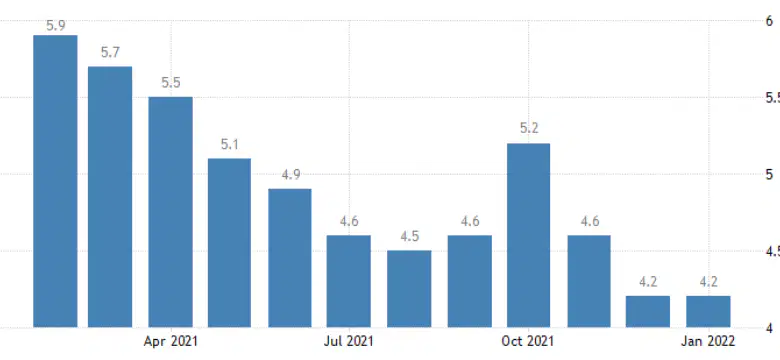
Based on the bar graph, what was the unemployment rate in Australia in January 2022?
5.9%
4.2%
4.6%
5.2%
The average unemployment rate in Australia is 4-5%.
True
False
Fill in the blank: One type of unemployment is ________ unemployment.
Structural
Seasonal
Frictional
Cyclical
Fill in the blank: One type of unemployment is ________ unemployment.
Cyclical
Seasonal
Frictional
Structural
Fill in the blank: One type of unemployment is ________ unemployment.
Frictional
Seasonal
Cyclical
Structural
Fill in the blank: One type of unemployment is ________ unemployment.
Seasonal
Permanent
Voluntary
Technological
One type of unemployment is ________ unemployment.
Hidden
Seasonal
Frictional
Cyclical
Fill in the blank: One type of unemployment is ________ unemployed.
Long term
Seasonal
Frictional
Cyclical
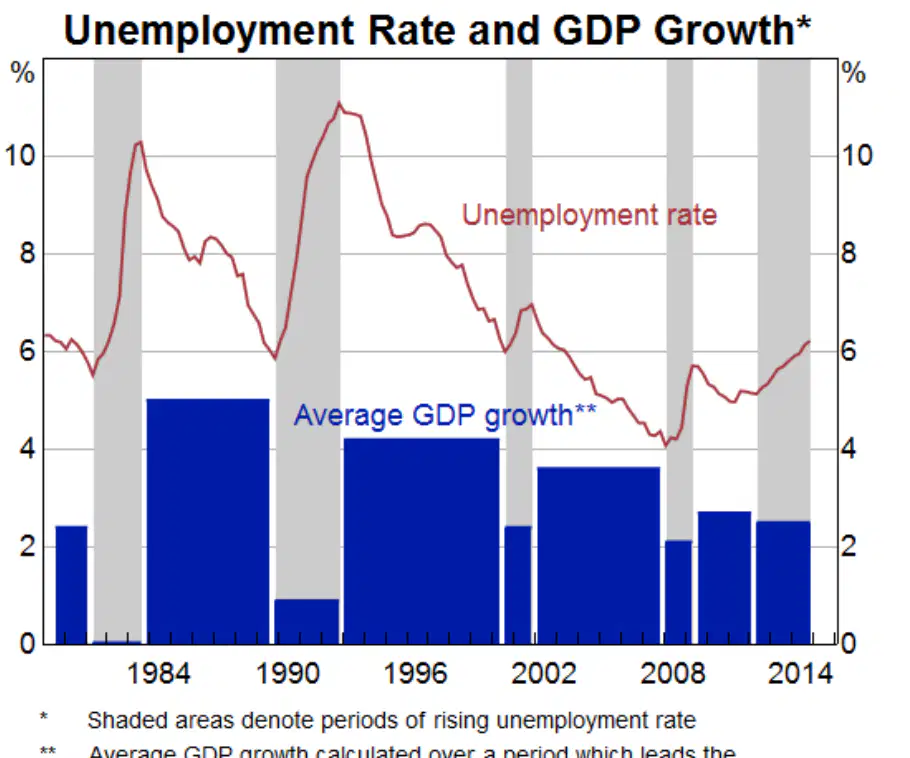
What do the shaded areas in the graph denote?
Periods of falling unemployment rate
Periods of rising unemployment rate
Periods of high GDP growth
Periods of low GDP growth
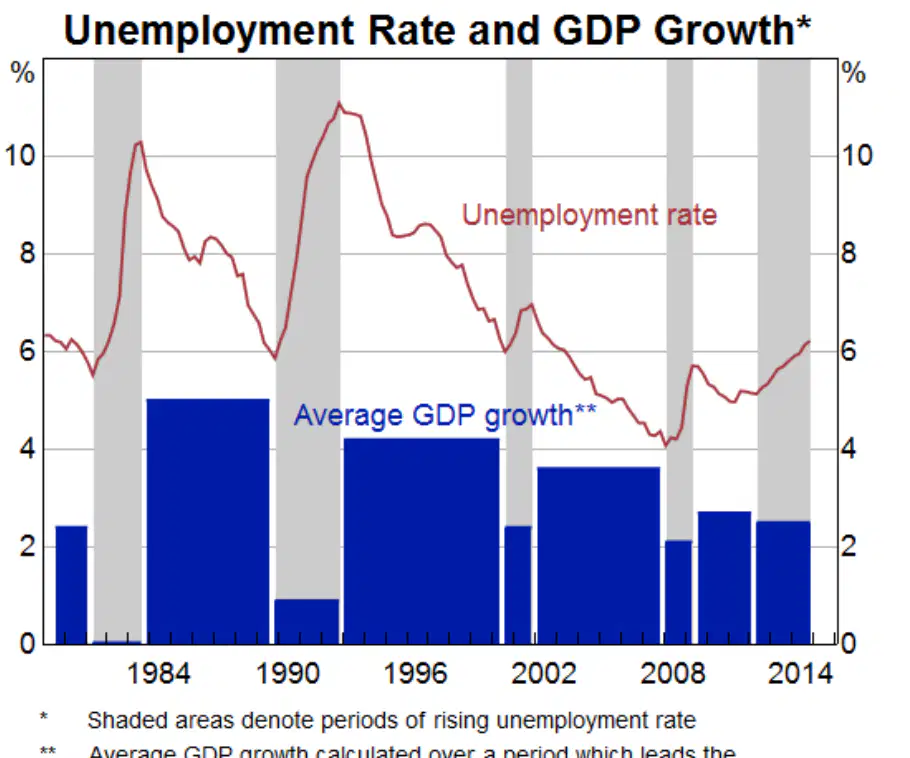
According to the graph 'Unemployment Rate and GDP Growth', how is the average GDP growth calculated?
Over a period which lags the unemployment rate by one quarter
Over a period which leads the unemployment rate by one quarter
Over a period of one year
Over a period of five years
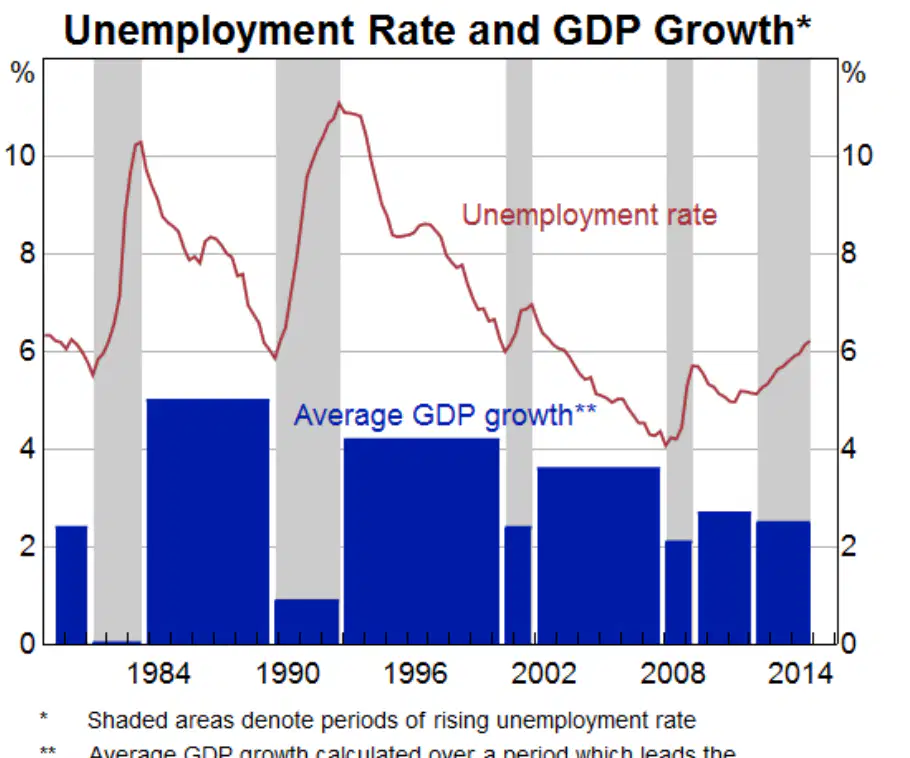
Fill in the blank: The sources of the data in the graph 'Unemployment Rate and GDP Growth' are _______.
ABS; RBA
World Bank; IMF
UNESCO; OECD
Bureau of Labor Statistics; Eurostat
Which of the following is a cause of unemployment?
Economic Growth (Aggregate Demand)
Photosynthesis
Plate Tectonics
Water Cycle
Which of the following is a cause of unemployment?
Government Policies
Photosynthesis
Plate Tectonics
Water Cycle
Which of the following is a cause of unemployment?
Participation Rates
Photosynthesis
Plate Tectonics
Water Cycle
Which of the following is a cause of unemployment?
Structural Change
Photosynthesis
Plate Tectonics
Water Cycle
Which of the following is a cause of unemployment?
Technological Change
Photosynthesis
Plate Tectonics
Water Cycle
Which of the following is a cause of unemployment?
Productivity
Photosynthesis
Plate Tectonics
Water Cycle
Which of the following is a cause of unemployment?
Training and Investment (Inflexibility)
Photosynthesis
Plate Tectonics
Water Cycle
Which of the following is a cause of unemployment?
Labour Costs
Photosynthesis
Plate Tectonics
Water Cycle
Name one impact of unemployment related to living conditions.
Living standards
Increased job opportunities
Higher income
Improved education access
Name one impact of unemployment related to the availability of skilled workers.
Skills shortage
Increased job security
Higher wages for all
Surplus of skilled workers
Name one impact of unemployment related to government spending.
Government expenditure
Increase in exports
Rise in private investments
Decrease in imports
Name one impact of unemployment related to changes in salaries.
Wage growth
Increased job security
Higher consumer spending
Lower inflation
Name one impact of unemployment related to social fairness.
Inequality
Economic growth
Technological advancement
Environmental protection
Name one impact of unemployment that affects specific social groups.
Unemployment for particular social groups
Increase in agricultural output
Rise in technological innovation
Decrease in leisure activities
Review the seasonally adjusted unemployment rate. What is the current seasonally adjusted unemployment rate?
3.7%
5.2%
4.8%
6.1%
The seasonally adjusted unemployment rate aligns with the 4-5% average target, which implies:
The economy is close to full employment, indicating a healthy labour market.
There is significant underemployment in the labour market.
The unemployment rate is above the target, suggesting economic instability.
The labour market is experiencing high inflationary pressure.
What is the target rate for inflation/price stability according to the definition provided?
1-2%
2-3%
3-4%
4-5%
Inflation/Price Stability is the rate at which the general level of prices for goods and services rises, leading to a decrease in the purchasing power (value) of a currency.
True
False
Inflation is measured using the Australian Inflation rate of the _________
Consumer Price Index (CPI)
Gross Domestic Product (GDP)
Producer Price Index (PPI)
Unemployment Rate
Which of the following is the most important category in the Consumer Price Index (CPI) for inflation measurement?
Housing (23.0 percent)
Alcohol and tobacco (7.0 percent)
Transport (11.5 percent)
Furnishings, household equipment and services (9.0 percent)
Food and non-alcoholic beverages account for what percentage in the Consumer Price Index (CPI)?
12.5 percent
17.0 percent
23.0 percent
7.0 percent
Recreation and culture account for ______ percent in the Consumer Price Index (CPI).
12.5
8.3
15.0
5.7
Which category has the lowest percentage in the Consumer Price Index (CPI)?
Transport
Alcohol and tobacco
Furnishings, household equipment and services
Clothing and footwear, education and communication (combined)
Clothing and footwear, education and communication (combined) account for what percentage in the Consumer Price Index (CPI)?
10.8 percent
5.2 percent
15.3 percent
22.7 percent

