
 Worksheets
Macro Midterm Units 1-3
Total questions: 87
Worksheet time: 22hrs 45mins
Which of the following is an example of a factor of production?
A want
A bank
A bond
Capital
Stock
Which of the following is the most fundamental issue that economics addresses?
Choice of appropriate technology
Reduction of unemployment
Reduction of budget deficit
Promotion of privatization
Use of scarce resources
Scarcity exists because
human wants exceed the productive capacity of the economy
supplies of land and other natural resources are unlimited
physical capital does not depreciate
population and labor force growth are slowing
innovation causes unemployment
Which of the following describes scarcity?
Wants are limited.
Wants exceed resources.
Resources are unlimited.
Resources are fully employed.
Resources are allocated efficiently.
Any point inside a production possibilities curve is
better than points on the production possibilities curve
allocatively efficient but technologically inefficient
associated with inefficient use or unemployment of some resources
associated with movements along the production possibilities curve
associated with constant opportunity costs
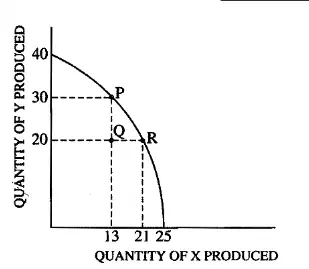
On the basis of the diagram above showing an economy's production possibilities curve for two goods, which of the following statements must be true?
I. The opportunity cost of moving from point P to point R is 10 units of Y.
II. The opportunity cost of moving from point R to point P is 8 units of X.
III. The opportunity cost of moving from point Q to point R is 0 units of Y.
I only
III only
I and II only
II and III only
I, II, and III
The concept of opportunity cost would no longer be relevant if
poverty in an economy no longer existed
the supply of all resources were unlimited
resources were allocated efficiently
real wages were flexible
all current incomes were invested in technological research

The graph above shows the production possibilities curve for a small township that is deciding to build parks and gymnasiums. Which of the following combinations of parks and gymnasiums is unattainable given the township's available resources?
5 parks and 6 gymnasiums
5 parks and 8 gymnasiums
10 parks and 6 gymnasiums
15 parks and 4 gymnasiums
20 parks and 4 gymnasiums
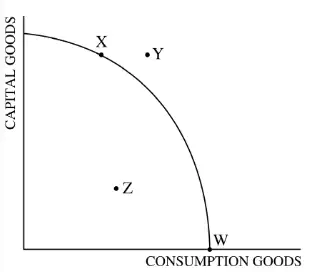
The diagram above shows the production possibilities curve for an economy that produces only consumption and capital goods. All of the following statements about this economy are true EXCEPT:
Producing at point Z results in the underutilization of resources.
The combination represented by point Y is unattainable, given the scarcity of resources.
Resources are fully utilized at points W and X.
Producing at point X will result in greater economic growth than will producing at point W.
Point X represents the most efficient combination of the two goods that can be produced by this economy.

The best combination of belts and coats for this economy to produce is
95 belts and 1 coat
85 belts and 2 coats
70 belts and 3 coats
40 belts and 4 coats
indeterminate with the available information
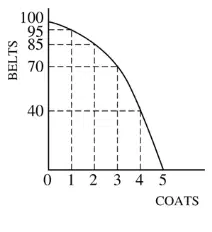
If two coats are currently being produced, the opportunity cost of producing the third coat is
85 belts
75 belts
40 belts
15 belts
10 belts
When an economy producing two goods is operating efficiently and at full employment, increasing the production of one good will result in
an inward shift of the production possibilities curve
an outward shift of the production possibilities curve
a decrease in the amount of the other good that can be produced
an increase in the costs of both goods
an increase in the amount of resources available
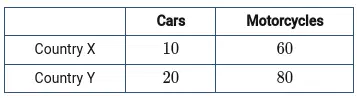
Based on the data in the table, which of the following will happen if Country X and Country Y agree to specialize and trade based on their comparative advantage?
Country X will export cars, and both countries will gain from trade if 1 car is exchanged for 3 motorcycles.
Country X will export motorcycles, and both countries will gain from trade if 1 car is exchanged for 5 motorcycles.
Country Y will export cars, and both countries will gain from trade if 1 car is exchanged for 3 motorcycles.
Country Y will export motorcycles, and both countries will gain from trade if 1 car is exchanged for 5 motorcycles.
Country Y will export motorcycles, and both countries will gain from trade if 1 car is exchanged for 7 motorcycles.
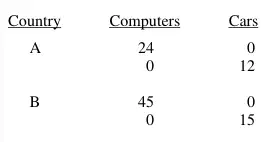
Which of the following is true according to the data in the table?
Country A has an absolute and comparative advantage in the production of computers.
Country B has an absolute and comparative advantage in the production of computers.
Country B should import computers and export cars.
Since Country B has an absolute advantage in the production of both goods, it will not trade with Country A.
Neither country can benefit from trade.

The table shows that Home Nation can produce five autos or one hundred computers using all its available resources in a year. Foreign Nation can produce five autos or fifty computers using all its available resources in a year.
Based on the information provided above, which of the following must be true?
Home Nation has an absolute advantage in the production of computers.
Foreign Nation has an absolute advantage in the production of autos.
Home Nation has a comparative advantage in the production of autos.
Foreign Nation has a comparative advantage in the production of computers.
Neither nation has a comparative advantage.
If two nations specialize according to their individual comparative advantages and engage in trade, then which of the following must be true?
Nations would be better off if they were self-sufficient.
If one nation gains from trade with the other nation, then the other nation will lose.
Both nations can consume beyond their individual production possibilities.
Both nations can consume only what they produce.
Both nations will lose from trade.
If two nations specialize according to the law of comparative advantage and then trade with each other, which of the following would be true?
A smaller number of goods would be available in each trading nation.
Total world production of goods would decrease.
Everyone within each nation would be better off.
Each nation would increase its consumption possibilities.
One nation would gain at the expense of the other nation.

The diagram above shows two demand curves for video games identified as D1 and D2.
Which of the following changes will most likely cause a shift of the demand curve from D1 to D2 as shown in the diagram?
An increase in consumers’ income, assuming that video games are a normal good
An increase in the price of game consoles, a complementary good
A decrease in the price of mobile games, a substitute good
A decrease in the number of buyers in the market
A decrease in the price of video games
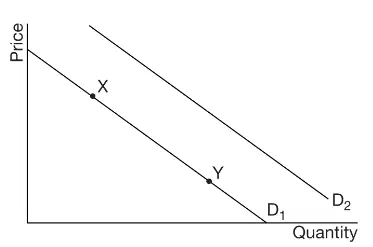
The diagram above shows two demand curves for video games identified as D1 and D2.
Which of the following changes will most likely result in a movement from point D to point D along the demand curve D1 ?
A decrease in the number of buyers
A decrease in the price of video games
A decrease in the expected future price of video games
An increase in the negative effects of video games on players
An increase in the use of video games for educational purposes
Which of the following will cause a movement along the demand curve for chicken, a normal good, resulting in an increase in the quantity demanded?
An increase in consumers' income
An increase in the price of fish, a substitute good
An increase in the price of barbecue sauce, a complementary good
A decrease in the price of chicken
A decrease in the number of consumers of chicken
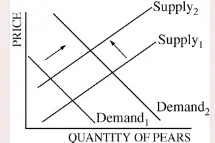
Assume that for consumers, pears and apples are substitutes. It is announced that pesticides used on most apples may be dangerous to consumers’ health. As a result of this announcement, which of the following market changes is most likely to occur in the short run in the pear market?
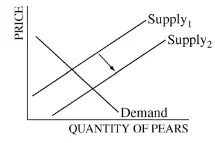
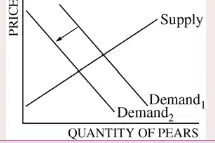
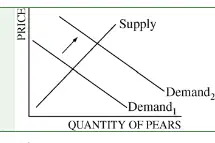
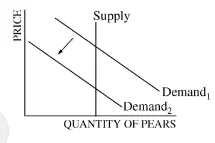
If the wage rate of workers producing a good decreases, then which of the following will most likely occur?
The demand curve will shift to the right.
The supply of the good will increase.
The quantity supplied of the good will decrease.
Demand for the good will increase
Quantity demanded for the good will decrease.
A leftward shift of the supply curve for computers could be caused by which of the following in the short run?
A decrease in the number of computer manufacturers
A decease in taxes on computer manufacturers
A decrease in the price of computers
A decrease in the price of components used to assemble computers
An increase in the price of mobile devices, a substitute good
Which of the following describes the law of supply?
An increase in the price of a good will decrease the quantity demanded.
The price of a good will increase if production input costs increase.
An increase in taxes will decrease the supply of a good.
An increase in the number of sellers will increase the supply of a good.
An increase in the price of a good will increase the quantity supplied.
Assume that the market for bottled water is in equilibrium. If both the supply of and the demand for bottled water decrease, what will be the effect on equilibrium price and quantity?


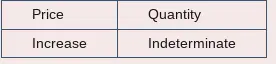

In the coffee market, which of the following changes will increase the price and decrease the quantity of coffee?





Which of the following will occur in a competitive market when the price of a good is less than the equilibrium price?
Price will decrease to eliminate the surplus and restore equilibrium.
Price will decrease to eliminate the shortage and restore equilibrium.
Price will increase to eliminate the surplus and restore equilibrium.
Price will increase to eliminate the shortage and restore equilibrium.
Price will remain constant, because supply will increase to eliminate the shortage.
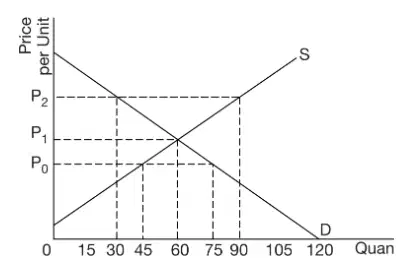
The supply (S) and demand (D) for a good are shown in the diagram above.
At a price of P2 in the diagram above which of the following will happen in the market?
There will be a surplus of 30 units and 90 units will be exchanged.
There will be a surplus of 90 units and 30 units will be exchanged.
There will be a surplus of 60 units and 30 units will be exchanged.
There will be a shortage of 90 units and 30 units will be exchanged.
There will be a shortage of 30 units and 90 units will be exchanged.

In the competitive market represented by the graph provided, which of the following is true at a price of $20 ?
There is a surplus of 60 units.
There is a surplus of 35 units.
There is a shortage of 60 units.
There is a shortage of 35 units.
The quantity sold equals 60 units.
If there is a decrease in the price of the coffee beans used to make brewed coffee, how will this affect the equilibrium price and quantity of brewed coffee?
Equilibrium price will decrease and equilibrium quantity will increase
Equilibrium price will decrease and equilibrium quantity will not change
Equilibrium price will decrease and equilibrium quantity will decrease
Equilibrium price will increase and equilibrium quantity will decrease
Equilibrium price will increase and equilibrium quantity will not change
If labor costs rise in the automobile industry, which of the following will happen to car prices and the quantity of cars sold?





If the production technology of a good improves and at the same time the number of consumers willing and able to buy the good in the market increases, which of the following will definitely occur?
Equilibrium price will increase.
Equilibrium price will decrease.
Equilibrium quantity will increase.
Equilibrium quantity will decrease.
Equilibrium quantity will remain the same.
Which of the following is true according to the circular flow model?
Firms are suppliers in both the product and factor markets.
Firms are demanders in the product markets and suppliers in the factor markets.
Households are demanders in both the product and factor markets.
Households are demanders in the product markets and suppliers in the factor markets.
The government is a demander in the product market only.
Which of the following is most likely included in gross domestic product?
Matt gives his secondhand bicycle to his brother.
Sal paints his own bicycle.
Ali buys a new bicycle.
Mike buys a share of stock in a bicycle firm.
Daniel bikes to school every day.

The table below shows a country’s macroeconomic data in 2013.
The country's gross domestic product is
$220 billion
$282 billion
$304 billion
$309 billion
$347 billion
A short-run increase in national income could be caused by a decrease in which of the following?
Consumption
Investment
Imports
Government spending
Exports
GDP does NOT account for which of the following?
The value added by all firms in the economy
The depletion of natural resources
Wages, rent, profit, and interest payments
The value of final goods and services produced domestically
Imports from foreign countries
Which of the following transactions will be included in the calculation of Country X's Gross Domestic Product (GDP) in 2020?
The sale of corporate stocks
The exchange of a used automobile for a used boat
The purchase of new construction equipment
Social Security checks received by retirees
Carrots grown in a household’s backyard and consumed by the family
As a measure of economic performance, GDP accounts for which of the following?
Used books donated to a local library
Depletion of durable consumer goods
Increased leisure time
Souvenir gifts purchased by tourists domestically
Cash transactions in the underground economy
Gross domestic product has been criticized as a measure of well-being because it fails to take into account which of the following?
The distribution of income
The value of services
The value of intermediate goods
The value of financial transactions and sales of used items
The value of government services

Based on the information in the table above, what is the unemployment rate for Country X?
3.3%
4.0%
6.0%
6.38%
7.5%
Which of the following unemployed individuals represents frictional unemployment?
Marissa, a full-time student who plays on the school’s soccer team.
Janet, an accounting graduate who is interviewing with a number of accounting firms.
Sameer, a retired faculty member who volunteers at the local hospital.
Jeremy, a customer service representative who was laid-off after his job was automated.
Elizabeth, a financial analyst who was laid off because of the recession.

What is the nation’s unemployment rate?
4%
5%
6%
9%
66,7%

Based on the above table which of the following is most likely correct?
The natural rate of unemployment is 5 percent.
The labor force participation rate is 91 percent.
Discouraged workers are 4 percent of the labor force.
There are 9 million discouraged workers in the nation
There are 95 million people in the labor force
A continuous increase in the consumer price index (CPI) is
deflation
stagflation
inflation
recession
disinflation

If 2012 is the base year, which of the following is true?
The inflation rate from 2012 to 2013 is 10%.
The CPI in year 2013 is 110
The CPI in year 2013 is 120.
Based on the CPI, the average real weekly wage rate increased by 10% from 2012 to 2013.
Based on the CPI, the average real weekly wage rate decreased by 20% from 2012 to 2013
Which of the following explains why the rate of change of the consumer price index (CPI) tends to overstate the actual inflation rate?
Consumers will require more income to buy goods whose prices have increased.
Nominal wages do not always increase by as much as prices do.
When real wages increase, consumers can afford higher-priced goods
Consumers tend to substitute lower-priced goods that may not be represented in the basket of goods.
The basket of goods in the base year is frequently updated with new products.
In 2017 Sabrina earned an annual salary of $100,000 as an engineer. In 2018, her income rose to $105,000. The inflation rate in 2018 was 2%. How did Sabrina’s nominal income and real income change in 2018 compared to 2017?
Nominal income decreased and real income decreased
Nominal income decreased and real income did not change.
Nominal income increased and real income decreased.
Nominal income increased and real income did not change.
Nominal income increased and real income increased.
Which of the following will happen if the actual inflation rate is greater than the expected inflation rate?
Lenders of fixed interest rate loans will be better off.
Lenders of variable interest rate loans will be worse off.
Borrowers of fixed interest rate loans will be worse off.
Borrowers of fixed interest rate loans will be better off.
Borrowers of variable interest rate loans will be better off.
Which of the following situations will benefit lenders of fixed interest rate loans?
The actual inflation rate is equal to the natural rate of unemployment.
The actual inflation rate is less than the expected inflation rate.
The actual inflation rate is equal to the fixed interest rate.
The consumer price index is greater than 100.
There is no cyclical unemployment.
Which of the following allows an individual to gain from unexpected inflation?
Living on a fixed income
Working at the minimum wage
Lending money at a fixed interest rate
Borrowing money at a fixed interest rate
Saving money in a fixed-interest-rate savings account
Public policy that generates an unexpected increase in consumer prices will inflict short-run costs on all of the following EXCEPT
borrowers
workers with fixed incomes
savers holding non-interest-bearing money
taxpayers shifted into higher tax brackets
people whose incomes are not adjusted for inflation
In 2016 the nominal GDP for Country X was $330 billion and the GDP deflator was 110. The real GDP for 2016 was
$110 billion
$220 billion
$300 billion
$330 billion
$440 billion

What are the nominal GDP and real GDP in 1993?
Nominal GDP is $90, Real GDP is $96
Nominal GDP is $74, Real GDP is $96
Nominal GDP is $70, Real GDP is $96
Nominal GDP is $96, Real GDP is $90
Nominal GDP is $96, Real GDP is $74
The major difference between real and nominal gross domestic product (GDP) is that real GDP
excludes government transfer payments
excludes imports
is adjusted for price-level changes using a price index
measures only the value of final goods and services that are consumed
measures the prices of a market basket of goods purchased by a typical urban consumer
If nominal gross domestic product fell while real gross domestic product rose, which of the following must be true?
Unemployment increased.
The inflation rate was negative.
Net exports were negative.
he average of stock prices rose while bond prices fell.
Nominal interest rates rose by less than the rate of inflation.
If a nation’s actual real GDP is less than potential real GDP, which of the following must be true?
The economy is in expansion
The economy is in recession.
There is no cyclical unemployment.
There is no frictional unemployment.
The actual rate of unemployment exceeds the natural rate of unemployment
Which of the following typically occurs during an expansionary phase of a business cycle?
Nominal interest rates decrease.
Income taxes decrease.
The price level decreases.
Government transfer payments increase.
Employment increases.
Which of the following necessarily occurs during an economic recession?
Cost-push inflation decreases.
Real gross domestic product decreases.
Cyclical unemployment decreases.
Demand-pull inflation increases.
Nominal wages increase.
A country’s real gross domestic product is the annual value of all final goods and services that are
purchased in that country, adjusted for changes in the price level
produced in that country, expressed in current prices
produced in that country, less exports
produced in that country, less depreciation
produced in that country, adjusted for changes in the price level
Which of the following statements best describes the concept of an automatic stabilizer?
It is nondiscretionary fiscal policy that mitigates business cycles by increasing aggregate demand during recessions and decreasing aggregate demand during expansions.
It is discretionary fiscal policy that increases government spending during recessions and decreases government spending during expansions.
It is a measure of the effect that a change in government spending and investment has on the gross domestic product.
It is a description of how total income is always equal to total expenditures as a measure of gross domestic product.
It is the process whereby surpluses lead to falling prices and shortages lead to rising prices to stabilize market equilibrium.
Which of the following will most likely result from a decrease in government spending?
An increase in output
An increase in the price level
An increase in employment
A decrease in aggregate supply
A decrease in aggregate demand

The diagram above shows a nation’s short-run aggregate supply (SRAS) curve, long-run aggregate supply (LRAS) curve, and aggregate demand (AD) curve.
Based on the diagram above, which of the following describes what will happen in the long-run adjustment process?
The natural rate of unemployment will increase.
Potential real GDP will increase.
Aggregate demand will decrease.
Short-run aggregate supply will increase.
Wages and input prices will increase.
Which of the following will remain unchanged when the price level decreases?
Inflationary expectations
Aggregate quantity demanded
Long-run aggregate supply
Nominal wages
Nominal output
Which of the following must be true in the long run?
Production increases when prices increase.
An increase in the price level reduces aggregate demand.
The natural rate of unemployment is not affected by changes in production capacity.
Full employment increases when price level decreases.
Prices and wages are flexible.
Which of the following explains why the long-run aggregate supply curve corresponds to the production possibilities curve?
Both curves are downward sloping.
Both curves illustrate flexible wages and prices.
Both curves illustrate the maximum sustainable capacity.
Both curves illustrate the trade-off between inflation and unemployment.
Both curves illustrate short-run macroeconomic equilibrium.
If there is an inflationary gap, which of the following changes will move the economy back toward full employment?
An increase in investment spending
An increase in government spending
An increase in taxes
An increase in exports
An increase in transfer payments

Based on the level of savings and disposable income data in the table above, which of the following must be true?
The marginal propensity to save is 0.2.
The marginal propensity to save is 0.9.
When disposable income is $12,000, consumption is $10,000.
The marginal propensity to consume is 0.1.
The marginal propensity to consume is 0.9.

Based on the data on savings and disposable income in the table above, what are the income tax multiplier and the spending multiplier?
The tax multiplier is −0.1 and the spending multiplier is 0.9.
The tax multiplier is 0.2 and the spending multiplier is −0.8.
The tax multiplier is −2 and the spending multiplier is 8.
The tax multiplier is −9 and the spending multiplier is 10.
The tax multiplier is 10 and the spending multiplier is −1.
Assume the countries of Ornania and Kumbagi are major trading partners. Ornania is currently in long-run macroeconomic equilibrium. As a result of a recession in its economy, Kumbagi decreases its demand for goods produced in Ornania. Which of the following will occur in Ornania in the short run?
Responses
The aggregate demand curve will shift to the right, causing the actual rate of unemployment to exceed the natural rate of unemployment.
The aggregate demand curve will shift to the left, resulting in an inflationary gap.
The aggregate demand curve will shift to the left, resulting in a recessionary gap.
The short-run aggregate supply curve will shift to the left, resulting in an inflationary gap.
The short-run aggregate supply curve will shift to the left, resulting in a recessionary gap.
Which of the following is an example of an automatic stabilizer?
Discretionary fiscal policy
Progressive income taxes
Autonomous consumption
The spending multiplier
Cyclical unemployment

Given the graph of the short-run aggregate supply (SRAS) and long-run aggregate supply (LRAS) curves above, which of the following is true?
At point Z, the economy has cyclical unemployment.
At point Z, the economy is in long-run equilibrium but not in short-run equilibrium.
At point Y, the natural rate of unemployment is zero.
At point X, the economy is experiencing a recessionary gap
At point X, there is no frictional unemployment
Which of the following will result in a rightward shift of the aggregate demand curve?
Responses
An increase in the income tax rate
An increase in the exports
A decrease in the price level
A decrease in household income
A decrease in government spending
Aggregate demand may be measured by adding
consumption, investment, savings, and imports
savings, government spending, and business inventories
consumption, investment, government spending, and net exports
domestic private expenditures and government spending
domestic expenditures and imports
An increase in the marginal propensity to consume causes an increase in which of the following?
Marginal propensity to save
Spending multiplier
Savings rate
Exports
Aggregate supply
Which of the following changes will necessarily cause inflation?
A decrease in aggregate demand and a decrease in short-run aggregate supply.
A decrease in aggregate demand and an increase in short-run aggregate supply.
A decrease in aggregate demand with no change in short-run aggregate supply.
An increase in aggregate demand and a decrease in short-run aggregate supply.
An increase in aggregate demand and an increase in short-run aggregate supply.
Which of the following is an example of an expansionary fiscal policy?
An increase in income tax rates
An increase in government expenditures
A decrease in transfer payments
An increase in the price level
An increase in consumption spending
Recessions will most likely be less severe if tax revenues and transfer payments automatically change in which of the following ways?
Tax revenues increase, and transfer payments increase.
Tax revenues decrease, and transfer payments decrease.
Tax revenues increase, and transfer payments decrease.
Tax revenues decrease, and transfer payments increase.
Tax revenues do not change, and transfer payments decrease.
Which of the following will cause a rightward shift of the short-run aggregate supply curve?
An increase in consumption spending
An increase in nominal wages
An increase in income taxes
A decrease in the price level
A decrease in the costs of production
An economy is in long-run macroeconomic equilibrium. What will be the short-run effects of an increase in investment spending?
An increase in real output, an increase in unemployment, and a decrease in the price level
An increase in real output, an increase in unemployment, and an increase in the price level
An increase in real output, a decrease in unemployment, and an increase in the price level
A decrease in real output, a decrease in unemployment, and a decrease in the price level
A decrease in real output, a decrease in unemployment, and no change in the price level
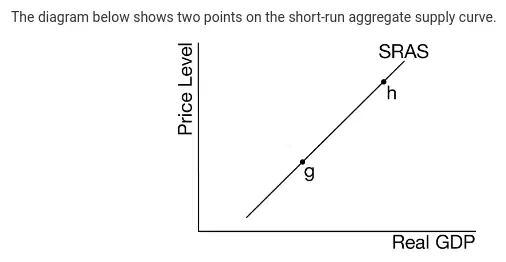
The movement from point g to point h is best described as which of the following?
A decrease in full employment output
A decrease in aggregate demand
An increase in real output due to an increase in the price level
An increase in real output due to technological change
An increase in unemployment
Which of the following will most likely cause the short-run aggregate supply curve to shift to the left?
A decrease in nominal wages
A decrease in the expected rate of inflation
An increase in energy prices
An increase in the price level
An increase in the size of the labor force
In the AD−AS model, which of the following is true?
The economy is in an inflationary gap when the short-run equilibrium real output is below the long-run equilibrium real output.
The economy is in an inflationary gap when the short-run equilibrium real output is at the long-run equilibrium real output.
The economy is in a recessionary gap when the short-run equilibrium real output is at the long-run equilibrium real output.
The economy is in a recessionary gap when the short-run equilibrium real output is below the long-run equilibrium real output.
The economy is in a recessionary gap when the short-run equilibrium real output is above the long-run equilibrium real output.
If there is an adverse (negative) short-run aggregate supply shock due to an increase in the price of natural resources and the government pursues no policy to address the supply shock, then which of the following will occur in the long run?
Responses
Nominal wages will fall with no change in the natural rate of unemployment.
Inflation will rise and nominal wages will fall.
Deflation will worsen and nominal wages will rise.
Aggregate demand will increase to restore full employment.
The long-run aggregate supply curve will shift right and increase unemployment.
An economy is currently in short-run equilibrium, and real output is below the full-employment level of output. Which of the following market adjustments is most likely to occur in the long run?
The recessionary gap will create upward pressure on prices, shifting the aggregate demand curve to the left.
The existence of cyclical unemployment will increase consumption spending and increase real output.
Full-employment output will fall to equal the short-run equilibrium real output.
Nominal wages will fall, shifting the short-run aggregate supply curve to the right.
Input prices will increase as firms compete for labor and capital.
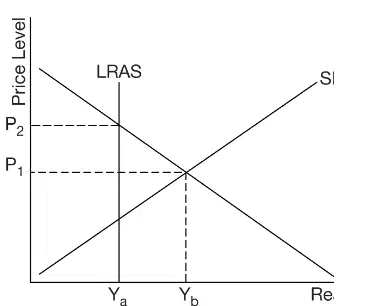
The diagram above shows a nation’s short-run aggregate supply curve (SRAS), long-run aggregate supply curve (LRAS), and aggregate demand curve (AD).
Based on the diagram above, which of the following describes the short-run equilibrium?
The economy is operating at full employment.
The economy is operating below full employment.
The economy is operating above full employment.
There will be downward pressure on the price level.
There is a recessionary gap.
If a nation’s government cuts income taxes, how will consumption spending, real output, and unemployment change in the short run?
Consumption spending will increase, real output will increase, and unemployment will decrease.
Consumption spending will increase, real output will decrease, and unemployment will decrease.
Consumption spending will decrease, real output will decrease, and unemployment will increase.
Consumption spending, real output, and unemployment will all decrease.
Consumption spending, real output, and unemployment will all increase.

