
 Worksheets
STJ ENDO + REPRO
Total questions: 46
Worksheet time: 24mins
Select the false statement
Thyroid hormone is mainly stored in the colloid and not follicular cells
Oxyphil cells are degenerated parafollicular cells
The neurohypophysis does not produce any hormones
Adrenal medulla contains chromaffin cells
The thyroid is located deep to the platysma muscle
When the pituitary stalk is cut (eliminating hypothalamic control of pituitary function), secretion of all of the following hormones will decrease EXCEPT
Growth hormone
Prolactin
Follicular stimulating hormone (FSH)
Oxytocin
Thyroid stimulating hormone (TSH)
Which of the following statements about aldosterone is FALSE?
Aldosterone increases potassium secretion at the distal tubule
In a disease state, a high plasma aldosterone concentration will always be accompanied by decreased renin activity due to negative feedback
Excessive aldosterone secretion rarely causes oedema
Aldosterone exerts its physiological effect by binding to intracellular receptors which regulate gene transcription
Adrenocorticotropic hormone (ACTH) may increase aldosterone secretion
A middle-aged man has lung cancer. His plasma sodium concentration is 125mmol/L (normal range: 135-145), his plasma osmolality is 265 mOsm/kg (normal range: 280-295), his urine osmolality is 650 mOsm/kg (normal range: 650-1200). What is the most likely problem?
Aldosterone production was increased due to metastasis of the cancer to the adrenal glands
There was polydipsia due to spread of the cancer to the thirst center of the hypothalamus
There was an excess secretion of Na+
There was excess ADH production
There is excessive sodium loss in the urine because of kidney damage
Low blood glucose concentration will lead to all of the following EXCEPT:
loss of consciousness
increased heart rate
decreased ACTH
decreased insulin
increased growth hormone
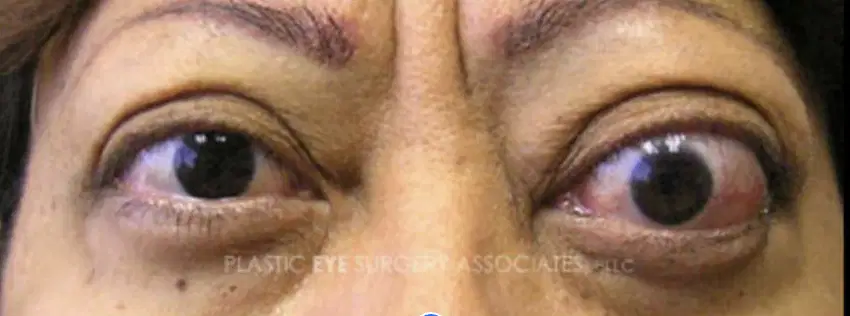
50 year old lady presents to clinic looking like this. Select the best statement.
She is in a hyperthyroid state, etiology unknown.
She is in a thyroid storm, treat urgently.
She has Graves’ disease.
She has Hashimoto’s disease
52 year old lady with small diffuse painless goitre as an incidental finding. She has a BPM of 56, increase in BMI, anti TSH receptor and anti thyroid peroxidase. What is the most accurate statement?
There will be low TSH and low T4
It is simple follicular hyperplasia caused by low iodide
Clusters of Follicular cells and colloid scalloping can be seen
It is Graves disease with the production of anti thyroid autoantibodies
She has an increased chance of lymphoma if there is continued enlargement of the goitre
A 28-year-old woman with Graves’ disease has been taking propylthiouracil (PTU) for the past 2 weeks. She presents to her GP with a sudden onset of fever, sore throat, and malaise. On examination, she is febrile at 38.5 °C with mild pharyngeal erythema.
Which is the most appropriate next step in management?
Advice the patient to continue with meds as per usual and take paracetamol for fever
Increase the PTU dosage as symptoms suggest poorly controlled hyperthyroidism
Continue PTU, stay at home and avoid contact for the next few days as this is probably a viral infection
Stop PTU immediately and do an urgent FBC
Switch PTU to Carbimazole immediately
Which statement on iodine is false?
High concentrations of iodine are contraindicated in pregnant women as they can cause foetal goitre
Patients who take iodine long term may experience increased salivation and headache
A/Es experienced by patients can disappear spontaneously within a few days of stopping iodine treatment
Allergic-like reactions including angioedema are the most common A/E
Patients can take iodine with juice or milk to reduce GI irritation
Patient with known Graves’ comes in with fever, agitation, tachycardia and altered mental status. Diagnosed with thyroid storm. What medications should be given to her? (>1 correct answer)
Propranolol
Propylthiouracil
Lugol's iodine
Antipyretics
Hydrocortisone
A 41 yo woman comes to the clinic for a follow-up evaluation. She has a 3 year history of hypothyroidism for which she is taking levothyroxine; the dosage has been stable for the last 2 years and her TSH has remained normal. She has been otherwise well apart from being newly diagnosed with iron deficiency anemia.
Her current medications include levothyroxine 75mcg OM and ferrous fumarate 1 tablet daily which she takes on waking. O/E, vital signs are normal, BMI is 24. Her thyroid gland is enlarged and smooth. She is otherwise euthyroid. Her blood investigations are as follows:
Free thyroxine 12.2 (9.0-19.1) pmol/L
TSH 9.5 (0.35-4.94) mIU/L
Total T3 0.60 (0.54-2.96) nmol/L
Increase dose of levothyroxine to 125 mcg OM
Stop levothyroxine
Add liothyronine 10mcg TDS
Advise to take current levothyroxine dose separate from ferrous fumarate
Maintain current levothyroxine dose and recheck in 6 weeks
49F presented with a firm, immobile thyroid mass that was irregular. Ultrasound was done, and microcalcifications were seen. Which of the following statements is true? Which of the following descriptions is most correctly matched with the thyroid malignancy?
Papillary carcinoma – Orphan Annie eye nuclei and psammoma bodies
Follicular carcinoma – Commonly spreads via lymphatics to cervical nodes
Medullary carcinoma – Associated with RET proto-oncogene and elevated calcitonin
Anaplastic carcinoma – Indolent tumour with excellent long-term survival
Which blood test would be most useful to workup the lump?
Full Blood Count
Thyroid Function Test
Iodine level
Calcitonin level
What first line imaging will you do for this lump?
MRI neck
CT neck
X ray neck
Ultrasound neck
FNAC
Which of the following statements correctly differentiates Type 1 Diabetes Mellitus (T1DM) from Type 2 Diabetes Mellitus (T2DM)?
T1DM can often be controlled with oral hypoglycaemic agents, while T2DM requires immediate insulin therapy at diagnosis.
T1DM usually presents in adulthood, while T2DM typically occurs in children
T1DM is strongly associated with obesity, while T2DM is not.
T1DM is characterised by autoimmune destruction of β-cells, while T2DM is caused by insulin resistance with relative β-cell dysfunction.
In which of these patients is insulin therapy indicated?
Patient with 9.0 mmol/L fasting blood glucose diagnosed with T2DM, currently relying on lifestyle modifications for glucose control
Patient with newly diagnosed T2DM
Patient with newly diagnosed T1DM
Patient with 9.0 mmol/L fasting blood glucose diagnosed with T2DM, currently on metformin
Patient with well controlled T2DM on metformin and glipizide, complaining of too many medications
Which of these following insulin combinations cannot be mixed together? (>1 correct ans)
Glulisine + NPH
Regular human insulin + NPH
Lispro + Glargine
Aspart + NPH
Detemir + Glulisine
Which of the following factors do not affect the pharmacokinetics of insulin?
Site of injection
Volume and depth of injection
Exercise
Meal time
Massage of injection site
Which of the following is the most important and potentially life-threatening adverse effect associated with metformin therapy?
Lactic acidosis
Nephrotoxicity
Vitamin B12 deficiency
Hepatotoxicity
Hypoglycemia
Which of the following statements is false?
SGLT2 inhibitors should be stopped 3 days prior to surgery
SGLT2 inhibitors increase the incidence of vulvovaginal fungal infections
SGLT2 inhibitors can increase the risk of lower limb amputation
SGLT2 inhibitors should never be taken with food
Most worrying adverse effect of SGLT2 inhibitors is euglycemic diabetic ketoacidosis
A 35-year-old woman presents with central obesity, moon face, proximal myopathy, and hypertension. Laboratory results show elevated cortisol. A low-dose dexamethasone suppression test does not suppress cortisol. High-dose dexamethasone test shows suppression, and plasma ACTH is elevated.
Which of the following is the most accurate statement?
A) This is Cushing’s syndrome
B) This is Cushing’s disease
C) This patient has exogenous steroid use, ACTH will be high and cortisol low
D) This is primary adrenal insufficiency, associated with weight gain and hypertension
A 55-year-old woman presents with polyuria and polydipsia. After water deprivation, her urine osmolality does not rise. After desmopressin, urine osmolality increases to 600 mOsm/kg (normal: 500–800). She complains that she has become more clumsy and can’t see things at the sides of her vision.
Which of the following best explains her condition?
A) Central diabetes insipidus due to compression of the pituitary stalk
B) Nephrogenic diabetes insipidus due to renal resistance to ADH
C) SIADH due to ectopic ADH secretion by the pituitary tumour
D) Primary polydipsia due to psychiatric water drinking
E) Addison’s disease causing secondary adrenal insufficiency
Select the false statement
On sitting, the ischial tuberosity bears the weight of the body
Pudendal nerve leaves via the lesser sciatic foramen and re-enters via the greater sciatic foramen
The ischial spine separates the greater and lesser sciatic notch
The male pelvis has a smaller suprapubic angle and longer sacrum than the female
The pelvic splanchnic nerve provides parasympathetic innervation for the pelvis region
Select the false statement
The pelvic diaphragm separates the pelvis and perineum region
The deep perineal pouch lies between both layers of the pelvic diaphragm
There is communication between ischiorectal fossa posteriorly only and not anteriorly
The perineal body lies in between the urogenital and anal triangle
The root of the penis lies in the deep perineal pouch
Select the false statement
The cremaster muscle is a continuation of the internal oblique
Sertoli cells secrete androgen binding protein to maintain high testosterone levels
Spermatogonia is diploid while a primary spermatocyte is haploid
A spongy urethra rupture can lead to extravasation of urine to the anterior abdominal wall
Seminal vesicles is the major contributor to ejaculated fluids
Select the false statement
Ovarian arteries are contained within the ovarian ligament
Oogenesis begins before puberty
Cardinal ligament is a major support of the uterus
Paraurethral glands are homologous to the prostate
Majority of the breast tissue is drained to the axillary lymph nodes
During sexual differentiation
Female gonads secrete Mullerian stimulating hormone
Testosterone inhibits differentiation of Mullerian ducts in males
Testosterone directly stimulates differentiation of male external genitalia in males
Gonadal females can develop male external genitalia
TDF stimulates development of female gonads
In Androgen Insensitivity Syndrome (AIS), which of the following statements is FALSE
The patient is genetically a male (XY)
The secondary sex characteristic is female
The patient is infertile
The patient has testes
The patient has lower levels of testosterone than normal male
What is the cause of involution of corpus luteum?
Low levels of LH
Low oestrogen and progesterone in blood
High levels of FSH secreted from anterior pituitary
High levels of hCG in blood
Onset of menstruation
After a blastocyst implantation has occurred, the first missed menstrual period in a healthy female is the result of:
Degeneration of the corpus luteum
Formation of a trophoblast that secretes gonadotrophins
Formation of a trophoblast that secretes oestrogen and progesterone
Decreased ovarian synthesis of oestrogen and progesterone
Increased placenta secretion of oestrogen and progesterone
Which of the following hormones are not secreted by the placenta?
Oestrogen
Progesterone
Oxytocin
hCG
Human placental lactogen
25 year old male presents with painless enlargement of the right testis. It was found that he has elevated alpha fetoprotein and human chorionic gonadotrophin. Excised portion shows mass lesion with variegated surface. What is the most likely histopathological condition that he has?
Seminoma
Mixed germ cell tumour
Lymphoma
TB
Filiariasis
A 59 year old man with a history of hypertension and urinary retention due to benign prostate hyperplasia was referred to your clinic. He informs you that he has been on a single drug to control both his hypertension and urinary retention previously. Which of the following drugs is it MOST likely to be?
felodipine
Metoprolol
Prazosin
Labetolol
Diltiazem
A 65-year-old man with a history of prostatic disease was found on radiologic examination of his skeleton to have extensive carcinomatous metastases in the skull and lumbar vertebrae. The PSA level in his blood was found to be excessively high. The following statements concerning this patient are correct EXCEPT
The patient has advanced carcinoma of the prostate that has spread some distance from the primary site.
The prostate is surrounded by the prostatic venous plexus, which drains into the internal iliac veins.
Large veins with valves connect the prostatic venous plexus to the vertebral veins.
Coughing, sneezing, or straining at stool can force the blood from the prostatic plexus into the vertebral veins.
Dislodged cancer cells can be carried with the blood to the vertebral column and skull.
Which zone does BPH often present in?
Central Zone
Peripheral Zone
Transitional Zone
Fibromuscular Zone
Most common presentation of Prostatic CA?
Back pain
LOW, LOA
LUTS
No symptoms
The following statement in preventing HPV are correct except:
HPV vaccination is effective in preventing HPV that cause cervical cancer
HPV vaccination is effective for male
HPV vaccination may reduce genital warts
HPV infection is associated with oropharyngeal cancer
HPV infection do not cause pre-cancerous cervical intraepithelial neoplasia
Patient has right sided breast cancer. Underwent mastectomy and axillary clearance. She developed oedema in the right limb. Which of the following is the most likely cause of the edema?
Compensatory blood flow to limb
Disrupted Lymphatic Drainage
Compromised venous drainage
Increased permeability of capillaries due to cytokines
Reduced oncotic pressure in the bloodstream
A 20 year old young woman went to get a breast examination. On examination, a firm, mobile lump was felt. Which of the following is it likely to be?
Fibroadenoma
Papilloma
Phyllodes tumour
Fibroma
Carcinoma
Features of breast cancer include all of the following, EXCEPT:
Nipple Retraction
Greenish nipple discharge
Peau D’Orange
Fixation of breast to muscle
Palpable lump in the breast
The following is true of breast cancer screening EXCEPT:
It can detect early stage breast cancer
It can reduce mortality
It is most suited for women between the ages of 30 and 40
It cannot detect masses smaller than 5 cm
Ultrasound is not an optimal screening modality
All of the following about adenosis of the breast are true except
it is a normal physiological process during pregnancy
it may be associated with calcification in the duct
it is associated with decreased acini per lobule
there is fibrosis and cysts of the breast
it is a component of the non-proliferation breast change
A 59 year old woman presents with a firm mass in her breast. A guided core biopsy was done and the mass was confirmed to be an invasive carcinoma. Which is the most common form of invasive carcinoma?
invasive ductal carcinoma
invasive lobar carcinoma
mucinous carcinoma
tubular carcinoma
medullary carcinoma
. A 35 year old woman presents with multiple, non-tender lymph node enlargements in the axillary region. A lymph node examination was performed and microscopic examination showed a tumour forming glands and tubules composed of cells with enlarged pleomorphic nuclei. Which of the following is the most likely tumour origin?
Ductal carcinomal in-situ of breast
Invasive ductal carcinoma of breast
Hodgkins Lymphoma of breast
Adenocarcinoma of the lung
Adenocarcinoma of the stomach
Special histological types of breast carcinomas are generally associated with a better prognosis than ductal and lobular carcinomas. A special type of carcinoma with pleomorphic neoplastic cells, many mitoses and prominent lymphoid infiltrate is called:
Medullary carcinoma
Tubular carcinoma
Papillary carcinoma
Mucinous carcinoma
Lobular carcinoma
Inheriting defective BRCA1 and BRCA2 disposes one to breast and ovarian cancer. These are two tumour suppressor genes that encode for proteins that are involved in one of the following:
DNA mutation repair
Repair DNA double strand breaks
Cell cycle checkpoint system that ensures cells in S phase from progressing without growth factor
Cell cycle checkpoint system that prevents metaphase from progressing to anaphase unless mitotic spindles attach to sister chromatids
Suppress apoptosis

